Month: May 2026

  • Writing Seekers of the Fallen Stars

    Writing Seekers of the Fallen Stars

    From a labour of love to a debut novel.

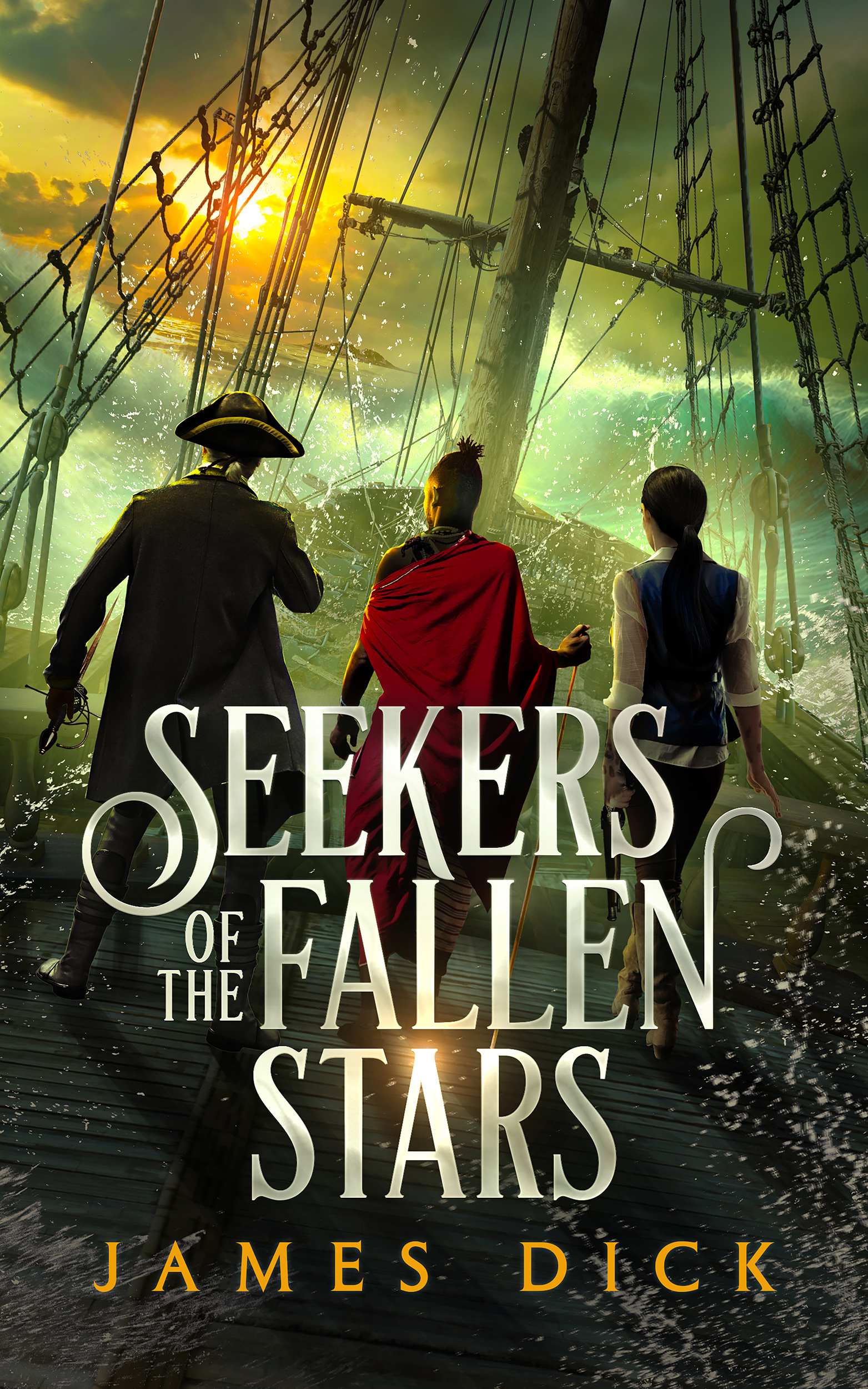
    On May 22nd, 2026, I received an email from Flame Arrow Publishing in which was enclosed the cover of my debut novel, Seekers of the Fallen Stars. This is a moment which very few writers ever have. I imagine it’s not so different from the feeling a parent gets when they see the ultrasound of their child for the first time.

    You might think that’s a bit hackneyed, but let me assure you that this book, like a child, was created from the most intimate parts of me. My thoughts, my beliefs, my experiences, my pain, and my passion are in these pages. And to see all of them summed up by a single image is both invigourating and humbling in equal measure.

    Seekers represents the culmination of five years of career-building, ten years of focused writing, and a lifetime of reading, gaming, and dreaming. I’d like to tell you a little of how I got to this point.

    I’m not going to be the dick who says, “If I can do it, so can you.” The harsh reality is that not everyone can do this, not everyone will get to have that moment of seeing the beautiful cover of their first book. But if, in my experiences, there’s something that resonates with you, that helps you in your own voyage, surely it is worth sharing.

    Disney‘s Last Minute Tie-In

    You will, of course, remember a little film that released in July of 2003 called Pirates of the Caribbean: The Curse of the Black Pearl. This film single-handedly resurrected the swashbuckler genre and redefined its formula for modern audiences. To this day, there has not been a single pirate-related piece of media released that has not been informed by the visual language of PotC.

    What you might not know, however, is that the same month that Curse of the Black Pearl released, a tie-in game quietly slipped onto game shelves called Pirates of the Caribbean. This game, as it turned out, was made by Russian developer Akella, and up until a couple weeks before the film released, was actually titled Sea Dogs 2.

    You see, Disney had absolutely no faith in PotC. They believed it would be a flop, and so their promotion of the film was halfhearted. They realized they had no tie-in material, so they contacted a developer (Akella) who was working on a pirate game, paid them a sack of cash and said, “Hey, can you tweak the story of your game so that it aligns with our movie?”

    What was Akella gonna do, say no?

    It just so happened that Sea Dogs 2, by some friggin’ miracle, had a story which almost perfectly mirrored Curse of the Black Pearl: a ship called the Black Frigate plundered an ancient Incan temple and stole the artifacts of the temple’s builders. In retribution, the gods of the Incan people cursed ship and crew to a living death until such time as they returned what they stole.

    Change the Black Frigate to the Black Pearl, her captain’s name from Balthazar to Barbossa, and throw in a thirty-second bit of narration by Keira Knightley, and Disney had themselves a tie-in game juuuuust in time for the release of their silly pirate movie.

    (Whaddya mean the game takes place a full hundred years before the movie? Who’s gonna know?)

    I played the hell out of this game when I was little. It scared the bejeezus out of me. These days, liminal spaces from childhood are all the rage: the labyrinthine corridors of House of Leaves‘ titular residence, the concrete playgrounds of Control‘s Oldest House, and the off-yellow sprawl of the Backrooms.

    For me, the liminal spaces which hold my mind prisoner are the jungles and towns of Akella’s Pirates of the Caribbean.

    I keenly remember walking through jungles with my officers and sprinting like hell past groups of bandits to the safety of town, or accidentally discovering the dungeons of Oxbay and soiling myself when a skeleton in a tricorn came at me with a sword. And the music.

    My God, the music!

    This game had some of the catchiest, most exciting tracks I remember hearing in a game. Between this, Warcraft III: Reign of Chaos, and Star Wars: Knights of the Old Republic, I had some of the best childhood soundtracks a boy could wish for.

    Have a listen, and tell me this isn’t great stuff.

    Menu Theme

    This track fills me with such longing to see the pyramids of South and Central America.

    Town 1

    This one has me swaggering down the street like Dr. Livesey.

    I think, between this game and the film it was tied to, the seeds of my later interest in pirates, windjammers, and Naval history were sown. But it would be another two decades before they bore fruit.

    The Learning Curve

    Throughout my late teens and early twenties, I wrote almost exclusively novels.

    I fell victim to that seductive dream most young writers have of crafting that exquisite First Novel, taking the world by storm, and becoming a household name. Not that the dream is bad–on the contrary: it’s excellent fuel for the fire of creative passion. But that doesn’t make it any more attainable. Those who succeed on their first try are as rare as unicorns, and they don’t always have the most consistent of careers.

    “Early failure is healthier than early success.”

    Chris Hadfield

    I’ve lost count of how many drafts of science fiction and fantasy “masterpieces” I wrote in college and university, but sometime around my 24th birthday, I realized that my writing skills weren’t improving. I resolved, then, to try a completely different approach.

    A word to you aspiring writers out there: there’s no “one-size-fits-all” career path. There is no teacher, no book, no guru who can give you the “optimal” system of creating stories–though many will try to sell you just such an idea. Discovering your process is a matter of trial and error.

    However… there is one thing which I recommend which always seems to benefit writers who try it.

    Start by writing short fiction.

    Writing a novel is a big time- and energy-sink, and if you’re a writer still learning your craft, there’s a very small return on investment when it comes to building your skills.

    The best thing most young writers can do is begin small: write a 1000-word story. That’s about four pages. The tiny scale forces you to be economical, to set the scene, describe the characters, and kick off the plot as quickly as you can.

    Then, when you feel confident, expand: scale up to 2000, 3000, 4000, 7000, 10,000 words incrementally, and keep experimenting with different lengths. Short stories allow you to try and fail repeatedly in a short span of time, and also provide endorphin boosts more often because you can complete many of them in a short span of time.

    Consider: in the time it takes you to write a novel, you can write as many as 80 short stories.

    1 novel.

    80 short stories.

    Which do you think is going to help you improve faster?

    You can also submit short stories to magazines and anthologies to start getting your name out there and develop a thick skin toward rejection. All of this will serve you well, both in your career and life.

    There are many writers out there who attained early success with a breakout novel who, by their own admission, cannot write short fiction. They wrote a big book when they were young, got lucky with an agent or publisher, and continued writing at that scale into their 20s, 30s, and 40s.

    • If you start out writing short fiction, you can easily scale up.
    • If you start out writing long-form fiction, it is hard to scale down.

    My aspiration when I was 24 was to develop my craft, not try to swing a novel and hope for the best. So I focused exclusively on short fiction, and through short fiction, I learned:

    • How to do more with less
    • How to write character arcs
    • How to plot stories
    • How to write a series of interconnected stories
    • The kinds of stories I enjoyed reading and writing (and the kinds I didn’t)
    • The sorts of messages I wanted to spread with my writing
    • That I am, at heart, an optimist, and want to tell optimistic stories
    • How to market myself

    All these came into play in late 2023 when I eventually did return to novel writing.

    2023: The Dwindling Days

    September 2023.

    Leila Batten, my boss at the Whitehouse Meats Butcher Shop in the St. Lawrence Market, unable to find a buyer for her shop, elected to close it completely and retire from the market. I suddenly found myself out of a job, but with a little money to float on.

    Since I had the time now, and since I’d grown so much as a writer in the past three years, I decided to finally try writing a novel again. Something small–maybe 70,000 words. And it wouldn’t be some project which I thought “might be marketable” or “might be popular”. I’d write purely from a place of passion, satisfying no one but myself. After all, that was how I broke into professional short fiction writing with “EDIE”, my first major sale to Analog.

    But what to write?

    As a child, I had no idea that Pirates of the Caribbean was originally part of the Sea Dogs series. These days, PotC/Sea Dogs 2 is a hard game to find; lost in the sea of licensing, it is, for all intents and purposes, abandonware.

    In 2023 I felt the need to play it again, but I couldn’t find it. Instead, I found Sea Dogs: To Each His Own, a roleplaying game which is a Eurojank classic. Despite many frustrations with the interface and quests, I nevertheless was captivated by the world Sea Dogs: TEHO presented. Through it, I discovered a love of nautical fiction, including Patrick O’Brian‘s Aubrey & Maturin books (better known as Master and Commander) and C.S. Forester‘s Horatio Hornblower series.

    Engrossed in sailing ships and stormy seas, I decided to write a nautical fantasy with a mid-18th century Caribbean atmosphere. That was the answer to my first question.

    Now the second: do I set it in the real Caribbean, or a secondary world?

    I immediately discarded the idea of using a real historical setting. The Caribbean has been the site of some of the most appalling genocides in the long dark catalogue of human misery, and given that I’m a white-as-bread descendent of the British Isles, I felt it would be wrong to use someone else’s history as my personal plaything.

    Plus, with a secondary world setting, I could still deal with serious issues, but in a manner and pace of my own choosing, and I wouldn’t be treading upon anyone’s real–and personal–history.

    I was actually able to resurrect a world I’d created for The Journeyman and the Bear, a series of short stories I’d written in high school and college–and one which I now realize was also inspired by my time playing PotC/Sea Dogs 2.

    So, late on the night of December 28th, 2023, with the snow falling heavily outside and the wind howling like a tortured voice from the past, I sat down on the sofa in my parents’ living room and wrote the outline to Seekers of the Fallen Stars.

    2024: A Year of Darkness and Wonder

    I wrote the bulk of Seekers in almost exactly nine months, starting December 28th 2023, finishing on or about September 15th 2024.

    Many things happened in that time.

    Image Credit: NASA

    I couldn’t work in my chosen field: media. Unbeknownst to me, I’d graduated into one of the worst job markets in Canadian history, and my financial prospects looked grim–still do, if I’m being honest. My inability to provide for myself or find steady income meant I had to continue living with my family. All of this contributed to some of the worst episodes of depression and anxiety I’ve ever experienced. My sense of self-worth steadily weakened.

    Through all that, the thing which got me up in the morning was my novel. Seekers was the only thing on my brain. It consumed my every waking thought, and sometimes made its way into my dreams. It was the first thing I thought of when I got up and the last before I went to bed. It energized me and gave me a reason to keep going.

    The rest of humanity was still sloughing off the long time-skip of COVID-19, and 2024 offered miracles to help us shake the cobwebs:

    I witnessed my first eclipse on April 8th–an event which made its way into the novel.

    A new comet came to visit us in the form of Tsuchinshan-ATLAS.

    Solar winds created some of the brightest aurorae in living memory.

    If I can say one thing about 2024, it is that I lived, in every sense of the world: I survived my inner demons, accomplished a dream I’ve had for a decade, and saw things that restored my sense of wonder. For all the difficulties I was fraught with, both mentally and financially, I cannot help but think of that year as the time when I finally began to bloom.

    And Seekers was there, a constant companion, a source of endless joy.

    2025: Flame Arrow

    “A story is not a machine that does what you tell it. A story is a beast with a life of its own. You can create it, shape it, but as the story grows, it starts wanting things of its own. Change one thing and you set off a chain reaction of events that spreads through the whole thing. The characters have to be true to themselves. The events have to follow a logic that fits the story. A single flaw and the magic is gone. The story dies.”

    Alan, Alan Wake

    After finishing the third draft of Seekers in September 2024, I took a few months to relax and recharge. In the start of 2025, I reached out to Rae Oestreich, a fellow writer who attended Clovis Editorial‘s Group Coaching sessions with me, and took her up on the offer of letting her beta-read my book.

    When she finished, she had many good notes, but the one which stuck in my brain was this:

    “Why does it have to be one book?”

    Few questions have I ever loved more, and few have I ever loathed more. Because Rae had a good point: the current draft of Seekers was a bloated, overlong mess with a rushed ending, over 120,000 words in length. So, I cut it in two around the 100,000 word mark, and sat with it…

    And sat with it…

    And the damnedest thing happened: I realized it needed to be two books.

    I wrote a fourth draft, and then a fifth (which was really just a reassembling of the plot structure of the fourth), sent it to Genevieve Clovis for a copy edit, and then in May, I began querying.

    Would You Like to Know More?

    “Querying” is the process by which an author sends out a query letter and a sample of their manuscript to an agent or editor. It basically says, “Here’s what my book’s about, here’s why I think it’s a great fit for your agency to represent (or your publishing house to publish), and here’s my publishing history.”

    I sent my package out to ten agents both in Canada and the States. Half didn’t reply, and the other half rejected me. By this point, October was coming around and with it, Can*Con, so I decided to put queries on hold until after I gathered more information about publishing from the panels in Ottawa.

    While I was walking the Vendors’ Hall with my Genevieve and Rachel MacLean (another Clovis Editorial alum), I spotted a new title by Rich Larson being sold at a table. The title was The Sky Didn’t Load Today and Other Glitches. The table was Flame Arrow Publishing. As I stepped closer, the man behind the table, Dave Dufour, spoke to me.

    Our conversation went something like this:

    Dave: “Reader or writer?”

    James: “Well, both actually.”

    Dave: “Nice. What have you written?”

    James: “I’ve published some stories in Analog, a few other international markets. And recently I completed a 100,000 word fantasy swashbuckler about found families and inherited trauma.”

    Dave: “Oh, you should definitely query us.”

    James: (Eyeing the lengths of the other books on offer) “100,000 words…?”

    Dave: “Yeah, we’re looking for works in that range. But you should definitely do it, like, now, because we’re opening queries November 1st.”

    James: “Oh, wow, okay, I’ll get right on it.”

    Dave: “Let me give you my card…”

    You might think it strange, but I’ve always been able to sense the moments when my life changes direction. It’s like a subtle itch at the back of my skull. It usually happens when I meet someone new, or exchange correspondence with them.

    I spoke to three other publishers while at Can*Con, and I only got that feeling from Dave at Flame Arrow.

    So, as soon as I got back to Toronto, I watched George Springer hit the home run that sent the Blue Jays to the World Series.

    And then I wrote my query letter–and it was a home run, too.

    Baseball players talk about seeing the perfect pitch coming, the one they know is gonna be a homer even before they swing. I got that feeling whilst writing my query letter to Flame Arrow. Normally I try not to get my hopes up, but as I wrote the words, I couldn’t help but feel as if the universe had shown me the way.

    I was leery of that feeling, especially in light of the Blue Jays narrowly losing the World Series to the Dodgers. What had seemed like a storybook ending was ripped away from us Toronto fans at the last moment, and as November turned into December and Christmas neared, I began to fear that my hopes for Seekers would be dashed as well.

    December 8th, 2025 — 1:00 p.m.

    Hi James,

    Thank you again for sending Seekers of the Fallen Stars. Our team has now completed the full evaluation, and we’re really pleased with the strength of both the premise and the execution. The manuscript shows clear potential for our catalogue, especially with its imaginative worldbuilding and reflective themes that align closely with Flame Arrow’s editorial direction.

    We’d love to move forward and discuss acquisition with you.

    Dave

    710 days since I wrote the first words of Seekers, I received an acceptance letter for it.

    I wrote and sold a novel in less than two years.

    There are writers who don’t get there in ten years.

    There are writers who don’t get there in twenty.

    There are writers who never get there.

    I got there in 710 days. I got there in less than two years.

    I don’t write these words to brag, but to reaffirm my success. There were times when the only thing which got me out of bed, the only thing that kept me sane, the only thing that brought me joy, was writing this book. For nine months, it was my life entire. And even after signing the contract, the old demons of self-doubt and anxiety crept in.

    Humility is a virtue, and is right and healthy, but it is also right and healthy for us to speak boldly of our triumphs, to ourselves and others, so that we may resist the demons–both within and without–that try to erode our sense of self worth.

    Seekers was a labour of love, and if I’m being honest, I never believed I’d be able to sell it, at least not right away. Few publishers will buy a book over 100,000 words in length from a new novelist. I thought for sure Seekers would end up on the backburner while I wrote and queried a shorter, tighter novel.

    The fact I sold it right out the gate tells me two things:

    • I am a good writer
    • The Canadian indie publishing scene shows more imagination than the Big Five

    I’m glad I ended up with a small Canadian publisher. The work these houses are doing is innovative and exciting, and they take a great interest in the development of their creators. I’m looking forward to a lasting partnership with Flame Arrow.

    The Voyage Continues…

    Aboard the Empire Sandy tern schooner at the Midland Tall Ships Festival, August 17th, 2025. This is the same class of vessel as the Seeker from my novel.

    Ten years ago, I fantasized about publishing a novel. I was very impatient and thought–as doubtless millions of young writers have thought–that I could get to the finish line quicker than others had before me, that I would be a household name by the time I was twenty-five.

    If I could go back and give myself three pieces of advice, it would be these:

    • Learn to love the journey. Each day you get to sit at a desk and put words on a page is a treasure. Not everyone has the time or freedom to do that.
    • Start small. Work on the smallest scale you can, and then expand from there.
    • Try everything. Opportunities surround you. Listen. Be attentive. Be ready at all times to leap at a chance to get your work into the world.

    Having read all this, scroll back to the top and look at the cover again, and think about all the things that had to happen, all the strife, all the lucky turns of fate, for that image to exist.

    I know I will.

  • Laser Books Review 15

    Laser Books Review 15

    15. The Star Web by George Zebrowski

    I’m not crazy, right? You guys see it too?

    This has been driving me crazy for weeks now. I dodge enough bullets for a living; I don’t need sic semper tyrannis over here adding on his two cents o’ lead.

    Anyway, you guys check out this review while I check out my hat for holes.

    Nebula and Theodore Sturgeon Award nominee George Zebrowski brings us a story in the purest tradition of the Golden Age of Science Fiction. I say that without the least bit of prejudice because, at their best, Golden Age stories depicted battles of wits between humanity and the cosmos.

    Reading up on Zebrowski, I’m unsurprised to find out that, like many of our authors thus far, he wrote tie-in novels for Star Trek, focusing on The Next Generation era. Most of those works were co-authored with writer Pamela Sargent.

    Going boldly where many have gone before, Zebrowski’s Star Web articulates a classic question popularized by Arthur C. Clarke, and perfected by Andy Weir:

    Are these people smart enough to survive?

    Would You Like to Know More?

    If you spot a copy of this book in the wild, most likely at a used bookstore, buy it. It is some of the best value-for-money you can get in a book. Not only does it contain Clarke’s body of short fiction (which by itself is marvelous), it also holds one or two novel-length works which usually are published under the SF Masterworks label.

    Clarke’s importance to science fiction isn’t that he was a great storyteller (he was), or that he predicted many technologies before they were invented (he did), but that he made his readers feel that the story of the universe, of our solar system, of Earth, was their story–that no matter the colour of your skin, your sex, or your personal beliefs, you have a magnificent heritage written in the stars themselves, and no one can deny you that heritage.

    There are few tropes from the 1930s that have aged well, but this is one of them, and was used to greatest effect in books like The Martian and Project Hail Mary.

    But how well does Zebrowski employ it? Does The Star Web stand tall or fall flat? And just who is that John Wilkes Booth-lookin’ doofus, anyhow?

    We’ll find out after paying our dues to Kelly Freas.

    Cover

    Ahhh… you know that crisp, refreshing sound you get when you crack open a cold one with the lads? For some reason, that’s exactly what I hear when I look at this cover.

    Maybe it’s the cool cerulean of the aurora, or the sharp lines of the bright star in the sky. Maybe it’s the texture of the sky itself or the ice as the spaceship breaks through. Maybe it’s the gentle curves and shadows of the thready title at the top. Maybe it’s Juan Obrion’s wavy hair. Maybe it’s Maybelline.

    Whatever it is, there’s something just so soothing about this cover.

    I’ve been staring at it for so long trying to decide whether it’s one of Freas’s better covers, or more workmanlike ones. Having read the book, I can tell you that there are very few story elements present. In fact, Freas has chosen to depict a single scene from the book: the rising of the alien ship in the third or fourth chapter.

    But it kind of works. He really evokes a sense of “jumping-off” combined with a feeling of wonder. There could be anything hiding behind those curtains of light, and we’re gonna peer behind them and find out.

    Blurb

    A UN research team has been sent to the Antarctic to investigate strangely patterned radio signals. Expecting a buried transmitter, the team is awestruck by what they discover hidden beneath the polar ice. But it doesn’t remain hidden for long! The team is soon hurtling through space on an adventure that is as incredible as it is frightening. George Zebrowski, author of The Star Web, is a Nebula Award Finalist. His first novel, Omega Point, published in 1972, has already been translated into six languages.

    You pitch me a spaceship buried under Antarctica, and I’ll buy a ticket on that hotrod today.

    In the review of Birthright, we talked about tropes that always hook readers, right? “Literally-Anything-Buried-in-Antarctica” is one of them.

    I think the reason this never fails has to do with the nature of Antarctica: it’s the only continent on our planet that was never colonized by humans. There’ve been proposals and attempts, both aborted and ongoing, but the reality is there’s very little economic or political incentive to setting up shop.

    Would You Like to Know More?

    I spent three years writing for the Hearts of Iron IV submod Operation Deep Freeze. Set in the alternate history universe of The New Order: Last Days of Europe, our story depicted a fictionalized Scramble for Antarctica in which three superpowers vie for control of the “Exile Continent”.

    The events my brother and I wrote for that mod are some of my best work. We drafted hundreds of thousands of words over the course of COVID and created countless storylines and plot threads. Our research into Antarctica revealed the most astonishing things about the continent that laypeople simply don’t know.

    COVID was a shit time for humanity, but I’ll always have fond memories of my brother and I quietly going insane together as we crafted the most outlandish scenes this side of a Terry Gilliam fever dream.

    The landmass is covered in glaciers, and is routinely scraped by katabatic winds exhaled from the mountains of the interior. Assuming you can even reach the Antarctic littoral (you have to cross the Roaring Forties, which are some of the most vicious latitudes on the planet), depending on where you make landfall, you might be met with sheer walls of ice that are too high and too unstable to be scaled from sea level. And even if you make it into the continent proper, you will find cold desert stretching for thousands of kilometres–desert in which the mean annual temperature is -40 degrees Celsius.

    There is nothing there to eat except scarce pockets of wildlife. Nothing grows. Half the year is spent in perpetual daylight, and the other half in persistent darkness. It is, for all intents and purposes, impossible to survive there without great financial and technological investments.

    Antarctica is not for us.

    But it wasn’t always so inhospitable. We know from paleontological evidence that in the deep past, it was a tropical paradise, a veritable Garden of Eden. Dinosaurs prowled jungles denser than the Amazon. Flora proliferated and learned to survive seasonal frosts without dying. All of that is still there, buried and fossilized under hundreds of metres of ice.

    It’s no secret why stories of horror have been set there: the essence of cosmic horror is that human existence on planet Earth is bracketed by beings far older and more powerful than we are, that we are comparative newcomers to a vast and ancient stage.

    This is entirely true from a paleontologist’s point of view.

    While there is definitely some fear in Zebrowski’s novel, it is not the chief emotion which The Star Web elicits.

    That would be wonder.

    Story

    “Wonder” indeed. As in, wonder at the fact that this is the first Laser Book that’s less than the regulation 190 pages in length.

    I’m serious, this is completely unheard of! Every single book in this series, up until this point, has been ~50,000 words long, and exactly 190 pages in length. These are the guidelines set by Harlequin.

    So how the hell did Zebrowski get away with subtracting 13 pages from this novel?

    I wonder if any of the other Laser Books have the same problem. Which ones are they?

    What are their destinies?

    All joking aside, my experience of this book was much like my experience of reading Bob Heinlein‘s Methuselah’s Children: thoroughly enjoyed the first half, but found the second to be underwhelming.

    Would You Like to Know More?

    Funny story about Methuselah’s Children. The copy I had was a paperback older than the Antarctic dinosaurs and the binding was crumbling. The pages of this little book were literally falling out as I turned them. So when I read the book, I placed a wastepaper basket next to my bed and let each page fall in as I finished reading it.

    If you can cast your minds back to the very first Laser Book review, for Thomas F. Monteleone‘s Seeds of Change, you’ll recall that I wrote that that book felt like two stories Frankensteined together: one was Logan’s Run, and the other was a gripping tale of scientists figuring out the workings of an alien spacecraft. I also suggested that, to salvage that tale, you’d simply have to peel the disparate stories apart and let them grow into their own books.

    Zebrowski clearly had the same idea, because he took the spaceship plotline of Seeds and did exactly that.

    The story follows four UN scientists, led by our protagonist, Juan Obrion (the John Wilkes Booth-lookin’s doofus), who try to unravel the mysteries of a structure found beneath the Antarctic ice. The structure is in fact an ancient alien spacecraft, buried under the ice for untold millennia, and before you can say “Geronimo!” the scientists find themselves trapped in the spacecraft as it hurtles away from Earth at relativistic velocity.

    Suddenly, unraveling the vessel’s mysteries is no longer an academic exercise, but a matter of life and death.

    This is where the story is at its strongest. Are these people capable of thinking like beings which are far more intelligent than humans? Can these supposedly educated people use rationality and logic to puzzle out the workings of this ship while simultaneously batting aside their preconceptions and biases?

    These kinds of stories are a dime a dozen from the Golden Age, but seldom do GA authors demonstrate the deftness and detail that Zebrowski demonstrates–which makes it all the more frustrating when he falls victim to cliche.

    The Journey of the Spacecraft

    Look, if you’ve read these two books, you can probably guess where Star Web is heading.

    The vessel taps into an interstellar network of tunnels–the titular Star Web–and navigates to its native port: a berth hidden inside a blue giant star. Obrion and co. learn that the builders of this spacecraft eventually eschewed space travel altogether in favour of stargates.

    Would You Like to Know More?

    It never ceases to amaze me how often this trope is used in sci-fi to denote an advanced civilization: thousands of doorways scattered across space, connecting thousands of different planets in a sort of galactic metro system. We’ve even seen it used in this very series with Gates of the Universe.

    The Expanse, Star Trek, Contact, and 2001: A Space Odyssey all had some version of stargates, but in my opinion, no story did it better than the TV series named for the device.

    If you’ve not seen this show, I heartily recommend it. It’s a classic of science fiction, and one of the rare examples when a spinoff of a feature film (Roland Emmerich‘s Stargate) turned out smarter, funnier, and more exciting than the original. With ten seasons and two films, and featuring a friggin’ army of Canada’s finest screen talent, you are guaranteed two hundred hours of wonder, laughter, chills, and thrills.

    The spacecraft, like the Monolith in 2001, like the wormhole in Contact, takes the scientists on a tour of its builders’ history, from their humble beginnings to their tragic downfall. The spacecraft itself is a character–it has goals, opinions, beliefs–and is an intriguing part of the story, but ultimately, Zebrowski doesn’t do anything really novel with the concepts he explores.

    Conclusions and Recommendations

    I will never say no to Antarctica, spaceships, aliens, or combinations thereof.

    Some of my favourite tales in this genre involve scientists puzzling out the workings of extraterrestrial technology.

    My favourite video game–perhaps my favourite piece of media period–Outer Wilds is about the unraveling of a millennia old mystery.

    My Goodreads Review

    All the things I love in a sci-fi tale are present in the Star Web, and there is much to recommend in this novel, but unfortunately, the tropes which Arthur C. Clarke and Carl Sagan plumbed to such a great depth in their magnum opuses are recycled too easily in this novel. I would like to give The Star Web a solid 3.5 out of 5, but since that’s not possible with Goodreads rating system, a 3 shall have to suffice.

    Kathleen Sky‘s Birthright was so effective because she took tried and tested tropes and put her own unique spin on them. George Zebrowski never quite gets there with The Star Web. The novel would work a lot better if it were longer, and put more obstacles in the path of our characters: more puzzles to unravel, more secrets to uncover, more machines to figure out.

    I could recommend it, but then again, why not just read 2001: A Space Odyssey, or Contact, or watch Stargate SG-1? All those pieces of media have the same essential premise: pitting human intellect against ancient alien machines and seeing who comes out on top. This trope has been done perfectly before, and Zebrowski, strong writer though he is, is simply treading a well-beaten path.

    Who’s Next?

    Rufus Kane is a born rebel. Forced to flee from the tightly controlled life of an isolated commune, he finds safety in a large city. But his dream of freedom to live is soon shattered. He is betrayed by a friend and his incredible trial reveals a society gone mad. Law and order are absolute, human rights have surrendered to fear. Hope has vanished fromt he world. In this exciting tale, Jeff Clinton is at his storytelling best. Rufus becomes a rebel with a cause: the creation of a world fit for men!

    Ehh… I’m not gonna get my hopes up.

    Ancillary Matters

    Credit: David Twohy

    Those who’ve read my 8000-word retrospective on the Riddick franchise know what a huge fan I am of screenwriter/director David Twohy. Recently I discovered his website where he posts every screenplay he’s ever written, either on-spec or shooting, including an unused Alien3 screenplay.

    This lattermost script in particular will be of great interest to cinephiles because many of the elements he introduced in it (sci-fi prison, different versions of xenomorph, killer hounds) would later be re-used in the Alien franchise and his own films like Pitch Black and The Chronicles of Riddick.

    His scripts have renewed my appreciation for the importance of solid scripts, and how films transform and evolve in the course of shooting and editing.

    I even dropped him a line via email and he was kind enough to reply, mentioning his acquaintance with Harlan Ellison. Still super jealous you got to meet him, David!

  • Laser Books Review 14

    Laser Books Review 14

    14. Birthright by Kathleen Sky

    “I am an android.”

    Data, Star Trek: The Next Generation

    Ray Nelson kicked in the door of the second round of Laser Books with a piece of historical fanfiction that took us to the past, the future, the afterlife, and all places betwixt. Today, our next author–pardon me, authoress–steps through that door.

    The Laser Books (and indeed sci-fi in general) being such an “old boys club”, it’s a breath of fresh air every time a woman arrives to tell a tale, and to date, Kathleen is only the second female writer to submit an entry to this series, the first being Juanita Coulson‘s terrific novel Unto the Last Generation.

    I couldn’t dig up much information on Kathleen. The most comprehensive biography I could find comes from the website Worlds Without End, and it’s pretty thin.

    Kathleen Sky is the pen name of Kathleen McKinney Goldin, an American science fiction and fantasy author. Her pen name is her former married name from her marriage to first husband Karl Sky. From 1972 to 1982 she was married to fellow author and collaborator Stephen Goldin.

    Most of her fiction is romantic in nature. Her books include Vulcan! and Death’s Angel, two of the earliest original novels based on the 1960s Star Trek TV series.

    Sky appeared as an Enterprise crewmember in the recreation deck scenes in Star Trek: The Motion Picture.

    WWEnd/Kathleen Sky

    I’m beginning to see a pattern with these Laser Books authors: many seem to be, or have been, extremely active in fan circles and written much tie-in media for either Star Trek or Wars. And some, like Kathleen, have pretty sparse credits apart from said tie-in work and their contributions to Laser Books.

    Which is a damn shame, because as we’ve seen–and will see again today–many of these authors are very skilled.

    So, cue up the android memes, let’s talk about Birthright!

    Cover

    “Big things have small beginnings.”

    David, Prometheus

    First off, let me apologize for the state of this cover. Not all the Laser Books in my collection have been properly cared for, and a few are scuffed like this one. One or two have torn covers, and a lot have some of the wear and tear you see here. They don’t look too bad in person, but the HD scanner on my Canon printer isn’t doing them any favours.

    Even so, the major elements are intact. The Double Helix worshipped by the android Children of Vat rises like a phoenix behind Miranda, whose inscrutable glare really tells you a lot about her character; she’s no Golden Age sci-fi waif who needs saving.

    In the portrait to our bottom-right are two characters, Bron and Andros. Bron is the one with tattoos, and is the android foil to our protagonist (I am reticent to say “hero” because Andros is most emphatically not that).

    This is one of Kelly Freas‘s workmanlike covers, and it’s pretty barebones when it comes to representing the story, but there’s one element I want to call your attention to, and that’s the title. The word “BIRTHRIGHT” looms like a tombstone over the cover. It is, in fact, the blackest, bleakest part of the cover. If the rest of the cover filled you with excitement and hope for a gripping space yarn, the font and colour of the title take the starch out of your stride.

    It really makes you question whether a birthright is something desirable.

    Blurb

    Hey, this is another Bakka purchase!

    Anyway, blurbtime.

    In this towering adventure, Kathleen Sky has created an unforgettable character. Is Andros human or an android created by his scientist-father? Others besides Andros would like to know. The survival of an entire android civilization hangs in the balance. In his desperate search for the truth about himself, Andros discovers what terror means. But neither terror nor love will stop him from finding the answer. He must claim his Birthright.
    Kathleen Sky is a storyteller of the first rank.

    If I had a nickel for every time this trope has been used in a story, I could retire early.

    This is one of the Big Ones, a standby dating back to the earliest days of Ye Auld Scientifiction. It’s a hook that works, despite its total lack of originality. But we haven’t had a story like this in the Laser Books, so… I guess it’s permissible?

    Look, I’ve long since learned my lesson that Marketing Guy is strapped for word space and is doing the best that he can. He rarely succeeds in selling me on stories, and the real fun comes in retrospect: reading the story, and seeing how much of it he managed to mention in the blurb. It’s no one’s fault but Harlequin‘s; they draw the lines, and everyone else has to colour inside them.

    This blurb probably wouldn’t impress even the most casual sci-fi fan; it certainly doesn’t impress me. But like I said: lesson learned. I’m never going to judge the author(ess)’s work by the blurb.

    Story

    “Quite an experience to live in fear, isn’t it? That’s what it is to be a slave.”

    Roy Batty, Blade Runner

    Well, lube me up and call me Slick! That was a tightly-written tale!

    My College screenwriting teacher, Rob Corbett, said, “There are no bad stories, only stories badly told. For example, if I were to pitch you a story about a little person who travels a thousand miles to throw a ring into a volcano, you’d say, ‘Huh? What? DUMB!’ But Tolkien went ahead and wrote The Lord of the Rings.”

    A story, regardless of premise, theme, plot, or characters, is made or broken in the telling. There are thousands of incredible novels, video games, and films out there which, if you reduced them to a one-liner, would be laughable–and yet they work.

    Execution > Concept

    Burn that into your minds, because that is the equation which governs Birthright.

    Andros Roarchik is an aspiring space cadet who also happens to be the son of the finest android designer in the galaxy, Dr. Erik Roarchik. When a routine medical check casts doubt on whether or not he’s human, he suddenly finds himself without job prospects and the victim of assault by every Tom, Dick, and Harry at the academy. With his future growing dim, his one hope is to go to his late father’s factory on the planet Mhalkeri and find proof that he is not an android.

    Would You Like To Know More?

    Those of us who are struggling to make our living in this most terrible Year of Our Lord 2026 would empathize keenly with Andros’s struggle.

    With the rise of generative artificial intelligence, writers submitting stories to publications around the world have been confronted with some variation on the following text:

    I submit that I DID/DID NOT use AI in the creation of all or part of this piece.

    As AI becomes more advanced, I expect such challenges to artists to “prove you are human” will become ever more common.

    But when he arrives, he learns that there is a power struggle going on between the acting head of Roarchik’s, a sleazeball named Fitzsimmons, and the androids. Dr. Roarchik, went full Tyrell toward the end of his life, and was moving androids closer and closer to humans, to the point where the two are indistinguishable from one another. The Confederation is terrified of that: they want drones working their mines and spacedocks and chemical plants, not entities which can think for themselves and have feelings.

    “‘More human than human’ is our motto.”

    –Eldon Tyrell

    Andros, whose humanity is entirely in question, finds himself at the centre of this struggle. If he can prove his humanity, he can regain control of Roarchik’s and decide the fate of the androids. If he can’t, he’ll be deactivated. Either way, he’s a challenge to Fitzsimmons’ authority, and must be removed.

    Fitzsimmons sics his android aid (andraid? aidroid?) Miranda on Andros with the intent of keeping tabs on him, and distracting him from what’s really going on. But Miranda, far from being a mere lackey, is a member of the android resistance, and the Church of Vat, an emergent religion founded by the androids. Through Miranda, Andros learns that the androids have faith, culture, politics–they are, for all intents and purposes, a people. And yet they are denied personhood by the humans who designed them.

    If this were a Golden Age story, told by one of the Old Boys, Andros would be a Moses-like figure come to lead the slaves out of Egypt, but Sky refrains from falling for such plain cliches.

    Instead, she makes Andros an insufferable, self-centred prick who couldn’t care less what happens to others. He just wants his humanity confirmed dammit! Except…

    … except it’s almost as if someone doesn’t want him to be able to prove he’s human.

    Think about that for a sec: if the son of the smartest android designer in the galaxy turned out to be an android, then the only way to claim his birthright would be to gain personhood for all androids–himself included. That’s what Dr. Erik Roarchik wanted: emancipation of his “children”: the Nexus-6–sorry, I mean, Super-Matrix androids.

    Andros is no emancipator.

    But he could be.

    We Need Brains, not Bron!

    Bron is a clever element in the story that further casts doubt on Andros’s humanity. He is an android who looks exactly like Andros, hinting that Andros himself is just another model that thinks he’s human.

    Now, all androids are supposed to be marked by tattoos that tell the world what they really are, no matter how human they look, but it would’ve been a simple matter for Dr. Roarchik to create an android and just… not apply the tattoo. If he knew his life was ending, and he saw a chance to create an heir which would have a vested interest in protecting androids (assuming he is one), he would absolutely do it.

    Bron is a delightful foil to Andros: an android with Andros’s appearance, the love of the Double Helix in his heart… and no chance of guiding his people to a better future, because he is:

    • A: Too headstrong
    • B: Not human
    • C: Involved in schismatic conflict.

    In any lesser novel, there’d be some switcheroo bullshit involving Bron and Andros, but Kathleen Sky doesn’t go in for such paltry plotting tricks. Bron is a tool, in every sense of the word, and he gets used and discarded when he is no longer needed.

    Of Androids and Politics

    One of my favourite things about Birthright is the politicking of the androids. Again, in a Golden Age story, they would present a united front to the humans: one glorious voice crying out “We Shall Overcome!”

    But in Birthright, they are, as Elrond would say, “Scattered, divided, leaderless.” The religious fanatics, the rationalists, the scientists, the street gangs, each has their own idea about how to win their freedom from humanity, but no one can agree on a single course of action.

    How very… human.

    But if, like me, at this point, you’re asking, “Why the hell was Roarchik so obsessed with making the androids such independent thinkers?”

    Once again, Kathleen demonstrates her storytelling chops.

    Drina

    For Dr. Erik Roarchik, creating a new race was an intellectual exercise; for his partner Drina, it was a megalomaniacal imperative.

    Drina has to be one of the most fucked-up characters yet seen in the Laser Books. She is the mother of Andros, but she considers–as Roarchik did–the androids to be her true children.

    Yes, Andros is human. As Drina says, it’s in his name: “andros” in Ancient Greek means “behold, a man”. She was the one who hid the documents who proved Andros’s humanity. She put him through hell just so he would come to Mhalkeri, get to know the androids–even fall in love with one, Miranda, and become their greatest advocate, so that, when he finally did prove his humanity, it would be as a defender of androidkind.

    And Drina’s plan works flawlessly. All it cost was Miranda’s life, Bron’s , and that of countless other humans and androids.

    Drina is obsessed with the creation of an entirely new race, of being the mother to that race, and she is utterly lacking in conscience. She is the kind of person who was lynched at the end of World War II–but here, she gets everything she wants.

    Conclusions and Recommendations

    “I’ve seen things you people wouldn’t believe.”

    –Roy Batty, Blade Runner

    I haven’t even had time to talk about the most horrifying scenes: the humans burning the android Nurseries, the riots in the streets, the lynch mobs, the death of Miranda. Suffice to say, Kathleen isn’t pulling any punches when it comes to violence and strife. She gets away with things I thought for sure were impossible in the Laser Books.

    My Goodreads Review

    There is a tendency for stories about AI and androids to devolve into anti-slavery narratives, which have not only been done to death, but are at best a superficial way of engaging with topics like artificial intelligence and machine life. And while Kathleen Sky is not exempt from this, she subverts expectations just enough to create a truly compelling, dark, and believable tale of a people fighting for their right to life. I am awarding this story four stars; the absence of a fifth is strictly because this story plays with an aged and well-used trope. Sky has proven her excellence.

    I’d like to underline the word “believable”. Since this is an anti-slavery story, and if you’re even slightly aware of the history of the Civil Rights Movement in Canada and the States, you know exactly how cruel humans can be to other humans who, due to melanin variations and evolutionary pressures, have darker skin.

    Now imagine that those other humans… were not human at all. They were, in fact, not born of womb. How much worse would our cruelty be? How much greater licence would we give ourselves to inflict pain, if we knew for sure the beings we were hurting were not human?

    This is an idea as old as the science fiction genre, but Sky illustrates it to devastating effect. There were points I actually had to stop reading for a minute to process the horror of what I was seeing.

    I perceive a pattern among our female Laser Books contributors: both Juanita Coulson and Kathleen Sky have written cutting social commentaries that command the reader’s attention. Their books, so far, are praiseworthy and nuanced in ways most of the other Laser Books haven’t been, and I can easily commend them to modern audiences.

    I can’t even make jokes about them! These women step up to the plate, knock it out of the park, and head home. We need more of this, dammit!

    We must bid farewell to Kathleen Sky for now, but she will be back for 38. Ice Prison. A long wait, I know, but in a very short time, Juanita Coulson shall be gracing us with 20. Space Trap.

    Looking forward to seeing you ladies again.

    Who’s Next?

    George Zebrowski‘s comin’ in ice cold with… wait a minute…

    *squints*

    Is that… John Wilkes Booth?

    Well… this is awkward; I just dedicated 2500 words to talking about great emancipators.

    *Raises voice* Hey, L., honey? Yeah, sorry, we can’t go to the theatre next week!

    … ‘why’ you ask?

    Oh, um… just take my word for it…

    Blurb

    A UN research team has been sent to the Antarctic to investigate strangely patterned radio signals. Expecting a buried transmitter, the team is awestruck by what they discover hidden beneath the polar ice. But it doesn’t remain hidden for long! The team is soon hurtling through space on an adventure that is as incredible as it is frightening. George Zebrowski, author of The Star Web, is a Nebula Award Finalist. His first novel, Omega Point, published in 1972, has already been translated into six languages.

    I have a really good feeling about this. Nothing bad ever happened to a science team that went to Antarctica in a science fiction story!*

    *Would You Like to Know More?

    Why in Satan’s glorious name haven’t the studios let this man make his At the Mountains of Madness movie? Do you schmucks not realize that that would be a money-making machine?

    Guess it’s true what John Cleese says: “Ninety percent of people in their chosen field have no clue what the fuck they’re doing.”