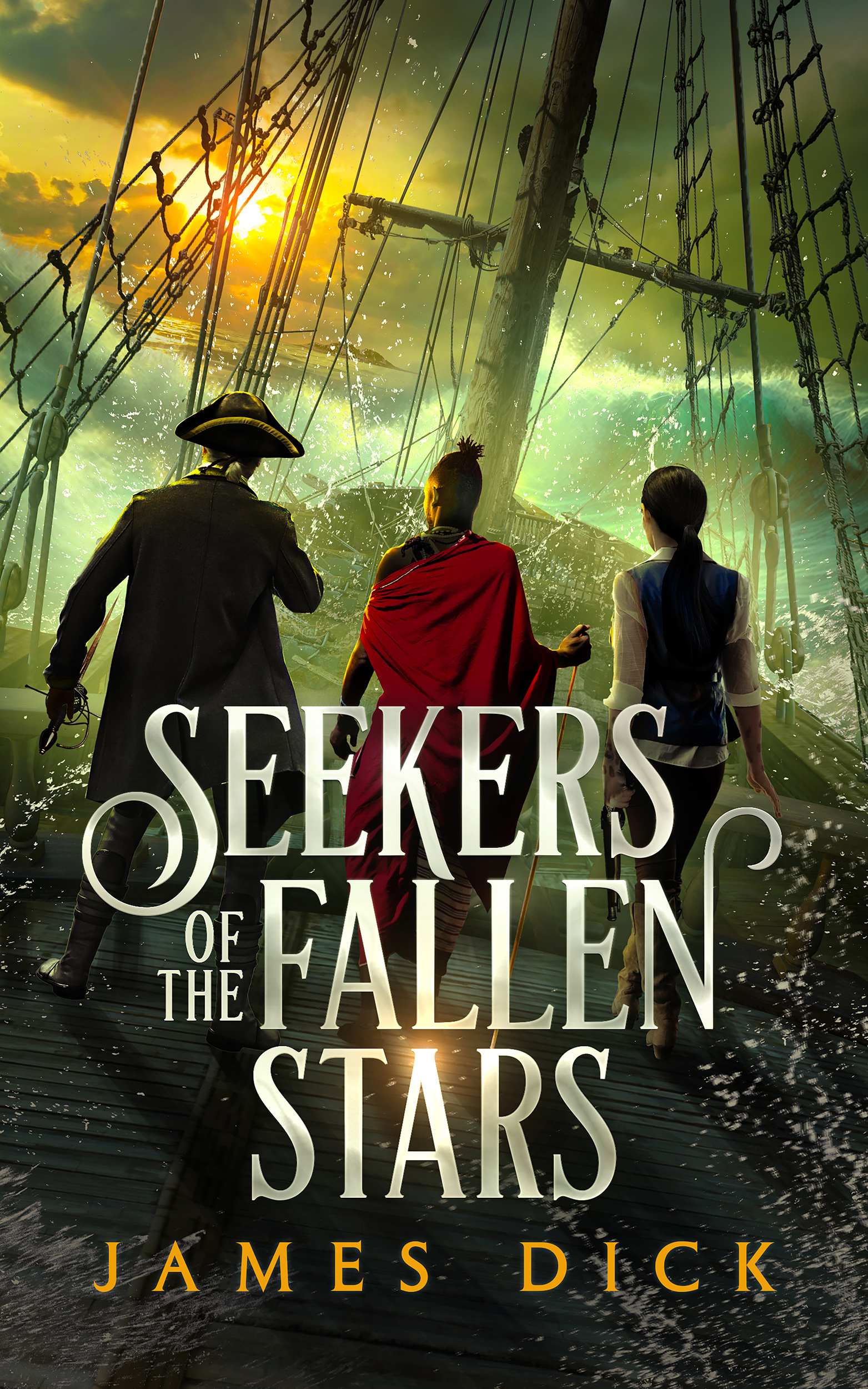
On May 22nd, 2026, I received an email from Flame Arrow Publishing in which was enclosed the cover of my debut novel, Seekers of the Fallen Stars. This is a moment which very few writers ever have. I imagine it’s not so different from the feeling a parent gets when they see the ultrasound of their child for the first time.
You might think that’s a bit hackneyed, but let me assure you that this book, like a child, was created from the most intimate parts of me. My thoughts, my beliefs, my experiences, my pain, and my passion are in these pages. And to see all of them summed up by a single image is both invigourating and humbling in equal measure.
Seekers represents the culmination of five years of career-building, ten years of focused writing, and a lifetime of reading, gaming, and dreaming. I’d like to tell you a little of how I got to this point.
I’m not going to be the dick who says, “If I can do it, so can you.” The harsh reality is that not everyone can do this, not everyone will get to have that moment of seeing the beautiful cover of their first book. But if, in my experiences, there’s something that resonates with you, that helps you in your own voyage, surely it is worth sharing.
You will, of course, remember a little film that released in July of 2003 called Pirates of the Caribbean: The Curse of the Black Pearl. This film single-handedly resurrected the swashbuckler genre and redefined its formula for modern audiences. To this day, there has not been a single pirate-related piece of media released that has not been informed by the visual language of PotC.
What you might not know, however, is that the same month that Curse of the Black Pearl released, a tie-in game quietly slipped onto game shelves called Pirates of the Caribbean. This game, as it turned out, was made by Russian developer Akella, and up until a couple weeks before the film released, was actually titled Sea Dogs 2.
You see, Disney had absolutely no faith in PotC. They believed it would be a flop, and so their promotion of the film was halfhearted. They realized they had no tie-in material, so they contacted a developer (Akella) who was working on a pirate game, paid them a sack of cash and said, “Hey, can you tweak the story of your game so that it aligns with our movie?”
What was Akella gonna do, say no?
It just so happened that Sea Dogs 2, by some friggin’ miracle, had a story which almost perfectly mirrored Curse of the Black Pearl: a ship called the Black Frigate plundered an ancient Incan temple and stole the artifacts of the temple’s builders. In retribution, the gods of the Incan people cursed ship and crew to a living death until such time as they returned what they stole.
Change the Black Frigate to the Black Pearl, her captain’s name from Balthazar to Barbossa, and throw in a thirty-second bit of narration by Keira Knightley, and Disney had themselves a tie-in game juuuuust in time for the release of their silly pirate movie.
(Whaddya mean the game takes place a full hundred years before the movie? Who’s gonna know?)
I played the hell out of this game when I was little. It scared the bejeezus out of me. These days, liminal spaces from childhood are all the rage: the labyrinthine corridors of House of Leaves‘ titular residence, the concrete playgrounds of Control‘s Oldest House, and the off-yellow sprawl of the Backrooms.
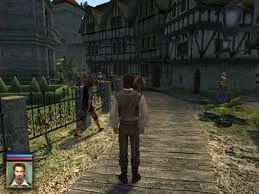
For me, the liminal spaces which hold my mind prisoner are the jungles and towns of Akella’s Pirates of the Caribbean.
I keenly remember walking through jungles with my officers and sprinting like hell past groups of bandits to the safety of town, or accidentally discovering the dungeons of Oxbay and soiling myself when a skeleton in a tricorn came at me with a sword. And the music.
I think, between this game and the film it was tied to, the seeds of my later interest in pirates, windjammers, and Naval history were sown. But it would be another two decades before they bore fruit.
The Learning Curve
Throughout my late teens and early twenties, I wrote almost exclusively novels.
I fell victim to that seductive dream most young writers have of crafting that exquisite First Novel, taking the world by storm, and becoming a household name. Not that the dream is bad–on the contrary: it’s excellent fuel for the fire of creative passion. But that doesn’t make it any more attainable. Those who succeed on their first try are as rare as unicorns, and they don’t always have the most consistent of careers.
“Early failure is healthier than early success.”
Chris Hadfield
I’ve lost count of how many drafts of science fiction and fantasy “masterpieces” I wrote in college and university, but sometime around my 24th birthday, I realized that my writing skills weren’t improving. I resolved, then, to try a completely different approach.
A word to you aspiring writers out there: there’s no “one-size-fits-all” career path. There is no teacher, no book, no guru who can give you the “optimal” system of creating stories–though many will try to sell you just such an idea. Discovering your process is a matter of trial and error.
However… there is one thing which I recommend which always seems to benefit writers who try it.
Start by writing short fiction.
Writing a novel is a big time- and energy-sink, and if you’re a writer still learning your craft, there’s a very small return on investment when it comes to building your skills.
The best thing most young writers can do is begin small: write a 1000-word story. That’s about four pages. The tiny scale forces you to be economical, to set the scene, describe the characters, and kick off the plot as quickly as you can.
Then, when you feel confident, expand: scale up to 2000, 3000, 4000, 7000, 10,000 words incrementally, and keep experimenting with different lengths. Short stories allow you to try and fail repeatedly in a short span of time, and also provide endorphin boosts more often because you can complete many of them in a short span of time.
Consider: in the time it takes you to write a novel, you can write as many as 80 short stories.
1 novel.
80 short stories.
Which do you think is going to help you improve faster?
You can also submit short stories to magazines and anthologies to start getting your name out there and develop a thick skin toward rejection. All of this will serve you well, both in your career and life.
There are many writers out there who attained early success with a breakout novel who, by their own admission, cannot write short fiction. They wrote a big book when they were young, got lucky with an agent or publisher, and continued writing at that scale into their 20s, 30s, and 40s.
If you start out writing short fiction, you can easily scale up.
If you start out writing long-form fiction, it is hard to scale down.
My aspiration when I was 24 was to develop my craft, not try to swing a novel and hope for the best. So I focused exclusively on short fiction, and through short fiction, I learned:
How to do more with less
How to write character arcs
How to plot stories
How to write a series of interconnected stories
The kinds of stories I enjoyed reading and writing (and the kinds I didn’t)
The sorts of messages I wanted to spread with my writing
That I am, at heart, an optimist, and want to tell optimistic stories
How to market myself
All these came into play in late 2023 when I eventually did return to novel writing.
2023: The Dwindling Days
September 2023.
Leila Batten, my boss at the Whitehouse Meats Butcher Shop in the St. Lawrence Market, unable to find a buyer for her shop, elected to close it completely and retire from the market. I suddenly found myself out of a job, but with a little money to float on.
Since I had the time now, and since I’d grown so much as a writer in the past three years, I decided to finally try writing a novel again. Something small–maybe 70,000 words. And it wouldn’t be some project which I thought “might be marketable” or “might be popular”. I’d write purely from a place of passion, satisfying no one but myself. After all, that was how I broke into professional short fiction writing with “EDIE”, my first major sale to Analog.
But what to write?
As a child, I had no idea that Pirates of the Caribbean was originally part of the Sea Dogs series. These days, PotC/Sea Dogs 2 is a hard game to find; lost in the sea of licensing, it is, for all intents and purposes, abandonware.
In 2023 I felt the need to play it again, but I couldn’t find it. Instead, I found Sea Dogs: To Each His Own, a roleplaying game which is a Eurojank classic. Despite many frustrations with the interface and quests, I nevertheless was captivated by the world Sea Dogs: TEHO presented. Through it, I discovered a love of nautical fiction, including Patrick O’Brian‘s Aubrey & Maturin books (better known as Master and Commander) and C.S. Forester‘s Horatio Hornblower series.
Engrossed in sailing ships and stormy seas, I decided to write a nautical fantasy with a mid-18th century Caribbean atmosphere. That was the answer to my first question.
Now the second: do I set it in the real Caribbean, or a secondary world?
I immediately discarded the idea of using a real historical setting. The Caribbean has been the site of some of the most appalling genocides in the long dark catalogue of human misery, and given that I’m a white-as-bread descendent of the British Isles, I felt it would be wrong to use someone else’s history as my personal plaything.
Plus, with a secondary world setting, I could still deal with serious issues, but in a manner and pace of my own choosing, and I wouldn’t be treading upon anyone’s real–and personal–history.
I was actually able to resurrect a world I’d created for The Journeyman and the Bear, a series of short stories I’d written in high school and college–and one which I now realize was also inspired by my time playing PotC/Sea Dogs 2.
So, late on the night of December 28th, 2023, with the snow falling heavily outside and the wind howling like a tortured voice from the past, I sat down on the sofa in my parents’ living room and wrote the outline to Seekers of the Fallen Stars.
2024: A Year of Darkness and Wonder
I wrote the bulk of Seekers in almost exactly nine months, starting December 28th 2023, finishing on or about September 15th 2024.
Many things happened in that time.
Image Credit: NASA
I couldn’t work in my chosen field: media. Unbeknownst to me, I’d graduated into one of the worst job markets in Canadian history, and my financial prospects looked grim–still do, if I’m being honest. My inability to provide for myself or find steady income meant I had to continue living with my family. All of this contributed to some of the worst episodes of depression and anxiety I’ve ever experienced. My sense of self-worth steadily weakened.
Through all that, the thing which got me up in the morning was my novel. Seekers was the only thing on my brain. It consumed my every waking thought, and sometimes made its way into my dreams. It was the first thing I thought of when I got up and the last before I went to bed. It energized me and gave me a reason to keep going.
The rest of humanity was still sloughing off the long time-skip of COVID-19, and 2024 offered miracles to help us shake the cobwebs:
I witnessed my first eclipse on April 8th–an event which made its way into the novel.
Solar winds created some of the brightest aurorae in living memory.
If I can say one thing about 2024, it is that I lived, in every sense of the world: I survived my inner demons, accomplished a dream I’ve had for a decade, and saw things that restored my sense of wonder. For all the difficulties I was fraught with, both mentally and financially, I cannot help but think of that year as the time when I finally began to bloom.
And Seekers was there, a constant companion, a source of endless joy.
2025: Flame Arrow
“A story is not a machine that does what you tell it. A story is a beast with a life of its own. You can create it, shape it, but as the story grows, it starts wanting things of its own. Change one thing and you set off a chain reaction of events that spreads through the whole thing. The characters have to be true to themselves. The events have to follow a logic that fits the story. A single flaw and the magic is gone. The story dies.”
After finishing the third draft of Seekers in September 2024, I took a few months to relax and recharge. In the start of 2025, I reached out to Rae Oestreich, a fellow writer who attended Clovis Editorial‘s Group Coaching sessions with me, and took her up on the offer of letting her beta-read my book.
When she finished, she had many good notes, but the one which stuck in my brain was this:
“Why does it have to be one book?”
Few questions have I ever loved more, and few have I ever loathed more. Because Rae had a good point: the current draft of Seekers was a bloated, overlong mess with a rushed ending, over 120,000 words in length. So, I cut it in two around the 100,000 word mark, and sat with it…
And sat with it…
And the damnedest thing happened: I realized it needed to be two books.
I wrote a fourth draft, and then a fifth (which was really just a reassembling of the plot structure of the fourth), sent it to Genevieve Clovis for a copy edit, and then in May, I began querying.
Would You Like to Know More?
“Querying” is the process by which an author sends out a query letter and a sample of their manuscript to an agent or editor. It basically says, “Here’s what my book’s about, here’s why I think it’s a great fit for your agency to represent (or your publishing house to publish), and here’s my publishing history.”
I sent my package out to ten agents both in Canada and the States. Half didn’t reply, and the other half rejected me. By this point, October was coming around and with it, Can*Con, so I decided to put queries on hold until after I gathered more information about publishing from the panels in Ottawa.
While I was walking the Vendors’ Hall with my Genevieve and Rachel MacLean (another Clovis Editorial alum), I spotted a new title by Rich Larson being sold at a table. The title was The Sky Didn’t Load Today and Other Glitches. The table was Flame Arrow Publishing. As I stepped closer, the man behind the table, Dave Dufour, spoke to me.
Our conversation went something like this:
Dave: “Reader or writer?”
James: “Well, both actually.”
Dave: “Nice. What have you written?”
James: “I’ve published some stories in Analog, a few other international markets. And recently I completed a 100,000 word fantasy swashbuckler about found families and inherited trauma.”
Dave: “Oh, you should definitely query us.”
James: (Eyeing the lengths of the other books on offer) “100,000 words…?”
Dave: “Yeah, we’re looking for works in that range. But you should definitely do it, like, now, because we’re opening queries November 1st.”
James: “Oh, wow, okay, I’ll get right on it.”
Dave: “Let me give you my card…”
You might think it strange, but I’ve always been able to sense the moments when my life changes direction. It’s like a subtle itch at the back of my skull. It usually happens when I meet someone new, or exchange correspondence with them.
I spoke to three other publishers while at Can*Con, and I only got that feeling from Dave at Flame Arrow.
And then I wrote my query letter–and it was a home run, too.
Baseball players talk about seeing the perfect pitch coming, the one they know is gonna be a homer even before they swing. I got that feeling whilst writing my query letter to Flame Arrow. Normally I try not to get my hopes up, but as I wrote the words, I couldn’t help but feel as if the universe had shown me the way.
I was leery of that feeling, especially in light of the Blue Jays narrowly losing the World Series to the Dodgers. What had seemed like a storybook ending was ripped away from us Toronto fans at the last moment, and as November turned into December and Christmas neared, I began to fear that my hopes for Seekers would be dashed as well.
December 8th, 2025 — 1:00 p.m.
Hi James,
Thank you again for sending Seekers of the Fallen Stars. Our team has now completed the full evaluation, and we’re really pleased with the strength of both the premise and the execution. The manuscript shows clear potential for our catalogue, especially with its imaginative worldbuilding and reflective themes that align closely with Flame Arrow’s editorial direction.
We’d love to move forward and discuss acquisition with you.
Dave
710 days since I wrote the first words of Seekers, I received an acceptance letter for it.
I wrote and sold a novel in less than two years.
There are writers who don’t get there in ten years.
There are writers who don’t get there in twenty.
There are writers who never get there.
I got there in 710 days. I got there in less than two years.
I don’t write these words to brag, but to reaffirm my success. There were times when the only thing which got me out of bed, the only thing that kept me sane, the only thing that brought me joy, was writing this book. For nine months, it was my life entire. And even after signing the contract, the old demons of self-doubt and anxiety crept in.
Humility is a virtue, and is right and healthy, but it is also right and healthy for us to speak boldly of our triumphs, to ourselves and others, so that we may resist the demons–both within and without–that try to erode our sense of self worth.
Seekers was a labour of love, and if I’m being honest, I never believed I’d be able to sell it, at least not right away. Few publishers will buy a book over 100,000 words in length from a new novelist. I thought for sure Seekers would end up on the backburner while I wrote and queried a shorter, tighter novel.
The fact I sold it right out the gate tells me two things:
I am a good writer
The Canadian indie publishing scene shows more imagination than the Big Five
I’m glad I ended up with a small Canadian publisher. The work these houses are doing is innovative and exciting, and they take a great interest in the development of their creators. I’m looking forward to a lasting partnership with Flame Arrow.
The Voyage Continues…
Aboard the Empire Sandy tern schooner at the Midland Tall Ships Festival, August 17th, 2025. This is the same class of vessel as the Seeker from my novel.
Ten years ago, I fantasized about publishing a novel. I was very impatient and thought–as doubtless millions of young writers have thought–that I could get to the finish line quicker than others had before me, that I would be a household name by the time I was twenty-five.
If I could go back and give myself three pieces of advice, it would be these:
Learn to love the journey. Each day you get to sit at a desk and put words on a page is a treasure. Not everyone has the time or freedom to do that.
Start small. Work on the smallest scale you can, and then expand from there.
Try everything. Opportunities surround you. Listen. Be attentive. Be ready at all times to leap at a chance to get your work into the world.
Having read all this, scroll back to the top and look at the cover again, and think about all the things that had to happen, all the strife, all the lucky turns of fate, for that image to exist.
My love affair with eyeshine, Necromongers, and David Twohy.
Each year I tend to dive deep into a particular franchise. Sometimes it’s a book series, like Patrick O’Brian‘s Aubrey & Maturin. Sometimes it’s a video game series, like Bungie‘s Halo. And sometimes it’s a multimedia cabinet of curiosities like today’s exhibit.
“You’re not afraid of the dark, are you?” — Richard B. Riddick
In 2025 I discovered the Riddick franchise, and I have been endlessly fascinated ever since.
By happenstance, I became a fan of this franchise just as it turned 25 years old. I’d been aware of it since 2004, but I’d never made the leap into watching it. It’s like been like a ghost at the back of my mind whispering from the dark for most of my life, and now that I’ve finally jumped in, I’m wondering what the hell took me so long.
Few things make me more excited than seeing this face in my notifications.
The story begins on February 7th, 2025, when Lord Mandalore dropped his latest video game review: The Chronicles of Riddick: Escape from Butcher Bay.
Would You Like to Know More?
MandaloreGaming is a channel dedicated to reviewing videogames. His content tends toward “lost media” or “abandonware”, so watching the reviews is like observing an archaeologist dig up some bizarre artifact from the past.
Mandalore’s writing is witty, his delivery dry, with in-jokes and references carrying from one review to another. These reviews, in my opinion, easily stand as entertainment pieces in themselves, as well as allowing you to experience the world and story of games which you might not be able to find anymore.
This was the first time in my life that I actively engaged with Riddick content, however vicariously. Mandalore has an incredible ability to bring his subjects to life in his reviews, and Butcher Bay is no exception. I believe it’s one of his best-written and -edited videos.
A few minutes into the video, it suddenly hit me that I had seen this game before. My childhood friend Ian had a copy. My parents never let me buy M-rated games, but Ian’s did, so his house was sort of a contraband hotbed for me. I remembered him describing the premise of Riddick: he’s a man with hypersensitive eyes who can see perfectly in darkness, but even small amounts of light will cause him pain unless he wears his trademark protective goggles.
I didn’t think much of it at the time — just another M-rated game in his library — but there were other whisperings…
Summer of 2004
In 2004, my brother was taking music lessons after school, so my parents would drive me to my grandmother’s house on Coleridge Avenue and I’d hang out for a couple of hours. At the time I was cultivating a love of Star Trek, and the Syfy channel did afternoon reruns of all five shows (back when there were only five, of course). From 3p.m. to 5p.m. was Next Generation and Voyager, so I’d crack open a Coke, heat up a box of Michelina’s macaroni and cheese, and watch.
At that time there was a flood of dark and strange action films in cinemas. The Matrix Revolutions, Underworld, Blade: Trinity, and Van Helsing are all movies I recall seeing trailers for on TV, but Chronicles to this day is the one that remains clearest in my mind, and it’s largely thanks to Canadian actor Colm Feore.
“Convert now or fall forever.” — Lord Marshal, The Chronicles of Riddick
This specific shot and Feore’s menacing delivery remained lodged in my brain for twenty years, along with the baroque imagery and moody lighting. With other films like Underworld and The Matrix Revolutions, I could at least tell you what world they took place in, but Chronicles… I couldn’t pin it down. Was it sci-fi? It looked like there were knights and magic in it, so… fantasy? Some altogether stranger reality? Just what kind of world was it? I chewed on such questions a great deal at the time, and would occasionally think of them in the years since.
Then along came Mandalore’s reviews and I finally decided to take the plunge.
SPOILERS for the entire Riddick franchise beyond this point. This is your only warning!
Some films are heightened by a blind viewing; Pitch Black is one of them. As such, I recommend giving it a watch before you read further. It remains the best of the Riddick franchise and I would hate to spoil it for you.
The film chronicles the crash-landing of the commercial transport Hunter Gratzner on a desolate planet (M6-117) in a triple star system. Richard B. Riddick (Vin Diesel) is a convict who’s being conveyed to prison by the spacecraft, in the custody of bounty hunter William J. Johns (Cole Hauser). A number of other passengers sleep aboard in cryotubes, including Pilot Carolyn Fry (Radha Mitchell), Imam (Keith David), and Jack (Rhiana Griffith), among others. Shortly after the crash, Riddick escapes into the wasteland.
With no food or water, the survivors are forced to explore the desolate world, and this is where screenwriter/director David Twohy shows his skill at building intrigue.
The survivors make a series of discoveries in rapid succession:
There are a number of termite-like pillars on this planet near the crash site
Skeletons further from the crash site reveal that all life on this planet has been wiped out
There is a mining settlement a long distance from the crash site. It’s abandoned, but a skiff is still landed on the surface. This vessel can be powered with fuel cells from the Hunter Gratzner and used to escape the planet
Fry finds an orrery (a model of the solar system) and spins it, discovering that their planet is bathed in perpetual daylight at all times
Back at the Hunter Gratzner‘s crash site, something kills one of the survivors
Fry learns the pillars are tunnels leading deep into the crust of the planet, where carnivorous aliens dwell
At the settlement, a survivor disturbs a swarm of these creatures in juvenile form and is eaten, but the creatures do not emerge into sunlight.
So, altogether, we have a deadly threat that is afraid of sunlight, on a planet where there’s never darkness, and all the survivors have to do to escape is move a few fuel cells. No problem, right?
Well…
Pitch Black‘s Best Sequence
The orrery, powered by a solar cell, spins lazily. Coloured lightbulbs represent the suns.
The survivors find the remains of the mining team in the coring room of the settlement, and Fry is bugged by the question of how these people could’ve been killed by nocturnal creatures if the sun never sets. She goes to the orrery, and spins it.
Spins it…
Spins it…
Boom. Turns out there is actually one alignment of the planetary system in which a nearby gas giant blots out the suns, producing an eclipse on this side of the planet. A lasting eclipse. Hours? Days? Longer?
B-but, it’s a rare event, right? The date on the most recent core sample was twenty-two years ago. Surely the eclipse isn’t going to happen anytime soon, right?
Oh shit.
This is one of the most thrilling sequences I’ve ever seen in a sci-fi film. Every scrap of information we’ve gleaned over the last hour as an audience comes together in one moment of revelation. Up until now, Riddick has been the scariest thing in the film, and now there’s something way worse coming.
The cinematography, the music, the editing, all of it gels to create a thrilling race against the clock that ends in pure terror.
The Story Behind Pitch Black
“PITCH BLACK grew out of an idea suggested by David Madden at Interscope. Travelers visit a planet where multiple suns mean perpetual daylight, but when an eclipse brings darkness, ghosts emerge. The ghost element only made it as far as our first draft, but that wasn’t what was most important to us.” — Ken Wheat, Screenwriter, in an interview with Script Secrets
Put a pin in that ghost idea. It’ll come back to haunt us.
Seeing the opening shot from Pitch Black immediately made me think of Alien3, and that’s no accident. Writer/director David Twohy wrote one of the drafts of the Alien3 screenplay: the critical one that turned the setting into a space prison.
The film was originally titled Nightfall and about a female outlaw named Tara Krieg with tribal tattoos and enhancements from her interstellar tribe of barbarians. Imam was named Noah Toth a member of a technology-based version of Christianity and he had no pilgrims, there was no eclipse, only a two-month day and two-month night, there was no geologist’s outpost, only ancient ruins and instead of aliens the villains were the ghosts of the creatures who built the ruins trying to defend their homeworld. There was no escape ship, but a distress beacon, and Tara, Carolyn Fry, Jack, Noah Toth (Imam) and Paris were all supposed to make it off the alien world, called “Hades” instead of M6-117. Johns’ morphine addiction, the cannon-fodder teens, the solar orrery and the geologist’s camp were added by David Twohy. — Pitch Black IMDb Trivia
Put a pin in this too.
Twohy came onto the film and decided to bring everything down to Earth. He gave his three leads character arcs (unusual in an action-horror film), placed a very human question at the heart of the story, and just lightly drizzled on some sci-fi elements (eyeshine, aliens). He used the action sequences to build up his themes, and the quiet moments to sketch out a larger world beyond the confines of the story. This whole film is a masterclass in how to do more with less.
And, crucially, it feels like what Alien3 should have been: the dregs of humanity deciding whether or not to be human.
I mention all this background info now because I want you to hold it in the back of your mind going forward. These versions of Pitch Black containing barbarians and supernatural forces will become very relevant in four years.
Toward the end of filming Pitch Black, Twohy and Vin Diesel realized that Riddick had potential for more stories, so they changed the ending of the film: instead of Riddick sacrificing himself to save Carolyn Fry, Fry would sacrifice herself to save Riddick, sowing the final seeds of his transformation back into a member of the human race.
Thematically, this ending is perfect. Like the rest of the movie, it’s totally unexpected and goes against convention.
Riddick in Pitch Black
Now we need to talk about eyeshine.
In Pitch Black, Riddick is a murderer. We don’t know who he killed, how many, or why, but he got “sent to a slam” where he was told he’d never see daylight again. In order to survive, he paid a prison doctor 20 menthol Kools (cigarettes) to surgically alter his eyes so he could see in darkness.
Menthol, being a natural anaesthetic, cools the harsh burn caused by cigarette smoke, making the experience of smoking less of a shock to young people’s lungs the first time they inhale. Studies have found that nicotine addiction develops much faster when smoking menthol cigs because of this.
And yet, for some reason, the sale of these cigarettes is legal on Indigenous reservations across Ontario, where substance abuse remains a critical health concern.
As I mentioned, ordinary light is now unbearably painful to him.
I loved the scene where he tells this story: when he realized normal life was forever beyond his reach, he sacrificed a huge part of his humanity in order to live comfortably among monsters. And now, with the alien planet turning dark around them, he might be the survivors’ only hope to peer through the blackness and find a way to safety.
They need him to see; he needs them to help haul the fuel cells to the escape skiff.
This is ultimately what Pitch Black is about: the social contract. We, as humans, make a mutual promise to help each other, stay close to each other, and not betray each other’s trust. If we fail in any of these respects, we find ourselves alone and at the mercy of the beasts slavering in the dark.
Would You Like to Know More?
I read the Pitch Black screenplay after watching the film and there’s a critical shot that was left out of the finished cut: one of the adult aliens, when denied a chance to feast on a survivor’s remains, cannibalizes one of her brood. The movie isn’t necessarily weaker for this omission, but it helps crystallize the movie’s message: we can either choose to be humans or animals.
Riddick chose to be an animal. Fry chooses the same thing when she tries to sacrifice all the passengers during the crash landing to save her own skin. Her crewmate stops her, dies doing so, and she becomes the unwilling hero of the film. She makes the choice to be human, and by her example, Riddick makes the same choice.
In darkness and desperation, far more is revealed about us than can ever be seen in the light.
My Thoughts on Pitch Black
David Twohy took what could have been a very by-the-numbers action-horror flick and injected it with a level of humanity rarely seen in such medium-budget features. It’s clear that he takes a special passion in sci-fi, particularly of the gritty, swaggering kind. It’s scenes like the eyeshine reveal that show his strength: he’s able to sketch out a much larger world, despite working inside a very small canvas.
Pitch Black is perfectly situated as a sci-fi film, representing the hinge point between 90s and early 2000s cinema and science fiction. It’s notable for having one of the first highly successful internet promotion campaigns for a film, and was able to punch high above its budget range thanks to passionate writing, directing, and acting — not to mention a killer score by Graeme Revell. I instantly fell in love with it and the universe, and longed to see more.
And moviegoers at the time clearly wanted more as well, because Pitch Black made back two-and-a-half times its budget in ticket sales, which is a necessary first step for a sequel. Tie-in media was also a possibility, and this is where Pitch Black: Slam City enters the picture.
Pitch Black: Slam City (2000)
Written by David Twohy and illustrated by Brian Murray, Slam City is an interactive flash comic prequel to Pitch Black, available for download on the film’s website (now defunct). YouTube user Demented Derek has the entire recording of Slam City, running at ~8 minutes in length, if you would like to check it out.
The story is framed as a prison log, detailing Riddick’s escape from the Ursa Luna Penal Facility (a.k.a. “Slam City”) in 11 hours 22 minutes, acquiring his eyeshine ability along the way. The whole thing is framed like a log from the station’s security feeds, enhanced with art from “Police Sketch Artist” Brian Murray.
David Twohy’s back on form writing for this gritty sci-fi setting, penning the same sharp, efficient dialogue he showcased in Pitch Black. Brian Murray delivers art that is, in a word, clean. There’s a seamless blending between the hand drawn panels and the computer-generated 3D elements.
Would You Like to Know More?
Watching Slam City brought back a wave of nostalgia for late 90s, early 2000s video game cutscenes for me; the kind I grew up with. Check out the intro cutscene from System Shock to see what I mean.
Slam City confirmed a suspicion I had in Pitch Black: Riddick was, in 2000, a cyberpunk character and intellectual property. This interactive comic epitomizes Twohy’s initial stamp on the series. He took it from a fluffy Hollywood fantasy to a gritty sci-fi universe reminiscent of William Gibson‘s Neuromancer.
Hey, wait a minute…
Doesn’t Molly Millions also have shiny eyes??
There’s also a moment in Slam City which returned in The Chronicles of Riddick. After Riddick arrives in Ursa Luna, the guards turn some dogs loose to hunt down prisoners who aren’t in their cells for curfew. One of these dogs runs into Riddick, and they befriend each other. Riddick notes the scars on the dog’s face and says, “Yeah, know how it feels.” This line was omitted from the final cut of Chronicles but it’s in the screenplay and the novelization.
Fans of this version of Riddick — the cyberpunk version where Riddick is just a man who sacrificed a big part of his humanity to survive — didn’t know it at the time, but Slam City was the last they would ever see of him.
The Chronicles of Riddick (2004)
After PolyGram Filmed Entertainment merged with Universal Studios, the latter acquired the rights to the character Riddick. While Pitch Black hadn’t broken any records, it had turned a tidy profit, which suggested to Universal that Riddick was franchise material.
“… but if you look into any Riddick project, you’ll find out that Vin Diesel had a ton of input into the character.” — MandaloreGaming, The Chronicles of Riddick Escape from Butcher Bay Review
It’s clear from researching this franchise that this is probably Vin Diesel’s favourite role. He and David Twohy were chomping at the bit to bring Riddick back to the big screen after Pitch Black, and they were determined to do it in a big way. Twohy wrote material but Universal was, initially, uninterested. Pitch Black did well, but not that well, at the box office.
What changed Universal’s tune was DVD sales. Pitch Black turned out to be a big seller on home video; so much so that, a couple years later, Universal came to Twohy and asked to see what he’d written.
You have to understand, when we made Chronicles of Riddick, this is how confident we were […] when David and I delivered the script to the studio, we delivered three leather binders. One said “Core One,” the second said “Core Two,” and the third said “Core Three.” Now, all but the first one basically had Xerox paper stuffed in it, right? With like a little treatment on each one. It was a locked leather binder and we only gave the studio keys to the first binder. [laughs] It was a statement saying, “This is a trilogy. Think of Pitch Black as The Hobbit to The Lord of the Rings” […] — Vin Diesel
Whatever they did worked because Universal greenlit The Chronicles of Riddick and pulled out all the stops: they threw over a hundred million dollars at the film, lined up tie-in media such as short films and video games, hired sci-fi and fantasy heavyweight Alan Dean Foster to write the novelization, and promoted the film like crazy.
That’s probably why I remember it: it must’ve been everywhere.
Chronicles is set five years after the end of Pitch Black. Right away, the tone is immediately different: the opening shots of giant conquest icons planted on a dead world, plate-clad warriors standing on cathedral steps, and a ghostly hand depressing a switch that obliterates a planet is far more evocative of Warhammer 40,000 than Alien3. Aereon (Judi Dench) delivers a Galadriel-style voiceover telling of an army called Necromongers crusading across the universe, killing or converting every world in its path.
Riddick is in hiding on the planet U.V.6, after dropping off Jack and Imam on Helion Prime. A group of mercs led by Toombs (Nick Chinlund) track him down, but he gets the better of them and learns that the bounty on his head has spiked to 1.5 million U.D. and the planet that posted the bounty is Helion Prime. Thinking that Imam has betrayed him, he ditches Toombs and takes off.
I have never seen an actor have as much fun on-camera as Nick Chinlund playing Toombs.
En route, Riddick has a vision of a dead world and a woman, Shirah (Kristin Lehman) telling him he needs to remember where he comes from. These words are echoed by Imam and Aereon when Riddick arrives on Helion Prime. They tell him he’s a Furyan, and he’s the one hope they have to stop the Necromonger horde.
Riddick in Chronicles
Unfortunately, we must now discuss my least favourite of David Twohy’s creative decisions in this franchise.
Up until this point, Riddick was just a man. A remarkably dangerous, fiercely intelligent, improvisational killer, but still just a man. In his own words, he started out in a liquor store trash can with an umbilical cord wrapped around his neck (the story is achingly familiar to anyone who’s even glanced at the statistics of infants abandoned in impoverished neighbourhoods). Recall that in Pitch Black, he repeatedly gets beaten and subdued by bounty hunter Johns, also an ordinary man, and the battered and bruised Fry even gets a shot or two in when he turns his back on her.
In Chronicles, Twohy makes Riddick a prophesied hero destined to stop the Necromonger legion’s rampage across the universe.
As a result, Riddick’s origin story is retconned: he was one of millions of male Furyans strangled with their own umbilical cords by the Lord Marshal Zhylaw, a move evocative of Pharoah commanding all Hebrew firstborn boys to be cast into the Nile River in the book of Exodus.
Would You Like to Know More?
Lord Marshal Zhylaw is played by Canadian stage veteran Colm Feore. Hot off his turn as Andre Linoge in Stephen King‘s Storm of the Century, Feore had become by this time one of Hollywood’s go-to pinch hitters. I had the chance to see him play King Lear a few years ago, and he was stellar. Watching him act in Chronicles was like watching a Formula 1 car go for a Sunday drive: he has a gear that would leave all his cast-mates in the dust, but sadly, he’s never given the chance to demonstrate it.
A common criticism levelled at the film is that it’s Conan the Barbarian in space. Having read many of Robert E. Howard‘s Conan stories, plus the novelization of Chronicles, and watched Riddick (2013), that comparison is far more apt than people think. Like Conan, Riddick is a cutthroat who rises to become a king (well, Lord Marshal), falls victim to powerplay, and has to claw his way back to the top against impossible odds.
Riddick in Escape from Butcher Bay
As part of the multimedia push Universal was giving Riddick, a video game was commissioned. The Chronicles of Riddick: Escape from Butcher Bay is a prequel to Pitch Black that tells the story of Riddick’s incarceration and eventual escape from the eponymous triple max prison, Butcher Bay.
As far as I’m aware, this game is canon. I’m not going to do a deep dive into it — you can watch MandaloreGaming’s review for that — but I will call your attention to the eyeshine.
At the start of the game, Riddick doesn’t have eyeshine. He acquires it after meeting a character named Pope Joe. But unlike in Pitch Black, Pope Joe doesn’t surgically give Riddick eyeshine, he just stitches up some injuries, and suddenly, without warning, Shirah speaks and Riddick gets his eyeshine ability.
Now, the game frames this moment as if Riddick chose to believe Pope Joe gave him eyeshine. If so, he both lied to Fry and Jack in Pitch Black and to himself over the years. The implication is that eyeshine is an innate Furyan ability.
But… if so, why doesn’t Shirah or the Purifier have it?
Would You Like to Know More?
Shirah and the Purifier are both Furyans. The latter even evinces some of the same Furyan energy Riddick uses. So why don’t they have eyeshine? Is it just one of many abilities that a Furyan can acquire, or is it somehow unique to Riddick, him being what the script labels an “Alpha” Furyan?
These are the kinds of problems Twohy’s changes introduced.
Chronicles Continued
In addition to being made a Chosen One, David Twohy spun the dials on Riddick’s strength and combat ability. Whereas Riddick struggled to take down a single rent-a-cop in Pitch Black, now he’s able to mop the floor with entire squads of the best soldiers in the universe. By the end of Chronicles, he’s even going toe-to-toe with a supernatural half-undead Colm Feore moving as fast as Sonic the Hedgehog! You never feel worried about him because it seems like there’s never a situation he encounters he can’t come through smiling.
And, if you watch the Director’s Cut of Chronicles, Riddick even has a dash of the supernatural himself: just as Vaako (Karl Urban) is about to blast him with a pair of pistols, Riddick receives a final vision from Shirah who bestows some kind of Furyan energy upon him. He unleashes it in the form of a shockwave that wipes out Karl Urban’s Necro squad.
The Meaning of the Changes
“I knew the trap that other sequels had fallen into, kind of replaying the same thing over and over again. So I said I think the key to it is not to do the expected: don’t go back to the same planet, don’t meet the same creatures, don’t even let it be a creature movie. Could we change genres and yet keep the same tone and keep the same characters? I think that was the inspiration for the approach and the metamorphosis between Pitch Black and Chronicles of Riddick.” — David Twohy
I have such unbelievable respect for David Twohy for making this change. He seems like a writer after my own heart: when writing a sequel, it’s imperative to try something new and not retread old ground.
But with all due respect to Twohy, I don’t think this is the whole story.
Pitch Black was a low-budget sci-fi action-horror film from a small studio shot in the loneliest part of the Australian outback. David Twohy and Vin Diesel could swing for the fences so long as they took responsibility for the film’s success or failure.
Chronicles is a big-budget special effects extravaganza funded by a major studio/distributor complete with a host of tie-in media. A movie this big cannot afford to be a failure. My feeling is that, finding themselves in the major leagues, Twohy and Diesel decided to play things safe: give the studio and audience a hero rather than an antihero, make him special, give him powers, elevate him above ordinary folk, give him admirers, pit him against the ultimate evil. Stay within a prescribed formula, don’t colour outside the lines.
Chronicles makes a lot more sense when you consider the media environment it was born into.
The Star Wars prequels and Harry Potter had dominated the box office for the past four years, and those franchises are built upon prophecies, Chosen Ones, and Dark Lords. The Force and wizardry had a stranglehold on pop culture.
Riddick was up against films the size of Necromonger conquest icons. Maybe Twohy and Diesel felt they had to incorporate elements from those films if they wanted to stand alongside them.
Would You Like to Know More?
In between Riddick films, the 9/11 terrorist attacks occurred and flipped a switch in the West’s collective consciousness. Suddenly stories of religious extremism were everywhere. The childhood game of Cops and Robbers (formerly Cowboys and Indians) became SWAT and Terrorists, or some variant thereof.
You didn’t go near brown-skinned people in the street because they might blow themselves up.
In gaming, Halo: Combat Evolved came out. The enemies in that game are the Covenant, an alliance of aliens following a fundamentalist interpretation of religion bent on the genocide of humanity. Around the time Chronicles came out, the advertising freight train for Halo 2 was just getting underway.
I have no trouble imagining the Riddick script containing thinly-veiled Jihadists was greenlit partly to meet the current zeitgeist. What’s interesting is that you have Imam, an Arab Muslim-coded character, return as a good guy in Chronicles.
A Deadly Weekend
The Chronicles of Riddick hit cinemas in the United States on Friday, June 11th, 2004.
Would you like to know what film premiered in the States exactly one week prior, on June 4th ?
I remember watching Harry Potter and the Prisoner of Azkaban twice in the same 24-hour period: once with my parents, and once with my friend Ian the very next day.
You remember my friend Ian, the one who first explained Riddick to me?
When I learned this, the pieces suddenly fell into place. I never heard any more about The Chronicles of Riddick because my ears were ringing with “EXPECTO PATRONUM!” the whole summer long.
I can hear you saying, “But James, they released a full week apart!”
This chart shows that Prisoner of Azkaban was #1 at the United States box office for two consecutive weeks, running right into Chronicles’ release window.
I imagine whoever decided to release on June 11th was fired from Universal.
Riddick had no business releasing within the same month as Azkaban, let alone the same week! Each Potter film generated more hype than the last. It was obvious to anyone that Harry would be the only thing people would be talking about until June 30th, when Spider-Man 2 swung into cinemas.
Looking at The Numbers, Chronicles also released the same weekend as Garfield: The Movie, which raked in $208,094,550 to Chronicles‘ $107,212,751. If Riddick had waited until June 25th, his only competition would’ve been The Notebook, the Harry Potter hype would’ve died down, and word of mouth would’ve killed off all interest in Garfield.
But I want you to take a moment and re-examine Chronicles‘ box office take: $107,212,751, against a budget of roughly the same amount.
Riddick made back most or all of his money during the reign of the second-highest grossing film of the year, Prisoner of Azkaban.
Really think about that for a second. People loved Riddick enough to shell out a hundred-million dollars in ticket purchases despite Harry Potter still going strong in theatres. Imagine what that number might look like if Riddick had released against softer competition.
The more I think about it, the more impressed I am. Riddick went up against Harry fuckin’ Potter and Garfield and took a sizeable bite out of both their box office earnings. That should tell you how much love there is for this character.
We’re going to return to this discussion after we talk about the third feature film.
My Thoughts on The Chronicles of Riddick
“I might’ve gone a different way.” — Riddick
One summer night, while alone on the family farm, I cracked open a beer and keyed up The Chronicles of Riddick on our janky home theatre system. I’d seldom been so excited to see a film; not only was it the sequel to one of my new favourite sci-fi features, but I would get closure to a mystery that’d scratched at my mind since 2004.
What is this film?
The version I watched was the Director’s Cut, and by the time the credits rolled I confess I felt… let down. It was a far greater divergence from Pitch Black‘s tone and aesthetic than I’d been expecting. The decisions surrounding Riddick’s “prophesied hero” character in particular rankled. And yet…
And yet…
… I couldn’t stop thinking about it! Visually, it is one of the most spectacular films I’ve ever seen. David Twohy is a sci-fi writer who delights in showing you how the pieces of his worlds fit together, and his full talents are on offer in Chronicles. From first shot to last, you understand how Necromongers work, how Crematoria works, how Helion Prime works — an entire universe, explored in just over two hours.
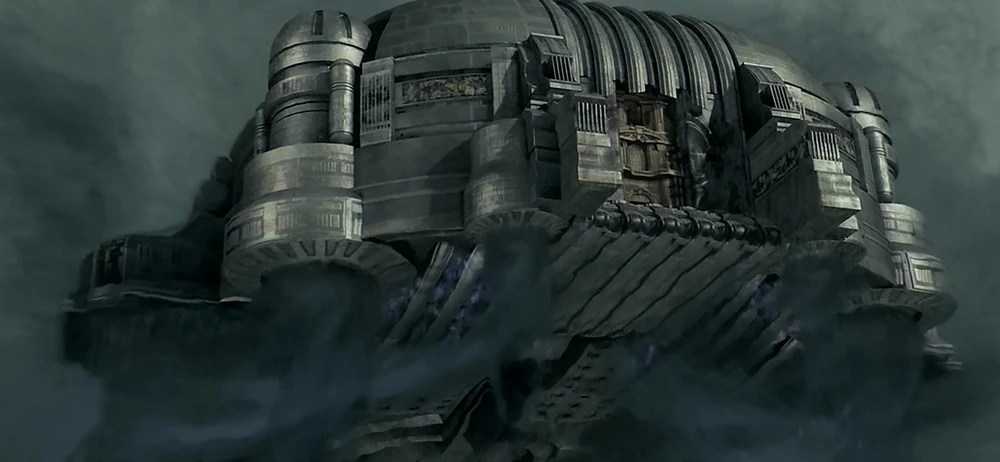
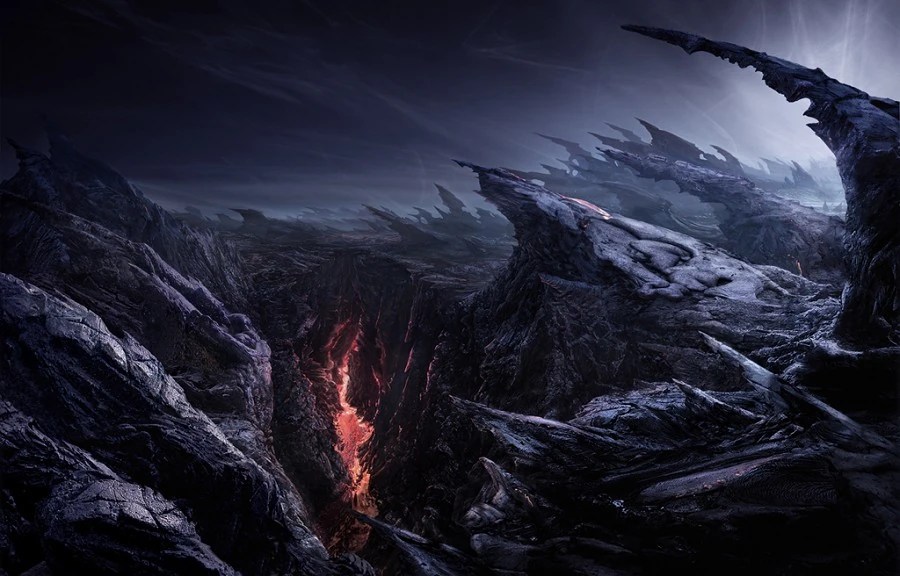
The special effects are astounding, and hold up remarkably well. The shots that stand out most in my mind are those of the Necromonger ships and conquest icons looming over Helion Prime and the hellscape of Crematoria.
Just look at these! This is like some fever dream or half-remembered fairy tale. The detail in these designs is exquisite, and when you read into the backstory of the characters and setting, it all serves a purpose. The production and art teams didn’t build a single piece of armour or animate any part of a spaceship without having a specific reason for doing so. There are big-budget films shot today that don’t take one-tenth this much care.
Would You Like to Know More?
This attention to detail is par for the course in Twohy’s films. From script to screen, whether the setting be mundane or fantastical, Twohy takes the time to make sure the story flows logically and all elements drive it forward. Check out his sci-fi film, The Arrival, to see an example of this.
If I could describe Twohy’s visual style in one word: swagger. He never loses his confidence when telling a story, no matter the incongruencies or idiosyncrasies. He clearly, unabashedly loves these worlds and wants to present them in the most flattering, sexy way possible. There’s any number of things you could criticize about Chronicles but presentation isn’t one of them.
I think this, ultimately, is why Chronicles stuck in my brain despite being initially disappointing as a follow-up to Pitch Black: no other film looks like it. What other big budget sci-fi fare was there in 2004? Star Wars. That’s it. J.J. Abrams‘ Star Trek (also featuring Karl Urban) was still five years away. Big budget sci-fi television wouldn’t take off until the 2010s with the rise of the streaming giants.
To this day I can’t think of any films with Chronicles‘ specific, far-flung science fantasy sensibilities aside from Dune. Chronicles is a giant question mark in the history of sci-fi cinema that my brain can’t stop chewing on.
Somewhere in the many threads of alternate realities, there’s a ‘verse where Chronicles opened on a different weekend and made $300,000,000 at the box office — not a groundbreaking payday, but enough to warrant greenlighting an immediate sequel, perhaps a franchise concurrent with Vin Diesel’s Fast & Furious films. If things had gone differently, I can imagine Riddick sitting in the same comfy niche as Underworld: a release every three years, making back 2.5 to 3 times its budget with each release, with more of the universe being illuminated with each film. I’m very curious what David Twohy and Vin Diesel would’ve chosen to explore.
Despite being an underwhelming box office release, Chronicles, like Pitch Black before it, did very well on home video, proving once again there was a hunger for this character. Alas, it would be nine years before we got another Riddick feature film.
Part of the multimedia push for Chronicles, Dark Fury is a 35 minute short film bridging the gap between the two Riddick feature films, released on June 15th — four days after Chronicles hit cinemas. Rhiana Griffith returns as Jack (she was recast by Alexa Davalos in Chronicles) along with Keith David as Imam. Futurama‘s Tress MacNeille and video game voiceover veteran Roger L. Jackson lend their talents to the villains Chillingsworth and Junner. Nick Chinlund makes his first chronological appearance as the mercenary Toombs.
Shortly after escaping M6-117, the skiff flown by Riddick with Jack and Imam aboard is captured by the Kublai Khan, a mercenary ship prowling the galaxy for the most wanted killers and crooks. Antonia Chillingsworth, owner of the ship, has a collection of human beings in “suspended time”: they experience time so slowly that an eyeblink is the work of an hour, and a breath the work of a day. But their synapses are unimpaired which means they experience every excruciatingly slow moment trapped inside their bodies.
Dark Fury feels like an episode of Love, Death & Robots. It has lush, lurid, sci-fi imagery and some really creative aliens in the form of the Shrill: whirling, tentacular creatures of neon light capable of liquifying their prey with a touch. The scene in the dark room where Riddick slays them is something to behold.
This is where animation shows its chops: creatures that would be almost impossible to create convincingly in a live-action film are brought to psychedelic life in a hand-drawn space.
Dark Fury is another case where Riddick breaks with pre-established style: the dark baroque imagery of the Necromongers and the gritty guts of Crematoria are traded for the slick, opulent interiors of the Kublai Khan: pearlescent floors and walls trimmed with looping whorls of gold.
What’s notable to me about this film is it mirrors, in many ways, the plot of Assault on Dark Athena, released in 2009: in that game, Riddick and Johns get captured by the titular merc ship after fleeing Butcher Bay in a stolen shuttle, where they face off against Revas (who has surprisingly similar hair to Chillingsworth), a merc leader who’s in the business of capturing people, but for an altogether grislier purpose.
Would You Like to Know More?
Revas raids planets and captures people to turn them into Ghost Drones, cyborg corpses who unquestioningly obey every command given to them. Check out Mandalore’s review if you want to hear the full story of this game, including why it came out five years after Chronicles.
Riddick (2013)
As soon as Chronicles was over, I cracked open another beer and put on Riddick. As the film buffered, I cast my mind back and tried to remember what the media landscape back then looked like. Breaking Bad was in its final season, Game of Thrones was taking over the world, Grand Theft Auto V was about to hit like the meteorite that killed the dinosaurs, and Disney and Marvel reigned supreme at the box office, with a decent showing from DC.
David Twohy and Vin Diesel had originally envisioned turning Riddick into Lord of the Rings, with Pitch Black serving as The Hobbit. Riddick 2 would’ve been an adventure in the Underverse, and Riddick 3 would’ve been a journey to Furya. But when Chronicles performed poorly at the box office, Universal shelved Riddick. It took some clever negotiation on Diesel’s part to get the rights to the character back.
When that happened, Twohy and Diesel scaled back the scope of their next movie to tell a more intimate story.
Riddick begins with a very moody, well-shot sequence of its hero indulging in the boons that come from being Lord Marshal of the Necromongers by day and fending off assassination attempts by night. He’s still grieving over Jack/Kyra’s death in Chronicles. We don’t know how much time has elapsed, but from the wear and tear on the Necromongers’ armour, it’s been probably been a while.
Karl Urban returns (briefly) as Vaako and is back to his usual schemes. He arranges a ruse whereby Riddick is taken to a dead world which Vaako claims is Furya, but is in fact just another desert planet. The Necromonger squad turns on Riddick and nearly kills him, but instead he is thrown down a rocky escarpment and left for dead.
I’m going to bring up Blindsided here because there’s no other place to do it.
This is a short motion comic in the same vein as Slam City. Unlike Slam City, however, it is based on storyboarded scenes that didn’t make the theatrical cut of Riddick, but which did make the Director’s Cut, so if you watch that but skip Blindsided, you aren’t missing anything.
Blindsided depicts a double assassination attempt on Riddick in his quarters aboard Basilica. One assassin appears to be an elite Necromonger warrior not previously seen in the films, the other is one of the Lord Marshal’s mistresses (now Riddick’s, because “You Keep What You Kill”).
The artistry is very grimdark and it’s a well-put together vignette, but aside from that, there really isn’t any reason to watch it. It was released separately as part of the promotional push for Riddick, but the substance of it appears in the Director’s Cut.
When people compare Chronicles of Riddick to Conan the Barbarian, I’m guessing they’re thinking of the 1982 film starring Arnold Schwarznegger. That’s fair — the plots have similar beats — but Riddick actually bears a much closer resemblance to Robert E. Howard’s original works, specifically “The Scarlet Citadel”.
This story opens with Conan, now king of Aquilonia, answering a bogus call for aid from one of his vassals. His army is obliterated and he is locked in a keep filled with eldritch monsters. His only hope of saving his own skin and his kingdom is a sorcerer believed dead for ten years who is also trapped in the citadel. The story culminates in a showdown with his betrayers wherein he retakes his throne.
Riddick follows many of the same beats: he’s left for dead in an ancient place filled with eldritch horrors, makes an unexpected alliance with the mercenary Johns’ father (Matt Nable), and faces many gruesome trials on the long climb back up to his throne aboard the Necromonger Basilica, where he manages to kill one of his betrayers, Krone (Andreas Apergis). Beats from Howard’s other stories appear: Riddick spends time in the wilderness, learning how to survive in alien environs, making friends with certain beasts, and eventually charming a diffident woman.
Most viewers (myself included) tend to agree on two things about Riddick:
The first act of the film is the strongest, where Riddick is left for dead, has to learn the rules of this alien world, and befriends a canine-like creature
Riddick tries too hard to be Pitch Black; being shipwrecked on a planet with an impending alien threat (heralded by rain this time instead of darkness) is something we’ve seen, and it was done better in Pitch Black.
Miscasting and Story Missteps in Riddick
Dave Bautista as DiazKatee Sackhoff as DahlBokeem Woodbine as Moss
When Riddick realizes he’s on the clock to escape this planet, he makes a risky move and broadcasts his presence to the mercenaries and bounty hunters of the galaxy, knowing they cannot resist such a juicy payday. Two bands of mercs touch down on the planet, and Riddick immediately begins playing them off one another, whittling down their numbers with subterfuge and sabotage.
But one of the merc leaders is Boss Johns, father of William J. Johns, the bounty hunter who was taking Riddick back to prison in Pitch Black. Boss Johns isn’t interested in collecting a bounty from Riddick, but instead wants answers regarding the fate of his son.
Yeah, that’s gonna be a real awkward convo…
When I saw that Katee Sackhoff, Dave Bautista, and Bokeem Woodbine were in this film, I was thrilled. One thing that both Pitch Black and Chronicles excelled at was hiring excellent local talent (Australian in the first case, Canadian in the latter) to breathe life into quirky side characters. Every side character in Pitch Black and Chronicles is memorable thanks to this.
Sackhoff had Battlestar Galactica under her belt. Dave Bautista was one year away from mega-stardom with Guardians of the Galaxy (in which Vin Diesel would also star). Bokeem Woodbine would turn around and deliver a magnificent performance as Mike Milligan in season 2 Fargo right after Riddick. With such enormous talent on-set, you’d think David Twohy would give them real characters to play.
Sadly that’s not the case. Nothing about these characters stands out in my memory. Twohy thus far with this franchise had been able to make the most of every single line of his scripts, using each one of his supernumeraries to sketch out the world a little further, but he faltered with Riddick‘s mercs. They’re neither memorable nor do they illuminate the ‘verse beyond the film. They are the cardboard cutouts that Twohy managed to avoid writing in Pitch Black.
Something I’ve noticed with Vin Diesel is that he needs characters as swaggering, quirky, and idiosyncratic as his own roles to play off of, otherwise he has to hold back in his performance to avoid looking out of place.
I know all of these supporting actors are exactly the right kind of people for Vin Diesel to work with, but the script doesn’t help them, so they can’t help Vin, and the whole movie suffers because of it.
The essential premise and conflict is strong, but there’s not enough good material to fill out the two-hour runtime.
Recommendations
There’s a couple ways you could tighten this into a killer story:
Cut thirty minutes from the runtime and double-down on “The Scarlet Citadel” mythic elements: the dethroned king lost in the wilderness who has to make some unlikely alliances to survive. Reduce the cast to only those most interesting actors, and give them good material to work with. Throw Riddick into the crucible with Boss Johns, have them duke it out until they’re at the brink of death, and only then allow them to work things out.
Cut this film down to under twenty minutes, maintaining the surreal, dreamlike feel of the opening and closing sequences. Make it into some kind of grief-fueled fever dream, where Riddick surfaces at the end clear-headed and ready for his next adventure.
So far, Riddick has failed to save people. Let this film be his chance to finally get it right, to move on from his guilt, and put him in a position to finally face Furya.
Beyond Riddick
“THRESHOLD! TAKE US TO THE THRESHOLD!” — Necromongers, after the fall of Helion Prime
The final shot of Riddick depicts our hero standing over the corpse of one of his betrayers, watching as the Threshold to the Underverse looms ever larger out the window. The architect of Riddick’s betrayal, Vaako, has followed in the Lord Marshal’s footsteps and become something not quite alive or dead, and he waits on the other side of this gaping wound in space. Riddick’s path leads into darkness, and an unknown future.
As much as I find Riddick a disappointment, I certainly won’t complain about it. It did its job, bringing the character back in a time and place when we least expected him. Critically, it may not have been a darling, but numbers don’t lie:
It earned $94,763,758 worldwide against a $23,000,000 budget, as well as an estimated $26,000,000 in home video sales. That, ladies and germs, is what is called a successful film.
Do you see now what I mean about there being a hunger for this character? Even the least impressive film in the series, when released in a slow week, made an absolute killing, earning far more than enough to justify a sequel. Universal made a huge blunder in 2004, pitting Chronicles of Riddick against Prisoner of Azkaban, and here is the proof!
Vin Diesel and David Twohy have teased a fourth Riddick film for years, but it wasn’t until 2024 that Riddick: Furya was confirmed to be in production.
“They say most of your brain shuts down in cryosleep…” — Riddick’s first line in Pitch Black
Little is known about this film, aside from that, in August 2024, Diesel confirmed that he and David Twohy were making it. A couple of production stills have appeared on IMDb since then, but even so, all we know about the plot is that it will involve Riddick returning to his homeworld to find survivors of the Necromonger purge.
I didn’t have the chance to see Pitch Black, Chronicles, or Riddick in theatres; I will not miss Furya. I may be a latecomer to this franchise, but I’ve quickly developed a passion for it, drawing inspiration from the character and his world for my own creative works. Let me now summarize what his stories mean to me:
Pitch Black remains one of my all time favourite science fiction films, full stop.
Pitch Black: Slam City is a lightning-flash look at the direction these films might once have taken, with 90s nostalgia-inducing presentation and sharp, efficient writing.
The Chronicles of Riddick is an endlessly watchable piece of low-engagement cinema featuring an army of Canada’s best stage and screen talent.
The Chronicles of Riddick: Dark Fury is a gorgeously-animated short sci-fi piece that could easily fit into a season of Love, Death & Robots.
Riddick, despite quite a few missteps, still has some marvelous sequences in it and with a few touchups, could have been a far stronger film.
If Riddick: Furya can make a splash, it might be the movie that brings Richard Bruno Riddick back into the spotlight, and welding goggles back into fashion. The character of Riddick has been thrown into cryosleep and thawed out again more times than any other convict. It wouldn’t take much to thaw a franchise like this.
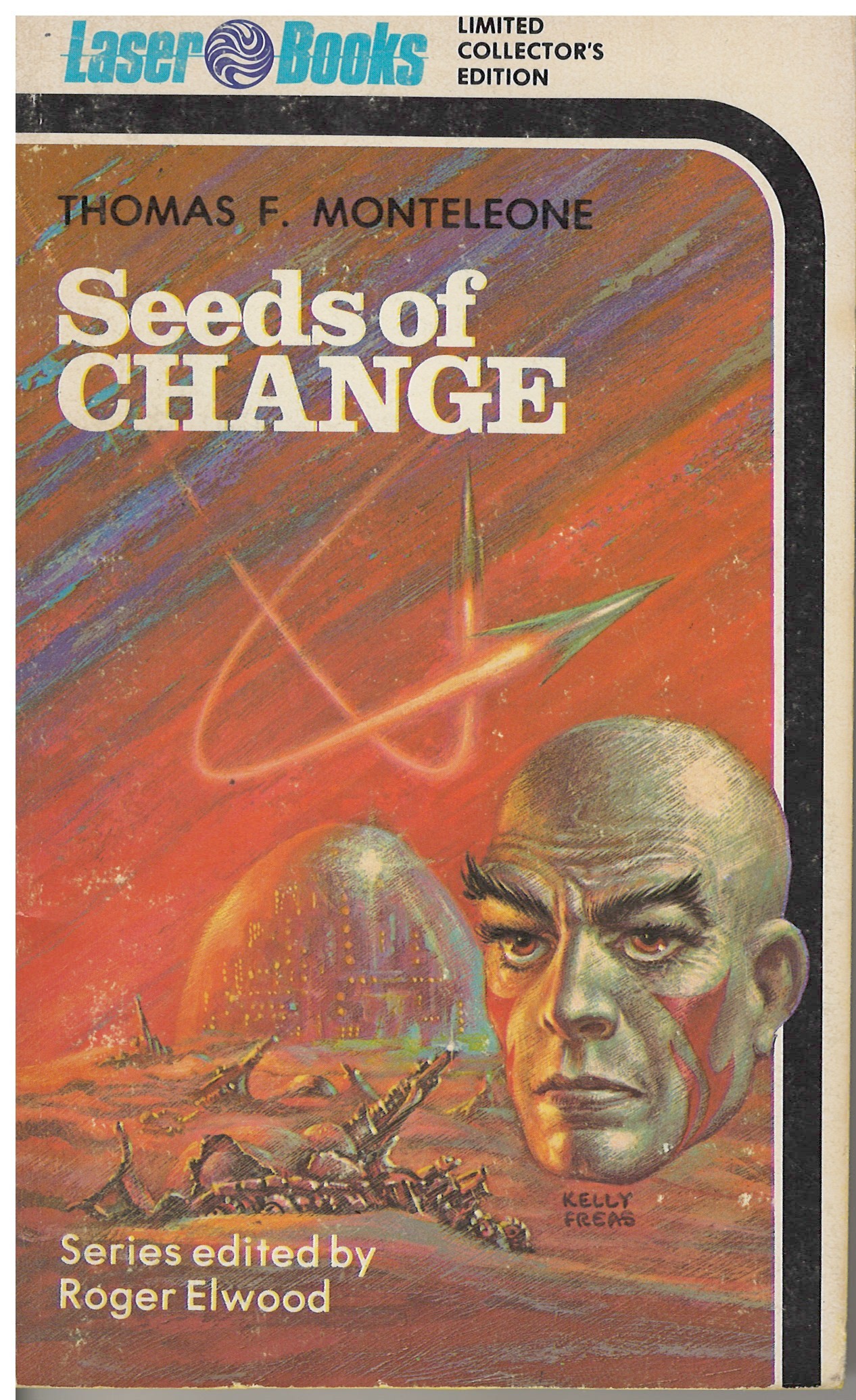
This book was not numbered, and was not part of the actual series. It was a “Laser Books Limited Collector’s Edition”, not available for sale, given away at selected bookstores to launch the series and then given away with subscriptions to Laser Books or with mail-in orders. This novel was also given away at science fiction conventions in 1975, starting many science fiction fans collecting them.
I hate to quote Wikipedia, but the thing is, as soon as you start researching this series, you realize just how sparse reliable sources are. Harlequin has all but disowned Laser Books, and the authors who’ve spoken publicly about it (like Tim Powers and Piers Anthony) all had axes to grind because of the way series editor Roger Elwood mangled their novels to fit Harlequin’s publishing requirements. I was lucky to find Steve Fahnestalk’s article at Amazing Stories, and even he admits to not being sure if the picture he has of Roger Elwood really is Roger Elwood!
We’re in the boonies of sci-fi fandom now, my friends. Here there be dragons.
Review Structure
Before we go any further, let’s quickly go over how I intend to review these books.
Cover — They say you shouldn’t judge a book by it’s cover, but cover art is the most important marketing element, so that’s where I’ll start. Kelly Freas illustrated every cover in the Laser Books lineup, and (surprise surprise) they follow a specific formula. But I think, with certain titles, you’ll be as delighted as I was to see just how much Freas plays within his constraints. The mark of a master indeed, which Freas no doubt was. It’s also surprising how often Freas added elements which had nothing to do with the story his art depicted(I’m looking at you, Serving in Time)
Blurb — Where’s the next place any good reader goes? Why, to the cover blurb, of course! This is the second-best marketing tool in the publisher’s kit, and with Freas hogging so much real estate on the back cover, the poor marketing expert for this series has to somehow get the reader’s money with a scant 100 words!
Story — Good marketing can make you start a book, but only the author can make you finish it! Unfortunately for me, I have to read every single word sandwiched between Freas’s artwork, and I have not the luxury of quitting. Am I in for a good time? I dunno, but with 57 (correction: 58) titles in the lineup, it’s sure gonna be a long time…
Conclusions and Recommendation — Some of these books will be good, some will be bad. Most will be average, but some… one or two… are books I think should still be talked about today, either because they depict something totally unique, or because they were simply very well written. This section will also include my thoughts on how the story could be improved, saved, or put out of its misery. All my fellow writers should take note: many of these novels have nuggets of great ideas that you should hold onto! Maybe one day, one of you will remix these ideas into a Hugo winner.
At the end, I will include a brief review which I will also post to Goodreads. These books have gotten little enough attention and I aim to change that. Now, with that bit of housekeeping out of the way, lets dive in to Thomas F. Monteleone’s Seeds of Change!
Cover
For the life of me, I can’t figure out who this bald boy’s supposed to be…
Ahh, would you look at that! This is peak Golden Age. If you hold this cover right up to your nose, you can practically smell Bob Heinlein‘s aftershave! Mark ye the shifting sands of a windswept desert, take heed of the broken bodies of war machines, and feast thine eyes on yon glimmering dome! (The city, not the bald guy. You can see one of the spaceships swerving to avoid him.)
Joking aside, I really love Freas’s use of colour, lighting, and lines to draw the eye to the Denver Citiplex in the distance. It really gives the impression of sunrise over a shattered, lifeless world, with the wrecked machines implying that the only life left is the people who reside in those encapsulated spires.
As for whose portrait the baldie is, with these books it’s usually one of three people: the protagonist, the antagonist, or some guiding figure of wisdom from the story. But for the life of me, I can’t figure out which of those three this chrome dome is supposed to be. Is he Turgenev’s mentor, Keating? Is he the head of the Resistance? The mayor of Denver? My DnD character?! WHO?!
Otherwise, Freas pretty much captured every element that appears in the book!
I think this is a good time to tell you: get used to this cover layout. It’s all you’ll be seeing for the next 57 covers.
Would You Like to Know More?
In case you don’t believe me, author David Anaxagoras was kind enough to furnish me with a link to an ISFDb database with images of all the Laser Books titles minus Seeds of Change.
Blurb
Art: Kelly Freas
The Denver Citiplex that evolves over the next two centuries, while technologically a masterpiece, is a living hell for those whom computer analysis labels potential deviants from the genetically controlled social norms. In his frantic effort to escape the fate of all such deviants, Eric Stone and his beautiful girlfriend, Jessica, manage to reach an underground colony living in the wastelands outside the city. It appears that not everyone loves the Citiplex, but only the arrival of a small colony of earthling survivors from Mars enables the dissidents to hope they may make some changes. But it is only a hope.
If you read that and thought of Logan’s Run, I wouldn’t blame you. I’ve neither read the book nor seen the movie, and yet I’m aware enough of that story that it was the first thing I thought of when I read the blurb. And while the film would come out the year after Seeds of Change was published, the novel Logan’s Run had been on bookshelves since 1967. There must have been others who made similar comparisons at the time. I’m not sure whether that would’ve helped or hindered Laser Books’ sales.
Whatever the case, the comparison, in my case, would not be enough to entice me to buy Seeds of Change were I to see it on a bookshelf. It would probably make me want to read Logan’s Run or watch the movie with my dad.
I gotta see if he’s available for movie night one of these days… hmm.
Story
Breaking News
Denver man verbally abuses boss, fall into thirst trap, overthrows government with help of Martians.
And now we come to the story itself. What’s it about? Does it sing? Does it squawk? Are there commentaries on the vicissitudes of the human condition? Does it offer up new perspectives on life, the universe, everything?
It’s a strange book, if I’m being honest. It feels like two stories that have gotten the old Frankenstein treatment: stitched together in all the right places, yet still visibly two different entities.
Story A
As advertised in the book blurb, Eric Stone is an analyst who spends his days combing the Denver Citiplex’s database for deviants. If you read sci-fi, you can probably already guess who that word refers to: anyone with a scrap of original thought and free will. The Citiplex is a totalitarian society sealed off from an Earth that’s been devastated by war. Their oppression is justified by that age-old excuse: “Survival of the race.”
Eric is a killer in the purest tradition of the KGB and Gestapo: he rubs people out with the stroke of a key rather than the pull of a trigger. But deep down, he feels discontent, and one day he says the wrong thing to the wrong man and gets himself on a watchlist.
Enter Jessica: a spy and saboteur belonging to a resistance group working to bring down the Citiplexes from both without and within. She seduces Eric, thereby signing his death warrant with a rather different kind of stroke (deviants are also those who enjoy what kids these days like to call “sexual intercourse”). With his whole society turned against him, Eric has no choice but to follow his new lover into the wastes and join the resistance.
Story B
The second story follows Turgenev and his motley crew of scientists on Mars. After Earth was sundered by war, the technocratic utopian colony on Mars was left to fend for itself, and so far they’ve managed to do so without resorting to fascism.
Yeah, I know, I don’t buy it myself. Apparently they embraced something called “dem-o-cra-cy”? Gotta be some kind of drug. Or tantric yoga. Either case… weirdoes.
Anyway, these Martians are happily enjoying the Bohemian lifestyle when an alien mothership flies by, deposits a spacecraft outside the Martian settlement, and continues on its merry way.
At this point you might be chuckling, but actually, this was my favourite part of the book.
“You mean the part that was barely mentioned in the blurb and has nothing to do with the Denver plot until the last quarter of the story?”
Yeah! That part.
Would You Like to Know More?
Here’s the deal: the spacecraft is a puzzle box with rooms and corridors spiraling from the airlock to the command deck. Each room poses a puzzle — some question of physics, math, or biology — with ever-increasing levels of difficulty. Answer all the questions and you get to take command of the spacecraft and join the aliens voyaging among the stars.
And if it turns out your entire species is a bunch of smoothbrains, well hey, you still get a 100,000 ton paperweight out of the deal!
The two stories merge very late in the book when Turgenev and the Martians (great name for a band!) fly the spacecraft to Earth and join the fight against the Citiplexes.
SPOILER!
The novel actually ends on a pretty dark note.
When the Citiplexes realize they brought a gun to a spaceship fight and have no hope of winning, they gas their own citizens. They commit mass murder rather than have the truth revealed that deviants not only escape the Citiplexes, but form their own societies — societies which thrive on equality and embrace difference.
Eric, Jessica, and Turgenev survive, along with their resistance and Martian friends, but all of them are pretty scarred by the hundreds of thousands of dead bodies they see in Denver. The revelation they have is that humans can become so entrenched in hatred that they’d rather kill themselves and all their loved ones rather than admit that the people they hate might actually be better than them.
A warning for our times, perhaps…
Conclusions and Recommendations
Barring one or two moments, there isn’t much about Seeds that stands out. The prose is very plain and workmanlike; when you’re writing about sex, tyranny, aliens, and genocide, higher language is called for. I can’t tell if the twin-story format is Monteleone being ambitious, or if he simply took two novellas he wrote and stitched them into a single work to sell to Laser Books.
Goodreads lists 221 distinct works (at time of writing) attributed to Monteleone, most of which are rated 3 or 4 Stars (by aggregate review), so clearly his talent or output is not in question. I feel like the quality of this book reflects less on the writer and more on the publishing requirements established by Harlequin, but that’s something I could only confirm by reading more of Monteleone’s work.
Let’s assume for a moment that Story A and Story B were peeled apart and allowed to grow into their own selves. What would make each one work?
The atrocities of the Denver Citiplex were described more fully
Eric’s psychological background is probed, providing us with a reason why he became and analyst and why he later became disenfranchised with it
The writing didn’t shy away from sex
Jessica doesn’t truly develop feelings for Eric, but instead manipulates him from start to finish (I did not buy her loving this man who was a murderer for most of his adult life)
The plot focus is entirely on solving the alien spacecraft
The relationship between Turgenev and his mentor Keating is properly explored
The inner lives of each of the scientists is revealed fully
Alas, we have 57 more Laser Books to review, and my time on this Earth is short. I shall leave this review for you to consider:
This novel feels like two separate novellas stitched together. Each has very different tones and themes and neither has anything to do with the other until the final pages. On the one hand, you have a story that reads like a knockoff of Logan’s Run, and on the other, a tale of first contact with an interesting premise which could be its own thing, but sadly is bolted to, and made worse by, the former. Overall, there’s a lack of cohesion and little that stands out apart from one or two moments. I’d recommend reading Logan’s Run or Contact if you want the same sci-fi hits this book’s trying to give.
And with that, this retrospective comes to an end. I certainly feel ready for a change.
Who’s Actually First?
I think I worked for this guy at a butcher shop once…
The real first entry in the Laser Books is Renegades of Time by Raymond F. Jones. I know this because it says “1” on the cover.
Blurb
The Algorans, masters of time travel had lost control of the time channels. In despair, they stood helplessly as the barbarian hordes of the devastating Bakori were unleashed on the universe. In the little town of Midland, U.S.A., Joe Simmons worked feverishly to assemble the only device that had a chance to stop them. He knew that success depended on a beautiful Algoran woman, Tamarina, yet he didn’t even know if she would re-appear! But he couldn’t stop trying. This whole disaster was his fault.
Tune in next week and I’ll tell you about a similar thing that happened to me in Midland, ON!