19. The Unknown Shore by Donald Malcolm
In the early 2010s, I went on a camping trip to Maritime Canada with my brother and father. It was a great trip. We saw whales, slept in the basement of a dilapidated (and possibly haunted) Red Bay schoolhouse, and discovered a rare species of mooseberry cheesecake.
We also drove the Trans-Labrador Highway.
In Happy Valley-Goose Bay, there is a map which shows the roads and towns of Labrador in white, and unsettled land in black. When you look at it, you see a ragged white ring around a huge black void. Contemplating that map, the realization slowly dawns on you that this part of Canada is almost totally devoid of civilization.
And then you squint, and notice a single thread that runs through the middle of that blackness, linking East with West.
That is the Trans-Labrador Highway, 1100 kilometres long… and at the time we drove it, two-thirds of that distance was unpaved gravel.
Imagine sitting in a Toyota Sienna, fully laden with camping equipment, bouncing up and down at 50kph for two days, wondering which will eventually triumph: efficient Japanese engineering, or the endless Canadian wilderness.
Funny thing about Siennas: they’re built for city driving, which means their tires have a safety bolt that can only be unscrewed by a special socket wrench that comes with the car. Did you know that? Well, we didn’t.
So when we blew a tire halfway down the Trans-Lab, we accidentally sheared that safety bolt off trying to replace the blowout.
We found ourselves stranded in one of the most sparsely populated regions on Earth, in high blackfly season, with night falling and the nearest help over 400km away. Fortunately, God preserves idiots, and He sent us a road crew who were retiring for the night who promised to bring back an acetylene torch in the morning to burn the safety bolt off our car.
All we had to do was survive the night.
We camped in a wet ditch, rain pattering down, water levels rising, surrounded by hungry black bears, our tent humming with swarms of the most relentless blackflies we’d ever seen, just hoping we could survive until daybreak, each of us wondering whether the bears or the bugs would get us first. Three men went into the tent, three came out, bit to shit and trench-footed. I’ll never leave home with a safety bolt on again.
Anyway… *sips whiskey* … we drove the Trans-Lab.
And it was almost as bad as the trip depicted in The Unknown Shore.


The bio for Donald Malcolm (far-right in the picture above) at the front of the book says this:
Donald Malcolm is a Fellow of the Royal Astronomical Society and a member of the British Interplanetary Society. He began his writing career in 1955 with astronomical and astronautical articles in New Worlds, Nebula, and Astounding and contributions to the Scottish national and local press. He continued to write for New Worlds from 1957 until 1964, stories such as “The Pathfinders,” “The House of Lights” and “Beyond the Reach of Storms.” The latter story was anthologized in a Penguin collection and published in Spain. Mr. Malcolm was one of three British writers put under the microscope by Brian Aldiss in SF Horizons (1965). His stories have also appeared in various anthologies, such as Out of This World and New Writings in SF.
Mr. Malcolm is married. He and his wife Rita live in Paisley, Scotland, with their two sons.
The Unknown Shore is his first LASER BOOK.
So, Malcolm’s bio stands out to me for a number of reasons.
First of all, he’s Scottish. Being of partial Scottish descent myself, this is delightful. “They may take our lives, but they’ll never take…” and so on and so forth. It shows that Roger Elwood has cast a wider net for his authors than just North America.
Second, Malcolm seems to have a more traditional career path compared to our other Laser Books authors. If you’ll recall, most of the authors published in Laser Books are noted for two things:
- They are known as major figures in fan circles, particularly SFF conventions
- They went on to write mostly tie-in fiction for Star Trek and Wars.
Malcolm doesn’t have a ton of writing to his name, but certainly a solid body of work. I note that on his Wikipedia page one of his earliest articles was titled “A Tenth Planet?”
Would You Like to Know More?


There is no real planet beyond the orbit of Neptune.
This isn’t a slight against Pluto, which I lovingly used as a setting in my short story, “I Felt a Star Die Today”, I’m just stating a fact. Neptune itself was originally discovered because of calculation errors in Uranus‘s orbit which couldn’t be resolved. Something was clearly tugging on Uranus, exerting gravitational influence on it, and so astronomers went looking for the cause, and found Neptune.
Later on, the U.S. Naval Observatory reported a similar phenomenon with Neptune, and so astronomers said, “Oh, we’ve done this dance before. Let’s find another planet!”
But no celestial body was ever found that was big enough to cause these disturbances.
It was eventually discovered that the gearbox in the telescope at the U.S. Naval Observatory had been taken apart for repairs, and not properly calibrated once reassembled. Once it was, the discrepancy disappeared.
And yet despite this, the media still stokes the fires of the “Missing Planet” hypothesis.
With his pedigree as a writer of science fact, I’m curious to see his take on science fiction.
Alright, Kelly, take it away!
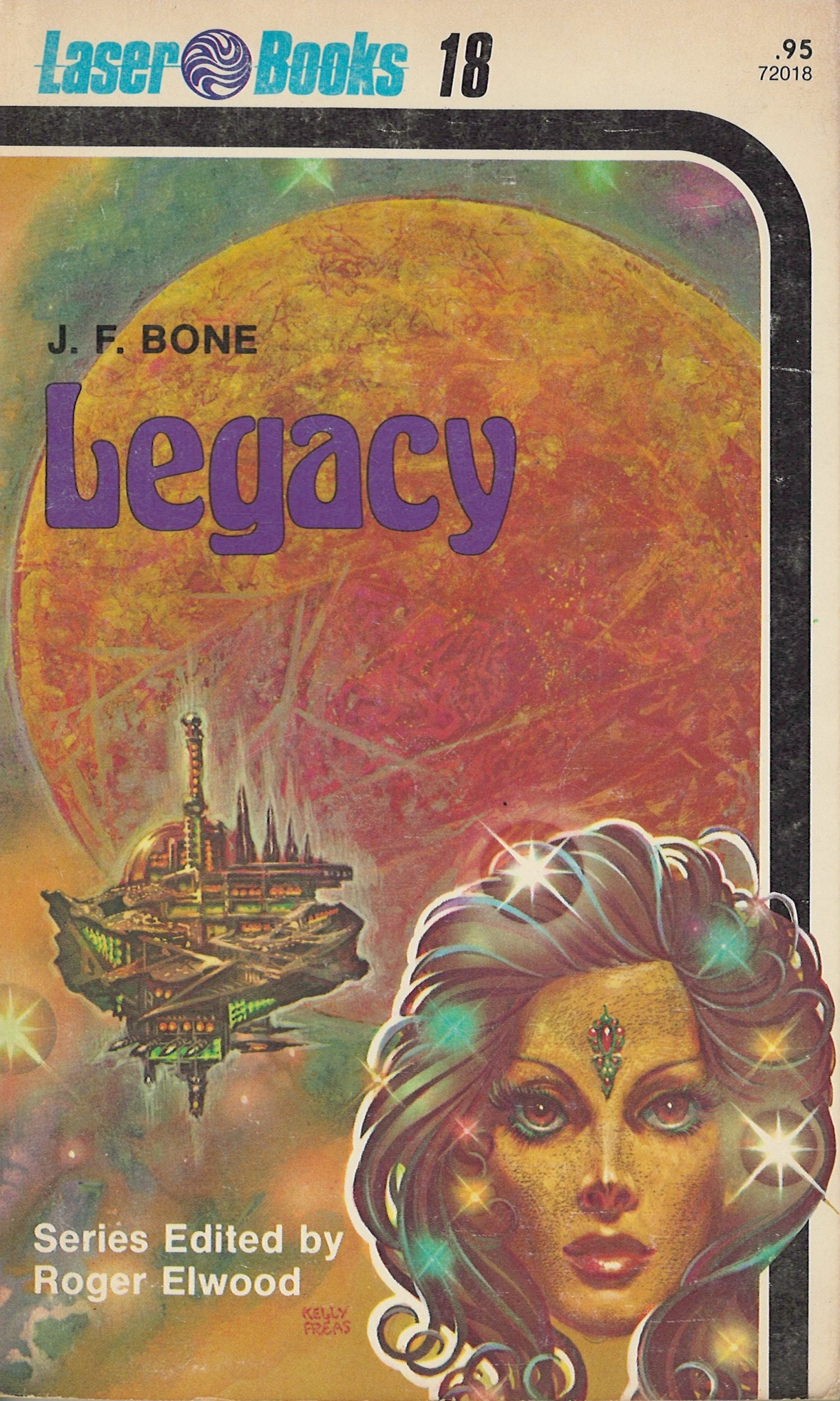
Cover

Ach, take it away!
Seriously, we haven’t seen crap like this since Walls Within Walls. This is really beneath you, man.
I guess the volcano’s pretty good, and so is the portrait of Rangone, the protagonist, but the drab olive colours and utterly flat background really brings the work down.
In fact aside from the volcano, the only splash of real colour comes from Ingrid Immelmann’s bra. I can’t say much against her–she’s missing three limbs and still is prettier than I’ll ever be–but my God, Kelly, why’d you dress her up in just a bra? She’s a trained architect and systems engineer for goodness’ sake…
I might forgive the scantily-clad woman if the overall composition of the cover was better, but everything’s so… bland.
Ugh, okay, let’s see if Marketing Guy can cleanse my palate.
Blurb

Fear swept through the crippled spaceship. The 200 men and women aboard realized they were trapped. To Rangone, chief medical officer, sudden death seemed preferable to the future they faced. Drifting aimlessly in the void outside the galaxy, they were on a journey to nowhere that would last forever! In a tense drama, Donald Malcolm brings to life the hopes and fears, the nobility and the meanness of people under the pressure of The Unknown Shore.
As stated last time… I really like this blurb. Tales of castaways and ships lost at sea are meat and drink to writers and readers alike, and the delight only increases when these tales are flung into the depths of space.
Stories of sailors being shipwrecked on unknown shores on Earth don’t always age well: with the benefit of modern archaeology and anthropology, we can see that a lot of these stories boil down to stupid mistakes, ecological damage, and the exploitation of whatever indigenous peoples inhabit that shore.
But in SF, the rules are different. You can create any adversary, natural or otherwise, for your heroes to face without worrying about rewriting history.
Unless your intent is to rewrite history, in which case we need to have a very different conversation.
Would You Like to Know More?
Two of my favourite spaceborne stories of shipwrecks, in any medium, are Apollo 13 (1995) and The Alters (2025).


Apollo 13 is a film which tells the true story of the titular moon mission from 1970. Shortly after departing Earth, an explosion crippled the spacecraft and the three astronauts aboard had to use their wits to keep themselves and their ship alive until they could get home.
The Alters is a video game wherein you play as Jan Dolski, the sole survivor of a crash landing on a planet orbiting a giant killer star. Your one hope of survival–and the survival of humanity–is to create a number of “Alters”, versions of Jan programmed with different life experiences (doctor, scientist, engineer, security guard), work with them, and keep them happy until you all get home.
Science fiction (and fact) provides the perfect backdrop for all manner of shipwreck adventures.
Well, not much more to say except… bring on the story!
Story

“This is no time for caution.” — Brandt, The Unknown Shore, (1976)
“Cooper, this is no time for caution.” — CASE, Interstellar (2014)
What are the odds that two stories about two insterstellar voyages gone wrong, created thirty-eight years apart, would have the same quote in them?
Either way, gives me an excuse to play this banger while I tell you about the novel.
Earth is at war with an Enemy we have never once seen in the flesh, but from the opening chapter, I gather we’re not winning.
Carlo Rangone, our protagonist, is Surgeon-Commander aboard a hospital ship. This excited me because we typically don’t see hospital ships depicted in fiction, despite being an essential wartime service since at least 1670.


Hospital ships have served multiple purposes throughout history, from carrying casualties away from a theatre of war to resupplying armies with medicine to providing a quarantine environment for plague victims.
In fact the origin of the word “quarantine” itself is nautical: ships moored off Venetian-ruled Dubrovnik were required to stand off for 40 days, “quaranta giorni“, before docking at the city, to ensure the disease could burn itself out in a closed environment.
Those of us living in the Post-COVID world are all too familiar with stories of cruise ships being denied landfall because of an outbreak of COVID or Hantavirus, and being required to remain at sea until proper patient intake can be established.
The Unknown Shore begins with our protagonist overseeing the loading of a hospital ship in an attempt to escape their Enemy. Rangone and his team are faced with a dilemma: the hospital ship only has capacity for 75 people, but there’s 194 on the station they need to evacuate.
Sam Templeton lays it out for everyone:
“We have two alternatives. One: a selection can be made and the most seriously wounded left behind…
“Two: by using laser surgery, Commander Rangone and his assistant, Major Donlevy, can remove the arms and legs of some of the patients, the number to be determined by the Commandant. This will allow the storage of the living trunks in refrigeration tanks and enable everyone to be evacuated. At one of the home hospitals, regeneration can be undertaken using the serum.”
— The Unknown Shore, pg 8-9
Would You Like to Know More?
As cruel as this sounds, there are many historical precedents for military decisions just like this.

The one that springs quickest to my mind is Napoleon Bonaparte‘s retreat from Jaffa in 1799. Pursued by enemy forces, and dealing with an outbreak of bubonic plague, Napoleon made the decision to euthanize between 15 and 50 of his sickest men using opium overdoses.
This was not a decision he made lightly; Napoleon knew that his men would be tortured to death if they fell into the Ottomans‘ hands, and if the plague had a chance to spread, his entire army could be laid waste. His opponents, both then and now, used this incident against him in the press, but the terrible truth is, such decisions are commonplace for soldiers and doctors in any period in history, and doubtless will continue to be so far into the future.
These scenes are handled with a great amount of gravity, and Rangone’s inner turmoil–the feeling that he has gone from doctor to butcher–is palpable.
Indeed, every moral crisis in the book is depicted with both brutality and depth. The question the book poses is, “How do you maintain your humanity under the harshest of survival conditions?”
These people risk their lives to give all their patients a fighting chance at life. They cannot be called inhuman–the inhuman thing would’ve been to abandon their patients and escape as soon as they could. Instead, they stayed till the last minute, undertaking the most painful actions–knowing they wouldn’t be thanked, knowing they might be hated–in the name of preserving life.
We in the 21st century can moralize all we want, but right now there are similar stories playing out in Ukraine, Gaza, and anywhere else you have a clash between those who respect life, and those who do not.
The hospital ship escapes, but is damaged by an Enemy missile, and its FTL jump sends it careering 25,000 lightyears beyond the edge of the Milky Way. The crew manages to claw their way back into the galaxy and find refuge on a harsh world covered in glaciers and volcanoes before their ship breaks down completely.
Slowly, they all come to the realization that they will never see home again.
What struck me most about the book is that there’s no traditional climax. It’s just one life-threatening situation after another. Malcolm throws problem after problem at his characters–and the reader–until we all grow weary and exhausted.
That’s not a criticism, by the way; if you watch any interviews with Ukrainians these days, many will say that the Russian artillery doesn’t even frighten them anymore. They’re just tired.
Malcolm depicts that exhaustion as if he’s lived it himself. The constant push-pull of hope being raised, followed by sudden loss of life, is uncomfortably well-written.

Also, kudos to Malcolm for understanding that one of the greatest threats to a population landing on a new landmass, be it a continent or a planet, would not be the flora, fauna, or even the environment, but microbes.
There’s a brilliant and horrifying section of the book which depicts two marines who contract a virus from bird scratches. The virus overstimulates the human stomach, causing it to produce excess acid. At first this manifests as increased hunger, but eventually turns to excruciating pain as the stomach dissolves its own lining and spills acid onto the organs surrounding it.
It’s a sobering example of how one can survive shipwrecks, volcanoes, and animal attacks with barely a scratch, only to be killed in a most gruesome way by an enemy too small to see.
The novel ends on a truly heartbreaking note: after going to superhuman lengths to save the amputees in cryo-sleep, sudden volcanic activity forces the soldiers and physicians to abandon the landing site with only a small number of the amputees reawakened. Most of the sleepers are killed when an earthquake swallows the ship.
The closing lines of the book drive the finality of this moment home like a coffin nail:
For there is no returning
to enter that beloved door;
Our hearts have stilled their wandering
we have found the unknown shore.
— Durbin, pg 190
Conclusions and Recommendations
My Goodreads Review
While this story delivers some interesting moral quandaries, an intriguing setup, and some truly tense sequences, there is still too much of the “Golden Age” fluff about the characters to make it more than a 3 out of 5 for me. If it had focused more on its protagonist and not wasted precious pages on supernumeraries, it might have been stronger. It’s a solid effort from Laser Books newcomer Donald Malcolm.
I will add here that this story had a much shorter distance to go if it wanted to be excellent. As I work through editing my novel, Seekers of the Fallen Stars, I’m relearning the importance of interiority in characters. “Showing their souls.” That’s what this book needed.
It needed to not waste its precious page space on characters besides Rangone, and show us this doctor’s troubled inner thoughts.
Even so, I was glad to have read it, and more of this book will stick with me than other entries in the series. It’s just a shame it missed the mark of excellence by so narrow a margin.
Who’s Next?

Juanita Coulson, authoress of Laser Book 11. Unto the Last Generation, makes her second entry in the series with Space Trap. As you’ll recall from that review, I deeply enjoyed Last Generation and had a lot to say about the reproductive pathology in that book.
Let’s blurb it and see what we’ve got!
Blurb
Planet NE 592 wasn’t due for Secondary Survey for another ten years. So why, Ken wondered, were they heading there now? Then on his screen he saw the disembodied face of a girl with jewel-like skin and felt, rather that heard, her plea: “Go Back.” But they couldn’t go back. Against their will, they were drawn into a crash landing on NE 592. They were trapped – with no means of escape. And NE 592 was not the uninhabited planet they had been led to believe it was!
*Sigh*
Another crash landing on another alien planet? That makes three of those in this series so far…


You know most of the universe is empty, right? The odds of you crashing anywhere are infinitesimal compared to the probability you’d just drift on for eternity.
Well, I’ll give Juanita the benefit of the doubt. So far the female writers in this series are batting .1000, but I’m a bit nervous. Gordon Eklund wrote the spectacular Serving in Time, then promptly shat the bed with Falling Toward Forever.
I guess one could say… only Time will tell.