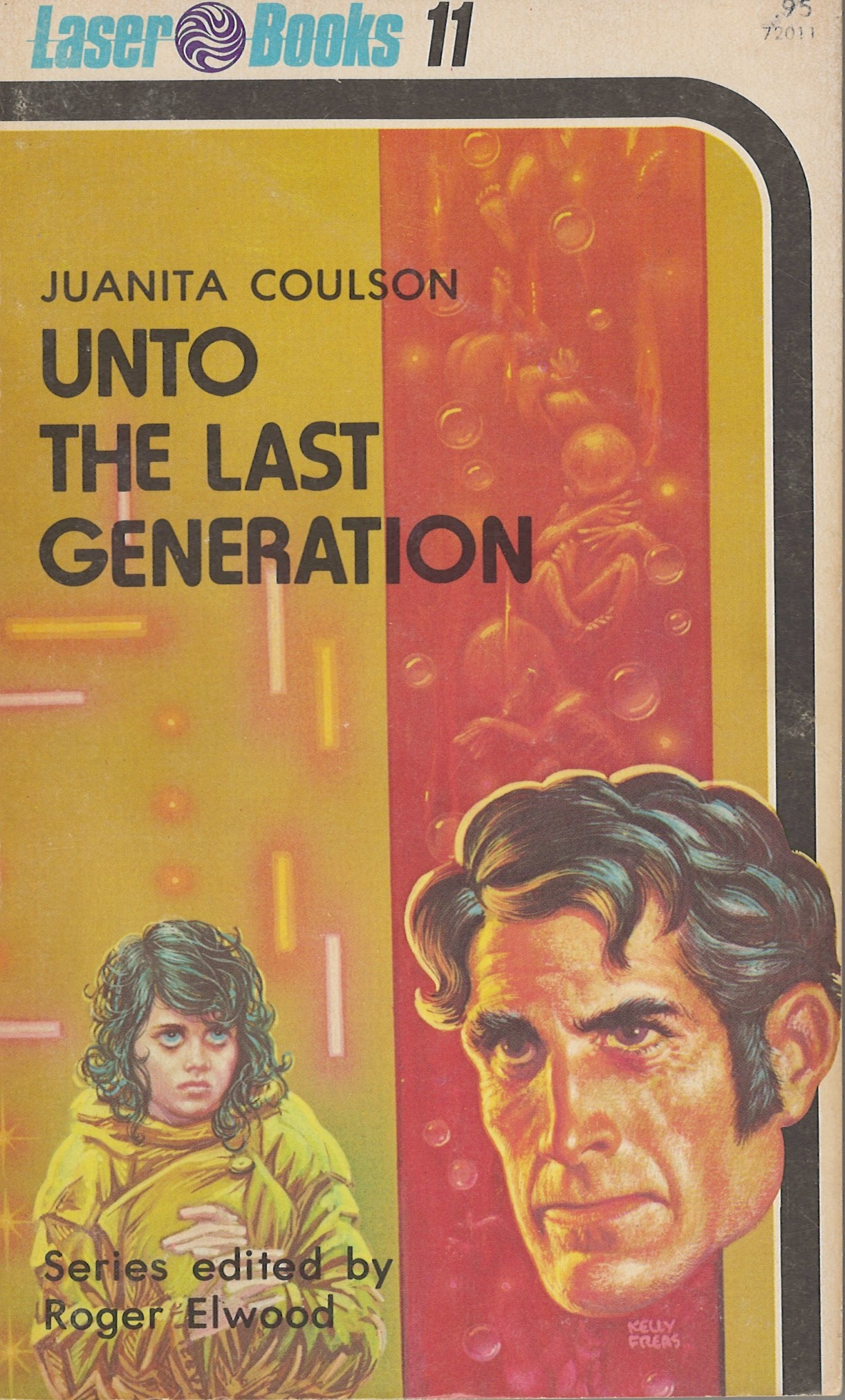
11. Unto the Last Generation by Juanita Coulson
Last review, I made a crack about women writing sci-fi, and got a crack on the head for my political incorrectness. To anyone who might’ve been offended: I apologize. I don’t know how I’ll ever forgive myself. I’ve already booked myself into rehab.
And next week I’ll be on the Jordan Peterson Podcast.
Okay, okay, I’m gonna cut the chauvinist humour now. In today’s review, we have to talk about extinction, cloning, and vaginas — subjects I take very seriously.


Juanita Coulson’s first listed sci-fi credit is “Another Rib”, published in The Magazine of Fantasy and Science Fiction, co-authored with Marion Zimmer Bradley in 1963 under the pen name John J. Wells. In 1965, after being nominated seven consecutive years, she, along with her husband Robert, won the Hugo Award for Best Fanzine for editing Yandro.
Would You Like to Know More?
If the name Robert Coulson sounds familiar, that’s because he co-authored Laser Book 4, Gates of the Universe, with Gene DeWeese. Check out my very short review of that forgettable tale here.
She is also a Filk Hall of Famer. Her list of works on ISFDB shows a healthy blend of original fiction, essays, art, and reviews — and that’s before you get into her history with filk songs and poetry. To my delight, she also wrote a Star Trek: TOS tie-in story as part of the collection Star Trek: The New Voyages.

I’m always excited to read works by authors who flex their muscles not only across many different kinds of writing, but also different kinds of art. Generally, this is indicative of a robust intellect and a linguistic ingenuity not often found in those who confine themselves to one field. An excellent example would be Clive Barker: a man whose paintings are as widely appreciated as his prose. He paints with words, and tells stories with paint.
And speaking of art…
Cover

Whoa, what a stark departure from the previous covers! I can tell Kelly Freas got tired of being told to colour inside the lines, so he made his own lines.
Having read the book, I can tell you this cover is representative of the story within, but not in the way you’d think. There’s a lot of travelling through abandoned cityscapes and desolate imagery in the story, but Freas chose not to depict any of that. So, what did he leave us with?
The first place the eye goes when looking at the cover is the huge red cloning vat on the right. The ghostly forms of unborn children float within. It’s a haunting image, and it takes effort to tear the eye away from it.
The bright yellow and orange lights of the leftmost panel draw the eye next. At first, I had no idea what he was saying with these geometric shapes and flashing lights, but now I realize he’s evoking the image of a computer — the bulky kind with flashing lights that was a staple of sci-fi storytelling from 1950 to 1970.
Next the eye travels to the little girl on the bottom left, Ria. She’s got a forlorn expression on her face, but a hard set to her lips and shoulders. She looks tougher than her size suggests. And her gaze naturally directs us to the portrait of our protagonist, Richard Parnell on the right, looking a little drawn and haggard.
It’s only writing this review that I realize what Freas was going for:
- Cloning
- Computers
- Ria
- Parnell
These are the people and technologies that the world is banking on to provide hope to a fading humanity. Rather than showing dark and depressing images of empty cities and rioting crowds, Freas showed us the tip of the spear, the vanguard, the forces trying to save Homo sapiens from extinction.
That would be striking enough, but the way he arrays his elements with unexpected geometric precision, leading the eye in a spiral down to our protagonist and all that concerns him, is such a stark departure from what I’ve grown used to seeing from him.
I hope to see more covers like this in the future.
Blurb
Population Zero has accomplished its mission only too well. Not only has the world’s population ceased to mushroom, it has ceased to reproduce…because it cannot. Wholesale application of population control technology has rendered man infertile. In the Life Sciences Building, a team of doctors and scientists is trying everything imaginable in their frantic efforts to produce life artificially…when into their midst walks a little girl. “I’m eight,” the girl announces proudly. But mankind has been sterile for more than 15 years!
I mentioned last review that this reminded me of The Children of Men. I’d never read the book, but I’ve seen the Alfonso Cuarón film, and the notion of a young woman suddenly turning up who provides hope to a dying humanity definitely has echoes with this blurb.
Marketing Guy did pretty good here! I’d certainly be intrigued. It’s dark with a bright ray of sunshine cutting the gloom. Nicely done, MG! Keep it up and we might not have to feed you to the hungry Targs.
Now, while he’s busy quaking in his boots, lets move on to the main course.
Story
*cracks open the book, clears throat*
The story begins… wait a minute…
*squints*
Now what are the odds of this!

First Re: Reading with Caravan, now Bakka!
You know what that means…
Bakka-Phoenix Books
It’s pluggin’ time!
Bakka was a combined SFF book and comic shop on Queen Street in Toronto, opened in May of 1972 (one month after John Young, Ken Mattingly, and Charles Duke went to the moon on Apollo 16, funny enough). The comic portion of the shop split off and became Silver Snail, originally situated across the street from Bakka.
In March 1998, Bakka “marched” over to Yonge Street, and in March 2005, it “marched” back to Queen. Then in November (sigh… they could’ve gone in March and got the hat trick) 2010, they… relocated… blech… to their current spot at Harbord and Spadina, and rebranded themselves Bakka-Phoenix Books.

In the years since, they’ve become the de facto launch site for Toronto-based genre writers. P.A. Cornell is the most recent author I know who launched a book there (Shoeshine Boy and Cigarette Girl — check it out!), and I hope to have the Toronto launch of my own debut novel, Seekers of the Fallen Stars, at that store. They’re also frequent vendors at Can*Con. I’ve given them an absurd amount of money over the years, and doubtless I’ll be giving them even more in the future. It’s worth every cent. They are the flagship of Toronto’s SFF scene and I’m happy to support them.
I look forward to the day when my book is on their shelves.
Digression Over
Okay, now that that’s out of the way, let’s get back to the story.
Unto the Last Generation presents us with a future with echoes of Stephen Goldin’s Caravan, but rather than too many people being the direct cause of societal collapse, it is too few.
The reason for this is actually quite intriguing. Prior to the events of the book, women across the planet developed an immune response to male sperm, killing sperm cells as they would a virus or bacteria. The result is that no sperm are able to reach an egg and so women cannot have children.
Would You Like to Know More?

Holy shit, Juanita. I don’t know if you realize just how smart and prescient your plot device is, but you deserve the gold-pressed latinum star of sci-fi worldbuilding.
Let me mansplain for a minute.
I’m not sure what the state of immmunology was at the time Last Generation was written, but it’s well-known now just how hostile and uninviting the female vagina is.
Microbiotically-speaking, of course.
The vagina has a high pH level, is coated with antimicrobial mucus, and is armed to the metaphorical teeth with every kind of immune cell available to the human body.
(Geez, this got Freudian fast…)
It shouldn’t be a surprise: being an orifice into the body’s interior, there has to be a great deal of security to prevent unwanted intrusion.
But that security also attacks sperm cells — the very cells needed for reproduction. The reason why is probably evolutionary: you don’t want any Tom, Dick, or Harry fertilizing your eggs, so the vagina’s defences whittle down the sperm count until only the toughest remain. From there, it’s a race to the ovaries.

But this world of immune-meets-reproductive systems gets even more interesting.
We’ve known for some time now that as much as 8% of the human genome comes from viruses — specifically ancient viruses who smuggled genetic sequences into our ancestors which never got eliminated, probably because it imparted an advantage of some kind.
But there’s a theory gaining traction in recent years that says we may owe our entire existence to viruses. How, you ask? It’s simple.
Sperm.
What is a sperm cell, really? It’s a vessel carrying a genetic payload which infiltrates a larger cell (ovum) and reprograms it. This is the exact behaviour a virus uses to reproduce.
The modern theory is that our ancient ancestors learned this trick during a viral infection and incorporated it into the reproductive process. And since anti-sperm antibodies are already a well-documented cause of infertility in some couples, it’s no stretch to believe that a slight change in genetics (particularly in a developed country, where autoimmune diseases are more common) could lead to sex-wide infertility.
If you’d like to know where I learned all this, read Philipp Dettmer‘s book Immune. You will come to know not only your immune system, but your whole life, a lot better.
Researcher Richard Parnell and his wife Therese, who’ve long dreamed of having a baby, have been working feverishly as part of a cross-country team of scientists to solve the fertility issue before humankind goes extinct. So far, cloning has seemed like the best option, and some scientists like Jesse Bliss are going all-in on the technology. Into their midst walks an eight year old girl, Ria, a street orphan being cared for by a group of elderly folk hiding out in the local library.
Eight years old… except women have been infertile for fifteen years.
Suddenly the Life Sciences team realizes that not all women are infertile. Someone out there is able to have children. Cloning may not be the only option.
As a riot inches closer to the Life Sciences Building, Richard and Therese make the decision to move Ria to the project’s headquarters, there to begin a nationwide search for her parents and any other children. This involves a perilous journey across a collapsing America.
Detloff, Bliss, and Preconceptions
One of the most interesting characters in the story is Nevin Detloff, a populist radical. Food is scarce in this world, and the government maintains strict control of it. Detloff works hard to redistribute calories equally.
Reading this book, I assumed early on — as many readers doubtless would — that Detloff would be the villain, a wolf in sheep’s clothing, a ringleader of the masses who would use charisma to get whatever he wants. I was surprised, then, when by happenstance he fell in with our hero’s convoy and turned out to be a decent guy.
Is he opportunistic? Yeah. Always hunting for a political angle? Sure. But it’s always in service of his movement to feed people and building grassroots connections. He is that legendary political unicorn: a moral demagogue.
If anything, it’s Detloff’s more zealous followers that pose the most danger; people who have taken his message to mean that they should take whatever they want by force of arms, even from innocent people. That’s not what Detloff believes. He always punches up, never down. He challenges authority and fights for the common folk.
As I mentioned in my Crash Landing on Iduna review, most grassroots movements start out innocently like this. Then some assholes take over and it becomes something sinister.
Would You Like to Know More?


One example that hits close to home is incel culture.
I want you to sit back and think for a minute. Where do you think the term incel came from? When I tell you the answer, you probably won’t believe it.
The term incel was originally coined by a Canadian university student named Alana. In 1997, she created an online forum called “Alana’s Involuntary Celibacy Project” wherein she discussed, and invited discussion, on sexual inexperience as it pertained to societal expectations. Initially, it was a positive conversation, and Alana departed believing it would continue thus in her absence.
But over the next twenty years, the term was taken and perverted by men who used it to blame women for why they failed at relationships. The movement metastasized and became a hub of misogynism — the total opposite of what Alana sought to foster.
After the Yonge Street Van Attack, she was shocked to discover what her conversation had turned into.
But do you know which character actually turns out to be an asshole? Jesse Bliss.
Bliss is the man in charge of the cloning efforts, working closely with a woman named Ines to create a test tube baby. They use one of his sperm and Ines’s ovum to make the child. When Bliss reveals the success to the Parnells, it is treated as a miraculous moment of hope.
And then Bliss, in front of Ines, casually suggests they dissect the child to make sure it developed properly.
Ines very nearly claws Bliss’s eyes out for that, and it’s only by revealing their success to the rest of the team that she stops Bliss from going ahead with the dissection.
Normally in Golden Age Sci-fi novels, the demagogue is the bad guy and the scientist is the good guy. But Juanita Coulson, New Wave authoress that she is, flips it, and throws in a good helping of maternity rights in the bargain. And it’s brilliant.
Two Hopes for Humanity
“Send in the clones!”
— Danilo Odell, Star Trek: The Next Generation, Episode 218, “Up the Long Ladder”
Shortly after the cloning process is revealed to be working, dozens of other children are found and brought to the Life Sciences headquarters along with their parents, to keep them all safe. Nevin Detloff plays a critical role, here: he uses his network of followers to find the children and their families. His national reach proves essential to Life Sciences’ work.
Richard Parnell realizes that even with these children, they’ll still need the cloning process; there aren’t enough natural-born kids alive to rebuild the human race in their own time. And what if the mutation that created the infertility problem spreads to the healthy kids eventually?
Better keep the Kaminoans on speed dial.
And how will clones be viewed in the future? Will they be seen as second-class citizens, less human than natural born children? How will legislature integrate cloning practices?
So many questions, so few answers, but the novel ends on a cautiously optimistic note: whatever vicissitudes and pitfalls await us, we’ve proven we’re smart enough not to go extinct. Rich and Therese now have the hope of having their own child someday — a cloned child, perhaps, but a child of their genes nonetheless. Coulson nails the final notes of the book with expert precision.
Conclusions and Recommendations
You can feel Juanita Coulson struggling against the constraints of the Laser Books in writing this tale. She clearly wants to go further, get meaner, but Harlequin has her on a leash, as they do all the other authors in this series. But she easily ranks among those authors who succeeded despite their constraints, and every page of this book crackles with expectation and tension.
If this book were written today, without those constraints, it would be very different — and much more brutal.
Consider this: what would the world’s reaction be if it discovered the human race was about to go extinct, and the female body was empirically proven to be the cause?
Violence against women would explode in ways the human race has never seen.
It nauseates me to even contemplate saying this… but I wish that had been examined in this story, because it would absolutely be a pandemic in the future Coulson depicts. Misogyny and femicide are on the rise now, but a fertility crisis involving only the female sex would cause crimes against women to reach the stratosphere.
I wonder if Coulson would’ve made that a part of her book if she’d been given free reign. I don’t think you could tell this story today without acknowledging it in some way.
I do not, by any means, advocate for graphic descriptions of violence against women — you can turn on the daily news and glut yourself on that horror any time, which is itself a tragedy — but pretending the crisis doesn’t exist, or would not worsen in Coulson’s invented future, is naive at best, and dishonest at worst.
But even as it stands, Coulson still manages to integrate women’s rights into the novel at the very end with the showdown between Ines and Bliss, and considering how much else she accomplishes, I’m more than happy with the end product.
My Goodreads Review
A tight, powerful, scientifically-informed tale of a fertility crisis in the near future, Unto the Last Generation marks the first story told by a woman in the Laser Books lineup, and it sets a high bar for those that follow. Crackling with tension, sprinkled with poignant commentary, this is a very powerful tale of hope in a hopeless future. Easy recommend if you can find a copy!
With that, I close out our review of the first female Laser Book entry. I’m eagerly looking forward to our next authoress, Kathleen Sky, and her novel Birthright. We don’t have long to wait; she’s #14 in the series!
But for the nonce, let’s see who #12 is.
Who’s Next?

Damn, that’s sparkly! Let’s see what the blurb says.
Adventure stories don’t normally make a point as well, but Raymond F. Jones is no ordinary adventure story writer. In this touching and beautiful tale, Forester Bradwell shares his son’s adventures and learns a lesson he will never forget. Neither will you. For Forester Bradwell is one of the elite in a time and society where stupidity and ignorance have been conquered by genetic engineering. But his son Freeman is a Retard. The King of Eolim is the story of the Bradwell’s search for a home that will truly be “home” for Free.
…
…
…
Fuck.
Leave a Reply