23. Birth of Fire by Jerry Pournelle
Foreigners often ask, “What’s the difference between Canadians and Americans?” The simplest answer I like to give ’em is this:
Our respective literature reflects this: you can’t throw a rock but that you hit a thousand American science fiction books with a military/civil war/war of independence theme. It’s baked into collective unconscious of the US of A. Whereas Canadian literature tends toward idyllic pastoralism (blech).
(We could also talk about how American science fiction frequently glorifies colonization, but pot, kettle, black; Canucks are just as guilty.)
Please don’t misunderstand me: as a descendent of Irish, Scottish, English, and Ukrainian stock, I find the subject matter of wars of independence deeply compelling, and have even adopted it in several of my own works, the most recent of which would be “The Pirates of Pan”, set in the aftermath of a war where the Outer Solar System wins independence from Earth.
I’m fascinated by the multitudinous ways nations and peoples choose to shape their own destinies, and what freedom means to each of them. Moreover, at what point do people decide that freedom has a price tag in human lives? What kind of freedom are they after? How do they define freedom?
These are the questions today’s title, Birth of Fire, flirts with, but doesn’t quite manage to answer.


On the Laser Books, we’ve had some noteworthy authors such as Dean Koontz, Ray Nelson, and Joe L. Hensley, but I think I can say that of all the authors thus far, the one who would truly catch people’s attention at the time is today’s writer, Jerry Pournelle.
Let me read you the bio included in the book:
Jerry Pournelle spent fifteen years as a working scientist in the US space program. He has been a successful political manager, executive assistant to the mayor of Los Angeles, and college professor. He now writes full time.
Dr. Pournelle is currently science editor at GALAXY SF magazine. He is a past president of the Science Fiction Writers of America, and winner of the first John W. Campbell Jr. Award. His works have frequently been nominated for other awards.
He lives in southern California with his wife, four sons, a Husky dog, no cats, and a number of bluejays who occupy the tree outside his office window. He is an ardent sailor and backpacker, and swings a sword as Knight Marshal of the West in the Society for Creative Anachronism.
His editorship at Galaxy alone gives him some serious street cred, but what is not mentioned in this bio is the many titles he co-authored with science fiction grandmaster Larry Niven, in addition to a fat stack of original novels including Falkenberg’s Legion. And, if you do some quick math, you realize that “spent fifteen years as a working scientist in the US space program”, stated in 1975, means he was probably there for the birth of NASA and all the triumphs and tribulations which followed.
So, if there’s a man qualified to write about space, above and beyond all the other authors in this series, it is most assuredly Jerry.
Radio Corporal Freas, get him in here. We have some battleplans–I mean, book covers–to look at.
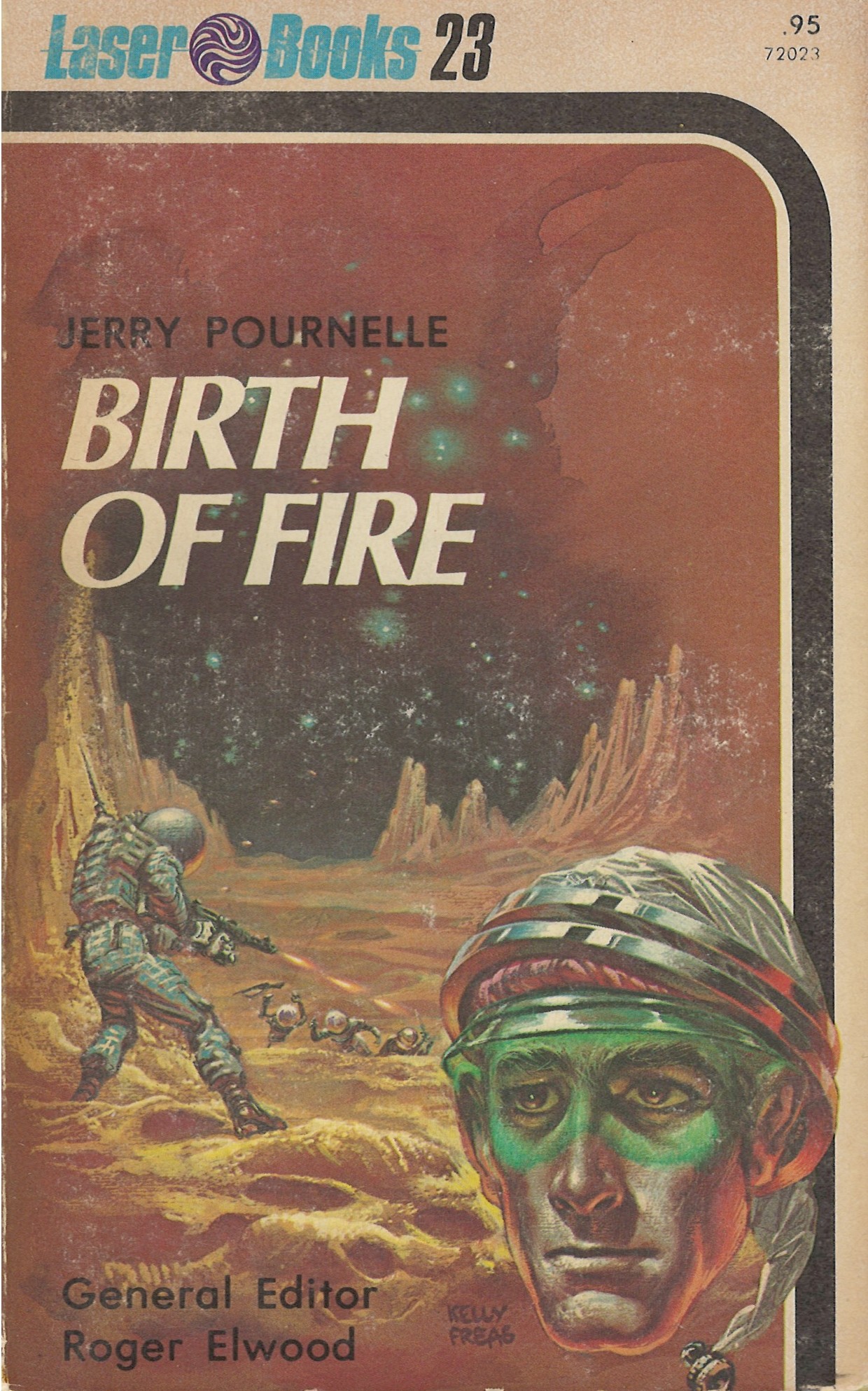
Cover

You could not be more Golden Age if you tried!
This cover could’ve been lifted off of any issue of Astounding, Amazing, or the Magazine of Fantasy & Science Fiction. The ruddy orange soil of Mars, the retro-futurist spacesuits, the soaring pinnacles lining the valley, the flash of laser fire… it’s enough to make a man feel downright idiotic–I mean patriotic!
I think I hear “Fortunate Son” playing.
I mean, they’ve literally got Garrett Pittson, our protagonist, done up in a tinfoil doo-rag and green face paint like he’s boutta commit casual war crimes against some space Vietnamese.
If you’re having a hard time parsing my sarcasm, let me speak plainly: I think this cover is great–if it were made in the 1930s or ’40s. But in 1976, with the terminus of the Vietnam War barely a year in the rear window, I have to ask myself… who is this for? I don’t think anyone asked for a callback to the longest war in US history (till it was supplanted by Afghanistan), especially when it left such deep cultural scars that, to this day, have not fully healed.
I’m not sure what else Kelly could’ve done. The book covers a guerrilla war set on Mars; Kelly depicted a guerrilla fighter. But if I was the parent of a child who died in Vietnam, I can’t imagine this imagery would make me buy the book.
Still, it knows what it wants to be and does it well. I can’t fault Kelly for that.
Blurb

Life imprisonment on Earth or transportation to Mars? Convicted of first-degree murder, Garrett Pittson chooses Mars–a colonized world strictly controlled by Earth and the giant mining corporations. But Garrett is not doomed to slavery in the mines. Tough men like him are needed on Mars–to fight for freedom in the outlawed Free Mars Army. With the beautiful Erica at his side, Garrett embarks on a deadly mission to prove that a free Mars has the power to survive and that he is a true Marsman.
Bakka strikes again, baby!

Okay, this blurb actually gets me excited, but not, perhaps, for reasons of plot or character.
The billionaires of Silicon Valley like Elon Musk dream of a day when humans build a colony on Mars. I ask myself… “Who is doing the building?” Because, of course there’s going to be some percentage of people who want to be there, but historically, colonization efforts always needed more bodies than were willing to transplant themselves to the new territory.
So the powers-that-be sent criminals and slaves to puff up the workforce.
America has a flourishing prison-industrial complex today, but how overcrowded will that system become if poverty continues to rise over the next century? All those bodies, all those muscles… what happens when the billionaires tell the state, “Hey, we can make your overcrowding problem go away. Just help us fund our reusable rockets, tweak the sentencing protocols for criminals, and we’ll move all these able bodies to Mars to help us build our colonies.”
And because minorities are always the first to feel the effects of poverty, they are also the first to suffer increased crime, and therefore the first to be sentenced. The faces who build the first Martian colony will be black, brown, red, and yellow, but seldom, if ever, white.
I fear the day when Starships become slaveships.
Jerry Pournelle obviously didn’t have SpaceX and Elon Musk on his mind when he wrote this book; he was just writing about America. This is how his country was built, as a colony of England. It is how many countries have been built. It is how countries yet-unborn will be built, long into the future, if humanity does not win out over inhumanity.
Birth of Fire is not science fiction, it is history, playing itself out in the same way it always does.
Story

We hold these truths to be self-evident, that all Laser Books are created equal, that they are endowed by their Editor with certain unalienable Traits, that among these are a Male Protagonist, a Cover by Kelly Freas, and a wordcount of 50,000 or so.
Birth of Fire is a good, engaging story, but it is incomplete.
Forced to come in under the word count, it only has time to cover the basic plot and nothing else. Garrett joins the Free Mars Army because his home is destroyed and his mentor arrested by Earth marines, and there is some discussion with his neighbours about their motivations for rebellion and why they’re against Earth, but there is no deep dissection of the individual motivations which drive a person to take up arms in pursuit of independence.
Consider this: 1 out of 4 people were Tories (British loyalists) during the American War of Independence. That is a significant number of people who believed that fighting against the King was wrong.
Or how about this: Lord Dunmore, a general of the British Army, made a proclamation outlawing slavery in America–not because the Brits believed in human rights, but because, by crippling the slave trade, the Brits would be crippling America’s economic and therefore military power. And this proclamation dramatically increased support for independence (and, by extension, slavery).

Or even this: one of the greatest attrition factors in George Washington’s army was the departure of soldiers at the end of their contracts because the army couldn’t pay them past that point, indicating a great number of them weren’t so ideologically committed to independence that they would fight without being paid.
In any war like this, an individual’s motivations for fighting are deeply personal and rarely simple. Pournelle touches on this when he says that even though crimes are being committed by Earth marines against Marsmen, most of Mars is unwilling to rise up for fear that rebellion is a lost cause.
One of the more realistic aspects of the novel was the plot point where Earth and the other Martians only begin to take the Free Mars Army seriously because Garrett helps the army acquire nuclear weapons.
Would You Like to Know More?

While I dislike all weaponry, and have a particular distaste for the hydrogen bomb, I am not so naive as to believe that a nation can be at peace without it.
One of the worst mistakes Ukraine ever made was surrendering its arsenal of nuclear weapons after the dissolution of the Soviet Union. That act is what allowed modern Russia to invade them. I do not believe they will know peace until they gain the capability to build their own nukes.
The simple fact is, in the modern world, there are Haves and Have-Nots: nations who have a nuclear arsenal, and those who have not. And bad actors who have nuclear weapons–like Russia, like Israel–have licence to attack any nation that does not. The world cannot intervene for fear those weapons will be turned upon the intervening countries.
So you wind up with situations where bullies like Russia, like Israel, can invade non-nuclear countries with impunity, commit genocide, and the world cannot put a stop to it.
If a nation craves the chance to determine its own destiny, the first thing they have to do is create the infrastructure and delivery systems for nuclear warheads. If they don’t have that, then when push comes to shove, they will have nothing. Props to Jerry Pournelle for understanding that and putting it in the book.
The other interesting plot note is that there is a disconnect between the Marsmen who work the land and the scientists studying Mars from the University. The Marsmen (quite sensibly) want to terraform Mars into a world like Earth. Trouble is, this will start a water cycle which will erase most surface chemistry on the planet, making the study of ice, geology, and potential fossilized life impossible.
One female scientist, Eileen (with whom Garrett has an affair after he’s promised to Erica), almost sabotages the resistance, despite the fact she herself is Martian-born. Her reasoning is that if the Marsmen win, all her people’s scientific progress will be unraveled. She cares only for science, not politics or the freedom of Mars. So long as she and her cohorts can study the planet, she’s happy.
There’s such a rich potential discussion here about the collision and conflict of grassroots movements and intelligentsia, and how each comes to mistrust and mistreat the other, but since this is a Laser Book, we never get that kind of depth.
My Goodreads Review
This book is a strong 3 out of 5, and would be rated much higher if it were allowed to be longer and have the sort of depth and nuance I’d expect from an 80,000 word novel, rather than a 50,000 word one. Jerry Pournelle does the best with the space he’s given.
Quite gripping all the same, but I’m certain there are sci-fi books out there which deliver on all the nuance and character study that’s absent from this book. I encourage you to comment below if you know of any; I’d like to read them.
But first, I got another 35 Laser Books to get through, and on deck we have…
Who’s Next?

Ruler of the World, by J.T. McIntosh! My goodness, that’s a lotta pink. What’s the blurb say?
Blurb
Earth, four centuries from today, is in dire peril. A half-empty world, it is slowly destroying itself. The Terrans are drab and obedient. Instant exile is the penalty for non-conformity. Interplanetary visitors are restricted to reservations where they cannot meet native Terrans or threaten their self-imposed isolation. But Burrell succeeds in breaking through. He is a rough, tough spaceman with a flair for stirring up trouble. And he is determined to shake the world of his ancestors out of its apathy.
From Earth to Mars and back again. Let’s hope the grass is greener there.
Till next time!
Leave a Reply