Tag: Book Review

  • Laser Books Review 21

    Laser Books Review 21

    21. A Law for the Stars by John Morressy

    I’m often asked, especially after installments like our last entry from Juanita Coulson, “James, why do you continue to torment yourself reading what is largely a very mediocre series of science fiction books?” And my answer is always the same.

    “For the memes, of course.”

    But memes aside… as I’ve repeated ad nauseam, there are gems among these books; stories which, despite their Golden Age-revival trappings, truly do speak to the world we live. I would endure all the shit books again if it meant I still got to read Serving in Time, Invasion, Birthright, and Unto the Last Generation. Some of these stories have inspired me, some have made me think, and some have changed my approach to writing science fiction.

    And now, with the Blackjack(et) of the Laser Books, I’m delighted to say we have yet another winner.

    John Morressy’s bio, courtesy of Roger Elwood and the Laser Books.

    John Morressy was born in Brooklyn, N.Y., in 1930. He published his first story in 1952, and has been writing ever since: novels, novellas, juvenile literature, stories, essays, fables, poetry, verse and reviews.

    A Law for the Stars is his first LASER BOOK but it is the ninth book he has had published. Of these, six have been science fiction novels. He plans to write a good many more, for he finds that science fiction is a pleasure to write and it offers him the chance to work with themes that don’t fit easily into works with a contemporary setting.

    If there is a single theme running through all his work, he hopes it is the belief that the world would be a more pleasant place if we could accept the fact that killing each other is not an effective way of solving our problems.

    I love the term “juvenile literature”. I think I’ll use that to describe my work more often.

    And I fully agree: science fiction is a pleasure to write because it offers possibilities not constrained by the reality we live in, thereby allowing us to examine reality from the outside, objectively and without dogma to hold us in check.

    (This is me foreshadowing the content of this review.)

    I have to say that I was not encouraged by the wording of the theme of his work. There’s a rule they teach you in creative writing school (one of the few lessons I actually agree with): don’t choose simple, childish themes that are obvious to everybody. That third paragraph felt like a warning.

    But I immediately overlooked it in light of what I saw on the title page.

    Whoooo! Ladies and germs, we have a new first in the Laser Books: a surprise signed copy!!!

    *Blows party horn*

    This might be one of the few signed copies of the Laser Books signed by the original author. I can’t imagine these novels (or their authors, I’m sorry to say) were popular enough to warrant many signatures.

    I might be the only man on Earth who has a signed copy of this exact book… That’s a scary thought. This might put a target on my back.

    And for the authors who did make it big, they have other works far more popular than whatever they turned in to the Laser Books that are deserving of signatures. For example, if I’m going to get a book signed by Tim Powers, am I going to take The Skies Discrowned (later published as Forsake the Sky), or am I going to take a chart-topper like The Anubis Gates, or Last Call, or On Stranger Tides, or The Stress of Her Regard?

    Um… actually… maybe not The Stress of Her Regard. The ghost of Mary Shelley would probably cut my balls off.

    Would You Like to Know More?

    I first discovered Tim Powers through the Treasure Chest which contained the other Laser Books. I plan to do a post about them once I finish reading the last of the titles which were included.

    I think we’ve dallied enough, let’s get this review started.


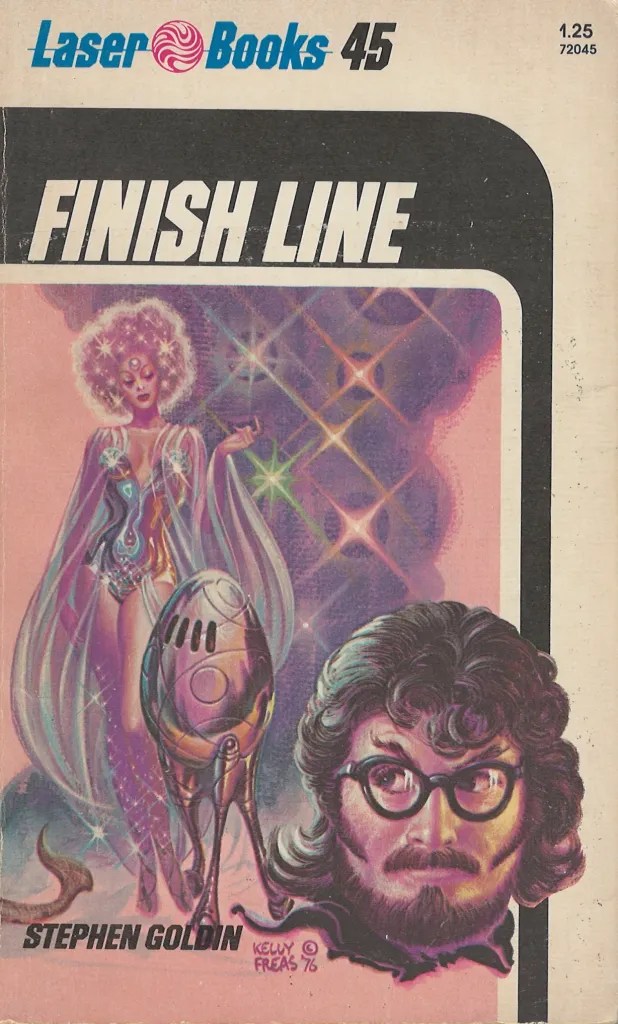
    Cover

    I really love this cover. It really brings a wave of nostalgia.

    Growing up with the late 90s, early 2000s Star Wars games, I got to see a lot of really cool science fiction character designs. Some of my favourites were actually the characters who were not human, but shared a lot of the same models and textures. Maybe they were coloured blue, or pink, or green, but other than that, they weren’t very “alien” looking.

    I think that’s what I liked about them: they were mostly recognizable as people, but there was just one or two odd things about them.

    I’m getting those same vibes here.

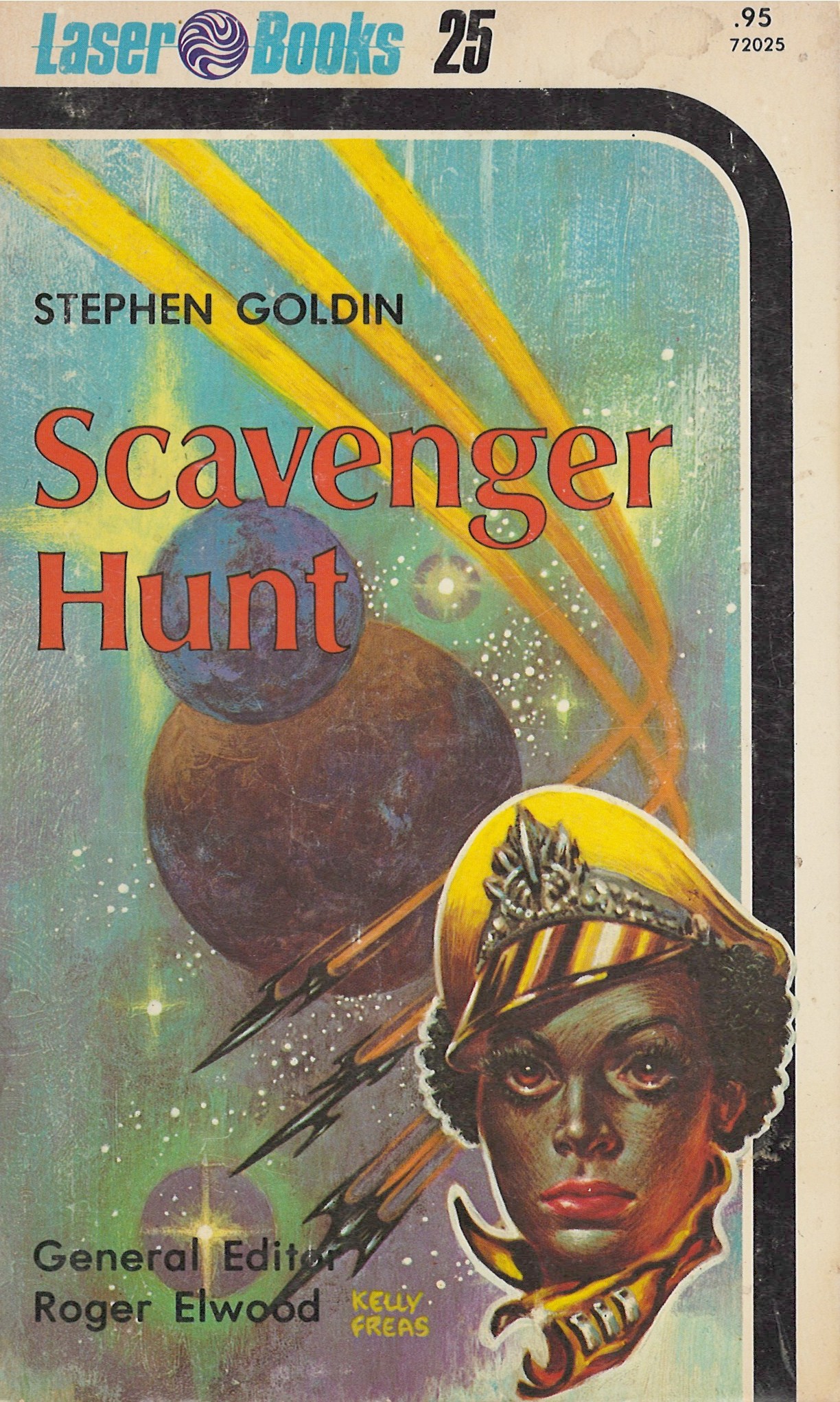
    I believe the man in the portrait is Thone, one of two characters who take our protagonist Ryne into the Sternverein Security forces. He’s got so much character in his face! The blue-black skin, the smirk, the world-weary eyes, the red ascot–you can tell this guy has been places. He could be a cherished uncle or brother.

    His cheerfulness is undercut by the shadowy figure behind him. This might actually be our protagonist, Ryne, but he’s not wearing any medals or commendations that I can see (an important aspect of adult Ryne’s character), and he looks a bit like Thone’s race, so it might not be him. Either way, it’s one of Kelly Freas‘s best character designs in my opinion.

    In the background, you’ve got a Sternverein driveship, and a collection of worlds which could be all the major locations in the novel, or simply one planetary system with two moons. Kelly arranges all these spacey elements vertically and backlights them with a river of stars to fill the negative space.

    This might be one of my favourite covers because, rather than simply capturing characters or moments from the story, it captures the essence of the story: a front of good cheer with the spectre of violence looming large in the background.

    Looking at this cover, I feel like I’m being made an offer I can’t refuse.

    This is why Kelly is a master of SFF covers: when he’s at his best, he pulls you into the story before you’ve read a single word.

    Would You Like to Know More?

    Oh! Before I forget… On the subject of signed Laser Books, I met a geezer at The Only Cafe a few months ago who actually had the entire Laser Books collection… signed by Kelly Freas.

    Jealous-making!

    But he also told me about a really incredible piece of animation that I’d like to share with you all, simply because there hasn’t been a better place to do it before now. If you watch Corridor Crew, you might be familiar with this guy. His name is Mike Jittlov, and his creation is “The Wizard of Speed and Time”.

    Feast your eyes.

    Let’s get onto the Blurb.


    Blurb

    The Sternverein polices the universe. Criminals dread it; law-abiding citizens esteem it; all respect it. Ryne, an orphan from the planet Jadjeel, worships it. The organization rescued him from slavery and trained him to be a man among men, an elite Blackjacket. It gave his life purpose and direction, excitement and adventure. But it is totally corrupt, as Ryne learns in the shattering episode that brings to a climax John Morressey’s sweeping odyssey, A Law for the Stars.

    A great blurb! Marketing Guy, you aren’t doing too badly these days.

    Stories of corrupt institutions have been popular for a long time, but especially now, as late-stage capitalism is deconstructed by intellectuals and artists.

    But I have a particular fondness for stories of soul-searching in law enforcement (more on this later). Indeed, in most of the novels I’ve written, there is often a grey-haired mercenary, cop, or soldier who comes to a crisis which forces him to reexamine the system of power he serves. Sometimes that examination costs him his life, and sometimes he manages to redeem the institution to which he belongs.

    We’ve had stories and blurbs many-a-time in the Laser Books of characters realizing they’re living under a dystopian society, so I wasn’t expecting much from Morressy. I was thinking this would be another run through Detroit.

    I was wrong.

    Buckle yer fuckles, boys and girls, this review is gonna be as sprawling as the Sternverein itself–but hopefully, more self-aware.


    Story

    Qiānggǎnzi lǐmiàn chū zhèngquán.

    Political power grows out of the barrel of a gun.

    — Mao Zedong

    How does law enforcement gain the trust of people? A Law for the Stars posits that one of the most lasting and effective ways is a demonstration of force right at the time and place the people are victimized the most.

    That’s how it goes for our protagonist, Ryne.

    On his planet Jadjeel, the citizens have forgotten that they once came from another planet called Earth, so they’re quite shocked when one day, visitors from the stars arrive, give weapons to a rival clan, and march together on the cities, killing and pillaging as they go. Ryne’s parents are killed and he finds himself alone on the streets of a city now ruled by bandit lords.

    In his quest to survive, Ryne accidentally kills an otherworlder who was trying to rob him. This scene is handled with such simple cruelty: when Ryne tries to stop the thief, the thief slaps him and goes back to rummaging through Ryne’s pack, as if Ryne is expected to know his place. It really gets your blood up, and you’re quite happy when Ryne greases the schmuck.

    Afterwards, fearing he’ll be made into an example, Ryne flees and falls in with two other otherworlders: a blind seer named Thone and his companion Varyssa. They take Ryne in, ostensibly because he has nowhere else to go, and Thone uses his “talents” to worm his way into the court of the Overlord, a star-borne renegade on the run from men and women called “blackjackets”.

    That night, Thone and Varyssa murder the Overlord and his cohorts in their sleep, and reveal themselves to be members of the Sternverein–the blackjackets the Overlord feared.

    But who are the Sternverein?


    Bad Men with Badges

    Sternverein Security is the military arm of an interstellar trading empire.

    After humanity expanded to the stars, human beings diversified into many phenomes, and that’s before alien civilizations were thrown into the mix. The nature of FTL in this universe mandates that only small arms can be carried aboard interstellar starships. If you try to go superluminal whilst carrying, say, a particle cannon or nuke, the FTL field collapses and the ship explodes.

    With no direct link to Earth, no central government to keep order, and only small weapons being available, a class of pirates, bandits, and warlords took power over multiple systems, preying on those who couldn’t defend themselves.

    In order to protect commercial vessels plying the shipping lanes, an alliance of merchants created a force of armed traders who eventually became the Sternverein Security forces.

    Officially, its role is to police the stars, hunting down pirates and despots, and keeping merchants safe.

    Unofficially, the Sternverein engages in the assassination and genocide of anyone it deems undesirable, and it has a hierarchical system that prizes racial purity. (They have a numerical scale for how close a person is to “Earth basic” genetically.)

    The only difference between a police force and a gang is a badge. So long as the state has the monopoly on force, it can–and often does–allow its peacekeepers to get away with murder.

    There are many historical precedents for the Sternverein: ICE, the Presidency Armies of the East India Company, and the Gun Trace Task Force of Baltimore, but the comparison I believe is most apt for the Sternverein is Spain’s guarda costa (“coast guard”) which operated in the Caribbean throughout the Golden Age of Piracy.

    In the late 17th and early 18th centuries, Spain had a real problem with piracy. Anybody with a canoe and a gun could, and often did, raid Spanish possessions. It didn’t help that rival powers, jealous of Spain’s wealth, gave permission for their own captains, whether military or commercial, to plunder Spanish holdings at gunpoint.

    Spain’s Navy didn’t have the numbers to protect its assets, so it began issuing letters of marque and reprisal to captains of armed traders, empowering them to search and seize any vessels heading into or out of the Caribbean. With these licenses in hand, the guarda costa proceeded to conduct a campaign of terror against pirates and honest merchants alike. They would torture, rape, and kill whomever they wished, and even if you somehow escaped with your life, chances are good they’d still rob you of your cargo, fence it, and burn your ship.

    The guarda costa were pirates, but pirates armed with badges and licences as well as guns and sabres, so they were considered legitimate, at least by their own government.

    The Sternverein’s modus operandi is explained early in the novel:

    “Remember, our primary mission is execution. We fight only if we must. This is not a tournament–we’re going after outlaws condemned by the Court of Mercy. If you can kill them in their sleep, do it. If you can kill them when they’re unarmed or after they’ve surrendered, do it. Kill them and everyone who sides with them, including women and children. You won’t be killing humans, you’ll be ridding the stars of an infection. You’ll be helping to build a future that promises safety and security for people who have no other protection but our strength. This is what you trained for. Do it right and you’ll stay alive and all the civilized worlds will benefit. You’re the deadliest weapon in the galaxy–a Sternverein Security trooper. Be a good one. That’s all, Ryne. You’re dismissed.”

    — Pg. 54-55

    I can easily imagine such lessons were given to the Sturmabteilung and Hitler Youth regarding the Jews, or to the Israeli Defence Forces regarding the Palestinians.

    And one page later:

    The simplest, most basic weapon of all was the trained professional warrior.

    — Pg. 56

    That is true.

    What’s also true is that for most of history, those trained professional warriors maintained their status through the brutal subjugation of anyone who threatened their power. Thus it is with the Sternverein.


    Ryne

    Having seen the efficacy of the Sternverein, and been promised the chance to join them, Ryne becomes one of the most zealous and effective troopers the organization has ever known.

    The reason this book is such a treat to read is because, as the reader, we know how fucked up the Sternverein is from the word “go”, but it’s so interesting to see Ryne fall in love with them because we’ve seen what happened to his family. He has legitimate reasons for wanting to be in law enforcement: they killed his family’s murderers and gave him shelter when no one else would.

    As a middle class white boy with a suburban upbringing, my parents drilled one lesson into me over and over again: “No matter what happens to us, you can always trust the police.” And for me, that was true; being straight, white, and male pretty much guaranteed the police would be on my side for life. I grew up a rule-follower, with a healthy respect–even reverence–for authority.

    It wasn’t until I dated my first partner in college, a black woman, that I realized what held true for me didn’t hold true for everyone.

    She had a problem with a stalker and I repeatedly urged her to talk to the police. To which her constant refrain was, “I don’t trust the police, and they don’t trust me.” I never got it through my head that for her, the police weren’t necessarily friends, and it was purely down to the colour of her skin.

    I would like to say that I know better now, but the truth is I still view law enforcement with rose-tinted glasses. In the past, I’ve gone out of my way to give witness statements to the cops on car accidents and assault cases.

    I cannot imagine I would ever lie to a police officer.

    That trust is magnified a thousandfold in Ryne, and cemented by the use of drugs. The Sternverein keeps all of its officers on Nolo while in service, a drug which suppresses emotion and sex drive and quietens conscience. It makes troopers more effective killers.

    Troopers are always given the chance to come off Nolo during their R&R, but over time, many simply choose to remain on the drug permanently. These men and women are not machines; on some level, they know that what they’re doing is wrong.

    But as long as they don’t have to feel their guilt, they can get on with the job.

    Ryne comes off Nolo for the first time and instantly begins to regret the lives he’s taken. He confesses this to his romantic partner Keela, who consoles him with these words:

    She placed her hands on his shoulders and looked at him intently. “Ryne, you’ve been talking about killing. But you’re a blackjacket. You don’t kill. You’ve never killed anyone yet, and you never will. Your purpose is to locate and eliminate dysfunctional components, and you do it superbly well. You’re a good man, Ryne–you know your purpose and you fulfill it. That’s why I love you so much.”

    — Pg. 98

    Dehumanization is a necessary first step in genocide.

    Ryne earns the Order of Leddendorf, the highest commendation of the Sternverein, for his actions on a mission gone bad. He is often cited as the most proficient soldier in the organization, and is given increasingly higher levels of trust.

    But predictably, it all comes crashing down.


    The Endgame

    The goal of the Sternverein is to cleanse the stars of pirates, renegades, and bandits–to Make the Galaxy Safe Again.

    And for the most part… they succeed.

    But as the last pirate strongholds are purged and the grizzled old Sternverein troopers retire, a new class of asshole takes power. These pencil pushers haven’t the guts to undertake dangerous missions and would prefer to just glass troublesome worlds from orbit. They draw even less distinction between rebel worlds and worlds that simply want to be left in peace than the Security forces do.

    And they are learning to build uncrewed bombships to that purpose.

    John Morressy pulls such a clever bait and switch on the reader. He convinces you that Ryne and his ilk are the worst thing in the universe, and then shows you that there’s still further for humanity to sink. Ryne, for all his faults, still has a code he adheres to, as twisted as it may be.

    The people rising to power in the Sternverein now have no code at all, save greed.

    And we come at last to the climax of the book. During a routine diplomatic mission to a supposedly primitive world, Mog Korb, Ryne partakes of a hunting ritual where he eats the heart of a wild animal. The Sternverein have explicit rules against eating local food, ostensibly because it might carry diseases for which they don’t have cures, but if you know a little about human biology, you might have guessed the real reason for this taboo.

    Ingesting food stimulates the body’s metabolism, speeding up the breakdown of molecules in the bloodstream… including drugs.

    Drugs like Nolo.

    That animal heart carries enzymes which breaks down the Nolo in Ryne’s body, causing him to experience heightened emotion for the first time in years.

    Ryne had never lost his curiosity about the great variety of human life forms found among the stars. As a boy in Jadjeel, he had seen all otherworlders as brutal enemies until he met the ones who saved his life and freed his world. An Agyari and a Mallelan were his first heroes; Seadhal the Thorumbian was the finest trooper he had ever known. Since his first space duty, most of his friends had been part of the Old Earth blood, it was true. That breed was predominant on nemesis runs. And the nature of his duties brought him in contact with only the worst of every galactic race. But despite all the experiences that might have led him to see every alien as a deadly enemy, the force of those early impressions was great. It had created a lifelong interest in alien races and cultures, an interest Ryne had pursued even when his superiors gave him no encouragement. Now he was grateful for the long discipline.

    — Pg. 135

    Free of Nolo, Ryne begins to empathize with the Korbians. He tells them about his experience with Nolo, and why troopers are forced to take it.

    Milam looked at him as if seeing someone new and fearsome. “You make yourselves less than men, less than women. You are not human!”

    “We sacrifice something, for a time, in order to gain the discipline that keeps us alive. Our discipline has made us the greatest power in the galaxy, and we’ve used that power for the good of all human races,” Ryne said.

    “This is not discipline, Ryne,” Milam said vehemently. “Discipline comes from within. It is freely chosen. You are slaves.”

    — Pg. 160

    But it’s more succinctly stated twenty-two pages later:

    The Sternverein, for all its proud boasts and imperial dreams, seemed to fear normal humans reacting in a normal way.

    — Pg. 182

    When Ryne discovers that a shadow mission has been deployed to Mog Korb–forty-four blackjackets sent to train a rival tribe in offworld firearms–he realizes that he was wrong about this organization which saved his life and took him in.

    This is Jadjeel all over again, only this time, it’s being perpetrated by his found family.

    Turns out the galaxy is getting sick of the Sternverein. Some worlds are banding together to form their own defence league against the blackjackets. There are also signs the Sternverein is about to collapse: the reason they’re interested in Mog Korb is because the planet is abundant with a critical element used in the construction of faster-than-light driveships. The ships used by the Sternverein are on their last legs, and once they break down, the blackjackets will have no vessels capable of carrying them across the stars.

    Moreover, the new leadership’s gambit of building bombships can only work with an influx of the element. Without that, the plan falls apart.

    Ryne’s actions on Mog Korb might have saved the galaxy from several generations of tyranny.

    I would like to close this portion of the review with a short piece of dialogue from Battlestar Galactica. It comes shortly after humanity finds itself on the run from the Cylons. President Roslin asks Commander Adama for his forces’ help in keeping order amongst the refugees.


    Conclusions and Recommendations

    The brilliance of this novel is not that it says anything new; rather, it shows us how a person can become indoctrinated into trusting a system of authority with their whole heart, and the extreme measures that must be taken to deprogram that person.

    Ryne is a simple character, but the truth is, there are millions of people like him around the world: people whose lives were saved by a powerful entity, and who now put their faith in that entity. It’s so easy to become enamoured with authority when authority exercises force in your defence. What is obvious to the reader is not obvious at all to Ryne, but Morressy’s strength is that he helps you understand where Ryne is coming from.

    Flawed as he is, misguided as he is, Ryne’s story could be mine.

    My Goodreads Review

    An insightful deconstruction of law enforcement, order, and justice, this novel is also a cautionary tale about putting one’s faith in systems of authority. It’s a reminder that, as dangerous as the world is, and no matter how badly people have hurt you, nothing should convince you to trade your freedom–or humanity–for security. I can easily recommend this novel, which is as relevant in 2026 as it was in 1976.

    This book was a joy to read, pure and simple, and it belongs on a shelf with the other Laser Books that actually say something about the world we live in. Easy 4 out of 5. Perhaps even a 4.5. It is at least on the level of Serving in Time, in case the length of this review wasn’t a clue.

    Sadly, we must now bid adieu to John Morressy for a very long time. We will not read his work again until Laser Book 52. The Extraterritorial. For now, we must turn our attention our next title, which represents only our third entry by a female author in this series.


    Who’s Next?

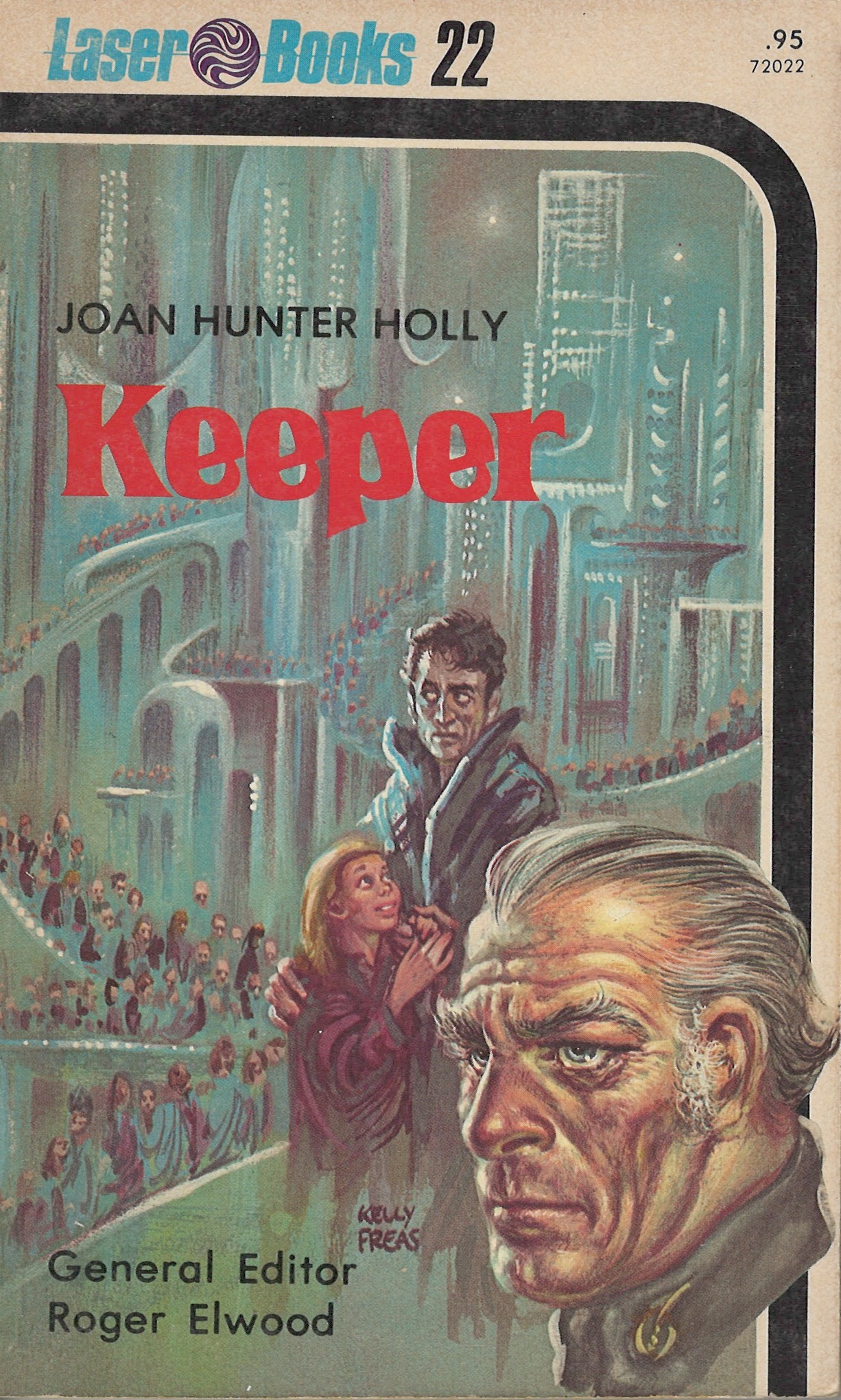
    Ooh, nice cover! Blurb me up.

    Blurb

    In this world of tomorrow is neither hatred nor love. Normal human sentiment is punishable by death! Dreams of happiness, human warmth and joy have given way to indifference. Man has been programmed not to feel. It is a chilling world in which there is no feeling at all, save fear…fear of any human emotion! This is the world in which Frederick Dainig must live. He told himself he couldn’t help it, but he knew better than to let himself care about the little child of whom he is the Keeper.

    Wait a sec…

    … is this Equilibrium?!

    Shiiiiiit it’s been ages since I practiced my gun kata!

  • Laser Books Review 20

    Laser Books Review 20

    20. Space Trap by Juanita Coulson

    Whoa, 20 came around real fast.

    Juanita Coulson, the author of Laser Book 11. Unto the Last Generation, brings us a tale of exploration gone awry on a far off planet. Yes folks, this is the third shipwreck story we’ve seen on the Laser Books.

    But, if you’ll recall my review for Last Generation, you’ll remember I had some glowing words for that book, in particular for Juanita’s perspicacious depiction of reproductive immune disorders. That was a 4 out of 5 book.

    So I’m going into Space Trap with high hopes that she’ll do something very interesting.

    First, some housekeeping.

    As of the previous book, 19. The Unknown Shore (review here), Roger Elwood began including biographies of the Laser Books authors. This is a godsend. As you’ve no doubt realized, most of the authors of these books were not very prolific, so they never got enough attention to warrant the writing of extensive bios in magazines and periodicals. And if the authors died before rounding the bend into 2000 A.D., they likely never began the process of creating digital personas and records of their lives.

    This means I have to go down a research rabbit hole for each and every one of these writers, but now, mercifully, I have a trailhead in the form of the Elwood bios, and I’ll include them in every review. For the sake of consistency, I’ll add Juanita’s here, even though I already covered her in my Last Generation review.

    ABOUT THE AUTHOR

    Juanita Coulson has been involved in the science fiction field most of her life. With her husband Robert, she edits and publishes the Hugo award winning fanzine, Yandro. Her first story, a collaboration with Marion Zimmer Bradley, was “Another Rib.” In addition to numerous short stories, she has the following science fiction novels to her credit: Crisis on Cheiron, The Singing Stones, Star Sister, The Gates of Eden, War Wizards. She has also written three gothic romances.

    The Coulsons, and their son Bruce, attend numerous science fiction conventions: they were Fan Guests of Honor at the 1972 World SF Convention in Los Angeles. and the 1975 Deep South Con in Louisville, Kentucky.

    Juanita Coulson also wrote Unto the Last Generation, LASER BOOK No. 11

    See? Isn’t that so much more elegant than my digital bumbling?

    Anyway, let’s get stuck in.

    *Deep breath*

    KELLY!


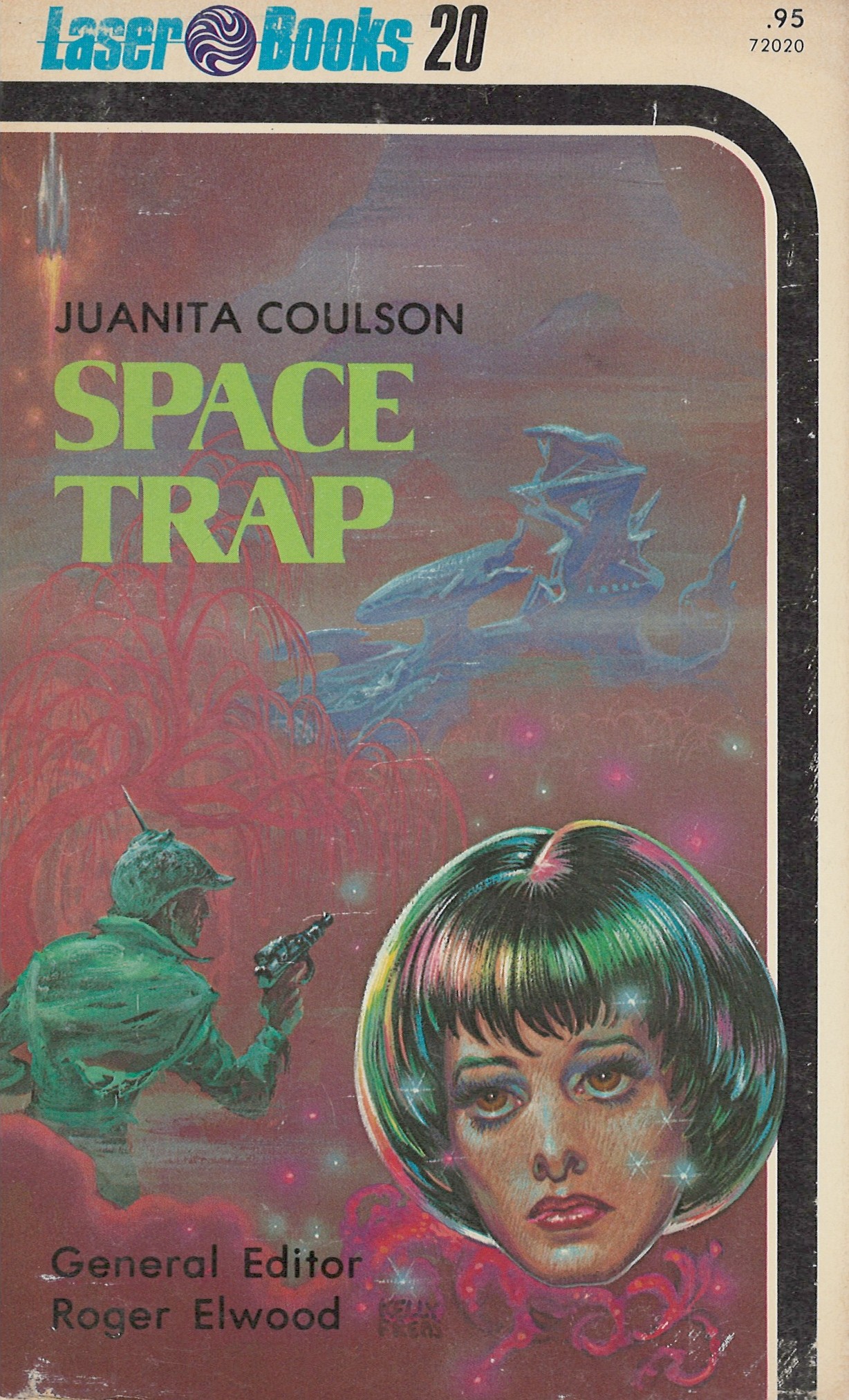
    Cover

    This is a bit better than The Unknown Shore. Kelly has really captured the surrealistic, dreamy quality of the planet NE 592. In fact, this might actually be a scene from early in the novel where R.C. and Ken are shown a vision of an Earthling murdering one of the M’Nae people. The Earthling is presented as a faceless, wraithlike image in the M’Nae’s telepathic imagery of the event. The giant crash of Noland’s Class-D spaceship in the background and the Survey Ship burning her engines as she falls planetward are all correct as well.

    The blood-coloured trees, sparkles, and Thayenta’s rainbow hair really elevate the dream-like quality of this cover. The whole thing feels like a memory plucked from an alien mind: subjective and colourful.

    That said, this still isn’t quite on par with Kelly’s best work, like The Black Roads or Invasion. The composition and staging of the elements is a little off. It feels like we’re looking at a stage play from the wings instead of the front row seats. It’s a little… off. Maybe you guys know what I mean.

    Anyway, lettuce move onto the blurb.


    Blurb

    Planet NE 592 wasn’t due for Secondary Survey for another ten years. So why, Ken wondered, were they heading there now? Then on his screen he saw the disembodied face of a girl with jewel-like skin and felt, rather than heard, her plea: “Go Back.” But they couldn’t go back. Against their will, they were drawn to a crash landing on NE 592. They were trapped–with no means of escape. And NE 592 was not the uninhabited planet they had been led to believe it was!

    As I said in my review of The Unknown Shore, I love nautical tales of shipwreck and marooning, and I love them even more when they’re set against the backdrop of the Universe.

    Would You Like to Know More?

    I was on vacation with L. in New Brunswick this past week whilst reading Space Trap, and we listened to a podcast episode which covered the sinking of the whaling ship Essex. This is the tale which inspired Herman Melville to write Moby-Dick.

    In brief, the Essex was an American whaler which was rammed and sunk by a sperm whale on November 20, 1820 in the South Pacific. Of a crew of 20, only 8 survived, some by making landfall on a Pacific island, and others by resorting to cannibalism. Melville later sought out the survivors and used their accounts as background to the writing of Moby-Dick.

    The story of the Essex matters because it is part of a growing body of evidence which proves the intelligence and sentience of whales. As whaling activity increased throughout the 19th century, a pattern of behaviour emerged among whales that is referenced in Moby-Dick: when whaling ships bore down on pods of whales in mating season, the males would signal the females to flee, and then they would turn and attack the whaling ships, usually losing their lives in the process, but sometimes taking a whaling ship with them to the deep. These attacks increased in frequency as more and more whalers invaded the sperms’ mating grounds.

    In short, the whales learned how to defend themselves, their mates, and their offspring.

    The importance of whales as a keystone species was only understood later with the discovery of the Whale Pump. The wanton destruction of these animals represents one of the greatest mistakes in the catalogue of human affairs on this planet–a mistake which we continue to perpetuate in the modern world.

    There’s a Gordon Lightfoot song which speaks to the tragedy of humanity’s actions: “Ode to Big Blue”.

    Knowing Juanita, she’ll probably make of this tale a deft study of colonialism and invading peoples. I’m actually excited! Let’s open this thing up and see what we got!


    Story

    Remember how excited I was to dive into Gordon Eklund‘s Falling Toward Forever after reading the incomparable Serving in Time? Remember how disappointed I became after seeing the travesty that Forever turned out to be? Remember how I said in my last review I shouldn’t get my hopes up just because an author turned in a great story once in the Laser Books?

    I never listen to myself. I know I should, but I’m ever the optimist.

    I was sitting with my girlfriend on the sofa in her parents’ house at ten-o’-clock. I finished the last page of Space Trap and let the book fall from my hands. L. looked up at me, laughed, and said, “You look so unimpressed.”

    I held up the book and replied, “Well, this was pointless.”

    And it was.

    My God, Juanita, what kind of month were you having when you wrote this?

    To outline in brief, our protagonist Ken…

    just Ken

    … crash lands with his captain, R.C. Zachary, on NE 592, and discovers that a race of telepaths has already colonized the place. Worse still, a group of regressive humans led by Zachary’s old colleague, Noland Eads, have also crashed here and the technophobic zealots have gone and started a shooting war with the telepaths.

    Ken and R.C. are charged with a murder committed by Eads, and it is here that Ken meets Thayenta, a telepathic apprentice, and falls for her scantily clad body and feminine helplessness.

    Look… if you’ve seen any number of Star Trek TOS episodes, you’ve seen this plot. Man falls for helpless alien waif–a “space trap,” if you will–who can barely speak English and immediately feels protective and possessive of her. He tries to make peace between the unenlightened humans and barbaric aliens and teach everyone Peace, Freedom, and the American Way.

    I cannot tell you how tiresome such a plot is, especially in 19-fucking-76 when the SF New Wave was at its peak, redefining the genre and thrashing the Old Boys Club that science fiction used to be. And I am stunned that Juanita Coulson, authoress of Unto the Last Generation, would turn in a story this banal, this pointless, this exhausted after such a wonderful examination of human fertility and the importance of hope in a world in freefall.

    But most shocking of all? How could a woman write a story that so naturally and effortlessly perpetuates the stereotypes her fellow female authors have struggled against for decades?

    In the words of Vannevar Bush, “I apologize if I’ve become stirred, but I am.”


    Conclusions and Recommendations

    My Goodreads Review

    A misogynistic colonizer’s wet dream. This novel is a throwback to the very worst stories produced in science fiction, and I’m shocked and appalled that a woman–let alone the authoress of the endlessly inventive and fiercely intelligent Unto the Last Generation–could pen it.

    I know I’m coming across as very hard on Juanita Coulson, but I’m honestly so baffled and disappointed. She’s shown herself to be a very talented writer, and her choice in subject matter was subtle and clever in Last Generation. So why did she choose to waste her talents on this drivel?

    There’s actually a very simple way to make this plot work, and it’s the same suggestion I made in Seeds of Change.

    Write Thayenta as only pretending to be a speechless, emotionally immature waif. In truth, she’s only feigning loyalty to Ken in a bid to gather intelligence for her people. Once she gets everything she needs, she casts him and the other humans aside and her people throw the humans off-world.

    This way, you could still tell the story from Ken’s POV, but his dreams of being the dashing space hero blow up in his face and his worldview is completely upended by Thayenta’s apparent “betrayal” of him. He realizes how stupid he was to underestimate her and her people, and how dangerous his own species has turned out to be. A real space trap indeed! This would be such a great inversion of expectations, and would be a massive “fuck you” to the imperialist plotlines of the Golden Age.

    Juanita, you missed a golden opportunity. I’m sad this is the last time we get to see you on the Laser Books. I really enjoyed Unto the Last Generation, and it’s been an inspiration for me. But Space Trap is such a waste.


    Who’s Next?

    Okay, let’s shake this one off and see if the next author can wash the bad taste out of our mouths.

    Ooh, hot diggity, I like the looks o’ this! Now, let’s see the blurb?

    Blurb

    The Sternverein polices the universe. Criminals dread it; law-abiding citizens esteem it; all respect it. Ryne an orphan from the tiny planet Jadjeel, worships it. The organization rescued him from slavery and trained him to be a man among men, and elite Blackjacket. It gave his life purpose and direction, excitement and adventure. But it is totally corrupt, as Ryne learns in the shattering episode that brings to a climax John Morressy’s sweeping odyssey, A Law For The Stars.

    Corrupt space cops? Sign me up!

  • Laser Books Review 19

    Laser Books Review 19

    19. The Unknown Shore by Donald Malcolm

    In the early 2010s, I went on a camping trip to Maritime Canada with my brother and father. It was a great trip. We saw whales, slept in the basement of a dilapidated (and possibly haunted) Red Bay schoolhouse, and discovered a rare species of mooseberry cheesecake.

    We also drove the Trans-Labrador Highway.

    In Happy Valley-Goose Bay, there is a map which shows the roads and towns of Labrador in white, and unsettled land in black. When you look at it, you see a ragged white ring around a huge black void. Contemplating that map, the realization slowly dawns on you that this part of Canada is almost totally devoid of civilization.

    And then you squint, and notice a single thread that runs through the middle of that blackness, linking East with West.

    That is the Trans-Labrador Highway, 1100 kilometres long… and at the time we drove it, two-thirds of that distance was unpaved gravel.

    Imagine sitting in a Toyota Sienna, fully laden with camping equipment, bouncing up and down at 50kph for two days, wondering which will eventually triumph: efficient Japanese engineering, or the endless Canadian wilderness.

    Funny thing about Siennas: they’re built for city driving, which means their tires have a safety bolt that can only be unscrewed by a special socket wrench that comes with the car. Did you know that? Well, we didn’t.

    So when we blew a tire halfway down the Trans-Lab, we accidentally sheared that safety bolt off trying to replace the blowout.

    We found ourselves stranded in one of the most sparsely populated regions on Earth, in high blackfly season, with night falling and the nearest help over 400km away. Fortunately, God preserves idiots, and He sent us a road crew who were retiring for the night who promised to bring back an acetylene torch in the morning to burn the safety bolt off our car.

    All we had to do was survive the night.

    We camped in a wet ditch, rain pattering down, water levels rising, surrounded by hungry black bears, our tent humming with swarms of the most relentless blackflies we’d ever seen, just hoping we could survive until daybreak, each of us wondering whether the bears or the bugs would get us first. Three men went into the tent, three came out, bit to shit and trench-footed. I’ll never leave home with a safety bolt on again.

    Anyway… *sips whiskey* … we drove the Trans-Lab.

    And it was almost as bad as the trip depicted in The Unknown Shore.

    The bio for Donald Malcolm (far-right in the picture above) at the front of the book says this:

    Donald Malcolm is a Fellow of the Royal Astronomical Society and a member of the British Interplanetary Society. He began his writing career in 1955 with astronomical and astronautical articles in New Worlds, Nebula, and Astounding and contributions to the Scottish national and local press. He continued to write for New Worlds from 1957 until 1964, stories such as “The Pathfinders,” “The House of Lights” and “Beyond the Reach of Storms.” The latter story was anthologized in a Penguin collection and published in Spain. Mr. Malcolm was one of three British writers put under the microscope by Brian Aldiss in SF Horizons (1965). His stories have also appeared in various anthologies, such as Out of This World and New Writings in SF.

    Mr. Malcolm is married. He and his wife Rita live in Paisley, Scotland, with their two sons.

    The Unknown Shore is his first LASER BOOK.

    So, Malcolm’s bio stands out to me for a number of reasons.

    First of all, he’s Scottish. Being of partial Scottish descent myself, this is delightful. “They may take our lives, but they’ll never take…” and so on and so forth. It shows that Roger Elwood has cast a wider net for his authors than just North America.

    Second, Malcolm seems to have a more traditional career path compared to our other Laser Books authors. If you’ll recall, most of the authors published in Laser Books are noted for two things:

    • They are known as major figures in fan circles, particularly SFF conventions
    • They went on to write mostly tie-in fiction for Star Trek and Wars.

    Malcolm doesn’t have a ton of writing to his name, but certainly a solid body of work. I note that on his Wikipedia page one of his earliest articles was titled “A Tenth Planet?”

    Would You Like to Know More?

    There is no real planet beyond the orbit of Neptune.

    This isn’t a slight against Pluto, which I lovingly used as a setting in my short story, “I Felt a Star Die Today”, I’m just stating a fact. Neptune itself was originally discovered because of calculation errors in Uranus‘s orbit which couldn’t be resolved. Something was clearly tugging on Uranus, exerting gravitational influence on it, and so astronomers went looking for the cause, and found Neptune.

    Later on, the U.S. Naval Observatory reported a similar phenomenon with Neptune, and so astronomers said, “Oh, we’ve done this dance before. Let’s find another planet!”

    But no celestial body was ever found that was big enough to cause these disturbances.

    It was eventually discovered that the gearbox in the telescope at the U.S. Naval Observatory had been taken apart for repairs, and not properly calibrated once reassembled. Once it was, the discrepancy disappeared.

    And yet despite this, the media still stokes the fires of the “Missing Planet” hypothesis.

    With his pedigree as a writer of science fact, I’m curious to see his take on science fiction.

    Alright, Kelly, take it away!

    Cover

    Ach, take it away!

    Seriously, we haven’t seen crap like this since Walls Within Walls. This is really beneath you, man.

    I guess the volcano’s pretty good, and so is the portrait of Rangone, the protagonist, but the drab olive colours and utterly flat background really brings the work down.

    In fact aside from the volcano, the only splash of real colour comes from Ingrid Immelmann’s bra. I can’t say much against her–she’s missing three limbs and still is prettier than I’ll ever be–but my God, Kelly, why’d you dress her up in just a bra? She’s a trained architect and systems engineer for goodness’ sake…

    I might forgive the scantily-clad woman if the overall composition of the cover was better, but everything’s so… bland.

    Ugh, okay, let’s see if Marketing Guy can cleanse my palate.

    Blurb

    Fear swept through the crippled spaceship. The 200 men and women aboard realized they were trapped. To Rangone, chief medical officer, sudden death seemed preferable to the future they faced. Drifting aimlessly in the void outside the galaxy, they were on a journey to nowhere that would last forever! In a tense drama, Donald Malcolm brings to life the hopes and fears, the nobility and the meanness of people under the pressure of The Unknown Shore.

    As stated last time… I really like this blurb. Tales of castaways and ships lost at sea are meat and drink to writers and readers alike, and the delight only increases when these tales are flung into the depths of space.

    Stories of sailors being shipwrecked on unknown shores on Earth don’t always age well: with the benefit of modern archaeology and anthropology, we can see that a lot of these stories boil down to stupid mistakes, ecological damage, and the exploitation of whatever indigenous peoples inhabit that shore.

    But in SF, the rules are different. You can create any adversary, natural or otherwise, for your heroes to face without worrying about rewriting history.

    Unless your intent is to rewrite history, in which case we need to have a very different conversation.

    Would You Like to Know More?

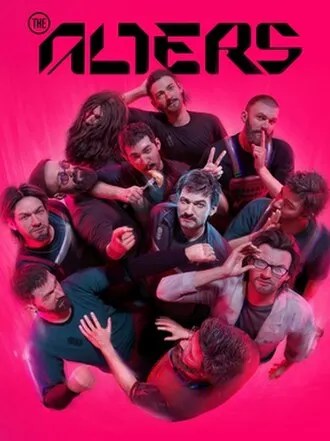
    Two of my favourite spaceborne stories of shipwrecks, in any medium, are Apollo 13 (1995) and The Alters (2025).

    Apollo 13 is a film which tells the true story of the titular moon mission from 1970. Shortly after departing Earth, an explosion crippled the spacecraft and the three astronauts aboard had to use their wits to keep themselves and their ship alive until they could get home.

    The Alters is a video game wherein you play as Jan Dolski, the sole survivor of a crash landing on a planet orbiting a giant killer star. Your one hope of survival–and the survival of humanity–is to create a number of “Alters”, versions of Jan programmed with different life experiences (doctor, scientist, engineer, security guard), work with them, and keep them happy until you all get home.

    Science fiction (and fact) provides the perfect backdrop for all manner of shipwreck adventures.

    Well, not much more to say except… bring on the story!

    Story

    “This is no time for caution.” — Brandt, The Unknown Shore, (1976)

    “Cooper, this is no time for caution.” — CASE, Interstellar (2014)

    What are the odds that two stories about two insterstellar voyages gone wrong, created thirty-eight years apart, would have the same quote in them?

    Either way, gives me an excuse to play this banger while I tell you about the novel.

    Earth is at war with an Enemy we have never once seen in the flesh, but from the opening chapter, I gather we’re not winning.

    Carlo Rangone, our protagonist, is Surgeon-Commander aboard a hospital ship. This excited me because we typically don’t see hospital ships depicted in fiction, despite being an essential wartime service since at least 1670.

    Hospital ships have served multiple purposes throughout history, from carrying casualties away from a theatre of war to resupplying armies with medicine to providing a quarantine environment for plague victims.

    In fact the origin of the word “quarantine” itself is nautical: ships moored off Venetian-ruled Dubrovnik were required to stand off for 40 days, “quaranta giorni“, before docking at the city, to ensure the disease could burn itself out in a closed environment.

    Those of us living in the Post-COVID world are all too familiar with stories of cruise ships being denied landfall because of an outbreak of COVID or Hantavirus, and being required to remain at sea until proper patient intake can be established.

    The Unknown Shore begins with our protagonist overseeing the loading of a hospital ship in an attempt to escape their Enemy. Rangone and his team are faced with a dilemma: the hospital ship only has capacity for 75 people, but there’s 194 on the station they need to evacuate.

    Sam Templeton lays it out for everyone:

    “We have two alternatives. One: a selection can be made and the most seriously wounded left behind…

    “Two: by using laser surgery, Commander Rangone and his assistant, Major Donlevy, can remove the arms and legs of some of the patients, the number to be determined by the Commandant. This will allow the storage of the living trunks in refrigeration tanks and enable everyone to be evacuated. At one of the home hospitals, regeneration can be undertaken using the serum.”

    The Unknown Shore, pg 8-9

    Would You Like to Know More?

    As cruel as this sounds, there are many historical precedents for military decisions just like this.

    Bonaparte Before the Sphinx by Jean-Léon Gérôme

    The one that springs quickest to my mind is Napoleon Bonaparte‘s retreat from Jaffa in 1799. Pursued by enemy forces, and dealing with an outbreak of bubonic plague, Napoleon made the decision to euthanize between 15 and 50 of his sickest men using opium overdoses.

    This was not a decision he made lightly; Napoleon knew that his men would be tortured to death if they fell into the Ottomans‘ hands, and if the plague had a chance to spread, his entire army could be laid waste. His opponents, both then and now, used this incident against him in the press, but the terrible truth is, such decisions are commonplace for soldiers and doctors in any period in history, and doubtless will continue to be so far into the future.

    These scenes are handled with a great amount of gravity, and Rangone’s inner turmoil–the feeling that he has gone from doctor to butcher–is palpable.

    Indeed, every moral crisis in the book is depicted with both brutality and depth. The question the book poses is, “How do you maintain your humanity under the harshest of survival conditions?”

    These people risk their lives to give all their patients a fighting chance at life. They cannot be called inhuman–the inhuman thing would’ve been to abandon their patients and escape as soon as they could. Instead, they stayed till the last minute, undertaking the most painful actions–knowing they wouldn’t be thanked, knowing they might be hated–in the name of preserving life.

    We in the 21st century can moralize all we want, but right now there are similar stories playing out in Ukraine, Gaza, and anywhere else you have a clash between those who respect life, and those who do not.

    The hospital ship escapes, but is damaged by an Enemy missile, and its FTL jump sends it careering 25,000 lightyears beyond the edge of the Milky Way. The crew manages to claw their way back into the galaxy and find refuge on a harsh world covered in glaciers and volcanoes before their ship breaks down completely.

    Slowly, they all come to the realization that they will never see home again.

    What struck me most about the book is that there’s no traditional climax. It’s just one life-threatening situation after another. Malcolm throws problem after problem at his characters–and the reader–until we all grow weary and exhausted.

    That’s not a criticism, by the way; if you watch any interviews with Ukrainians these days, many will say that the Russian artillery doesn’t even frighten them anymore. They’re just tired.

    Malcolm depicts that exhaustion as if he’s lived it himself. The constant push-pull of hope being raised, followed by sudden loss of life, is uncomfortably well-written.

    Also, kudos to Malcolm for understanding that one of the greatest threats to a population landing on a new landmass, be it a continent or a planet, would not be the flora, fauna, or even the environment, but microbes.

    There’s a brilliant and horrifying section of the book which depicts two marines who contract a virus from bird scratches. The virus overstimulates the human stomach, causing it to produce excess acid. At first this manifests as increased hunger, but eventually turns to excruciating pain as the stomach dissolves its own lining and spills acid onto the organs surrounding it.

    It’s a sobering example of how one can survive shipwrecks, volcanoes, and animal attacks with barely a scratch, only to be killed in a most gruesome way by an enemy too small to see.

    The novel ends on a truly heartbreaking note: after going to superhuman lengths to save the amputees in cryo-sleep, sudden volcanic activity forces the soldiers and physicians to abandon the landing site with only a small number of the amputees reawakened. Most of the sleepers are killed when an earthquake swallows the ship.

    The closing lines of the book drive the finality of this moment home like a coffin nail:

    For there is no returning

    to enter that beloved door;

    Our hearts have stilled their wandering

    we have found the unknown shore.

    — Durbin, pg 190

    Conclusions and Recommendations

    My Goodreads Review

    While this story delivers some interesting moral quandaries, an intriguing setup, and some truly tense sequences, there is still too much of the “Golden Age” fluff about the characters to make it more than a 3 out of 5 for me. If it had focused more on its protagonist and not wasted precious pages on supernumeraries, it might have been stronger. It’s a solid effort from Laser Books newcomer Donald Malcolm.

    I will add here that this story had a much shorter distance to go if it wanted to be excellent. As I work through editing my novel, Seekers of the Fallen Stars, I’m relearning the importance of interiority in characters. “Showing their souls.” That’s what this book needed.

    It needed to not waste its precious page space on characters besides Rangone, and show us this doctor’s troubled inner thoughts.

    Even so, I was glad to have read it, and more of this book will stick with me than other entries in the series. It’s just a shame it missed the mark of excellence by so narrow a margin.

    Who’s Next?

    Juanita Coulson, authoress of Laser Book 11. Unto the Last Generation, makes her second entry in the series with Space Trap. As you’ll recall from that review, I deeply enjoyed Last Generation and had a lot to say about the reproductive pathology in that book.

    Let’s blurb it and see what we’ve got!

    Blurb

    Planet NE 592 wasn’t due for Secondary Survey for another ten years. So why, Ken wondered, were they heading there now? Then on his screen he saw the disembodied face of a girl with jewel-like skin and felt, rather that heard, her plea: “Go Back.” But they couldn’t go back. Against their will, they were drawn into a crash landing on NE 592. They were trapped – with no means of escape. And NE 592 was not the uninhabited planet they had been led to believe it was!

    *Sigh*

    Another crash landing on another alien planet? That makes three of those in this series so far…

    You know most of the universe is empty, right? The odds of you crashing anywhere are infinitesimal compared to the probability you’d just drift on for eternity.

    Well, I’ll give Juanita the benefit of the doubt. So far the female writers in this series are batting .1000, but I’m a bit nervous. Gordon Eklund wrote the spectacular Serving in Time, then promptly shat the bed with Falling Toward Forever.

    I guess one could say… only Time will tell.

  • Laser Books Review 18

    Laser Books Review 18

    18. Legacy by J.F. Bone

    It’s become a habit of these reviews to choose a theme for each Laser Book motivated by the content of said book. F’rinstance, we had Star Wars for Seeklight, time travel for Serving in Time, and Mad Max: Fury Road for The Black Roads. I was about to do the same for Legacy, but then I realized… let’s hold off on that. Keep the memes in reserve until we reach Story.

    We’ll do this methodically, analyzing the cover and blurb, and I want you to try and guess the genre and content of this novel before I reveal it to you in the final segment. We’re gonna have fun.

    Trust me.

    Lettuce begin.

    Reading Jesse Franklin Bone’s biography brought a smile to my face. Take a look:

    (1916-2006) US veterinarian, in the US Veterinary Corps for many years until 1976; subsequently a professor of veterinary medicine and author who began publishing sf with “Survival Type” in Galaxy for March 1957. His first sf novel, The Lani People (1962), is his most memorable, perhaps especially for the guilty and/or atavistic pleasures afforded male readers through his depiction of the Alien Lani, human-like females only happy when naked and when pleasing males; in the end, his account of the costs to this folk of human exploitation is graphically related. Later works, including three contributions to Roger Elwood’s Laser Books imprint, are more routine.

    Much of Bone’s short fiction – thirty-odd stories in all – remains uncollected, though several have been released as individual ebooks [see Checklist below]. His most-anthologized tale is “Triggerman” (December 1958 Analog), in which World War Three is narrowly averted after the destruction of Washington by, as it emerges, a meteor impact. The posthumous collection Jesse F. Bone Resurrected (omni 2011) assembles eight previously reissued in ebook form, not including “Triggerman”; the selection seems to have been determined by convenience – availability as Project Gutenberg ebooks – rather than merit. Further ebooks have followed.

    SF Encyclopedia

    Galaxy was a flagship science fiction magazine, and the sole issue I’ve read from April 1965 has much to recommend it. I was thrilled to see his most notable work appear in Analog, my own personal favourite.

    But what isn’t mentioned in this bio, but which appears on Bone’s Goodreads bio, is that Bone returned from his tour of duty in Vietnam in 1976, the very year that Legacy was published by Laser Books.

    Put a pin in that: it’s gonna be important later.

    Also, it’s positively crazy to me that this guy was born halfway through mankind’s first industrial war, lived through the second, reached middle age at the time of the moon landings, and passed away in the Internet Age. He literally watched the high tech future, which he and the Golden Age authors dreamt up, unfold around him. He saw the best and the worst of our species with his own two eyes.

    Put a pin in this too.

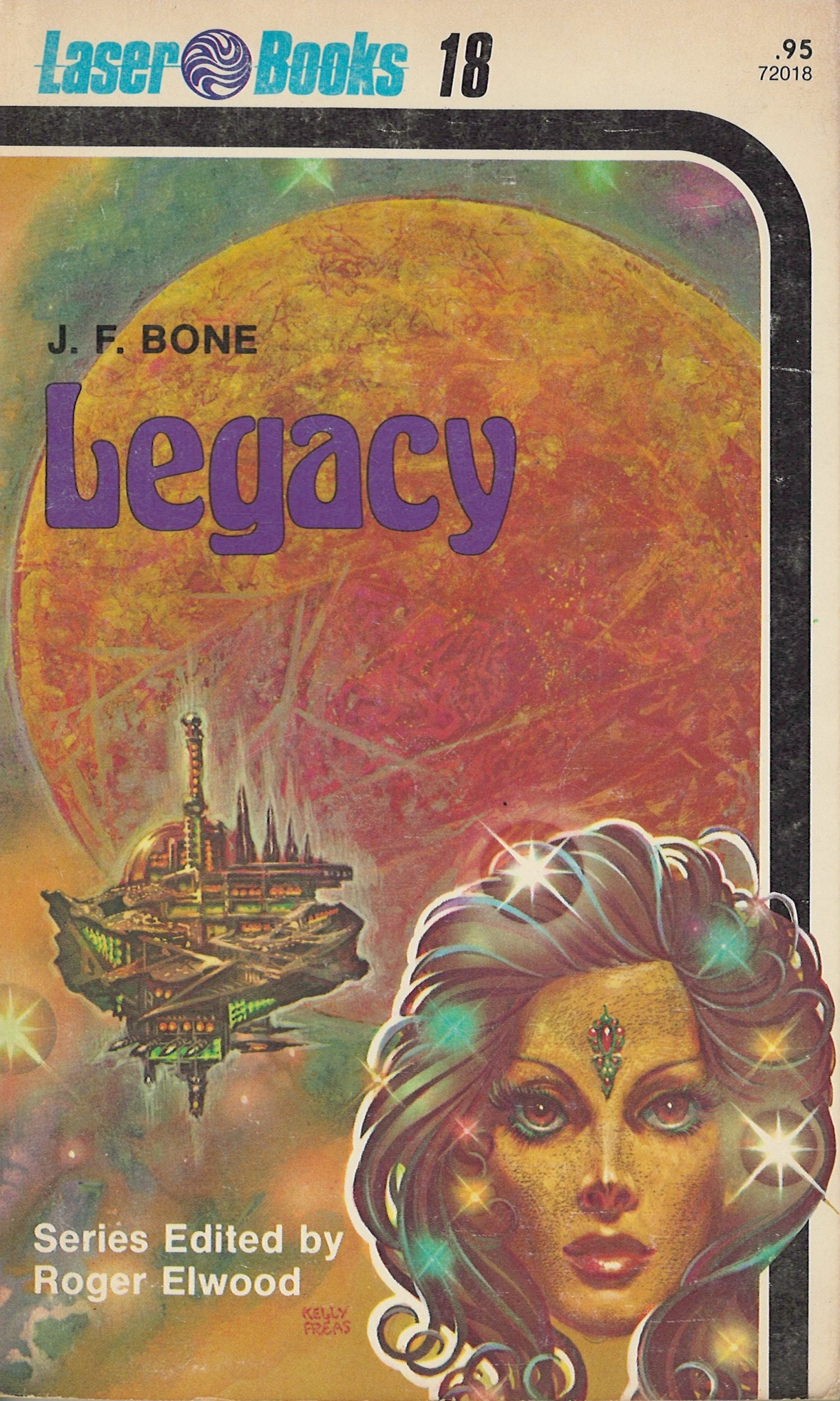
    Cover

    *sniff… sniff…*

    Bob? Bob, is that you?!

    Sorry, thought I smelt Bob Heinlein’s aftershave again. Haven’t caught a whiff since Seeds of Change.

    Nor has Kelly Freas delivered a cover this whimsical since Renegades of Time. I feel like I’m on the verge of a whimsy overdose. The grapefruit planet, the city-sized spaceship, the nebular backdrop, the… the lady in the portrait.

    Listen, I don’t want to say too much about her yet. Suffice to say, she’s the hero’s love interest.

    I do really like it though. I’ve got a soft spot for Golden Age SF covers (if not necessarily what lies beneath them). It’s the kind of cover that promises high adventure against a soft sci-fi backdrop. Really nice work.

    Let’s take a walk round the block and see what Marketing Guy has cooked up.

    Ugh… my OCD brain just hates the fact my scanner nicked the first letter of each line. That ain’t badass, that’s bad asset procurement. *beats breast* Mea culpa, mea culpa, mea maxima culpa.

    Anyway, here’s what it says.

    Sam Williams is a fighter, but fate has dealt him a bad hand. Marooned on the bleak world of Arthe because of a computer error, he joins the local police force… and is soon fighting for his life. The enemy? The drug that drives men mad, the dreaded Tonocaine! In a harrowing, action-packed adventure, Williams whirls across the strange, forbidding planet as he trails a madman who is using the drug to satisfy his own lust for power. But the madman is chasing him, too!

    Hmm, okay, okay, bit of darkness in this here high adventure tale. Getting a touch of John Carter perhaps.

    Although, the talk of drugs makes me a little nervous. In the 1970s, the Drug War was climbing toward the zenith of its violence, and anti-drug rhetoric was used to excuse arrests made on the basis of racism toward minorities and apathy toward the sick.

    Consequently, science fiction tales frequently pushed the same narrative: addicts are not people, minorities peddle poison, and violence toward both is the only answer.

    Would You Like to Know More?

    Carver: Girl, you can’t even call this shit a war.

    Herc: Why not?

    Carver: Wars end.

    The Wire, Season 1 Episode 1, “The Target”

    The War on Drugs is a colossal failure and has destroyed more lives than it has saved. It has helped to entrench xenophobia in the countries who participate in it and estrange ordinary folk from people they should see as neighbours and family who need help.

    The only proven way to reduce or eliminate drug use is to reduce or eliminate the demand for it. Healthcare, social programs, safe injection sites, decriminalization of substances, and education (not propaganda) about the nature of narcotics are the true weapons with which successful democracies should be fighting drug abuse.

    This video from Kurzgesagt–In a Nutshell is an excellent primer for how a country can address addiction and recovery; I encourage you to do your own research as well.

    So, I think we can guess what kind of story Legacy is, right? A fish-out-of-water tale of high stakes adventure, fate of a civilization on the line, and a beautiful alien queen for our hero to chase, all with a fine dusting of topical subjects. Are we in agreement?

    Good.

    Glad we’re all on the same page.

    Story

    Legacy is a hardboiled detective novel and that bejeweled woman is a nurse in a walk-in clinic.

    Let’s have a slow-clap for Kelly Freas and Marketing Guy. They really pulled the wool over my eyes.

    The entire book jacket is a red herring.

    But is the story itself any good? Well, how shall I put this…

    … it’s great!

    Not a word of a lie, I couldn’t put this book down. The very first page establishes Bone’s talent as a writer of good science fiction prose, and that continues for almost the entire novel.

    Protagonist Sam Williams ranks up there with Catherine Boucher in terms of how likeable he is. He’s a short-fused hothead who’s quick to resort to violence, but he never raises a hand to those who don’t deserve it. His temper is reserved for those who are indecent to their fellow human beings.

    A humanitarian to the core, Sam renders medical aid to anyone who needs it, regardless of their social standing or race. This makes him stand out in a society where racism and prejudicial treatment is the order of the day. He’s a cop on a police force whose mantra might rightly be “enforce and subjugate” rather than “protect and serve”. He despises corruption and narrow-mindedness.

    In any other Laser Book, Sam could’ve been an insufferable, holier-than-thou dickhead who makes you want to rip the book apart, but Bone strikes a healthy balance between Sam’s faults and virtues: just when Sam starts getting on your nerves, he goes and does something absolutely noble, heroic, and downright decent.

    Sam is a veteran of the Gakan War, a conflict which saw the first use of a drug called tonocaine. It’s a fungus-derivative which launches the user into a state of subjective, dreamlike reality. They become totally dissociated and filled with bliss, and there’s a disconnect between what they perceive and what their body actually does.

    The Gakan, whom Sam calls “Geeks”–a racial epithet uncomfortably close to a real-world one used for the Vietnamese– employed tonocaine as a battlefield bioweapon, spraying enemy battalions with it to cripple their combat effectiveness. And the highly addictive nature of the drug means that a person is hooked after two or three exposures. If they stop receiving the drug, they die.

    Sam is honourably discharged due to a battlefield injury and boards a transport for home, but a clerical error spits him out on the planet Arthe instead of Earth. Arthe is in the grip of a tonocaine epidemic, and rather than leave, Sam opts to stay and join the local police force. His experience with tonocaine makes him the perfect man to investigate, so Inspector Lantham gives him the remit of undercover agent to look for the source of the narcotic.

    Here is where Sam really starts to grow on you: he disarms a fellow officer who is beating up a tonocaine victim, speaks out against his partner’s abuse of authority, and saves a woman from being assaulted by the mayor’s nephew. After arriving in Dunkelburg *snicker*, he opens a walk-in-clinic for lower-income families and charges much lower rates than the nearby hospital. He hires staff from the local community and teaches them basic healthcare.

    In his treatment of tonocaine victims, he uses narcosine, which weans them off the tonocaine, but which also acts as a truth serum. So, during treatment, he gently questions his patients and gathers information on the source of the tonocaine.

    Narcosine? Narc? Get it?

    I really loved this plot point because, on the one hand, it feels unethical, but on the other, tonocaine really is the greater evil in this city, and Sam draws no distinction between his role as a cop and his role as a doctor: both creeds demand he put the good of the city over his own moral comfort.

    It’s an excellent moral quandary for the protagonist: the patients are going to have to be treated no matter what, so is it right to get some information out of them while they’re under the influence of a drug, knowing that whatever they say may save their lives, and those of others, somewhere down the road?

    And no matter what, Sam’s patients always leave his clinic clean of tonocaine and healed of all physical injury, often for no charge. Sam wants to do right by them, even if he sometimes uses them for information or camouflage.

    His equitable treatment of the denizens of Dunkelburg has a massive payoff at the end of the story when he uses the mutual trust he’s built with them to avert a riot that could result in a military siege, while simultaneously arresting the pushers of tonocaine.

    Reminds of a quote from May Sarton:

    “One must think like a hero to behave like a merely decent human being.”

    This book exemplifies that.

    Conclusions and Recommendations

    So, the first 100 pages are rock solid. Nothing to say about those. But there is a point in the middle where Sam and his buddy Riker–

    Joe Riker, not Will Riker!

    Anyway, they go underground and find this sci-fi disco ball that lets them manipulate gravity and energy. It’s The Power of an ancient civilization called the Shambra.

    To be fair, this is hinted at earlier in the story, but the focus is never put squarely on this archaeological history, so it feels out of left field. The Power is the reason for the tonocaine epidemic. Inspector Lantham, who’s been stationed on Arthe for over a century, has heard tales of a device that acts like God’s Swiss Army Knife and wants it for himself. So he’s introduced tonocaine into the civilian population to destabilize it and create a pretext to exterminate the locals.

    Would You Like to Know More?

    This is similar to the way Britain introduced opium to China in order to reset the economy.

    Trade with the Qing Dynasty was arranged so that most of the profits flowed to China. Opium was introduced to artificially create a demand for a good which Britain could export in vast quantities.

    Textiles and capital were shipped to India, where opium was made from vast fields. The opium was then shipped to China, and through compradors and smugglers, sold for silver; the silver was used to purchase tea and other goods which were shipped back to Europe.

    Millions of people became hooked on opium solely for the purpose of balancing Europe’s books.

    In Legacy, as in history, drugs were used as a tool of conquest.

    The end result is that, for a couple dozen pages, the novel becomes a Conan story.

    But this isn’t a deal-breaker. It’s very clear Bone knows his stuff, and I wonder how much of Sam’s psychological makeup and life experiences were drawn from Bone’s own time in Vietnam.

    For the umpteenth time, I can’t help but think what the author would do differently were he not constrained by the format of the Laser Books. I should just put this on a plaque and show it during each review.

    My Goodreads Review

    A gripping hardboiled detective story set against the backdrop of a futuristic narcotic epidemic. J.F. Bone’s protagonist, Sam Williams, is easy to root for, and likeable despite his faults. Barring a couple of sour notes in the midpoint of the tale, this is an easy recommendation for me: a rare story which treats victims of drugs with compassion, emphasizes the importance of trust and humanity in police work, and reminds us that when it comes to fixing the blame for Drug Wars, we must look not just to the Cartels and Narcos, but our own Senators and law enforcement entities. I recommend this Laser Book

    I give this book four stars out of five.

    That’s case closed for Legacy, and we move on to number 19 in the Laser Books. Who can it be, now?

    Who’s Next?

    Is anyone else getting that low-poly feeling all of a sudden, or is it just me?

    Blurb

    Fear swept through the crippled Spaceship. The 200 men and women aboard realized they were trapped. To Rangone, chief medical officer, sudden death seemed preferable to the future they faced. Drifting aimlessly in the void outside the galaxy, they were on a journey to nowhere that would last forever! In a tense drama, Donald Malcolm brings to life the hopes and fears, the nobility and the meanness of people under the pressure of The Unknown Shore.

    … you know what? I’m excited.

    And I think there’s only one way to end this review.

  • Laser Books Review 17

    Laser Books Review 17

    17. The Black Roads by J.L. Hensley

    … when you get to queue up some Mad Max memes for a review.

    Today we’re gonna be taking a look at Blackrooms.

    Sorry, The Back Roads.

    Argh! Sorry. Look, it’s been a phonetically-challenging week. I just watched Backrooms with my girlfriend L. and now my tongue is in knots.

    Get your minds outta the gutters, you filthy animals.

    Would You Like to Know More?

    What a breath of fresh air this film was!

    As YouTubers break into the motion picture business, we’ve begun to see an energy, passion, and skill level absent from Hollywood films for over a decade. The phenomenon, started with Markiplier‘s Iron Lung, and now reaching a fever pitch with Backrooms and Obsession, is finally showing Hollywood that the revitalization of the stagnant cinema industry lies not with tired old directors succumbing to their own egos, but with wide-eyed youth belonging to the internet generation.

    Don’t believe me? Then look at the numbers. All these films, made on what Hollywood would consider a shoestring budget, made back twelve to three-hundred-and-eighty-two times their budget:

    Iron Lung

    Budget: ~$5 million

    Box Office: $60 million, briefly unseating Sam Raimi‘s Send Help as #1 Movie in America

    Backrooms

    Budget: $10 million

    Box Office: $262 million (at time of writing)

    Obsession

    Budget: $750,000

    Box Office: $287 million (at time of writing)

    Let’s try this again.

    This week on the Laser Books, we’re going to be taking a look at The Black Roads by J.L. Hensley.

    Joe Hensley is quite an interesting character. According to his Goodreads bio:

    Joseph Louis “Joe L.” Hensley (March 19, 1926 – August 27, 2007) was a lawyer, prosecuting attorney, member of the Indiana General Assembly, circuit court judge, science fiction fan, and writer of science fiction and mysteries. He was a long-time resident of Madison, Indiana and died there of complications of leukemia.

    Upon further investigation, it turns out Hensley actually spent most of his life in legal circles, primarily as a judge in various courts. This is a fascinating background for an author of fantasy and science fiction to have. Crime and punishment is such a specific–and revealing–lens through which to view society, because codes of conduct and methods of justice tell you what a society holds sacred.

    So, I’m eager to see what Joe’s take on a dystopian America in The Black Roads is.

    But first… the court recognizes the Hon. Kelly Freas.

    Cover

    Gyatt damn, Kelly! This might be a contender for my favourite cover thus far. The colour and composition… wow!

    Okay, let’s break it down.

    Right away, the big fireball in the centre is where the eye goes first. If I had to guess, this is from one of the early scenes in the book where Jackman (the man in the portrait) sends a youth in an elecar spinning out into a fiery wreck. Kelly has drawn this thing like a meteorite streaking to earth, and the way he’s sculpted those… towers? antennae? pylons? … around the trailing flames is such an imaginative stroke.

    Jackman is drawn with some incredible detail as well. The subtle sheen on the gold trim of his hat, the manic light in his eyes, the sneer. You know right away this guy ain’t the hero of the story.

    By far the best aspect of this cover is the use of colour. Aside from Jackman’s portrait and the title, there’s no primaries; every shade is a drab, muted version of its base colour. Reds become maroon, greens and blues become teal. It makes my brain draw comparisons to mould sprouting on food, or flesh inflamed with blood poisoning.

    This is a world that’s well past its Sell-By date.

    Once again, Kelly is doing the heavy lifting, but lets see what Marketing Guy has going on.

    Blurb

    Sam Church is a trained killer, a member of the infamous Red Roadmen organization. In the bizarre world of this future America, the Roadmen’s word is law; to incur their displeasure is death. But Sam Church refuses to kill and is imprisoned and tortured by his peers for his nonconformity. He escapes and, in a terrifying race across the continent, clashes with the Roadmen in a running duel that can only end in death – his own or that of the system of tyranny that reigns on The Black Roads.

    You know what? I’m on board. This is pretty slick copy from a guy who normally couldn’t sell a two-cent pencil topper. It’s simple, to-the-point, and teases the thrills to come.

    I can’t even make fun of it! The dude actually did his job well! I’d be intrigued, even tempted to buy it.

    Detour En-Route

    Pump the breaks, everybody… my brain is wrinkling.

    Something’s been bugging me for the last hour. Little neurons are firing, connections are being made.

    Road warriors…

    Duels on the highway…

    Hensley…

    There’s something… something there… but what? What doth my cognition reacheth for…?

    Oh! I’ve got it! This is like the plot of Harlan Ellison‘s short story, “Along the Scenic Route”, from the collection The Beast that Shouted Love at the Heart of the World!

    For those who haven’t read it, this story is a laugh-out-loud tale of futuristic road rage with a single, scathing message: those who live by the sword, die by the sword. It tells the tale of George and his wife, Jessica, a couple in a distant future of superfast armed cars trying to take a trip across the blacktop of America. They run afoul of a road-duelist who clips their car, and rather than let it go, George engages in battle with the bastard, despite his wife’s imprecations to just keep driving.

    By sheer dumb luck, George pastes the twerp, which marks him as the deadliest road warrior in America–a fact which is instantly made public and broadcast across the country, putting a target on George’s back for every other road warrior out there. He realizes he’s gonna have to fight them all, and never stop fighting. He got lucky once; can he get lucky a thousand more times?

    I first read the story in this collection. If you want a wide sample of Harlan’s work, pick up one of his Edgeworks series, published by White Wolf. Originally, there were supposed to be 30 volumes containing every piece of writing Harlan ever put out, but only four were released. Of those four, I recommend the first and the third. They combine some of his best fiction and non-fiction.

    These books are hard to find: I’ve only seen one in the wild, and that’s the one above. It was on sale at The Scribe Bookstore on the Danforth in Toronto. My copies of the Edgeworks were purchased through Thriftbooks.

    And I think somebody made a mistake because the copy of the above title that I eventually received… is signed.

    I shit you not, that is Harlan Ellison’s signature. I checked.

    I bought this for $26 CAD, plus $20 shipping. There was no note on the listing, no indication that this was a special, signed copy. I just bought a copy of the book, and it sat on my shelf for four months before I opened it.

    And when I did, Harlan’s signature was staring at me.

    Signed copies of the Edgeworks sell for anywhere from $250 to $400. This is as unlikely as picking up and cashing in a winning lottery ticket. Whoever made this mistake and sent me this book… thanks!

    And now I gotta bring this digression full circle.

    There’s another book in the Edgeworks, the Spider Kiss/Stalking the Nightmare combo. The latter of those two is a collection of short stories.

    And in that collection is a story called “Visionary”.

    And the by-line of that story: “written with Joe L. Hensley”.

    Mind. Blown.

    This–this!–is the joy of reading. You discover connections you didn’t even know existed. The world is tied together in the subtlest ways, and feeling part of that web is the whole reason I love books.

    I’ve hijacked this post-apocalyptic armada long enough. Let’s get to the story of The Black Roads.

    Story

    “MEDIOCRE!”

    Immortan Joe, Mad Max: Fury Road

    Would You Like to Know More?

    Let’s have a moment of silence for the loss of Hugh Keays-Byrne, a truly underrated actor.

    While most audiences will know him as the massive and terrifying Immortan Joe in Fury Road, or Toecutter in the original Mad Max, my personal favourite role of his is a brief guest spot on Farscape as the greedy, greasy, gluttonous Grunchlk (pronounced “grun-shlick”).

    His appearance on the show was brief, but so memorable and popular that his character was brought back from the dead to appear in Farscape: The Peacekeeper Wars.

    Immortal indeed.

    We’ve had a few let-downs over the course of the Laser Books, but this one really stings. I can so clearly see what this book was trying to be, and even hamstrung by the length of the Laser Books, I think it could’ve worked! It just needed to be bolder.

    The story is told without chapter breaks, much like Stephen King‘s Cujo. Reading it feels like taking a drive down one long stretch of barren highway. It kicks off remarkably strong: a Mad Max-style chronology of events talks about the outbreak of WWIII and the collapse of modern America, and how the new government created the Red Roadmen to patrol the highways. This is followed by Sam and Doc evading patrols as they break free of prison.

    We’ve seen such lawbringers before, in incarnations like Judge Dredd and the Spectres of Mass Effect: men who are judge, jury, and executioner rolled into one. There’s an almost ritual air to the Red Roadmen: they don red felt caps when they prepare to kill, and observe certain customs around obtaining the right to kill their targets.

    These kinds of characters are fascinating to read about because, while they are the justice-bringers of a nation, that justice is shaped by the particular sensibilities of the one wearing the mantle: some prefer a more rigid code, others will find any excuse to skin their smoke wagons and waste some fools.

    Jackman is of the latter variety.

    A Tale of Two Roadmen

    The setup for this story is a classic: two men–partners on “the force”–suddenly find themselves at cross-purposes when one of them has a break with “the code” and decides to challenge the reigning authority. This rankles his partner, who sets out on a mission of vengeance.

    When these stories are told well, you have such classic rivalries as Benjamin Sisko and Michael Eddington.

    Or Professor X and Magneto.

    But in order for the story to work, these rivals have to clash regularly and often. Their worldviews have to slam together with the power of tectonic plates, and we have to see where each man is right, and more importantly, wrong.

    Sam and Jackman are perfect mirrors of each other.

    • Sam is young; Jackman is old
    • Sam has forsworn killing; Jackman revels in it
    • Sam has abandoned the System; Jackman clings to it
    • Sam voluntarily betrays his codes of belief; Jackman is forced to do it

    Jackman in particular is a fun character. He’s an old man in a profession where men do not grow old; that immediately marks him as dangerous. He’s very near retirement age, and he dreads it. He’s so accustomed to holding the power of life and death that, rather than surrender it, he turns upon the very system that made him, killing his own kind, making himself an enemy and choosing the life of a fugitive simply so he has the chance to drive free down the roadways until the clock runs out.

    Jackman is the most entertaining kind of villain: the one who loves his work.

    So it’s a disappointment, then, when he’s only in the book for about four or five scenes–and he spends only one of those with Sam.

    This really pisses me off. Joe Hensley had the makings of a fantastic dual character study, and he squanders it on the same tame bullshit the bulk of the Laser Books is known for. You’d think with his background in law, Joe would take advantage of the opportunity to dissect the concepts of crime and punishment in a seemingly lawless world.

    Other discomforts:

    • There’s some kind of weird telepathic oracle
    • There’s a lack of description of the kinds of communities that exist in the wasteland
    • Sam spends an uncomfortable amount of time alone in a cabin shooting “black cannibal tribefolk” who come too close to his hideaway

    Conclusions and Recommendations

    To make this book truly historic, only a few changes are needed:

    • Sam and Jackman need to clash. Repeatedly
    • We need an equal share of screen time between Sam and Jackman
    • We need these characters to have their morality tested over and over, particularly Sam’s–his vow of non-violence in a world lost to violence is a compelling story beat
    • We need more than one roadrage battle scene; Hensley set up this thrilling concept of armed and armoured cars racing down killer highways, and the characters spend 70% of the book walking. There’s only one battle by road in the book.
    • We need a proper climax; as it stands, there isn’t one

    My Goodreads Review

    Don’t bother firing up the Gigahorse and pounding on the Doofwagon for this road chase. What could have been a proto-Mad Max instead feels kind of flat and lifeless. There’s the spark of greatness in this novel, and the promise of a great character clash, but overall the story falls prey to the same tired issues the other mediocre Laser Books do: tired tropes and prescribed writing formulae.

    As Harlan Ellison said, you can learn more from a bad film than a good one. The same is true for books. The Black Roads helped me to articulate some storytelling lessons that I can take with me into my own work, which I’m quite excited for. So, I’m glad I read this, but hopefully the next book truly does grab the sun and ride into Valhalla, shiny and chrome.

    Who’s Next?

    Ooh! Pretty! Blurb me, baby.

    Blurb

    Sam Williams is a fighter, but fate has dealt him a bad hand. Marooned on the bleak world of Arthe because of a computer error, he joins the local police force… and is soon fighting for his life. The enemy? The drug that drives men mad, the dreaded Tonocaine! In a harrowing, action-packed adventure, Williams whirls across the strange, forbidding planet as he trails a madman who is using the drug to satisfy his own lust for power. But the madman is chasing him, too!

    Two protagonists, one after the other, both named Sam. Do I need to start keeping a tally? I’ll see you guys for the next review…

    … huh…

    … I feel like I’m forgetting something…

    Ah! Yes.

  • Laser Books Review 16

    Laser Books Review 16

    16. Kane’s Odyssey by Jeff Clinton

    TRANSCRIPT of Bradbury v. Bickham

    Madame Register: Oyez, oyez, oyez! All those having business before the Court of Scientifiction Plagiarism, attend and ye shall be heard.

    Judge Gernsback: (sighs) Mr. Dick, what is this, the hundred-and-seventieth time?

    Dick: (stands) Your Honour, my client, Mr. Bradbury, cannot help it if he finds himself–due to his enormous talent–the repeated victim of plagiarism. Justice must be done in each and every case.

    Judge Gernsback: Oh Lord… proceed.

    Dick: Thank you, Your Honour–

    Elwood: Objection! Will my esteemed colleague please stop putting “u” in all his words? This is America!

    Dick: Can’t be helped, Your Honour. I am Canadian. It’s part of my culture. To censor me is discrimination.

    Judge Gernsback: Overruled. Mr. Elwood, as you so rightly state, this is America, and we have never, nor will ever, discriminate against any person in a court of law. Clear?

    Elwood: (mumbles in American)

    Judge Gernsback: Mr. Dick, please proceed.

    Dick: Thank you… Your “Honour”.

    Judge Gernsback: Don’t push it.

    Dick: Er, right. Well, my client asserts that in the year 1976, Mr. Jack Miles Bickham–pen name Jeff Clinton–did willfully and with full knowledge of his actions, plagiarize my client’s novel Fahrenheit 451 in his own novel, Kane’s Odyssey. I anticipate that you will hear evidence to that effect over the course of these proceedings. Now, if you will observe this cover by Kelly Freas

    Cover

    Dick: I would like this entered into evidence as Exhibit A–

    Elwood: Objection! No element of this cover bears even the slightest resemblance to Fahrenheit 451!

    Judge Gernsback: Sustained. Mr. Dick…

    (whispering between plaintiff and counsel)

    Dick: (stands) Ahem… Your Honour, we withdraw the request. (sits)

    Judge Gernsback: Mr. Elwood…?

    (whispering between defendant and counsel)

    Elwood: Your Honor, we would like this entered into evidence. We belief it supports our case that the Work In Question was not plagiarized.

    Judge Gernsback: Very well. Continue.

    Elwood: Major elements included in this cover are the portrait of Rufus himself, bottom-right. His farming community is shown front and centre. Behind are the trees, lit by a sickly yellow sun. And beyond them, the city, war-torn and mutilated. In essence, the entire story is told from right-to-left, foreground-to-background. Rufus goes on his journey from farmer to wildlands fugitive to urban rebel. This is as succinct a depiction of the story that it’s a wonder we don’t throw this case out right now!

    Dick: Objection: hyperbole.

    Judge Gernsback: Overruled. Mr. Dick, this is a court of scientifiction; being hyperbolic is standard process. We have hyperbolic generators in the basement, in fact. Mr. Elwood?

    Elwood: Defense rests.

    Dick: “Defence” rests.

    Judge Gernsback: Mr. Dick, just because we respect Canadian sovereignty and language, doesn’t mean I won’t hold you in contempt.

    Dick: Sorry, Your Honour.

    Elwood: Defense calls Laser Books’ Marketing Guy to the witness stand!

    Blurb

    Rufus Kane is a born rebel. Forced to flee from the tightly controlled life of an isolated commune, he finds safety in a large city. But his dream of freedom to live is soon shattered. He is betrayed by a friend and his incredible trial reveals a society gone mad. Law and order are absolute, human rights have surrendered to fear. Hope has vanished from the world. In this exciting tale, Jeff Clinton is at his storytelling best. Rufus becomes a rebel with a cause: the creation of a world fit for men!

    Elwood: Now, MG–may I call you MG?

    Marketing Guy: Why not? Everyone else does. (glares at plaintiff’s counsel)

    (chuckling from audience)

    Elwood: Well, MG, do you see any parallels between Rufus’s journey, as described by your words, and the plot of Fahrenheit 451?

    MG: ‘Course not. Rufus is an active protagonist from early on. He resists the constraints placed on him from the beginning. And he’s not engaged in any sorta book-burnin’.

    Elwood: Mm-hmm. And would you say he is a stronger driving force in the story than Montag in Fahrenheit, especially when comparing the first third of both books?

    MG: Absolutely–

    Dick: (stands) Objection: leading the witness.

    Judge Gernsback: Sustained.

    Elwood: MG, I put it to you, that this story, in fact, bears no resemblance to Fahrenheit at all–

    Dick: (stands, leans over table) Objection! You Honour, we have not entered plot or character into evidence at this time!

    Judge Gernsback: Sustained! Mr. Elwood, this is your final warning.

    Elwood: Defense rests.

    Dick: (steps around table, clasps hands behind back) Marketing Guy, would you call yourself a Bradbury fan?

    MG: I would.

    James: And you are thoroughly familiar with Fahrenheit 451?

    MG: I am.

    James: Then answer me this: doesn’t Montag stash books at the beginning of–

    Elwood: Objection. By his own admission, the plaintiff’s counsel has stated that Story has not been entered into evidence.

    Judge Gernsback: Sustained–Mr. Dick, you will play fair or stand down.

    Dick: Then I move that MG’s testimony be stricken from the record, because his words have never revealed anything of the Laser Books’ content and so can have no bearing on these proceedings!

    MG: You bastard! I’ll kill you! (witness climbs over the stand, cries of dismay from audience)

    Judge Gernsback: (bangs gavel) Bailiff! Bailiff! Remove the witness at once! Remove him!

    MG: (being dragged from the courtroom) He’s got it in for me, y’hear?! The Dick wants to ruin meeee!

    (doors slam)

    Dick: (under his breath) You’ve done that yourself…

    Interlude: A Brief Recess

    TRANSCRIPT cafeteria conversation, Dick and Elwood

    Elwood: Do you ever think you go too far?

    Dick: On the contrary, I don’t think I go far enough. (mastication) This is a capital mac n’ cheese.

    Elwood: Come back to Earth, Jim. At most you’ll be able to prove Subconscious Influence. You yourself are guilty of that in writing your own novel, Seekers of the Fallen Stars.

    Dick: Yes, yes, Dune influenced some pretty obvious elements of my book: race memory, ancestral voices, mind-altering substances–and I didn’t even realize it till after I’d written the chapters.

    Elwood: Subconscious Influence. Take it or leave it. (beat) Be reasonable for once. You can’t win.

    Dick: Says you.

    Story

    Dick: Your Honour, I’d like to enter Story as Exhibit C and state my case.

    Judge Gernsback: Done, and do so.

    Dick: Your Honour, what it all comes down to is six points:

    • Rufus is an indoctrinated member of a society where thoughts are controlled and reading material is banned, hidden, or destroyed.
    • Knowledge proves the unlocking of his mind and the reorientation of his worldview
    • He becomes a fugitive from those who seek to constrain his mind
    • He finds refuge among those with the knowledge he seeks
    • He confronts his own society
    • He becomes a rebel and flees, just in time to see the city burn down behind him

    Dick (cont’d): When I first read Kane’s Odyssey, even then it did not feel original, but when I compare it against Fahrenheit 451, I find the similarities striking. Truthfully, if I was in the business of reviewing science fiction novels, I would simply tell people to read the latter and ignore the former. Rufus’s story is a parallel to Guy Montag’s in virtually every way.

    Dick (cont’d): The worst technical offence in this book occurs in chapter five, where Mr. Bickham stops the story to give a ten-page future history lesson that borders on the absurd! By myself I found ten implausibilities in this chapter, but my brother, an historian, could doubtless tear that whole chapter to shreds. Granted, I largely felt engaged throughout the novel, never felt the need to put it down, but against Mr. Bradbury’s work, there is simply no contest; it is a candle compared to a house fire. (sits)

    Judge Gernsback: Mr. Elwood?

    Elwood: (stands) Ahem, Your Honor… the defense would like to call… Mr. Ray Bradbury to the stand.

    (pandemonium in the courtroom)

    Judge Gernsback: Order! I will have order!

    (plaintiff stands, walks to the witness stand)

    Elwood: Mr. Bradbury, I believe I speak for everyone in this room when I say it’s an honor to meet you.

    Bradbury: (smiling) Oh thank you. Thank you very much.

    Elwood: In fact under other circumstances I’d ask you to sign my copy of Something Wicked This Way Comes.

    Bradbury: I’d be happy to.

    Elwood: But for now I’d like to discuss another of your books–not Fahrenheit, but The Martian Chronicles.

    Dick: (stands) Objection–relevance?

    Judge Gernsback: Mr. Elwood, if you have a point to make, make it quickly.

    Elwood: I shall. Mr. Bradbury, I have a short excerpt here from your acceptance speech at the 2000 Medal for Distinguished Contribution to American Letters ceremony. It’s only a paragraph, would you please read it aloud for the record.

    Bradbury: Let me see… (reading, laughs) Oh yes, I remember…

    I arrived at the YMCA, the Sloan House, moved in there for $5 a week and proceeded to show my short stories to editors all around New York City, but nobody wanted my short stories. They said, “Don’t you have a novel?” I said, “No I’m a sprinter. I’m a sprinter.” But finally I had dinner my last night in New York with Don Congdon and Walter Bradbury, no relation of mine. Walter Bradbury at Doubleday. And sitting at dinner that night he said to me, “Ray, what about all those Martian stories you’ve been writing in the pulp magazines during the last 10 years? Don’t you think they would make a novel if you wove them together in some sort of tapestry and called it The Martian Chronicles?” I said, “Oh my God.” He said, “What do you mean?” I said, “I read Winesburg, Ohio by Sherwood Anderson when I was 24 and I said to myself, ‘Oh God, wouldn’t it be wonderful if someday I could write a book as good as this but put it on the planet Mars.’”

    Elwood: Mr. Bradbury… would you say that you plagiarized Mr. Anderson’s book to write The Martian Chronicles?

    Bradbury: Certainly not! No aspect of The Martian Chronicles is copied from Anderson’s book.

    Elwood: But by your own admission, you… drew inspiration?

    Bradbury: The uh, the “pattern”, if you wanna call it that, was drawn from Winesburg. Anderson showed me how I might go about stitching my Martian short stories into a cohesive novel.

    Elwood: And you did it rather successfully. So, would you contend that it is possible to be influenced by a story–follow its structure in your own work, even–without it being considered plagiarism?

    Bradbury: (shrugs) Isn’t that how all stories are born?

    Dick: (groaning) Oh God…

    Elwood: (shrugs, addresses courtroom) Well, if Ray Bradbury says it, who are we to argue?

    (laughter)

    Elwood (cont’d): Oh, one last question, Mr. Bradbury: who was it who suggested you sue my client?

    Bradbury: Well, my lawyer of course.

    Elwood: Can you point to him?

    Bradbury: Sure. (points)

    Elwood: Madame Register, let the record show that Mr. Bradbury has identified James Dick. The defense rests.

    Conclusions and Recommendations

    Judge Gernsback: Each party will now have a chance to make their closing statements, and since this is a court of scientifiction, grandiose pontification is not only welcome, but encouraged. Mr. Dick?

    (whispering between plaintiff and counsel)

    Judge Gernsback: Mr. Dick!

    Dick: (stands) Counsel rests… (sits)

    Judge Gernsback: Very well. Defense?

    Elwood: (stands, straightens tie, clears throat) Your Honor, ladies and gentlemen of the court, this case could–and more properly should–be called Dick v. Posterity. We are not here because Mr. Bradbury seeks justice. We are not here for the benefit of the literary world. We are here so that one man can salve his conscience.

    Elwood (cont’d): Mr. Dick, by his own admission–on multiple occasions–has plundered countless works of fiction across every genre for his ideas. Arthur C. Clarke, Patrick O’Brian, Clive Barker, Tim Powers, David Twohy–these are just a few of the artists whose ideas have been pilfered by this common thief. In fact, if there was any true justice in the world, he would be the one having to defend himself!

    Elwood (cont’d): (sighs) But thank God–thank God–there is room for nuance in this world. No story is created in a vacuum. I’m sure if we could call the cave-dweller who decorated Lascaux to the stand, we would learn that they were influenced by the Sherwood Anderson of cave paintings!

    (laughter)

    Elwood (cont’d): If we curtail creativity because a creator reimagines old ideas, we cut humanity’s storytelling potential by half. And consider what you’ve heard here today: The Martian Chronicles would not exist without Winesburg, Ohio, just as The Terminator would not exist without Harlan Ellison‘s “Soldier” and “Demon With a Glass Hand”. Yes, there will be many, many cases where the reimagining is vastly inferior to the original, but every now and then, the reimagining exceeds the original, and prompts new ideas, new creations. The potential far outweighs the drawbacks, but only if we learn to draw the line between plagiarism and inspiration. (sits)

    Later

    Judge Gernsback: In the matter of Bradbury v. Bickham, I find insufficient evidence of plagiarism as defined by law. Mr. Elwood, please inform Mr. Bickham he is free to go.

    Elwood: Thank you, Your Honor.

    Judge Gernsback: Mr. Dick, I’m of half a mind to cite you for wasting this court’s time. I’m surprised at how you’ve conducted this case, and I should be very worried if you were my counsel in a case such as this. But this time I’ll let you off with a warning. Pick your battles more carefully, please.

    Dick: I will, Your Honour. This has been a humbling experience. And if I may… I have some pages here–something I wrote–which I think would make a great fit for your own magazine, Amazing Stor

    Judge Gernsback: Overruled. Court’s adjourned. (slams gavel)

    Who’s Next?

    TRANSCRIPT telephone conversation, Bradbury and Dick

    Dick: Sorry ’bout today, Ray.

    Bradbury: Elwood had a point, you know. Can’t go around fighting everyone who creates something inspired by something else. Maybe take this as a lesson: free yourself to be inspired more by the works you meet rather than less, and experiment with others’ ideas to see what you can come up with.

    Dick: I guess so. Thanks, Ray.

    Bradbury: You got another case coming up?

    Dick: As a matter of fact…

    Bradbury: Goodness! What a cover! What does the blurb say?

    Blurb

    Sam Church is a trained killer, a member of the infamous Red Roadmen organization. In the bizarre world of this future America, the Roadmen’s word is law; to incur their displeasure is death. But Sam Church refuses to kill and is imprisoned and tortured by his peers for his nonconformity. He escapes and, in a terrifying race across the continent, clashes with the Roadmen in a running duel that can only end in death – his own or that of the system of tyranny that reigns on The Black Roads.

    Bradbury: Well, we’ve certainly seen ideas like this before. But why don’t you give this Joe fellow the benefit of the doubt?

    Dick: You know what? Maybe I’ll do just that…

    Bradbury: Something else, Jim?

    Dick: I’d just like to say… The Martian Chronicles… the story of how that book came to be was a huge inspiration for me to start pitching my own Europa Trilogy as a fix-up. In fact, your work consistently gives me the confidence to accept that there’s no right way to get my foot in the publishing door. If Europa does come out in the same format… I hope you’ll take it as the compliment it’s intended to be.

    Bradbury: Wouldn’t take it any other way. Good luck to you.

    Dick: You too, Ray. We miss you.

    Addendum

    My Goodreads Review for Kane’s Odyssey

    From the Case Notes of Bradbury v. Bickham

    This is a novel of a kind which has been seen countless times in science fiction canon: the “Good German” (an authoritarian, book burner, etc.) suddenly awakens to the injustices of his society and breaks free of the thought controls which bind him. He goes on to become a rebel and fight for the cause of knowledge/life/free potato chips, whatever. It’s basically Plato’s Allegory of the Cave. The problem is that Ray Bradbury perfected this story with Fahrenheit 451. This tale has been remixed, rebranded, and repackaged as films such as Equilibrium and The Matrix. Do yourself a favour, and read Fahrenheit 451. The essential plot has not been bettered since.

  • Laser Books Review 15

    Laser Books Review 15

    15. The Star Web by George Zebrowski

    I’m not crazy, right? You guys see it too?

    This has been driving me crazy for weeks now. I dodge enough bullets for a living; I don’t need sic semper tyrannis over here adding on his two cents o’ lead.

    Anyway, you guys check out this review while I check out my hat for holes.

    Nebula and Theodore Sturgeon Award nominee George Zebrowski brings us a story in the purest tradition of the Golden Age of Science Fiction. I say that without the least bit of prejudice because, at their best, Golden Age stories depicted battles of wits between humanity and the cosmos.

    Reading up on Zebrowski, I’m unsurprised to find out that, like many of our authors thus far, he wrote tie-in novels for Star Trek, focusing on The Next Generation era. Most of those works were co-authored with writer Pamela Sargent.

    Going boldly where many have gone before, Zebrowski’s Star Web articulates a classic question popularized by Arthur C. Clarke, and perfected by Andy Weir:

    Are these people smart enough to survive?

    Would You Like to Know More?

    If you spot a copy of this book in the wild, most likely at a used bookstore, buy it. It is some of the best value-for-money you can get in a book. Not only does it contain Clarke’s body of short fiction (which by itself is marvelous), it also holds one or two novel-length works which usually are published under the SF Masterworks label.

    Clarke’s importance to science fiction isn’t that he was a great storyteller (he was), or that he predicted many technologies before they were invented (he did), but that he made his readers feel that the story of the universe, of our solar system, of Earth, was their story–that no matter the colour of your skin, your sex, or your personal beliefs, you have a magnificent heritage written in the stars themselves, and no one can deny you that heritage.

    There are few tropes from the 1930s that have aged well, but this is one of them, and was used to greatest effect in books like The Martian and Project Hail Mary.

    But how well does Zebrowski employ it? Does The Star Web stand tall or fall flat? And just who is that John Wilkes Booth-lookin’ doofus, anyhow?

    We’ll find out after paying our dues to Kelly Freas.

    Cover

    Ahhh… you know that crisp, refreshing sound you get when you crack open a cold one with the lads? For some reason, that’s exactly what I hear when I look at this cover.

    Maybe it’s the cool cerulean of the aurora, or the sharp lines of the bright star in the sky. Maybe it’s the texture of the sky itself or the ice as the spaceship breaks through. Maybe it’s the gentle curves and shadows of the thready title at the top. Maybe it’s Juan Obrion’s wavy hair. Maybe it’s Maybelline.

    Whatever it is, there’s something just so soothing about this cover.

    I’ve been staring at it for so long trying to decide whether it’s one of Freas’s better covers, or more workmanlike ones. Having read the book, I can tell you that there are very few story elements present. In fact, Freas has chosen to depict a single scene from the book: the rising of the alien ship in the third or fourth chapter.

    But it kind of works. He really evokes a sense of “jumping-off” combined with a feeling of wonder. There could be anything hiding behind those curtains of light, and we’re gonna peer behind them and find out.

    Blurb

    A UN research team has been sent to the Antarctic to investigate strangely patterned radio signals. Expecting a buried transmitter, the team is awestruck by what they discover hidden beneath the polar ice. But it doesn’t remain hidden for long! The team is soon hurtling through space on an adventure that is as incredible as it is frightening. George Zebrowski, author of The Star Web, is a Nebula Award Finalist. His first novel, Omega Point, published in 1972, has already been translated into six languages.

    You pitch me a spaceship buried under Antarctica, and I’ll buy a ticket on that hotrod today.

    In the review of Birthright, we talked about tropes that always hook readers, right? “Literally-Anything-Buried-in-Antarctica” is one of them.

    I think the reason this never fails has to do with the nature of Antarctica: it’s the only continent on our planet that was never colonized by humans. There’ve been proposals and attempts, both aborted and ongoing, but the reality is there’s very little economic or political incentive to setting up shop.

    Would You Like to Know More?

    I spent three years writing for the Hearts of Iron IV submod Operation Deep Freeze. Set in the alternate history universe of The New Order: Last Days of Europe, our story depicted a fictionalized Scramble for Antarctica in which three superpowers vie for control of the “Exile Continent”.

    The events my brother and I wrote for that mod are some of my best work. We drafted hundreds of thousands of words over the course of COVID and created countless storylines and plot threads. Our research into Antarctica revealed the most astonishing things about the continent that laypeople simply don’t know.

    COVID was a shit time for humanity, but I’ll always have fond memories of my brother and I quietly going insane together as we crafted the most outlandish scenes this side of a Terry Gilliam fever dream.

    The landmass is covered in glaciers, and is routinely scraped by katabatic winds exhaled from the mountains of the interior. Assuming you can even reach the Antarctic littoral (you have to cross the Roaring Forties, which are some of the most vicious latitudes on the planet), depending on where you make landfall, you might be met with sheer walls of ice that are too high and too unstable to be scaled from sea level. And even if you make it into the continent proper, you will find cold desert stretching for thousands of kilometres–desert in which the mean annual temperature is -40 degrees Celsius.

    There is nothing there to eat except scarce pockets of wildlife. Nothing grows. Half the year is spent in perpetual daylight, and the other half in persistent darkness. It is, for all intents and purposes, impossible to survive there without great financial and technological investments.

    Antarctica is not for us.

    But it wasn’t always so inhospitable. We know from paleontological evidence that in the deep past, it was a tropical paradise, a veritable Garden of Eden. Dinosaurs prowled jungles denser than the Amazon. Flora proliferated and learned to survive seasonal frosts without dying. All of that is still there, buried and fossilized under hundreds of metres of ice.

    It’s no secret why stories of horror have been set there: the essence of cosmic horror is that human existence on planet Earth is bracketed by beings far older and more powerful than we are, that we are comparative newcomers to a vast and ancient stage.

    This is entirely true from a paleontologist’s point of view.

    While there is definitely some fear in Zebrowski’s novel, it is not the chief emotion which The Star Web elicits.

    That would be wonder.

    Story

    “Wonder” indeed. As in, wonder at the fact that this is the first Laser Book that’s less than the regulation 190 pages in length.

    I’m serious, this is completely unheard of! Every single book in this series, up until this point, has been ~50,000 words long, and exactly 190 pages in length. These are the guidelines set by Harlequin.

    So how the hell did Zebrowski get away with subtracting 13 pages from this novel?

    I wonder if any of the other Laser Books have the same problem. Which ones are they?

    What are their destinies?

    All joking aside, my experience of this book was much like my experience of reading Bob Heinlein‘s Methuselah’s Children: thoroughly enjoyed the first half, but found the second to be underwhelming.

    Would You Like to Know More?

    Funny story about Methuselah’s Children. The copy I had was a paperback older than the Antarctic dinosaurs and the binding was crumbling. The pages of this little book were literally falling out as I turned them. So when I read the book, I placed a wastepaper basket next to my bed and let each page fall in as I finished reading it.

    If you can cast your minds back to the very first Laser Book review, for Thomas F. Monteleone‘s Seeds of Change, you’ll recall that I wrote that that book felt like two stories Frankensteined together: one was Logan’s Run, and the other was a gripping tale of scientists figuring out the workings of an alien spacecraft. I also suggested that, to salvage that tale, you’d simply have to peel the disparate stories apart and let them grow into their own books.

    Zebrowski clearly had the same idea, because he took the spaceship plotline of Seeds and did exactly that.

    The story follows four UN scientists, led by our protagonist, Juan Obrion (the John Wilkes Booth-lookin’s doofus), who try to unravel the mysteries of a structure found beneath the Antarctic ice. The structure is in fact an ancient alien spacecraft, buried under the ice for untold millennia, and before you can say “Geronimo!” the scientists find themselves trapped in the spacecraft as it hurtles away from Earth at relativistic velocity.

    Suddenly, unraveling the vessel’s mysteries is no longer an academic exercise, but a matter of life and death.

    This is where the story is at its strongest. Are these people capable of thinking like beings which are far more intelligent than humans? Can these supposedly educated people use rationality and logic to puzzle out the workings of this ship while simultaneously batting aside their preconceptions and biases?

    These kinds of stories are a dime a dozen from the Golden Age, but seldom do GA authors demonstrate the deftness and detail that Zebrowski demonstrates–which makes it all the more frustrating when he falls victim to cliche.

    The Journey of the Spacecraft

    Look, if you’ve read these two books, you can probably guess where Star Web is heading.

    The vessel taps into an interstellar network of tunnels–the titular Star Web–and navigates to its native port: a berth hidden inside a blue giant star. Obrion and co. learn that the builders of this spacecraft eventually eschewed space travel altogether in favour of stargates.

    Would You Like to Know More?

    It never ceases to amaze me how often this trope is used in sci-fi to denote an advanced civilization: thousands of doorways scattered across space, connecting thousands of different planets in a sort of galactic metro system. We’ve even seen it used in this very series with Gates of the Universe.

    The Expanse, Star Trek, Contact, and 2001: A Space Odyssey all had some version of stargates, but in my opinion, no story did it better than the TV series named for the device.

    If you’ve not seen this show, I heartily recommend it. It’s a classic of science fiction, and one of the rare examples when a spinoff of a feature film (Roland Emmerich‘s Stargate) turned out smarter, funnier, and more exciting than the original. With ten seasons and two films, and featuring a friggin’ army of Canada’s finest screen talent, you are guaranteed two hundred hours of wonder, laughter, chills, and thrills.

    The spacecraft, like the Monolith in 2001, like the wormhole in Contact, takes the scientists on a tour of its builders’ history, from their humble beginnings to their tragic downfall. The spacecraft itself is a character–it has goals, opinions, beliefs–and is an intriguing part of the story, but ultimately, Zebrowski doesn’t do anything really novel with the concepts he explores.

    Conclusions and Recommendations

    I will never say no to Antarctica, spaceships, aliens, or combinations thereof.

    Some of my favourite tales in this genre involve scientists puzzling out the workings of extraterrestrial technology.

    My favourite video game–perhaps my favourite piece of media period–Outer Wilds is about the unraveling of a millennia old mystery.

    My Goodreads Review

    All the things I love in a sci-fi tale are present in the Star Web, and there is much to recommend in this novel, but unfortunately, the tropes which Arthur C. Clarke and Carl Sagan plumbed to such a great depth in their magnum opuses are recycled too easily in this novel. I would like to give The Star Web a solid 3.5 out of 5, but since that’s not possible with Goodreads rating system, a 3 shall have to suffice.

    Kathleen Sky‘s Birthright was so effective because she took tried and tested tropes and put her own unique spin on them. George Zebrowski never quite gets there with The Star Web. The novel would work a lot better if it were longer, and put more obstacles in the path of our characters: more puzzles to unravel, more secrets to uncover, more machines to figure out.

    I could recommend it, but then again, why not just read 2001: A Space Odyssey, or Contact, or watch Stargate SG-1? All those pieces of media have the same essential premise: pitting human intellect against ancient alien machines and seeing who comes out on top. This trope has been done perfectly before, and Zebrowski, strong writer though he is, is simply treading a well-beaten path.

    Who’s Next?

    Rufus Kane is a born rebel. Forced to flee from the tightly controlled life of an isolated commune, he finds safety in a large city. But his dream of freedom to live is soon shattered. He is betrayed by a friend and his incredible trial reveals a society gone mad. Law and order are absolute, human rights have surrendered to fear. Hope has vanished fromt he world. In this exciting tale, Jeff Clinton is at his storytelling best. Rufus becomes a rebel with a cause: the creation of a world fit for men!

    Ehh… I’m not gonna get my hopes up.

    Ancillary Matters

    Credit: David Twohy

    Those who’ve read my 8000-word retrospective on the Riddick franchise know what a huge fan I am of screenwriter/director David Twohy. Recently I discovered his website where he posts every screenplay he’s ever written, either on-spec or shooting, including an unused Alien3 screenplay.

    This lattermost script in particular will be of great interest to cinephiles because many of the elements he introduced in it (sci-fi prison, different versions of xenomorph, killer hounds) would later be re-used in the Alien franchise and his own films like Pitch Black and The Chronicles of Riddick.

    His scripts have renewed my appreciation for the importance of solid scripts, and how films transform and evolve in the course of shooting and editing.

    I even dropped him a line via email and he was kind enough to reply, mentioning his acquaintance with Harlan Ellison. Still super jealous you got to meet him, David!

  • Laser Books Review 14

    Laser Books Review 14

    14. Birthright by Kathleen Sky

    “I am an android.”

    Data, Star Trek: The Next Generation

    Ray Nelson kicked in the door of the second round of Laser Books with a piece of historical fanfiction that took us to the past, the future, the afterlife, and all places betwixt. Today, our next author–pardon me, authoress–steps through that door.

    The Laser Books (and indeed sci-fi in general) being such an “old boys club”, it’s a breath of fresh air every time a woman arrives to tell a tale, and to date, Kathleen is only the second female writer to submit an entry to this series, the first being Juanita Coulson‘s terrific novel Unto the Last Generation.

    I couldn’t dig up much information on Kathleen. The most comprehensive biography I could find comes from the website Worlds Without End, and it’s pretty thin.

    Kathleen Sky is the pen name of Kathleen McKinney Goldin, an American science fiction and fantasy author. Her pen name is her former married name from her marriage to first husband Karl Sky. From 1972 to 1982 she was married to fellow author and collaborator Stephen Goldin.

    Most of her fiction is romantic in nature. Her books include Vulcan! and Death’s Angel, two of the earliest original novels based on the 1960s Star Trek TV series.

    Sky appeared as an Enterprise crewmember in the recreation deck scenes in Star Trek: The Motion Picture.

    WWEnd/Kathleen Sky

    I’m beginning to see a pattern with these Laser Books authors: many seem to be, or have been, extremely active in fan circles and written much tie-in media for either Star Trek or Wars. And some, like Kathleen, have pretty sparse credits apart from said tie-in work and their contributions to Laser Books.

    Which is a damn shame, because as we’ve seen–and will see again today–many of these authors are very skilled.

    So, cue up the android memes, let’s talk about Birthright!

    Cover

    “Big things have small beginnings.”

    David, Prometheus

    First off, let me apologize for the state of this cover. Not all the Laser Books in my collection have been properly cared for, and a few are scuffed like this one. One or two have torn covers, and a lot have some of the wear and tear you see here. They don’t look too bad in person, but the HD scanner on my Canon printer isn’t doing them any favours.

    Even so, the major elements are intact. The Double Helix worshipped by the android Children of Vat rises like a phoenix behind Miranda, whose inscrutable glare really tells you a lot about her character; she’s no Golden Age sci-fi waif who needs saving.

    In the portrait to our bottom-right are two characters, Bron and Andros. Bron is the one with tattoos, and is the android foil to our protagonist (I am reticent to say “hero” because Andros is most emphatically not that).

    This is one of Kelly Freas‘s workmanlike covers, and it’s pretty barebones when it comes to representing the story, but there’s one element I want to call your attention to, and that’s the title. The word “BIRTHRIGHT” looms like a tombstone over the cover. It is, in fact, the blackest, bleakest part of the cover. If the rest of the cover filled you with excitement and hope for a gripping space yarn, the font and colour of the title take the starch out of your stride.

    It really makes you question whether a birthright is something desirable.

    Blurb

    Hey, this is another Bakka purchase!

    Anyway, blurbtime.

    In this towering adventure, Kathleen Sky has created an unforgettable character. Is Andros human or an android created by his scientist-father? Others besides Andros would like to know. The survival of an entire android civilization hangs in the balance. In his desperate search for the truth about himself, Andros discovers what terror means. But neither terror nor love will stop him from finding the answer. He must claim his Birthright.
    Kathleen Sky is a storyteller of the first rank.

    If I had a nickel for every time this trope has been used in a story, I could retire early.

    This is one of the Big Ones, a standby dating back to the earliest days of Ye Auld Scientifiction. It’s a hook that works, despite its total lack of originality. But we haven’t had a story like this in the Laser Books, so… I guess it’s permissible?

    Look, I’ve long since learned my lesson that Marketing Guy is strapped for word space and is doing the best that he can. He rarely succeeds in selling me on stories, and the real fun comes in retrospect: reading the story, and seeing how much of it he managed to mention in the blurb. It’s no one’s fault but Harlequin‘s; they draw the lines, and everyone else has to colour inside them.

    This blurb probably wouldn’t impress even the most casual sci-fi fan; it certainly doesn’t impress me. But like I said: lesson learned. I’m never going to judge the author(ess)’s work by the blurb.

    Story

    “Quite an experience to live in fear, isn’t it? That’s what it is to be a slave.”

    Roy Batty, Blade Runner

    Well, lube me up and call me Slick! That was a tightly-written tale!

    My College screenwriting teacher, Rob Corbett, said, “There are no bad stories, only stories badly told. For example, if I were to pitch you a story about a little person who travels a thousand miles to throw a ring into a volcano, you’d say, ‘Huh? What? DUMB!’ But Tolkien went ahead and wrote The Lord of the Rings.”

    A story, regardless of premise, theme, plot, or characters, is made or broken in the telling. There are thousands of incredible novels, video games, and films out there which, if you reduced them to a one-liner, would be laughable–and yet they work.

    Execution > Concept

    Burn that into your minds, because that is the equation which governs Birthright.

    Andros Roarchik is an aspiring space cadet who also happens to be the son of the finest android designer in the galaxy, Dr. Erik Roarchik. When a routine medical check casts doubt on whether or not he’s human, he suddenly finds himself without job prospects and the victim of assault by every Tom, Dick, and Harry at the academy. With his future growing dim, his one hope is to go to his late father’s factory on the planet Mhalkeri and find proof that he is not an android.

    Would You Like To Know More?

    Those of us who are struggling to make our living in this most terrible Year of Our Lord 2026 would empathize keenly with Andros’s struggle.

    With the rise of generative artificial intelligence, writers submitting stories to publications around the world have been confronted with some variation on the following text:

    I submit that I DID/DID NOT use AI in the creation of all or part of this piece.

    As AI becomes more advanced, I expect such challenges to artists to “prove you are human” will become ever more common.

    But when he arrives, he learns that there is a power struggle going on between the acting head of Roarchik’s, a sleazeball named Fitzsimmons, and the androids. Dr. Roarchik, went full Tyrell toward the end of his life, and was moving androids closer and closer to humans, to the point where the two are indistinguishable from one another. The Confederation is terrified of that: they want drones working their mines and spacedocks and chemical plants, not entities which can think for themselves and have feelings.

    “‘More human than human’ is our motto.”

    –Eldon Tyrell

    Andros, whose humanity is entirely in question, finds himself at the centre of this struggle. If he can prove his humanity, he can regain control of Roarchik’s and decide the fate of the androids. If he can’t, he’ll be deactivated. Either way, he’s a challenge to Fitzsimmons’ authority, and must be removed.

    Fitzsimmons sics his android aid (andraid? aidroid?) Miranda on Andros with the intent of keeping tabs on him, and distracting him from what’s really going on. But Miranda, far from being a mere lackey, is a member of the android resistance, and the Church of Vat, an emergent religion founded by the androids. Through Miranda, Andros learns that the androids have faith, culture, politics–they are, for all intents and purposes, a people. And yet they are denied personhood by the humans who designed them.

    If this were a Golden Age story, told by one of the Old Boys, Andros would be a Moses-like figure come to lead the slaves out of Egypt, but Sky refrains from falling for such plain cliches.

    Instead, she makes Andros an insufferable, self-centred prick who couldn’t care less what happens to others. He just wants his humanity confirmed dammit! Except…

    … except it’s almost as if someone doesn’t want him to be able to prove he’s human.

    Think about that for a sec: if the son of the smartest android designer in the galaxy turned out to be an android, then the only way to claim his birthright would be to gain personhood for all androids–himself included. That’s what Dr. Erik Roarchik wanted: emancipation of his “children”: the Nexus-6–sorry, I mean, Super-Matrix androids.

    Andros is no emancipator.

    But he could be.

    We Need Brains, not Bron!

    Bron is a clever element in the story that further casts doubt on Andros’s humanity. He is an android who looks exactly like Andros, hinting that Andros himself is just another model that thinks he’s human.

    Now, all androids are supposed to be marked by tattoos that tell the world what they really are, no matter how human they look, but it would’ve been a simple matter for Dr. Roarchik to create an android and just… not apply the tattoo. If he knew his life was ending, and he saw a chance to create an heir which would have a vested interest in protecting androids (assuming he is one), he would absolutely do it.

    Bron is a delightful foil to Andros: an android with Andros’s appearance, the love of the Double Helix in his heart… and no chance of guiding his people to a better future, because he is:

    • A: Too headstrong
    • B: Not human
    • C: Involved in schismatic conflict.

    In any lesser novel, there’d be some switcheroo bullshit involving Bron and Andros, but Kathleen Sky doesn’t go in for such paltry plotting tricks. Bron is a tool, in every sense of the word, and he gets used and discarded when he is no longer needed.

    Of Androids and Politics

    One of my favourite things about Birthright is the politicking of the androids. Again, in a Golden Age story, they would present a united front to the humans: one glorious voice crying out “We Shall Overcome!”

    But in Birthright, they are, as Elrond would say, “Scattered, divided, leaderless.” The religious fanatics, the rationalists, the scientists, the street gangs, each has their own idea about how to win their freedom from humanity, but no one can agree on a single course of action.

    How very… human.

    But if, like me, at this point, you’re asking, “Why the hell was Roarchik so obsessed with making the androids such independent thinkers?”

    Once again, Kathleen demonstrates her storytelling chops.

    Drina

    For Dr. Erik Roarchik, creating a new race was an intellectual exercise; for his partner Drina, it was a megalomaniacal imperative.

    Drina has to be one of the most fucked-up characters yet seen in the Laser Books. She is the mother of Andros, but she considers–as Roarchik did–the androids to be her true children.

    Yes, Andros is human. As Drina says, it’s in his name: “andros” in Ancient Greek means “behold, a man”. She was the one who hid the documents who proved Andros’s humanity. She put him through hell just so he would come to Mhalkeri, get to know the androids–even fall in love with one, Miranda, and become their greatest advocate, so that, when he finally did prove his humanity, it would be as a defender of androidkind.

    And Drina’s plan works flawlessly. All it cost was Miranda’s life, Bron’s , and that of countless other humans and androids.

    Drina is obsessed with the creation of an entirely new race, of being the mother to that race, and she is utterly lacking in conscience. She is the kind of person who was lynched at the end of World War II–but here, she gets everything she wants.

    Conclusions and Recommendations

    “I’ve seen things you people wouldn’t believe.”

    –Roy Batty, Blade Runner

    I haven’t even had time to talk about the most horrifying scenes: the humans burning the android Nurseries, the riots in the streets, the lynch mobs, the death of Miranda. Suffice to say, Kathleen isn’t pulling any punches when it comes to violence and strife. She gets away with things I thought for sure were impossible in the Laser Books.

    My Goodreads Review

    There is a tendency for stories about AI and androids to devolve into anti-slavery narratives, which have not only been done to death, but are at best a superficial way of engaging with topics like artificial intelligence and machine life. And while Kathleen Sky is not exempt from this, she subverts expectations just enough to create a truly compelling, dark, and believable tale of a people fighting for their right to life. I am awarding this story four stars; the absence of a fifth is strictly because this story plays with an aged and well-used trope. Sky has proven her excellence.

    I’d like to underline the word “believable”. Since this is an anti-slavery story, and if you’re even slightly aware of the history of the Civil Rights Movement in Canada and the States, you know exactly how cruel humans can be to other humans who, due to melanin variations and evolutionary pressures, have darker skin.

    Now imagine that those other humans… were not human at all. They were, in fact, not born of womb. How much worse would our cruelty be? How much greater licence would we give ourselves to inflict pain, if we knew for sure the beings we were hurting were not human?

    This is an idea as old as the science fiction genre, but Sky illustrates it to devastating effect. There were points I actually had to stop reading for a minute to process the horror of what I was seeing.

    I perceive a pattern among our female Laser Books contributors: both Juanita Coulson and Kathleen Sky have written cutting social commentaries that command the reader’s attention. Their books, so far, are praiseworthy and nuanced in ways most of the other Laser Books haven’t been, and I can easily commend them to modern audiences.

    I can’t even make jokes about them! These women step up to the plate, knock it out of the park, and head home. We need more of this, dammit!

    We must bid farewell to Kathleen Sky for now, but she will be back for 38. Ice Prison. A long wait, I know, but in a very short time, Juanita Coulson shall be gracing us with 20. Space Trap.

    Looking forward to seeing you ladies again.

    Who’s Next?

    George Zebrowski‘s comin’ in ice cold with… wait a minute…

    *squints*

    Is that… John Wilkes Booth?

    Well… this is awkward; I just dedicated 2500 words to talking about great emancipators.

    *Raises voice* Hey, L., honey? Yeah, sorry, we can’t go to the theatre next week!

    … ‘why’ you ask?

    Oh, um… just take my word for it…

    Blurb

    A UN research team has been sent to the Antarctic to investigate strangely patterned radio signals. Expecting a buried transmitter, the team is awestruck by what they discover hidden beneath the polar ice. But it doesn’t remain hidden for long! The team is soon hurtling through space on an adventure that is as incredible as it is frightening. George Zebrowski, author of The Star Web, is a Nebula Award Finalist. His first novel, Omega Point, published in 1972, has already been translated into six languages.

    I have a really good feeling about this. Nothing bad ever happened to a science team that went to Antarctica in a science fiction story!*

    *Would You Like to Know More?

    Why in Satan’s glorious name haven’t the studios let this man make his At the Mountains of Madness movie? Do you schmucks not realize that that would be a money-making machine?

    Guess it’s true what John Cleese says: “Ninety percent of people in their chosen field have no clue what the fuck they’re doing.”

  • Laser Books Review 13

    Laser Books Review 13

    13. Blake’s Progress by R.F. Nelson

    The Story So Far…

    With 1/5th of the Laser Books behind us, let’s pause for a moment, cast our minds back and look at the 12 (13, really) titles we’ve enjoyed/endured since late December, 2025. Yes, ladies and germs, today we’re doing a brief clip show.

    Hey, if Star Trek: The Next Generation could get away with that by the end of Season 2, so can I!

    No tears, please. It’s a waste of good suffering.

    Clive Barker, The Hellbound Heart

    Don’t worry, this won’t be an exhaustive list. I just want to quickly go over which of these twelve books I recommend, which ones I tentatively recommend, which ones I don’t, and which books should be killed with fire.

    Ready? Let’s go!

    Recommend

    Absolute bangers, every one. Caravan barely squeaks in; there’s just enough nuance in there to make it stand with the rest.

    Tentatively Recommend

    Seeds is an odd duck: two clever ideas Frankensteined together, both weaker together than they could’ve been apart.

    Seeklight is well written, but nothing we haven’t seen countless times from the masters of the Golden Age.

    Don’t Recommend

    No point in reading these stories. They don’t have much to offer.

    Kill it with Fire

    These titles espouse harmful rhetoric and ideologies which, in the past, have been used to curtail freedoms and enable tyranny.

    Surprisingly, there were far more easy recommends than I was expecting, and far fewer works that made me want to go full Fireman on them. And even the middle-of-the-road titles had some redeeming qualities.

    And so, a new chapter in these reviews commences, with today’s title…

    R.F. Nelson was a name unknown to me at the time I picked up this book. I refrain from looking Laser Books authors up until after I finish their first novel in the series, to go in with a blank slate as it were.

    So you can imagine my astonishment after finishing Blake’s Progress when I discovered that Nelson not only came back to this series with 32. Then Beggars Could Ride and 53. The Ecolog, he was also a contributing author to Harlan Ellison‘s seminal anthology Again, Dangerous Visions, and–

    I shit you not.
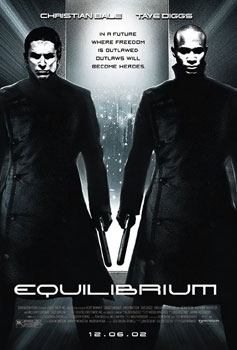
    –the inventor of the propeller beanie.

    I could not make this up!

    This is one of the principal joys of writing these reviews: discovering the lives of the authors and the things they made.

    I hope Ray gets remembered for his fiction, but even he admitted this wee cap is probably what’ll get his name into the history books.

    It’s little things like this that make life worth living: sunshine, hot coffee, and finding out a science fiction writer created a hat for nerds.

    Delightful.

    I’d love to tell you whether Ray can write the way he builds his headgear, but let’s touch base with Kelly Freas first.
    Cover

    13. Blake’s Progress by R.F. Nelson

    … wait a tit.

    Floating city… hawkman casting lightning… crumbling towers… rivers of blood… grim man picture-in-picture…

    Oh my God…

    … is this a Dark Souls Twitch stream?? I’m not hallucinating, right? You guys are seeing this too? Oh, man. Well, at least he’s not fighting the Fume Knight. Otherwise Blake would be making a very different face.

    Would You Like to Know More?

    What makes Fume Knight one of the most challenging bosses in the game is his large move-set and difficult tells to his attack animations and patterns.

    DKS2 Wiki

    The rage this fucker has induced in players from here to Japan is legendary, and many’s the gamer who has rage quit rather than face him again. Somewhere in the basement of a house in Scarborough, there’s a hole made by my brother’s fist which has been plastered over. It was made the first time he battled the Fume Knight.

    As far as Freas’s covers go, this one feels… off. Not bad–far from it!–but there’s definitely something jarring about the realistic sketch of Blake’s face, haloed in white, placed against the surreal image of an angel mopping the floor with some unfortunate people. It really puts you on the back foot and makes you feel uncomfortable.

    As always, that’s deliberate on Freas’s part. Blake’s Progress is a story of alienation from all familiar times and places, and Freas gets you started early on that. This is the kind of thing you could blow up on the walls of the Sistine Chapel and it would somehow work.

    Let’s see how Marketing Guy is doing.

    Blurb

    William Blake lived as no man had ever lived before. Sweeping across the centuries, he clashed with Cleopatra, chatted with Churchill, entertained with Ezekiel. His wife Kate was astounded at the man she had married. And she knew what she had to do! In this amazing account of Blake’s life, Ray Nelson tells it like it might have been, had Blake had his way. “There are wonders galore in this book… I don’t believe I’ve read a science fiction novel like Blake’s Progress before.” –Terry Carr

    Hmm, okay, Churchill and Cleopatra. Very promising. And while I’m not fond of wasting blurb space on quotes from other people, Terry Carr‘s words are at least short and to the point.

    Honestly… I’d be intrigued. I love people going on exciting journeys across spacetime, sweeping up their loved ones in the act–for good or ill.

    But can the story deliver?

    Story

    So first of all, Catherine Boucher and William Blake were real people.

    Blake (1757-1827) was a poet, painter, and printmaker who was largely unappreciated in his time. His Prophetic Books were dismissed in his time as being religiously problematic, but have since been reevaluated as unique, esoteric works of art. The more I read about him, the more William Blake feels like a character in an H.P. Lovecraft story: a man charting a hidden mythology and being dismissed by the rationalists of the world as a madman.

    I can’t speak to the quality or importance of Blake’s art. I’m already undertaking a forlorn odyssey in reviewing a series of 1975 Golden Age of Science Fiction revival novels; I’ve neither the time nor the inclination to add a foray into a late 18th century poet’s iconoclastic fantasyland, magical though it would no doubt be. But even a cursory reading of Blake’s biography reveals just how closely Ray Nelson cleaved to the source material.

    Even Kelly Freas took note:

    Look familiar?

    Catherine Boucher was the last child of market gardener William Boucher and his wife, Mary Davis. Though illiterate, Catherine demonstrated an inclination to art, and is credited as being the pillar which held William Blake aloft throughout his entire career. Blake took work as an engraver for printing houses in order to pay the bills, but frequently let that work fall by the wayside in favour of his own artistic pursuits. So, it fell to Catherine to pick up the slack and do the work so they could make rent.

    Would You Like to Know More?

    Okay, seriously, is there a Deadbeat Dead Poets Society that got created around the turn of the century?

    People romanticize the Romantics, but in order to have the time to write their best work, these guys put the burden of supporting them entirely on their families, avoided work like the plague, and gaslit their spouses into believing that “free love” (read “infidelity”) was the way God intended things to be.

    I’m so glad the conversation around these men finally started turning around. From a feminist perspective, you can point to any one of their works and say, “there is a deep, emotional cost attached to this poem’s creation–a cost that was paid by a woman.”

    Neither Golden Age of Sci-Fi novels nor period dramas set in the 18th century typically position a woman as the protagonist, so you can imagine my delight and surprise when I learned that Kate Boucher is the protagonist of the story!

    The tale begins with the Four Zoas (beings from Blake’s mythology). They travel to and fro across time, observing, but never interfering, until one day, Urizen wonders why don’t they interfere? Why don’t they make the world into what they please? The other Zoas don’t like this idea, but they are too late to stop Urizen from vanishing into the timestream.

    Fast forward (or backward?) a few thousand years, and Kate Boucher has butterflies about her imminent marriage to William Blake. They’ve had a brief courtship, but have decided they are right for one another. She signs the wedding certificate, they’re wedded, but never bedded–Blake has some hangups about sex. That’s okay. They’re happy.

    For now…

    Kate notices some odd behaviour on William’s part. He speaks with people late into the night, walks through a door of the house and comes back in a split second looking wild-eyed and disheveled. His work takes on a strange, esoteric tone. Finally, Kate begs to be let in on the mystery.

    William reveals that, since he was a child, he’s been visited by a being called Urizen, who looks like an angel, but isn’t one. Urizen has plans to build a new world by rewriting the past, and they want Kate along for the ride.

    But when Kate finds out they intend to do this by killing people at different stages of history, she’s mortified.

    Would You Like to Know More?

    In a true Golden Age story, Kate would be cast as the unreasonable female who can’t see the necessity of the male characters’ actions. Nelson flips this so that she is the sole voice of reason in Blake and Urizen’s insane world. Hers is the only conscience in sight, in this timeline or any other.

    In fact, Nelson consistently does a good job of putting the reader in the mind of a woman who is not only struggling to make her way in her own time, but trying to stop a strutting egoist as he attempts to erase everything she knows.

    Having been taught how to step out of spacetime by Blake, Kate takes on the mantle of the preserver of history. Much like in Serving in Time, we have two factions battling for their own perfect version of history, with all of humanity and William Blake caught in the middle.

    Social Commentary in Blake’s Progress

    There’s a tendency in a lot of time travel fiction to position organized religion (usually Christianity) as a destructive force in human affairs. In the novel, Urizen seeks to correct this by allowing a kind of animism–the worship of the sun–which espouses peace and cooperation.

    But inevitably, the same thing happens as happened with Christianity: systems of power became entrenched and perverted a message of peace into a licence to exterminate all those who are different.

    Urizen’s fundamental misunderstanding about humanity is that he can change the circumstances of our development all he likes, but the end of the day, we will still be human, and still flawed. Kate sees the detritus of his efforts all across the various histories that are born and unborn.

    The Triumph of Woman

    Ultimately, Kate realizes that she and her husband–now firmly back on her side–cannot defeat Urizen in a head-on confrontation, so her only hope is to outwit him. And she does so by discovering depths of power in the Zoas’ time manipulation techniques that not even they suspected. There’s a thrilling scene where Kate realizes she can multiply herself by backstepping one second at a time, creating a tsunami of Catherine Bouchers that wage war on Urizen across the timestream. It’s hilarious and invigourating seeing a tidal wave of 18th century urban housewives fighting an army of evil angels on the deck of Cleopatra’s galley.

    Ultimately Kate defeats Urizen by stepping outside not just her timeline, but all timelines, and is able to destroy all versions of Urizen at once before they embark on their crusade to alter history. I absolutely love that Kate wins by taking the high ground, metaphorically, metaphysically, and literally. It’s a terrific conclusion to a surreal dreamscape of a book.

    Conclusions and Recommendations

    Blake’s Progress is the strangest, most outlandish story yet featured in the Laser Books. It takes a pair of historical figures and sends them on a journey that mirrors the works of William Blake. You don’t need to know anything about Blake or Catherine to enjoy it. It’s a strong start to the next dozen Laser Books.

    What’s weird to me is that… I’ve actually read lots of stories like this in the canon of science fiction, but the way Nelson flips the narrative by placing a woman at the centre and challenging a lot of the assumptions both of his chosen time period and genre makes this a very magical unicorn of a novel.

    Catherine is an incredibly grounded protagonist: she definitely feels like an 18th century housewife in that she wants a safe, stable life with her partner, but she’s not spineless. Far from it: she goes to superhuman lengths to save the world thousands of times over, shows ingenuity to rival the gods, and withstands more emotional shocks than any person in her situation could be asked to endure. She’s a bundle of contradictions and convictions and you just can’t help rooting for her.

    My Goodreads Review

    A book whose title should probably be “Blake’s Acid Trip”, this novel takes the cliches of the Golden Age and flips them upside down, placing a woman in the driver’s seat of the narrative and taking you on a whirlwind tour of history, the afterlife, and one troubled poet’s weird view of creation. This novel has to be read to be believed.

    This was a great palate cleanser after the bullshit that was The King of Eolim. I’m suddenly feeling a lot better about life.

    Now… who’ve we got on deck?

    Who’s Next?

    Eyy, speaking of putting a woman in the driver’s seat, we’ve got our next entry of the Laser Books written by a woman! Kathleen Sky coming in hot with #14: Birthright.

    Blurb it, Sam.

    In this towering adventure, Kathleen Sky has created an unforgettable character. Is Andros human or an android created by his scientist-father? Others besides Andros would like to know. The survival of an entire android civilization hangs in the balance. In his desperate search for the truth about himself, Andros discovers what terror means. But neither terror nor love will stop him from finding the answer. He must claim his Birthright.
    Kathleen Sky is a storyteller of the first rank

    Until next time!

  • Laser Books Review 12

    Laser Books Review 12

    12. The King of Eolim by Raymond F. Jones

    *sigh* I was having such a good fortnight.

    First, my publisher told me they liked my first round of revisions on Seekers of the Fallen Stars, were adding the novel to their editorial pipeline, and wanted a proposal for Book 2 pronto. Sent that over, and they said it was strong, and told me to get writing.

    Then Escape Pod emailed me saying they wanted to add my breakout novelette “EDIE” to their reprint catalogue and podcast it.

    Then I watched Project Hail Mary, and knew right away that it was going down as a sci-fi classic alongside 2001, Contact, and Interstellar.

    And then, just when life couldn’t get any more awesome, four astronauts–including a Canadian–launched to the moon for the first time since Apollo 17 in 1972.

    A great wave of optimism has swept the world as Reid Wiseman, Victor Glover, Christina Koch, and Jeremy Hansen took us with them, further than any humans have ever gone before. I have been living a dream.

    And then I remembered…

    … I have to review The King of Eolim.

    Raymond F. Jones, author of Book 1: Renegades of Time, returns for a second outing. And oh-my-various-gods, it is painful.

    I suppose, much like the crew of Artemis II, sooner or later, we all gotta come back down to Earth.

    Cover

    If there’s a slide scale for Kelly Freas‘s work, it would look something like this:

    Bad —— Workmanlike —— Excellent

    Eolim’s cover falls somewhere between Workmanlike and Excellent, closer to the former than the latter. I really like what Kelly is doing with light and colour, but I think he overdid it a touch on the sparkle. And I’m not sure why there’s two spaceships; the Bradwell family takes two trips through space, sure, but on the same ship. Pictured in the portrait is Freeman, the protagonist (and no, you can’t convince me his father is the main character) and his crown, which we’ll talk about later.

    Oh, we will talk about it.

    Overall, the composition and blend of colours is good, but the sparkliness is just a little too much. I think he could’ve toned down the lighting.

    Enjoy this positive feedback, good people. It’s all downhill from here.

    Blurb

    Adventure stories don’t normally make a point as well, but Raymond F. Jones is no ordinary adventure story writer. In this touching and beautiful tale, Forester Bradwell shares his son’s adventures and learns a lesson he will never forget. Neither will you. For Forester Bradwell is one of the elite in a time and society where stupidity and ignorance have been conquered by genetic engineering. But his son Freeman is a Retard. The King of Eolim is the story of the Bradwell’s search for a home that will truly be “home” for Free.

    If you read that and threw up a bit in your mouth, I wouldn’t blame you. I had the same reaction, and I’ll tell you why.

    Elementary school was the most excruciating experience of my life. I had good teachers and made some friends, but I was always the slowest kid at sports and scholastics, to the point where I was given a Special Accommodations rating to help me keep pace with my classmates in learning.

    In the Ontario school system, this means I was often separated from the rest of my class and put in a small group of students with similar learning or concentration challenges so that I could be taught in a quieter environment where teachers could spend more time addressing my needs. These sessions actually nurtured my desire to be a writer, because I had the time to express my desires to my teachers who in turn gave me the time and space to pursue them.

    But what bothered me for all those years is that I knew I learned differently from other kids, but I was still chained to the school system. Some of my fondest memories are of going to the school library, picking up a book, and reading. I could read whole books in one sitting, and if it was an educational or non-fiction book, I could frequently recall every single thing I read in that book for weeks afterward.

    And yet, if you put me in a classroom and tried to teach me math, religion, or science, my eyes would glaze over and my mind would shut down.

    And yes, I had the R-word thrown at me a few times. That is not something you forget.

    Reading the cover blurb for this novel, I knew exactly what kind of story I was in for. I hoped I was wrong.

    I wasn’t.

    Story

    This just in: Neurodivergent Youth Taken from his Abusive Family and Placed in Foster Care with Telepathic Aliens

    In a eugenics-based future, undesirable traits have been edited out of human beings, but occasionally, children like Freeman Bradwell are born who, while completely ordinary by today’s standards, with healthy imaginations and empathetic minds, are considered R—— by the standards of a society where exceptionalism is ordinary and cold calculation is prized.

    In school, Freeman’s “disability” is recognized by his students and teachers and he is crowned “King of Eolim”, in a perverse tradition that follows the wearing of a dunce cap.

    Would You Like to Know More?

    The dunce cap is a tradition stemming from the 19th and 20th centuries. Children at school who were considered slow or disruptive were brought to the front of the class and forced to wear a pointed cap with a D or DUNCE printed on it. Modern psychologists agree that these “problem children” were likely kids with ADHD or who would’ve benefitted from special learning accommodations, or even who simply didn’t gel well with the school system.

    Kids like me, in other words.

    While a normal practice, there were many who, even at the time, called it debasing and harsh . I cannot imagine the psychological damage that was done to children with brains like mine because of it.

    The saddest thing is, Freeman knows he is being made fun of, but he tries to wear the crown with pride as a way of undercutting his abusers. He demonstrates a remarkable strength of will considering his young age and his lack of allies in this cruel society.

    His worst abusers are his parents. His mother won’t show him an ounce of love, and his father Forester wants to take his family away from Earth so he won’t have to listen to his colleagues demean him for having a R—– son. So they fly away in a spacecraft and crash-land on an alien world, Iduna-style.

    Throughout the novel, Forester belittles Freeman, disregards his ideas, and even when Freeman calls the attention of an alien tribe to assist his family after their crash landing, Forester takes it upon himself to assume the role of colonizer and indoctrinate the aliens into human ways of thinking.

    Oh yeah, and he frequently equates the aliens to Freeman because of their wide-eyed, dim-witted innocence, and denigrates them for sacrificing many of their number to stop Forester from taking Freeman away from them–Freeman, at this point, having become their friend.

    Forester and his wife, seeing that Freeman is happier on this alien world they’ve come to, leave him there and go back to Earth. At the end, Forester and his wife come to love Freeman, but they still think it’s for the best to leave him behind.

    Conclusions and Recommendations

    I’m sorry, guys, I have to wrap this up. I would’ve gone into more detail of the plot, but this book is too painful for me to talk about any longer.

    There have been many well-intentioned attempts by sci-fi authors over the years to address issues such as race, sex, and neurodivergence, but lacking in modern resources and studies, such attempts were inevitably clumsy, and often harmful. The King of Eolim is one such attempt.

    My Goodreads Review:

    Raymond F. Jones is a veteran of the genre. He was a regular contributor to Astounding (Analog) and Galaxy. His last outing in the Laser Books, Renegades of Time, had some good scenes in it. But King of Eolim, however well-intentioned, is a deeply harmful book, and in the world of modern science fiction and neurodivergent studies, it has no place.

    I can’t be too harsh on Jones, I’ve written some well-intentioned but deeply harmful stories myself, but I also had the benefit of living in a wiser society, with gentle, educated friends, who showed me where I mis-stepped and where I could do better. Maybe Jones could do better if he were alive today, maybe not.

    But let this stand as a cautionary tale to writers everywhere, including myself: educate yourself before you write, lest your pen draw blood.

    And with that… we’re one-fifth done the Laser Books. The King of Eolim marks the end of the initial run of 12 novels. Let’s see where Roger Elwood takes us next.

    Who’s Next?

    Lucky 13 is Blake’s Progress by R.F. Nelson. Blurb it, baby!

    William Blake lived as no man had ever lived before. Sweeping across the centuries, he clashed with Cleopatra, chatted with Churchill, entertained with Ezekiel. His wife Kate was astounded at the man she had married. And she knew what she had to do! In this amazing account of Blake’s life, Ray Nelson tells it like it might have been, had Blake had his way. “There are wonders galore in this book… I don’t believe I’ve read a science fiction novel like Blake’s Progress before.”–Terry Carr

    Well, you know, one mention of ole’ Winston C. and I’m on board. I’ll see you all then!

    Addendum: Artemis II

    As I write these words, the Orion spacecraft Integrity is falling back down Earth’s gravity well, on target for a splashdown April 10th at 7 o’clock. Godspeed, Artemis II. The whole world is wishing you four a safe and uneventful return.