Tag: Book Review

  • Laser Books Review 5

    Laser Books Review 5

    5. Walls Within Walls by Arthur Tofte

    Listen carefully. I don’t know how much time I have.

    I had to leave my house–drop everything, cut through the back field, cross the neighbour’s vineyard, and run ten kilometres toward town. From there I hitched a ride on a maple syrup truck south through Codrington to the 401, and thence to Cobourg. Tried to rent a car but my credit card bounced–should’ve known he’d have thought of that–so instead I paid cash for a train ticket to Ottawa.

    He was on the train.

    I thought about contacting my friends in Ottawa, maybe hole up at one of their places, but I realized that would just put them in danger. I slept on the bridge to Gatineau. My God, it was cold.

    Saw a shadow moving in the night. Knew it was him.

    He had the book with him.

    He’s always right behind me. I can’t outrun him. But that’s okay. If–when–he catches me, I’m going to give him what he wants.

    Just not the way he wanted it.

    I’ve got it all figured out, you see. He wants me to tell him his book is good, that it’s a great work of science fiction, but he’s from the 70s. He’s not canny with computers–even his characters aren’t; they talk about smashing them up all the time. He’s regressive. He touts “the old ways”. Fair enough.

    By the time he realizes I’ve tricked him, it’ll be too late.

    Speak of the Devil; there he is now, coming into the internet cafe. Yes, I see you Arthur. I’m ready.

    Give me the book.

    I don’t know what kompromat Arthur held over Roger Elwood to blackmail him into buying a second title so soon after the first, but it must have been serious. And, unfortunately for me, Elwood isn’t the only one getting screwed because I now have to read what he bought. I do not have high hopes after Crash Landing on Iduna, so lets see if Tofte can redeem himself.

    But before we cover Art, let’s start with cover art.

    Cover

    Speaking of blackmail, thanks to my swift intervention and the heroic efforts of the Ontario Provincial Police, Kelly Freas is no longer being threatened by the Marketing Guy to turn in shitty cover art.

    For this entry, he instead turned in a cover the colour of actual shit.

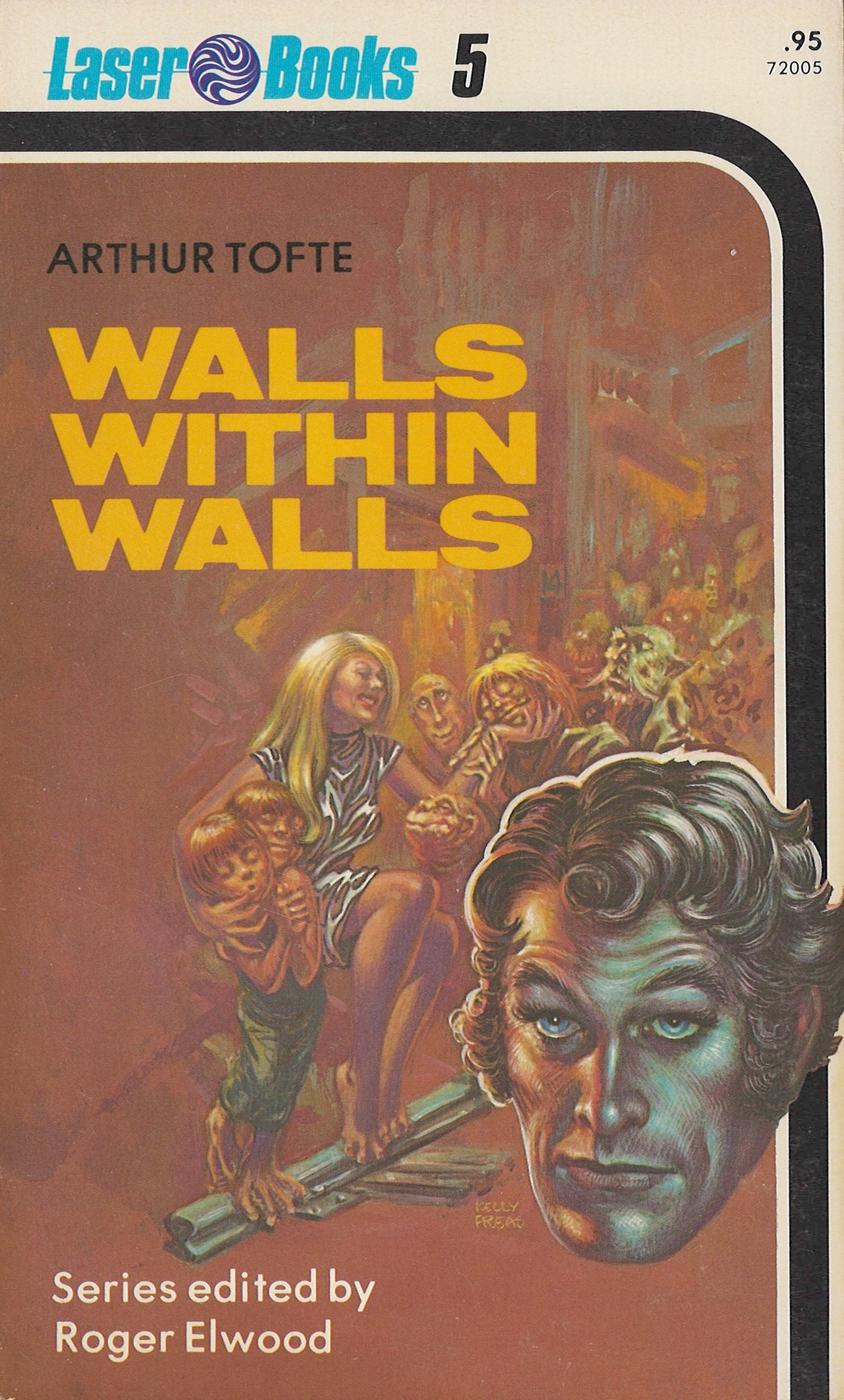
    Before you get on my case, I want the record to show that I don’t dislike this cover art. It’s… fine. This is one of Freas’s more workmanlike pieces. It depicts elements of the story: the mutants of Destruction City in the background, Rolf (the protagonist) is in the portrait, and lighting is used to suggest a ray of sun shining down into the caverns where the mutants dwell. But there’s no flair, to it, no creativity, no spark, and the colours all congeal into a hodgepodge of blandness.

    Also I’m troubled by the depiction of the mutants as some kind of carnival sideshow. Bodily deformities being used a selling point for sci-fi is such an outdated idea.

    But then, the Laser Books’ mission statement is about bringing back Golden Age sci-fi, so what else should I expect?

    Would You Like to Know More?

    Now these guys know how to do mutants.

    Blurb

    For sixteen years Rolf’s parents had kept him hidden away from the society in which they lived. His twin brother was able to move about freely and indeed was regarded by all as a young man of talent and great promise. But Rolf was a mutant and, as such, illegally alive. What happens when he escapes from his hiding place and discovers a whole world of mutants living underground, beneath the highly controlled technologically advanced city that had been his prison, is the main thread of Arthur Tofte’s engrossing tale. The city was never the same again. Nor, perhaps, will you be after you read it.

    I had horrible nausea at the end which I didn’t have at the start, so no, I was not the same after reading it.

    There are a million science fiction books in the world with blurbs exactly like this one. I’m still mad at Marketing Guy for what he did to Freas, and I still think his blurbs are mostly mediocre, but for once, he’s not to blame. He’s been handed a cliche story and told to pitch it to a highly discerning New Wave audience. Even Don Draper would struggle to find an angle on this.

    Would You Like to Know More?

    1975 was a year when Ursula K. Le Guin‘s The Dispossessed, Philip K. Dick‘s Flow My Tears, the Policeman Said, and T.J. Bass‘s The Godwhale were cleaning up at the Nebulas and Hugos. With these titans of sci-fi on bookshelves, do you really think anyone is gonna reach for novels with blurbs like the Laser Books have?

    Story

    DWAYNE: Please, do not be frightened, we’re harmless.

    RAOUL: I have three arms.

    DWAYNE: I said “harmless” not “armless”.

    VYOLET: Lay off him. You know he’s only got one ear.

    — Futurama, Episode 205 “I Second that Emotion”

    Well, it was easier to read than Crash Landing on Iduna, but not by much.

    The story unfolds exactly how you’d expect. The world and its characters dwell in a postwar society (Resurrection City) created to ensure the survival of the human race. They do this in part by wiping out anyone who presents with heavily mutated DNA, but they don’t always get everyone: many flee to the old sewers beneath the city (called Destruction City), which contain ruins of whatever settlement Resurrection is built overtop of.

    It’s a genetic twist on the behaviourally-controlled world of Seeds of Change‘s enclosed city (check out my review for that book).

    Rolf ventures into the undercity, meets a mentor figure, educates himself, gets discovered by the authorities, and has to flee to the other side of the wall separating Resurrection City from the rest of the world. He gets a taste of rough living, realizes he can’t leave Resurrection without doing something about his brother Ralf and the unjust regime there, so he goes back. Ultimately he discovers what you all probably guessed early on: that everyone in this city carries “the taint of mutation” since the war. The society’s built on a lie and every scientist is complicit.

    But of course, this is Arthur Tofte, so we’re in for some deeply uncomfortable flourishes like Rolf, as a child, spying on his neighbour Elissa, also a child.

    One very hot day I was at my secret perch at the side wall when she came out dressed, as usual, in her short white tunic. She started to lie down in the grass, stopped and glanced back toward her house.

    I could even hear her giggle as she lifted her tunic over her head. She had nothing on underneath.

    Almost as if she knew I was watching and she wanted me to look at her, she lifted her arms overhead and turned slowly, her face raised to the sky, to let the hot sun beat down on all parts of her. — page 19

    And he waffles on about how her body looks for a few paragraphs. When I read this page, I knew I wouldn’t be allowed to just glide through a mediocre sci-fi novel. I would be forced to endure some deeply uncomfortable passages before I could close this thing.

    There are musings on genetic purity, the importance of wilderness living (idyllic pastoralism again, really?), and even a suggestion by another character that Elissa’s cold shoulder could be cured if Rolf rapes her, and that if Rolf doesn’t do the job, this other character will happily do it.

    I can’t even look up who makes this suggestion. I don’t want to revisit that unpleasantness; I’m already going to have a hard time facing the women in my life with this book in my brain.

    Conclusions and Recommendations

    Look if you want a good story about mutants, I can recommend some excellent Futurama episodes. If you want a good story about in-groups, out-groups, preconceptions, and sexual frustration, there are plenty of better stories; some written by other authors in the same period as the Laser Books, and some appearing in the Laser Books themselves. Your own good judgment will probably steer you better in this department than I could.

    Would You Like to Know More?

    The biggest award-winner of 1975 was The Dispossessed, by Ursula K. Le Guin. It’s a wonderful commentary on anarchism, capitalism, societies estranged from one another, and how even societies that espouse personal freedom will find novel ways to limit that freedom in the name of economic security and infrastructure development.

    My Goodreads Review

    This is a superfluous book in sci-fi canon whose one virtue is that it’s not as bad as some others in the series. But there is no reason why you’d want to pick this up, aside from, like me, a desire to collect the entire series. Give this one and Crash Landing on Iduna a pass for your own sanity. They are both mediocre-to-bad books and are two of the weakest entries in the Laser Books. If you want good stories about mutants, go watch Futurama!

    And with that, I close out this third bummer of a review. With luck, Arthur will never realize I sabotaged him. He’s leaving the cafe now, taking the book with him.

    I am free.

    Who’s Next?

    Actually, we’re all free! The three books I’ve just reviewed–Crash Landing on Iduna, Gates of the Universe, and Walls Within Walls— comprise what I’ve (un)affectionately dubbed the Trench of Sadness in the Laser Books collection.

    At this point in my reading, I was beginning to despair that all the remaining books would be of this quality, but Stephen Goldin‘s Herds gave me hope that there still might be some gems out there; It convinced me to keep reading.

    I’m glad I did, because our next book, ladies and gentlemen… is Serving in Time.

    Blurb

    Jan Jeroux is leading a carefree and idyllic life in the serene, underpopulated pastoral earth of the year 2500. His idyll ends abruptly when he is abducted and forced to join the Time Service of the mysterious world government. In the service he learns how history was manipulated and controlled to produce the beautiful world he enjoyed so much. Thinking he understands how to rectify the injustice and devastation inflicted on the world by the time managers, Jan decides to make things right. But he makes a tragic error…

    Geez, I know I’ve harped on about idyllic pastoralism, but this is the one mention of it that’ll get a free pass.

    This novel, penned by Gordon Eklund, is the one that convinced me to start writing about the Laser Books. It’s a book that inverts several familiar sci-fi tropes and delivers something truly original.

    If you haven’t been vibing with the last three reviews, I promise you, this is one you won’t want to miss. It’s only a week away, and I’m stuck here in an Ottawa internet cafe. I hope I make it back in time…

  • Laser Books Review 4

    Laser Books Review 4

    4. Gates of the Universe by Robert Coulson and Gene DeWeese

    Our first pair of cowriters materializes in the Laser Books in the personages of R. Coulson and G. DeWeese. Behold what they have wrought!

    Considering the restrictions Harlequin placed on the Laser Books I’m keen to see if two heads are better than one. Let’s dive in!

    Cover

    …

    …

    …

    *sigh* Okay look, Kelly.

    I’m willing to give you the benefit of the doubt and say that, between this and Crash Landing on Iduna, maybe you were having an off-week. Probably flu season, right? Okay? Please? You’re gonna be back on form with the next title, right? Because I’m sorry man, you cannot keep doing this.

    There’s even more negative space than on your last cover! And the colour gradient is so similar I feel like you changed one digit on each of your hexadecimals and called it a day. This not why Elwood’s paying you the big bucks.

    Wait… did he withhold your paycheque for this month? Is that why your work is suddenly so bad? ‘Cause if that’s the case I will call up my lawyers and we’ll get this straightened out.

    No? It’s something else? But what could… oh my God, is it Marketing Guy?! Is he threatening you, getting you to reduce the quality of your art so his cover blurbs stand out more? Don’t speak, don’t do anything, I’m just going to turn the book over and point to the blurb, and if you are in danger, just nod your head once, slowly.

    Blurb

    Operating a bulldozer may be exciting, but it’s not normally exciting in the way that Ross Allen found it. The fact that he was a science fiction writer on the side had nothing to do with it. There was something strange about the rock he struck with his machine. Even stranger was what he found inside it. But that was only the beginning. It led him to Orl who was brilliant and likeable, even if a bit odd by human standards. It brought him to Kari who was beautiful, but far different from any woman he’d ever met before. It led him to a world he could never have dreamed up himself.

    OPP Transcript–19/01/2026

    Operator: 911, what’s your emergency?

    James Dick: Um, yes, operator, I think my friend is being threatened!

    Operator: All right, stay calm, sir. Can you describe the nature of this threat?

    JD: He’s a cover artist for a line of sci-fi books and he’s being made to reduce the quality of his work so that sub-par marketing blurbs can stand out. I–I just–I don’t know what to do!

    Operator: I understand completely, sir. Please just tell me: how bad is the quality of the blurb?

    JD: Well it’s… it’s not the worst I’ve ever seen, but it’s… it’s just mediocre. It’s meandering, doesn’t go anywhere, doesn’t say anything concrete about the book, and it… it… I’m sorry, this is really quite confusing.

    Operator: You’re doing very well, sir. We have officers en route. Just a little longer, sir. One final question: do you feel enticed to buy the book?

    JD: No, not at all.

    Operator: Good, good. We’re going to resolve this soon. Our officers are arriving on the scene now and they’re going to take over from here.

    JD: Oh, I can see the flashing lights! Kelly, we’re saved!!

    END TRANSCRIPT

    Story

    So um… there’s this story, right? And… it’s a… a sci-fi story.

    All right, I’ll be brutally honest with you. I cannot remember anything past page 9 of this book.

    I know for certain I read it cover to cover last year, otherwise I wouldn’t have moved on with this series, but aside from sentence fragments and bits of scenes, I cannot for the life of me recall anything clearly other than Ross getting teleported to the alien planet with his boss Kujawa.

    I’m so sorry, I’m truly at a loss! If you put a gun to my head right now and said, “Give me a synopsis or I’ll pull the trigger,” my response would be, “… you’d better pull the trigger.”

    I toyed with the idea of rereading this book for this review, but then I thought, “Why?” If this book left so little impact that I can remember only 0.5% of it, it’s not a book worth recommending, so what would be the point?

    Okay, here’s what I’m sure of:

    • Ross and his boss Kujawa accidentally travel to an alien planet via some kind of Stargate hidden under the construction site they’re working on.
    • Kujawa is killed… somehow. Pretty sure it’s Ross’s fault.
    • Ross falls in with a woman named Kari (pictured on the cover) whose brawn is greater than her brains, and Orl, a lizard-man whose brains are greater than his brawn.
    • Ross learns the planet is a sort of Union Station for Stargates, all leading to other parts of the universe.
    • Together they face some kind of alien threat.
    • Ross and Kari win the day, open the gates, and fly off into the sunset.

    Beyond that, I cannot recall specifics. So… yeah…

    My Goodreads Review

    I read this last year and cannot remember a single thing about it beyond page 9. This has been the single most unmemorable book I have ever read. Take that for what it is.

    This is a bummer. I feel like I’m shortchanging you guys with this review. Maybe next week will be–

    Who’s Next?

    5. Walls within Walls by Arthur Tofte

    Blurb

    For sixteen years Rolf’s parents had kept him hidden away from the society in which they lived. His twin brother was able to move about freely and indeed was regarded by all as a young man of talent and great promise. But Rolf was a mutant and, as such, illegally alive. What happens when he escapes from his hiding place and discovers a whole world of mutants living underground, beneath the highly controlled technologically advanced city that had been his prison, is the main thread of Arthur Tofte’s engrossing tale. The city was never the same again. Nor, perhaps, will you be after you read it.

    No… no it’s too soon! He can’t be back, he just can’t be! I only just finished Crash Landing on Iduna! I’m not mentally prepared for this!

    All right… all right, just breathe, just breathe.

    It can’t be that bad, right?

    … right?!

    Aaaaahhh!!

  • Laser Books Review 3

    Laser Books Review 3

    3. Crash Landing on Iduna by Arthur Tofte

    Well, life can’t all be sunshine and roses.

    Sometimes it’s cottagecore and fascism.

    This book is where the problem in “bringing back Golden Age sci-fi” shows itself: people think they want to go back, but they really, really don’t.

    Take John W. Campbell, editor of Astounding (now Analog) for example. He was a man of deplorable convictions who, according to Isaac Asimov, “Never had an unkind word to say about Hitler.” Many of the stories he championed depicted “supermen” (always white), degraded women, and positioned people of colour as evil.

    Would You Like to Know More?

    Cory Doctorow published an excellent opinion piece in Locus Magazine about Jeannette Ng‘s acceptance speech at the John W. Campbell Awards in which she called out both Campbell and the people who celebrate him.

    Crash Landing on Iduna romanticizes an imagined past.

    There’s a lot I have to unpack so let’s hurry up and crash the bloody ship already.

    Cover

    Even Freas has mentally checked out.

    Look, I’m not gonna sugar-coat it: this is one of Kelly Freas‘ most boring covers.

    I mean, look at all that negative space! You should be ashamed of yourself, Kelly. There’s a poor marketer starving for real estate on the back cover and here you are, throwing it away for nothin’.

    Front-and-centre we’ve got Chewbacca fondling Dolly Parton, and in the background… I can’t even tell what’s going on. Is that some kind of alien? What’s that dude on the left running through? Water? Tentacles?

    The blue-eyed devil on the right is Lars Evenson, the father of the Evenson family. I’ve got a bone to pick with him later.

    Blurb

    When a spaceship crashes, the survivors are in peril for their lives. When the planet and its inhabitants are unknown to the survivors, fear becomes tangible among them. When the survivors are a crippled man and his four children the odds against survival increase dramatically. When the entire family has lived a controlled, docile, protected life and has been deliberately kept passive by the managers of the society on earth from which they came, the situation looks hopeless. But when two of the survivors are Peder and Inga Evenson there is always hope. This is their story.

    Congratulations, marketing guy, you started every sentence of this thing but two with “When” and failed to capitalize “Earth.” You were lazy and disrespected Momma E. Hang your head in shame.

    Neither this nor Freas’s cover would entice me to buy this book, and I was not looking forward to reading it. But you know, I like to give people the benefit of the doubt. Maybe Freas and Marketing Guy had the flu that week, and that’s why Freas chose puke-green for the cover and Marketing Guy gave us a hundred words of fever drivel.

    Where art fails, maybe Art can succeed!

    Story

    Can’t believe my tree cousins were cut down to print this book.

    Nope.

    Buckle yer fuckles, good people, we’re in for a bumpy ride.

    On Earth, all needs are met and there are no wars, no strife, no scarcity. Jobs are optional and all your prescriptions are free. Sounds great, right?

    Lars Evenson doesn’t think so. He pines for the frontier lifestyle.

    When men built cabins in the woods and provided for their families. When human beings hunted and skinned animals in the woods. When people struggled with nature. When the average life expectancy was under fifty. When a cut finger could kill you. But when Lars breaks his leg in the first five minutes, he finds out just how much the past sucks. This is his story.

    (See, Marketing Guy? I can do it too!)

    Believing that true humans must struggle to survive, Lars packs up his whole family into a spaceship, flies it to an alien planet, gets his wife killed and himself crippled trying to land the thing, and his children have to shoulder the burden of survival.

    If Lars were around today, he’d be part of the cottagecore movement and his wife would have a tradwives TikTok — except they wouldn’t be around because they were vaccine deniers and measles and COVID tag-teamed them into an early grave!

    Would You Like to Know More?

    I recently read Philipp Dettmer‘s book Immune and found out why measles is such a scary disease. Like all viruses, measles reproduces by penetrating cells, hijacking them, and using them to make more of the virus, which then spreads to other cells to repeat the cycle.

    But measles is a special fucker in that it attacks Memory T and B cells. These are the cells in which the records of your body’s encounters with diseases are encoded, and they are the reason why you can’t get sick from the exact same virus twice (unless it mutates, as all viruses do, which is why vaccines are important).

    Once you survive a disease — influenza, common cold, COVID-19 — your body preserves a sort of “battle record”: what the enemy looked like, how they attacked you, and most importantly, which antibodies ultimately stopped the invasion. This is where “immunity” comes from: the memories of the battles your body won.

    Measles destroys those Memory cells and the records within, erasing the information your body needs to repel those diseases. Memory B cells in particular are a devastating loss because their records stretch back decades, possibly to the time you spent in your mother’s womb. And as we all know, some diseases like chickenpox are usually mild if we contract them as children, but potentially lethal if contracted as adults.

    So if you survive your bout with measles, you might actually be susceptible to hundreds, even thousands, of pathogens you already beat, and you’ll have to face them all again — get sick from them all again — to reacquire your immunity.

    So please, for the love of God, vaccinate yourself and your children!!!

    A few months after landing, Lars’s children, Inga and Peder, discover two tribes of aliens living on the planet: an aggressive one and a docile one. The family rushes to the aid of the docile one because white saviours, and after spending some time on Iduna, they set up a distress beacon and plan to go back to Earth to show people how sexy it is living that frontier lifestyle.

    I’m not joking: Peder sends his siblings Sven and Bretta back to Earth in the hopes that, once people see how toned you get building cabins in the woods, they’ll try it for themselves.

    They would be like a god and goddess out of man’s past… a past that could point to a better future. — page 190

    Conclusions and Recommendations

    Up until now, the Laser Books have been either harmless or entertaining. Crash Landing on Iduna is neither: the ideas it espouses are harmful and its story is incredibly boring.

    Idyllic pastoralism has been a staple of every regressive, exclusive, hateful ideology from Naziism to the Deep South alt-right because it extolls a past when men did not have to share power with women, their word was law, and the strong were determined through violent struggle.

    We find idyllic pastoralism so seductive because, in one sense, it is correct: we should co-exist with nature; we should find value in hard work; we should want to be masters of our own destinies.

    During COVID, cottagecore started as a movement among the LGBTQ+ community and flourished because people suddenly had the time to discover or rediscover simple joys: growing their own food, baking bread, handcrafting art.

    “But where our hearts truly lie is in peace, and quiet, and good tilled earth, for all Hobbits share a love of things that grow.” — Bilbo Baggins, The Lord of the Rings: The Fellowship of the Ring (2001)

    But what always happens with movements like this is that some asshole steps in and says, “Let’s go one step further… let’s also adopt traditional gender roles and morals,” when all we really wanted to do was bake nice bread and grow pretty flowers.

    I’ve spent many summers hiking and camping in the wilderness and I will be the first to tell you: I do not want to live there.

    I love reconnecting with nature, and I wouldn’t trade my adventures for anything. But when it’s minus ten degrees Celsius in a foot of snow and you can’t get a fire started, or you’re at death’s door in fifty degrees of desert heat, or you’re struck down with fever in a forest and you don’t have antipyretics, you understand why humans don’t live like that anymore.

    It fucking sucks.

    We need to walk in green places.

    We need to create things with our own two hands.

    We need to have the freedom to choose our path.

    But we should not idealize the past. Few words get my hackles up faster than, “Things were better when…”

    My brother’s an historian and I asked his take on this subject. I love his answer.

    “If there’s an amenity our ancestors would’ve killed for — hot shower, ready-made meal, warm bed — I will use it to the fullest, because they could not.” — Sean Dick

    Would You Like to Know More?

    Star Trek: Deep Space Nine did a phenomenal take on the sheer insanity of idyllic pastoralism with its season 2 episode, “Paradise”.

    Where was I? Oh yes. Crash Landing on Iduna. Can’t possibly be saved. This kind of book should never have been written.

    Recommendation

    “There be work for the axe. Take them behind the sauna, jumalauta.” — Ahti, Control

    Shoot. Almost forgot my Goodreads review!

    A frontier fantasy with every conceivable trope you might expect from that genre, including the white saviour. It touts idyllic pastoralism and positions its characters as heroes for choosing a life where they might die at any second from eating the wrong plant. This kind of backwards tripe should’ve died with the 1930s era of science fiction, but sadly, I predict us being plagued by it in the 2030s. Do yourself a favour and don’t read this book.

    That oughta do it.

    I gotta say, I’m not looking forward to the next appearance of Arthur Tofte in this series. He wrote Laser Book 5, so after our next title, we’re back in this man’s imagination. Mercifully, however, that will be the last we see of him in this series.

    Now, who’s on deck?

    Who’s Next?

    Gates of the Universe by Robert Coulson and Gene DeWeese, our first double act in the Laser Books.

    Blurb

    Operating a bulldozer may be exciting, but it’s not normally exciting in the way that Ross Allen found it. The fact that he was a science fiction writer on the side had nothing to do with it. There was something strange about the rock he struck with his machine. Even stranger was what he found inside it. But that was only the beginning. It led him to Orl who was brilliant and likeable, even if a bit odd by human standards. It brought him to Kari who was beautiful, but far different from any woman he’d ever met before. It led him to a world he could never have dreamed up himself.

    So… the protagonist… is a writer…

    … a sci-fi writer…

    … I’m gonna need another drink.

  • Laser Books Review 2

    Laser Books Review 2

    2. Herds by Stephen Goldin

    They’re moving in herds. They do move in herds. — Dr. Alan Grant, Jurassic Park

    With Raymond F. Jones‘s Renegades of Time behind us, it’s time to ring in the New Year with Stephen Goldin’s first Laser Books entry.

    This will not be the last tale we get from Goldin either; as mentioned in my previous review, this author spun four yarns across the run of 58 Laser Books. Guess we’ll see if his talent merits repeat appearances.

    But first, of course, we must pay due deference to the almighty Kelly Freas and his cover art.

    Cover

    O-ho, delicious!

    This book is very much a tale of opposites: light versus dark, generosity versus greed, community versus self-centredness. Freas captures that expertly with his use of contrasts: cold and warm colours juxtaposed in two opposing parts of the frame. Note how the Zartics occupy a lofty, heavenly position over Wesley Stoneham (the portrait) who is surrounded in a lower, baser position by the flames of hell.

    By placing a shining bright star above the Zartic city — a star which calls to mind that which shone over Bethlehem which caught the attention of wise men from a far distant country to bring gifts to Christ’s crib — Freas suggests that the Zartic way of life (communal, unselfish) might be the ideal we all should aspire to.

    Would You Like to Know More?

    There have been many scientific attempts to explain the Star of Bethlehem in the two thousand years since it occurred. This article by Astronomy explores some of those theories.

    Additionally, check out Arthur C. Clarke‘s landmark science fiction short story, “The Star”, for a truly heartbreaking study of this odd question mark in the annals of history.

    Also, even though Freas is following a formula prescribed for these covers by Harlequin, he still manages to reflect Stoneham’s ego by making his head appear just a hair (ha-ha) larger than his comrades on the other Laser Book covers.

    I don’t even feel like I can make jokes about this, it’s just a solid, well thought out cover. Great work, Freas!

    Blurb

    The wife of a powerful figure in California is found brutally murdered in the couples’ lonely mountain retreat. Wesley Stoneham made certain that all the evidence concerning the murderer of his wife pointed to a nearby hippie community. He had three goals in mind: to get rid of his wife, to drive out to the hippie commune and to enhance his own power in the State. He was at the point of achieving them all when Garnna, from the peaceful planet of Zartic finally made contact with Debby, a hippie from the commune, who had problems of her own. Then Stoneham’s troubles began.

    Looks like we got ourselves a good old-fashioned “howcatchem?” with a sci-fi twist! Unlike other Laser Books blurbs, it feels like the premise of a New Wave sci-fi tale, rather than a Golden Age one: a corrupt politician as a villain, a hippie from a commune for a heroine, and an alien from across the stars as a trusty sidekick. Golden Age stories typically position politicians as authority figures (or at worst, harmless buffoons), hippies as deviants, and aliens as either angels or demons.

    Actually, I can think of a fair few Golden Age short stories by Arthur C. Clarke that have similar premises: an alien helping a human put right what once went wrong. But in a post-Watergate world, a story like this takes on a new sense of urgency — and Watergate was only three years old by the time Herds was published.

    Again, I can’t really make jokes. The blurb works! So why don’t we just dive right in and see if this book is all that it promises?

    Story

    “… people won’t vote for a man who has been charged with a capital crime, even if he’s innocent.” Maschen, Herds

    Oof, this hits too close to home…

    The book reads exactly like an episode of Columbo (the episode I’m thinking of is “Candidate for Crime“, which aired two years prior to Herds‘ publication… and one year after Watergate… hmm) which is one of my favourite shows, so that alone pushes all the right buttons for me.

    Would You Like to Know More?

    If you haven’t seen Columbo, or you’re already a fan who craves some behind-the-scenes trivia, check out the comprehensive and sprawling Columbophile Blog. Here, you’ll find reviews of every single Columbo episode (including the two TV movies that first gave us the Lieutenant), series facts, and rankings of the best (and worst) of actor Peter Falk’s outings as the iconic detective. And, if you are a newcomer and want a taste of what this show has to offer, the blog also has links to a handful of full episodes free on YouTube!

    But what I love most about this book is the commentary on power and society, and how we view certain people as credible and others as incredible. Stoneham, as a politician, naturally curries favour with other politicians, local law enforcement, and the media. His attempt to pin his crime on a minority is a base, cynical act, but sadly one which feels all too familiar in Donald Trump’s America.

    Full Disclosure: I read this book a year before Trump got re-elected, and looking back through its pages for this review today is a chilling experience.

    In addition to the quote above, I’d like to share with you a couple more passages from the book — a book written, I’ll remind you, in 1975. The interlocutors are Dr. Polaski, an anthropologist studying the hippie commune, and Sheriff Maschen, who is investigating Wesley Stoneham:

    “If you could boil all the current troubles of the world down into a single word, sheriff, what would it be?”

    Maschen thought as best he could, but his brain was not functioning at its sharpest this morning. “I don’t know. What?”

    “Divisiveness. The splintering off of groups from the whole, the alienation of the individual from his group, and the sheer polarity between groups. Have you noticed that moderation has seemed to become a thing of the past? People are no longer able to agree to disagree anymore; they’re either violently in favor of something or just as violently opposed. Individuals are feeling more and more set apart from the society in which they’re living, which increases tensions. The groups, instead of trying to settle differences, actually go around looking for new ways to disagree. Each group becomes hardened against the problems of another, and then each one splinters into a myriad of sub-groups, and the cycle is repeated. — Herds, pages 170-171

    Ask yourself: how many times have I had this conversation with my friends and family lately? How often have I heard it at work or in the classroom? How clearly do I feel that I am seeing this every day?

    The discussion is not new — in truth, it’s probably thousands of years old — but how keenly these words cut in the year 2026 A.D.

    And further on, another character asks Polaski:

    “But you must have some theory as to causes,” Simpson persisted.

    “I do, yes, but I hesitate to state them when I can’t substantiate them. It would be a ridiculous oversimplification to blame any one factor, but I think that one of the primary causes is modern rapid communications. In the space of just a few generations, we have moved into a position where we can know instanteously what is gonig on anywhere else in the world. We never had that ability before, and consequently we find ourselves faced with worries over food riots in Kurdistan that we would never have even thought about a century ago. There are suddenly too many things that must be cared about, and our minds, which are unused to so many complications, rebel. In order to preserve sanity, they narrow their attention to one specific field and ignore — or worse, despise — all others. Society, which should be a cohesive whole in order to be most effective, is breaking down to a collection of narrow-minded individuals who care nothing for anyone but themselves and their group. And we’re going to have to learn how to treat this problem on an immense scale before our world becomes any saner.” — Herds, page 172

    Wow.

    This is what I meant in my first post about the Laser Books that some of these titles should still be talked about. Herds is a story about an self-centred egoist who believes he has just enough power to commit a murder and get away with it.

    And you know what?

    He would have.

    It takes the intervention of a psychic alien to find the evidence that will put Stoneham away. But even then, Goldin intimates that Stoneham might not actually see jail time, that the real victory is that, with this murder allegation hanging round his neck, he will never reach the corridors of power.

    But recall the Chappaquiddick incident, six years prior to Herds‘ publication, in which Teddy Kennedy’s reckless driving killed Mary Jo Kopechne and he got away with it.

    Or how about That Bad Man who orchestrated a failed insurrection, and was re-elected to the U.S. Presidency four years later? He got away with it.

    The most haunting thing about Herds as a book is that it throws the faults of our society into stark relief. Ask yourselves who’d win: a politician with a faultless track record, or a frazzled, pot-smoking hippie girl who says she gets visions from the planet Zartic?

    I really love the various symmetries that exist in this story. The commune and Zartic represent similar utopian societies. Debby and Garnna are both iconoclasts who believe in getting involved and challenging authority. Humanity and the Zartics face similar problems of burying their heads in the sand in the face of great trouble.

    But most of all, I love how the stakes reflect the moral question at the centre of the book: “Who has credibility… and why?”

    Conclusions and Recommendations

    One of the annoying publishing guidelines of the Laser Books is that the protagonist has to be a man. Consequently, even though Debby is the centre of the story, she’s not allowed to be the sole driver of the plot. Goldin is forced to bring in Sheriff Maschen, Dr. Polaski, and a few other boys to help Debby along. This is really the biggest fault with Herds. When these men appear, they crowd out Debby, who truly deserves the lion’s share of screentime.

    Other than that… there’s actually nothing wrong with this book. I vibed with it the whole way through and read a handful of my favourite passages to my family. I actually wished it were longer so Goldin could have more room to examine each of the book’s social environments — the police station, the commune, Zartic — in greater detail. My Goodreads review, therefore, will be very positive:

    This is a book for our times. The premise of a politician trying to pin his crime on a minority is always relevant, but is especially biting today with Donald Trump in the White House. The plot reads exactly like a classic NBC-era Columbo episode: a “howcatchem” as opposed to a “whodunnit”. Stakes are both high and personal, as you don’t want Wesley Stoneham anywhere near the levers of power in America, and the only one standing in his way is a woman whose credibility he’s determined to destroy. The only thing I would wish different is that that woman, Debby, received a greater share of screen time as opposed to being pushed aside for Big Strong Men to tell her how they’re going to catch Stoneham. An easy recommend from me!

    I’d love to talk more about this book, but we’ve barely scratched the surface of the Laser Books, so we’ll bid adieu to Herds and Stephen Goldin. Grieve not; we’ll see him again in Laser Book 8, Caravan!

    But for now, on deck we have… hold on… *squints at list*

    Who’s Next?

    *sigh* Next is… Crash Landing on Iduna by Arthur Tofte.

    Blurb

    When a spaceship crashes, the survivors are in peril for their lives. When the planet and its inhabitants are unknown to the survivors, fear becomes tangible among them. When the survivors are a crippled man and his four children the odds against survival increase dramatically. When the entire family has lived a controlled, docile, protected life and has been deliberately kept passive by the managers of the society on earth from which they came, the situation looks hopeless. But when two of the survivors are Peder and Inga Evenson there is always hope. This is their story.

    … I need a drink.

  • Laser Books Review 1

    Laser Books Review 1

    1. Renegades of Time by Raymond F. Jones

    Now, for the actual first title in the Laser Books…

    In case you missed my review of Thomas F. Monteleone‘s Seeds of Change, this is where the Laser Books officially start. Time is of the essence, so let’s jump right in.

    Cover

    I told you there’d be dragons.

    *Dial tone… ringing… ringing…*

    Yes, hello? Mr. Elwood? I’m calling about the first Laser Books title you mailed me… Well, thing is, sir, I subscribed to you because I wanted a sci-fi novel, but I think there’s been a mix-up because I’ve gotten a fantasy novel… Oh, but it must be fantasy! There’s a well-endowed woman riding a dragon in front of some gnomish-looking gears, and there’s some kind of drow wannabe staring into my soul…

    Whaddya mean, “What’s a drow?” Ain’t you ever heard of Dungeons and Dragons?… You have, but you never heard of the drow?… Oh, they’re gonna be huge two years from now!… Uh huh… uh huh… well okay, I’ll take your word for it that I’m holding a sci-fi, but you’d better be careful: I don’t want you getting sued by Anne McCaffrey…

    Ah, her lawyers have already gotten in touch, eh? Well, I wish you all the best in avoiding bankruptcy. Good day, sir!

    *Click*

    Sorry about that, had to clear something up. Apparently this is not a fantasy novel, despite looking like a World of Warcraft loading screen.

    I’m not knocking Freas‘s artwork — I actually like this cover! I’m a sucker for badass babes riding alien beasts into battle, skirts wind-whipped and hair trailing in the breeze. Freas also manages to imply the presence of giant eldritch machines with those house-sized gears and chimes even if he doesn’t explicitly depict them. Though it’s a mystery how he managed to draw such an accurate portrait of the Armenian guy I worked with at the butcher shop.

    Naw, I kid. Kenny was never that hairy or that mean, although I could make him turn blue in the face if I didn’t restock the counters properly. That guy is Amular, Director of Bakor. In case his expression didn’t tip you off, he is the Baddie.

    Also… did anyone else notice went from No Hair to Too Much Hair in back-to-back titles?

    Blurb

    The Algorans, masters of time travel had lost control of the time channels. In despair, they stood helplessly as the barbarian hordes of the devastating Bakori were unleashed on the universe. In the little town of Midland, U.S.A., Joe Simmons worked feverishly to assemble the only device that had a chance to stop them. He knew that success depended on a beautiful Algoran woman, Tamarina, yet he didn’t even know if she would re-appear! But he couldn’t stop trying. This whole disaster was his fault.

    As a proud descendent of barbarians, I find this blurb offensive. Why does every sci-fi writer insist on making the barbarians the bad guys? Don’t you know we gave you pants? Sleeves for your legs! If not for us, you’d all be wearing togas, and let me tell you, I would not want to face the harsh Ontario winters without my trusty woollies.

    Would You Like to Know More?
    “It’s fuckin’ freezing, it’s friggin’ frigid, you’re fit for flu in February without fleece, flannel, full-fledged furnace, or fire.” — Wayne, Letterkenny

    Though I must say, the blurb does a much better job of grabbing my attention than the one for Seeds of Change: it doesn’t promise a derivative story, and gives a hint of the desperate race against the clock our protagonist, Joe, finds himself in. Solid!

    Story

    Bill looked grim and exhausted himself. “If we don’t hear from Algor soon I’m going to set up a beacon on the Hill and see if we can find out what’s going on. When the Bakori attack gains some momentum our society could collapse very quickly.” — Renegades of Time, page 148.

    Joe Simmons is a young everyman from Midland, U.S.A. who ends up in the wrong place at the wrong time. He interrupts his friend, Bill Bradley, whilst he’s communing with Tamarina, an Algoran — masters of spacetime who walk between worlds as easily as you or I walk between rooms of our homes. The ensuing catastrophe catapults Joe and Tamarina to another planet. There, he falls in love with her while they wait for rescue by the Algorans, despite the fact she’s railing at him for screwing up her day, but when they get home, it turns out Bill also has his eye on Tamarina.

    The Algorans reveal to Joe and Bill that this seemingly victimless disaster is far worse than it appears. It has drawn the attention of another alien race, the Bakori, an intergalactic army bent on conquering the universe. The Bakori have advanced space travel, but it’s the spacetime-skipping powers of the Algorans they truly covet. With Algoran technology, they could conquer the universe in a day.

    The Algorans recruit Joe and Bill into their ranks to build a device that will utterly wipe out the Bakori, but they’re racing against the clock. The Bakori have set their sights on Earth, and we have no way to resist their onslaught.

    There is one concept, one sequence, that is absolutely thrilling in this book, and could easily be the kernel of its own story.

    The Bakori do not invade planets the way you’d expect. They’ve little need for warships, lasers, or weapons of mass destruction. They are a psychic people, and so they wage war psychically.

    As soon as Joe and Bill begin work on the device, the Bakori begin their attack. It starts small: a woman hallucinates blood running out of her faucet instead of water. But it quickly gets worse: pilots of jetliners crash whilst trying to avoid non-existent obstacles, giant sea creatures appear in the centres of towns, and humans everywhere can’t sleep because of persistent, terrible nightmares.

    It’s like The Call of Cthulhu meets It.

    Imagine an enemy who can reach inside your head, pluck out your worst fears, and make them feel so real that you swear you can touch them, smell them, feel them eating you one bite at a time. You have no defence, no way to fight back. You’re too scared to go outside because you don’t know what horrors are waiting for you. All the while, you have to maintain concentration to develop some kind of countermeasure or weapon to destroy your attacker.

    It’s such vivid writing, I’m amazed Harlequin printed it.

    SPOILER!

    This is the second Laser Book in a row that ends with mass genocide.

    The love triangle of Joe, Bill, and Tamarina is broken when poor Bill gets captured by the Bakori in the penultimate chapter. He is killed when the device goes off which destroys Bakor and all its conquered worlds.

    Now, the Bakori are set up to be bad guys (barbarians, as the blurb says), so naturally they cannot be reasoned with or bartered with. They take what they want and kill whoever gets in the way. And yes, they’ve committed genocide on an unspeakable level themselves.

    But still, I’m kind of shocked how casually this is used as a means to resolve the plot, especially in 1975, with the Irish Troubles at their peak, the Khmer Rouge rising to power, and the very recent Bangladesh Genocide. And that’s not even taking into account the deluge of New Wave sci-fi works which were challenging traditional narratives of “Us vs. Them”.

    Conclusions and Recommendations

    Jones spins a tighter yarn with his Laser Books entry than Monteleone, but it would still be hard for me to recommend reading it as-is. Really the best part is the Bakori attack chapters — the implications are so terrifying that they overshadow the rest of the story. My recommendations are simple:

    Recommendations
    • Cut this down to a short story or novella purely about the Bakori’s psychic invasion
    • Depict the ever-increasing collapse of civilization as Joe, Bill, and their team of scientists try to find a way to block the psychic signals of the Bakori, or even fight back
    • Go further on the horror elements: how quickly would society break down if their worst nightmares suddenly began walking the streets? What are the most terrible shapes those nightmares might take?

    My Goodreads Review

    Most of this book reads like a classic Golden Age sci-fi tale, but there is a sequence toward the end of the book which is absolutely horrifying. The villains of the story, the Bakori, launch a psychic invasion of the planet Earth, plucking humanity’s worst nightmares from our skulls and recreating them before our very eyes. Water turns to blood, planes swerve to avoid non-existent birds, sea monsters flop up onto land, and acid sludge covers our coastlines. It’s all a mass hallucination, but imagine how quickly society would break down under such a psychic attack? How could you resist? How could you even live? Other than that sequence, there’s not much to recommend this to modern audiences.

    Look at that! We’re already done our (official) first entry in the Laser Books. I gotta say, this one makes me optimistic. While Laser Books have a formula, it seems like some of their authors are intent on injecting some truly original ideas into these books. Let’s see who’s on deck.

    Who’s Next?

    Book 2 is Herds, by Stephen Goldin! Remember that name, because you’re going to see him more than once; by my count, he’s penned four novels in this series.

    Blurb

    The wife of a powerful figure in California is found brutally murdered in the couples’ lonely mountain retreat. Wesley Stoneham made certain that all the evidence concerning the murderer of his wife pointed to a nearby hippie community. He had three goals in mind: to get rid of his wife, to drive out to the hippie commune and to enhance his own power in the State. He was at the point of achieving them all when Garnna, from the peaceful planet of Zartic finally made contact with Debby, a hippie from the commune, who had problems of her own. Then Stoneham’s troubles began.

    One down, fifty-six to go… I’ll see you guys next week for the next installment — or sooner, if one of you happens to be a time-skipping Algoran.

    An Adventure in Midland, ON

    Ah, you thought I’d forgotten, didn’t ya? A Dick never forgets! I promised you the Midland adventure, and I’m damn well gonna deliver, because it’s cute.

    Over the course of 2025, I’d gotten to know an incredible woman (whom I shall call “L.”), an actor, director, and writer of no small talent. By August, I’d say that we were very close friends.

    But mid-August, our relationship took a turn for the Rom Com.

    At the end of one of our movie nights, after we’d both had considerable to drink, I stood on the steps of her apartment and stole a small kiss on her lips. I immediately apologized and regretted my behaviour, at which point she asked me, “Did you want to kiss me on the lips?”

    I did. I really did. But instead I said, “I want to make decisions when I’m sober.”

    She gave me a peck on the cheek to send me off, and with that sexual tension brewing between us, we both prepared for our long-planned day trip to the Tall Ships Festival in Midland, ON.

    I’m glad to say that unlike Joe and Tamarina, we had no arguments, no moments of discord, but we did have a run-in with some barbarians — and not the kind that invent pants! Concurrent with, and adjacent to, the Tall Ships Festival was… a Southern BBQ sauce festival.

    And God forgive us, we made the mistake of paying $2.00 CAD entry fee for the promise of cheap beer.

    There we were, at the centre of the horde, surrounded by doods selling ten-gallon hats and Medieval helmets, brood mothers who looked like they couldn’t even pronounce the words “birth control”, and young women who were all boob giving free samples of BBQ sauce over the table… and who-knew-what under it.

    Were these my people? Were these true Canadians? They couldn’t be! If they were, they must’ve been mind-controlled by devious Texans.

    L. leaned over to me and whispered, “I feel like these people think about the Roman Empire.”

    I shuddered and replied, “So do I.”

    We lacked a means to save these poor souls, and we had no device to blow them to kingdom come; the most we could do was save ourselves. We tore the paper wristbands from our flesh and ran for the shelter of the nearby harbour restaurant. The beer there was not cheap, but at least we weren’t at risk of brainwashing. Once we’d rested and eaten, we boarded the Empire Sandy and set sail on an evening cruise.

    On the drive home, L. had a bout of sciatica and was in terrible pain for the last hour of the drive. I felt it best that I heave ho and part company as fast as possible so she could go home and get horizontal.

    In the morning, I woke to find the following text on my phone:

    I had wanted to let you know that when you kissed me after dinner the other week, it made me realize that I wanted you to. And I know that’s complicated. And I don’t think I know any more of my feelings besides that. But I wanted you to know.

    Well, we both know now. We’re four months going strong, and I can’t wait to see what the new year brings for us. You ride dragons with the best of ’em, babe.

    Love you!

  • Laser Books Review 0

    Laser Books Review 0

    0. Seeds of Change by Thomas F. Monteleone

    My odyssey to review every single Laser Book begins with the one that started it all.

    Sort of.

    As mentioned in my post announcing this review project, Seeds of Change is not a numbered entry in the Laser Books. According to Wikipedia:

    This book was not numbered, and was not part of the actual series. It was a “Laser Books Limited Collector’s Edition”, not available for sale, given away at selected bookstores to launch the series and then given away with subscriptions to Laser Books or with mail-in orders. This novel was also given away at science fiction conventions in 1975, starting many science fiction fans collecting them.

    I hate to quote Wikipedia, but the thing is, as soon as you start researching this series, you realize just how sparse reliable sources are. Harlequin has all but disowned Laser Books, and the authors who’ve spoken publicly about it (like Tim Powers and Piers Anthony) all had axes to grind because of the way series editor Roger Elwood mangled their novels to fit Harlequin’s publishing requirements. I was lucky to find Steve Fahnestalk’s article at Amazing Stories, and even he admits to not being sure if the picture he has of Roger Elwood really is Roger Elwood!

    We’re in the boonies of sci-fi fandom now, my friends. Here there be dragons.

    Review Structure

    Before we go any further, let’s quickly go over how I intend to review these books.

    • Cover — They say you shouldn’t judge a book by it’s cover, but cover art is the most important marketing element, so that’s where I’ll start. Kelly Freas illustrated every cover in the Laser Books lineup, and (surprise surprise) they follow a specific formula. But I think, with certain titles, you’ll be as delighted as I was to see just how much Freas plays within his constraints. The mark of a master indeed, which Freas no doubt was. It’s also surprising how often Freas added elements which had nothing to do with the story his art depicted(I’m looking at you, Serving in Time)
    • Blurb — Where’s the next place any good reader goes? Why, to the cover blurb, of course! This is the second-best marketing tool in the publisher’s kit, and with Freas hogging so much real estate on the back cover, the poor marketing expert for this series has to somehow get the reader’s money with a scant 100 words!
    • Story — Good marketing can make you start a book, but only the author can make you finish it! Unfortunately for me, I have to read every single word sandwiched between Freas’s artwork, and I have not the luxury of quitting. Am I in for a good time? I dunno, but with 57 (correction: 58) titles in the lineup, it’s sure gonna be a long time…
    • Conclusions and Recommendation — Some of these books will be good, some will be bad. Most will be average, but some… one or two… are books I think should still be talked about today, either because they depict something totally unique, or because they were simply very well written. This section will also include my thoughts on how the story could be improved, saved, or put out of its misery. All my fellow writers should take note: many of these novels have nuggets of great ideas that you should hold onto! Maybe one day, one of you will remix these ideas into a Hugo winner.

    At the end, I will include a brief review which I will also post to Goodreads. These books have gotten little enough attention and I aim to change that. Now, with that bit of housekeeping out of the way, lets dive in to Thomas F. Monteleone’s Seeds of Change!

    Cover

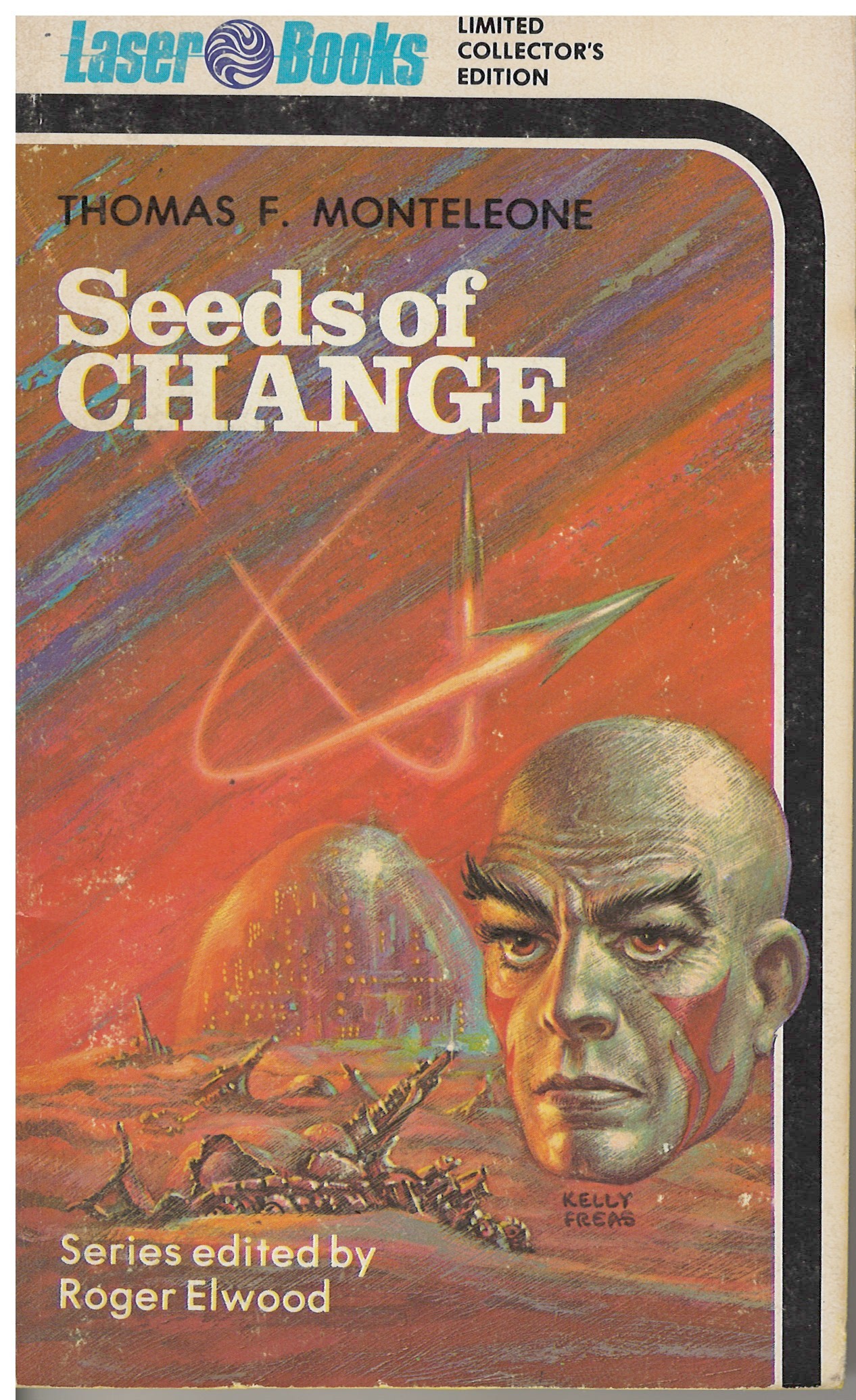
    For the life of me, I can’t figure out who this bald boy’s supposed to be…

    Ahh, would you look at that! This is peak Golden Age. If you hold this cover right up to your nose, you can practically smell Bob Heinlein‘s aftershave! Mark ye the shifting sands of a windswept desert, take heed of the broken bodies of war machines, and feast thine eyes on yon glimmering dome! (The city, not the bald guy. You can see one of the spaceships swerving to avoid him.)

    Joking aside, I really love Freas’s use of colour, lighting, and lines to draw the eye to the Denver Citiplex in the distance. It really gives the impression of sunrise over a shattered, lifeless world, with the wrecked machines implying that the only life left is the people who reside in those encapsulated spires.

    As for whose portrait the baldie is, with these books it’s usually one of three people: the protagonist, the antagonist, or some guiding figure of wisdom from the story. But for the life of me, I can’t figure out which of those three this chrome dome is supposed to be. Is he Turgenev’s mentor, Keating? Is he the head of the Resistance? The mayor of Denver? My DnD character?! WHO?!

    Otherwise, Freas pretty much captured every element that appears in the book!

    I think this is a good time to tell you: get used to this cover layout. It’s all you’ll be seeing for the next 57 covers.

    Would You Like to Know More?

    In case you don’t believe me, author David Anaxagoras was kind enough to furnish me with a link to an ISFDb database with images of all the Laser Books titles minus Seeds of Change.

    Blurb

    Art: Kelly Freas

    The Denver Citiplex that evolves over the next two centuries, while technologically a masterpiece, is a living hell for those whom computer analysis labels potential deviants from the genetically controlled social norms. In his frantic effort to escape the fate of all such deviants, Eric Stone and his beautiful girlfriend, Jessica, manage to reach an underground colony living in the wastelands outside the city. It appears that not everyone loves the Citiplex, but only the arrival of a small colony of earthling survivors from Mars enables the dissidents to hope they may make some changes. But it is only a hope.

    If you read that and thought of Logan’s Run, I wouldn’t blame you. I’ve neither read the book nor seen the movie, and yet I’m aware enough of that story that it was the first thing I thought of when I read the blurb. And while the film would come out the year after Seeds of Change was published, the novel Logan’s Run had been on bookshelves since 1967. There must have been others who made similar comparisons at the time. I’m not sure whether that would’ve helped or hindered Laser Books’ sales.

    Whatever the case, the comparison, in my case, would not be enough to entice me to buy Seeds of Change were I to see it on a bookshelf. It would probably make me want to read Logan’s Run or watch the movie with my dad.

    I gotta see if he’s available for movie night one of these days… hmm.

    Story

    Breaking News

    Denver man verbally abuses boss, fall into thirst trap, overthrows government with help of Martians.

    And now we come to the story itself. What’s it about? Does it sing? Does it squawk? Are there commentaries on the vicissitudes of the human condition? Does it offer up new perspectives on life, the universe, everything?

    It’s a strange book, if I’m being honest. It feels like two stories that have gotten the old Frankenstein treatment: stitched together in all the right places, yet still visibly two different entities.

    Story A

    As advertised in the book blurb, Eric Stone is an analyst who spends his days combing the Denver Citiplex’s database for deviants. If you read sci-fi, you can probably already guess who that word refers to: anyone with a scrap of original thought and free will. The Citiplex is a totalitarian society sealed off from an Earth that’s been devastated by war. Their oppression is justified by that age-old excuse: “Survival of the race.”

    Eric is a killer in the purest tradition of the KGB and Gestapo: he rubs people out with the stroke of a key rather than the pull of a trigger. But deep down, he feels discontent, and one day he says the wrong thing to the wrong man and gets himself on a watchlist.

    Enter Jessica: a spy and saboteur belonging to a resistance group working to bring down the Citiplexes from both without and within. She seduces Eric, thereby signing his death warrant with a rather different kind of stroke (deviants are also those who enjoy what kids these days like to call “sexual intercourse”). With his whole society turned against him, Eric has no choice but to follow his new lover into the wastes and join the resistance.

    Story B

    The second story follows Turgenev and his motley crew of scientists on Mars. After Earth was sundered by war, the technocratic utopian colony on Mars was left to fend for itself, and so far they’ve managed to do so without resorting to fascism.

    Yeah, I know, I don’t buy it myself. Apparently they embraced something called “dem-o-cra-cy”? Gotta be some kind of drug. Or tantric yoga. Either case… weirdoes.

    Anyway, these Martians are happily enjoying the Bohemian lifestyle when an alien mothership flies by, deposits a spacecraft outside the Martian settlement, and continues on its merry way.

    At this point you might be chuckling, but actually, this was my favourite part of the book.

    “You mean the part that was barely mentioned in the blurb and has nothing to do with the Denver plot until the last quarter of the story?”

    Yeah! That part.

    Would You Like to Know More?

    Here’s the deal: the spacecraft is a puzzle box with rooms and corridors spiraling from the airlock to the command deck. Each room poses a puzzle — some question of physics, math, or biology — with ever-increasing levels of difficulty. Answer all the questions and you get to take command of the spacecraft and join the aliens voyaging among the stars.

    Basically the interstellar version of Jeopardy!

    And if it turns out your entire species is a bunch of smoothbrains, well hey, you still get a 100,000 ton paperweight out of the deal!

    The two stories merge very late in the book when Turgenev and the Martians (great name for a band!) fly the spacecraft to Earth and join the fight against the Citiplexes.

    SPOILER!

    The novel actually ends on a pretty dark note.

    When the Citiplexes realize they brought a gun to a spaceship fight and have no hope of winning, they gas their own citizens. They commit mass murder rather than have the truth revealed that deviants not only escape the Citiplexes, but form their own societies — societies which thrive on equality and embrace difference.

    Eric, Jessica, and Turgenev survive, along with their resistance and Martian friends, but all of them are pretty scarred by the hundreds of thousands of dead bodies they see in Denver. The revelation they have is that humans can become so entrenched in hatred that they’d rather kill themselves and all their loved ones rather than admit that the people they hate might actually be better than them.

    A warning for our times, perhaps…

    Conclusions and Recommendations

    Barring one or two moments, there isn’t much about Seeds that stands out. The prose is very plain and workmanlike; when you’re writing about sex, tyranny, aliens, and genocide, higher language is called for. I can’t tell if the twin-story format is Monteleone being ambitious, or if he simply took two novellas he wrote and stitched them into a single work to sell to Laser Books.

    Goodreads lists 221 distinct works (at time of writing) attributed to Monteleone, most of which are rated 3 or 4 Stars (by aggregate review), so clearly his talent or output is not in question. I feel like the quality of this book reflects less on the writer and more on the publishing requirements established by Harlequin, but that’s something I could only confirm by reading more of Monteleone’s work.

    Let’s assume for a moment that Story A and Story B were peeled apart and allowed to grow into their own selves. What would make each one work?

    • The atrocities of the Denver Citiplex were described more fully
    • Eric’s psychological background is probed, providing us with a reason why he became and analyst and why he later became disenfranchised with it
    • The writing didn’t shy away from sex
    • Jessica doesn’t truly develop feelings for Eric, but instead manipulates him from start to finish (I did not buy her loving this man who was a murderer for most of his adult life)

    • The plot focus is entirely on solving the alien spacecraft
    • The relationship between Turgenev and his mentor Keating is properly explored
    • The inner lives of each of the scientists is revealed fully

    Alas, we have 57 more Laser Books to review, and my time on this Earth is short. I shall leave this review for you to consider:

    This novel feels like two separate novellas stitched together. Each has very different tones and themes and neither has anything to do with the other until the final pages. On the one hand, you have a story that reads like a knockoff of Logan’s Run, and on the other, a tale of first contact with an interesting premise which could be its own thing, but sadly is bolted to, and made worse by, the former. Overall, there’s a lack of cohesion and little that stands out apart from one or two moments. I’d recommend reading Logan’s Run or Contact if you want the same sci-fi hits this book’s trying to give.

    And with that, this retrospective comes to an end. I certainly feel ready for a change.

    Who’s Actually First?

    I think I worked for this guy at a butcher shop once…

    The real first entry in the Laser Books is Renegades of Time by Raymond F. Jones. I know this because it says “1” on the cover.

    Blurb

    The Algorans, masters of time travel had lost control of the time channels. In despair, they stood helplessly as the barbarian hordes of the devastating Bakori were unleashed on the universe. In the little town of Midland, U.S.A., Joe Simmons worked feverishly to assemble the only device that had a chance to stop them. He knew that success depended on a beautiful Algoran woman, Tamarina, yet he didn’t even know if she would re-appear! But he couldn’t stop trying. This whole disaster was his fault.

    Tune in next week and I’ll tell you about a similar thing that happened to me in Midland, ON!

  • The Laser Books

    The Laser Books

    My odyssey to read and review every single one of the 58 Harlequin Laser Books.

    A fine addition to my collection.

    On August 30th, 2024, my dad gave me an extraordinary birthday gift: a banker’s box containing old trade paperback novels by James P. Blaylock, Tim Powers, Allen Steele… and most of the 58 Laser Books published by Harlequin.

    As Dad tells it, he was visiting his favourite rare book dealer, Minotavros Books, when the owner, Stefanos Lazakis, said, “I have the perfect gift for your son.” He sold Dad thousands of dollars of worth of rare titles for a little less than $300 CAD.

    Digging through what I’ve since dubbed my “Treasure Chest” (and it indeed contains treasure–three of the Blaylock novels are signed!) on the day I turned 28, Dad poured out the story: Laser Books was an attempt by Harlequin to break into the science fiction market, publishing stories in “the good old fashion of SF”. Beyond that, he knew little.

    I began to investigate.

    What Are the Laser Books?

    To begin, I’d like to note that these novels were published at the crest of the New Wave movement in science fiction. The authors belonging to the New Wave included women, people of colour, and queer folk who wanted anything but a return to “the good old fashion of SF.”

    Never forget: the much-vaunted Golden Age of science fiction was deeply unkind and exclusive to writers who were not white, male, and heterosexual.

    Edited by author/editor Roger Elwood, with cover designs by SFF heavyweight Kelly Freas, Laser Books put out three titles a month for three years, beginning in 1975 and ending in 1977. It operated on a subscription model, much like a magazine, though I imagine it was possible to find the titles in bookstores and at conventions as well.

    Some notable authors who either started or furthered their careers with Laser Books include K.W. Jeter, Dean Koontz (writing as Aaron Wolfe), Tim Powers, and Piers Anthony.

    SFF? More like FFS!

    As with all Harlequin book lines, the Laser Books adhere to a strict house style:

    • A word count of ~50,000 (about half the length of your average sci-fi novel)
    • No blasphemous or scatological verbiage (in other words, cut the G*d-d@mn sh!t)
    • No explicit sex scenes (though sexual situations, implied sex, and even implied rape are, unfortunately acceptable…)
    • No slang in exposition (though slang in dialogue is “just peachy”)

    According to the Wikipedia entry on the Laser Books, many authors chafed under these restrictions, having to cut large portions of their novels to fit the word count and changing their writing style to satisfy editor Roger Elwood and his publisher. After the line shut down, all rights to the Laser Books novels reverted to their respective authors, some of whom later restored the material they’d been forced to cut and republished the novels in their completed forms.

    Would You Like to Know More?

    A 2015 article by Steve Fahnestalk in Amazing Stories goes into exhaustive detail about the Laser Books line: how it started, how it was run, how it ended. It’s well worth a read, and covers things beyond the scope of this post.

    My Goal

    It’s quite simple: I’m going to read and review every single one of the Laser Books.

    “Why,” you ask?

    Why not?

    Historically, given that the Laser Books were the launching point for many successful authors, they form a nugget of sci-fi history I don’t think many people are aware of.

    Aesthetically, the novels serve as a time capsule for what a publishing giant thought readers wanted.

    And personally, few things are more exciting for me as a reader than opening up a box, picking out a dusty old paperback, and reading the words of a writer whom the world might have forgotten.

    Who’s First?

    Two chrome domes for the price of one!

    Actually, it’s “Who’s Zeroth?”

    Thomas F. Monteleone‘s Seeds of Change is not a numbered entry in the Laser Books. Rather, it was a promotional title given away at select bookstores at the launch of the series, or by Roger Elwood himself at certain conventions he attended. The only other way to have obtained the book back in the day would be to become a subscriber to the Laser Books, or possibly buy it at a second-hand bookstore. In Laser Books listings, it is commonly assigned the number 0.

    Join me next week to see if this zero’s a hero!

    Seeds of Change Cover Blurb

    The Denver Citiplex that evolves over the next two centuries, while technologically a masterpiece, is a living hell for those whom computer analysis labels potential deviants from the genetically controlled social norms. In his frantic effort to escape the fate of all such deviants, Eric Stone and his beautiful girlfriend, Jessica, manage to reach an underground colony living in the wastelands outside the city. It appears that not everyone loves the Citiplex, but only the arrival of a small colony of earthling survivors from Mars enables the dissidents to hope they may make some changes. But it is only a hope.