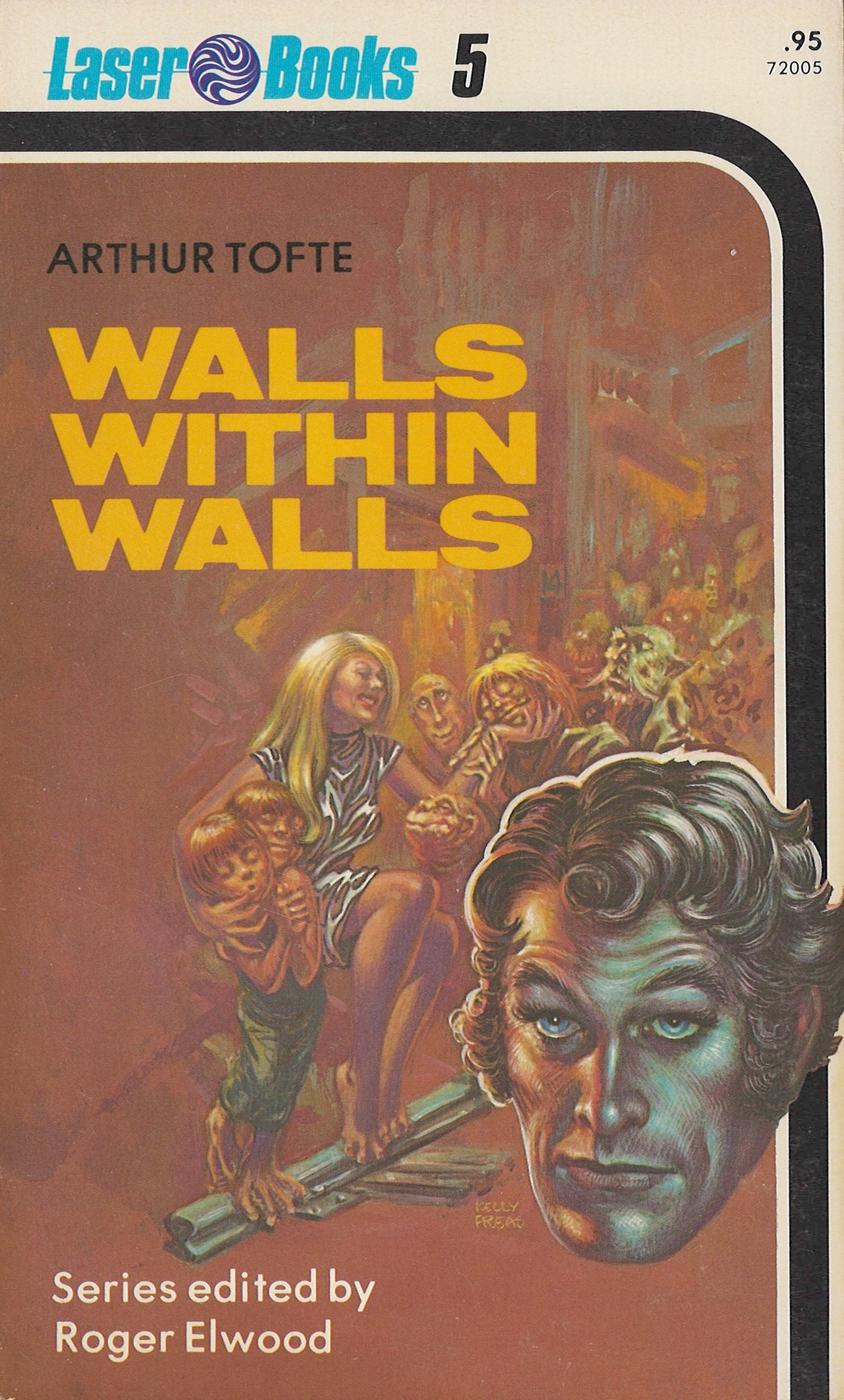
5. Walls Within Walls by Arthur Tofte
Listen carefully. I don’t know how much time I have.
I had to leave my house–drop everything, cut through the back field, cross the neighbour’s vineyard, and run ten kilometres toward town. From there I hitched a ride on a maple syrup truck south through Codrington to the 401, and thence to Cobourg. Tried to rent a car but my credit card bounced–should’ve known he’d have thought of that–so instead I paid cash for a train ticket to Ottawa.
He was on the train.
I thought about contacting my friends in Ottawa, maybe hole up at one of their places, but I realized that would just put them in danger. I slept on the bridge to Gatineau. My God, it was cold.
Saw a shadow moving in the night. Knew it was him.
He had the book with him.
He’s always right behind me. I can’t outrun him. But that’s okay. If–when–he catches me, I’m going to give him what he wants.
Just not the way he wanted it.
I’ve got it all figured out, you see. He wants me to tell him his book is good, that it’s a great work of science fiction, but he’s from the 70s. He’s not canny with computers–even his characters aren’t; they talk about smashing them up all the time. He’s regressive. He touts “the old ways”. Fair enough.
By the time he realizes I’ve tricked him, it’ll be too late.
Speak of the Devil; there he is now, coming into the internet cafe. Yes, I see you Arthur. I’m ready.
Give me the book.


I don’t know what kompromat Arthur held over Roger Elwood to blackmail him into buying a second title so soon after the first, but it must have been serious. And, unfortunately for me, Elwood isn’t the only one getting screwed because I now have to read what he bought. I do not have high hopes after Crash Landing on Iduna, so lets see if Tofte can redeem himself.
But before we cover Art, let’s start with cover art.
Cover
Speaking of blackmail, thanks to my swift intervention and the heroic efforts of the Ontario Provincial Police, Kelly Freas is no longer being threatened by the Marketing Guy to turn in shitty cover art.
For this entry, he instead turned in a cover the colour of actual shit.
Before you get on my case, I want the record to show that I don’t dislike this cover art. It’s… fine. This is one of Freas’s more workmanlike pieces. It depicts elements of the story: the mutants of Destruction City in the background, Rolf (the protagonist) is in the portrait, and lighting is used to suggest a ray of sun shining down into the caverns where the mutants dwell. But there’s no flair, to it, no creativity, no spark, and the colours all congeal into a hodgepodge of blandness.
Also I’m troubled by the depiction of the mutants as some kind of carnival sideshow. Bodily deformities being used a selling point for sci-fi is such an outdated idea.
But then, the Laser Books’ mission statement is about bringing back Golden Age sci-fi, so what else should I expect?
Would You Like to Know More?
Now these guys know how to do mutants.
Blurb
For sixteen years Rolf’s parents had kept him hidden away from the society in which they lived. His twin brother was able to move about freely and indeed was regarded by all as a young man of talent and great promise. But Rolf was a mutant and, as such, illegally alive. What happens when he escapes from his hiding place and discovers a whole world of mutants living underground, beneath the highly controlled technologically advanced city that had been his prison, is the main thread of Arthur Tofte’s engrossing tale. The city was never the same again. Nor, perhaps, will you be after you read it.
I had horrible nausea at the end which I didn’t have at the start, so no, I was not the same after reading it.
There are a million science fiction books in the world with blurbs exactly like this one. I’m still mad at Marketing Guy for what he did to Freas, and I still think his blurbs are mostly mediocre, but for once, he’s not to blame. He’s been handed a cliche story and told to pitch it to a highly discerning New Wave audience. Even Don Draper would struggle to find an angle on this.
Would You Like to Know More?
1975 was a year when Ursula K. Le Guin‘s The Dispossessed, Philip K. Dick‘s Flow My Tears, the Policeman Said, and T.J. Bass‘s The Godwhale were cleaning up at the Nebulas and Hugos. With these titans of sci-fi on bookshelves, do you really think anyone is gonna reach for novels with blurbs like the Laser Books have?
Story

DWAYNE: Please, do not be frightened, we’re harmless.
RAOUL: I have three arms.
DWAYNE: I said “harmless” not “armless”.
VYOLET: Lay off him. You know he’s only got one ear.
— Futurama, Episode 205 “I Second that Emotion”
Well, it was easier to read than Crash Landing on Iduna, but not by much.
The story unfolds exactly how you’d expect. The world and its characters dwell in a postwar society (Resurrection City) created to ensure the survival of the human race. They do this in part by wiping out anyone who presents with heavily mutated DNA, but they don’t always get everyone: many flee to the old sewers beneath the city (called Destruction City), which contain ruins of whatever settlement Resurrection is built overtop of.
It’s a genetic twist on the behaviourally-controlled world of Seeds of Change‘s enclosed city (check out my review for that book).
Rolf ventures into the undercity, meets a mentor figure, educates himself, gets discovered by the authorities, and has to flee to the other side of the wall separating Resurrection City from the rest of the world. He gets a taste of rough living, realizes he can’t leave Resurrection without doing something about his brother Ralf and the unjust regime there, so he goes back. Ultimately he discovers what you all probably guessed early on: that everyone in this city carries “the taint of mutation” since the war. The society’s built on a lie and every scientist is complicit.
But of course, this is Arthur Tofte, so we’re in for some deeply uncomfortable flourishes like Rolf, as a child, spying on his neighbour Elissa, also a child.
One very hot day I was at my secret perch at the side wall when she came out dressed, as usual, in her short white tunic. She started to lie down in the grass, stopped and glanced back toward her house.
I could even hear her giggle as she lifted her tunic over her head. She had nothing on underneath.
Almost as if she knew I was watching and she wanted me to look at her, she lifted her arms overhead and turned slowly, her face raised to the sky, to let the hot sun beat down on all parts of her. — page 19
And he waffles on about how her body looks for a few paragraphs. When I read this page, I knew I wouldn’t be allowed to just glide through a mediocre sci-fi novel. I would be forced to endure some deeply uncomfortable passages before I could close this thing.
There are musings on genetic purity, the importance of wilderness living (idyllic pastoralism again, really?), and even a suggestion by another character that Elissa’s cold shoulder could be cured if Rolf rapes her, and that if Rolf doesn’t do the job, this other character will happily do it.
I can’t even look up who makes this suggestion. I don’t want to revisit that unpleasantness; I’m already going to have a hard time facing the women in my life with this book in my brain.
Conclusions and Recommendations
Look if you want a good story about mutants, I can recommend some excellent Futurama episodes. If you want a good story about in-groups, out-groups, preconceptions, and sexual frustration, there are plenty of better stories; some written by other authors in the same period as the Laser Books, and some appearing in the Laser Books themselves. Your own good judgment will probably steer you better in this department than I could.
Would You Like to Know More?
The biggest award-winner of 1975 was The Dispossessed, by Ursula K. Le Guin. It’s a wonderful commentary on anarchism, capitalism, societies estranged from one another, and how even societies that espouse personal freedom will find novel ways to limit that freedom in the name of economic security and infrastructure development.
My Goodreads Review
This is a superfluous book in sci-fi canon whose one virtue is that it’s not as bad as some others in the series. But there is no reason why you’d want to pick this up, aside from, like me, a desire to collect the entire series. Give this one and Crash Landing on Iduna a pass for your own sanity. They are both mediocre-to-bad books and are two of the weakest entries in the Laser Books. If you want good stories about mutants, go watch Futurama!
And with that, I close out this third bummer of a review. With luck, Arthur will never realize I sabotaged him. He’s leaving the cafe now, taking the book with him.
I am free.
Who’s Next?
Actually, we’re all free! The three books I’ve just reviewed–Crash Landing on Iduna, Gates of the Universe, and Walls Within Walls— comprise what I’ve (un)affectionately dubbed the Trench of Sadness in the Laser Books collection.
At this point in my reading, I was beginning to despair that all the remaining books would be of this quality, but Stephen Goldin‘s Herds gave me hope that there still might be some gems out there; It convinced me to keep reading.
I’m glad I did, because our next book, ladies and gentlemen… is Serving in Time.

Blurb
Jan Jeroux is leading a carefree and idyllic life in the serene, underpopulated pastoral earth of the year 2500. His idyll ends abruptly when he is abducted and forced to join the Time Service of the mysterious world government. In the service he learns how history was manipulated and controlled to produce the beautiful world he enjoyed so much. Thinking he understands how to rectify the injustice and devastation inflicted on the world by the time managers, Jan decides to make things right. But he makes a tragic error…
Geez, I know I’ve harped on about idyllic pastoralism, but this is the one mention of it that’ll get a free pass.
This novel, penned by Gordon Eklund, is the one that convinced me to start writing about the Laser Books. It’s a book that inverts several familiar sci-fi tropes and delivers something truly original.
If you haven’t been vibing with the last three reviews, I promise you, this is one you won’t want to miss. It’s only a week away, and I’m stuck here in an Ottawa internet cafe. I hope I make it back in time…
Leave a Reply