Tag: Arthur Tofte

  • Laser Books Review 5

    Laser Books Review 5

    5. Walls Within Walls by Arthur Tofte

    Listen carefully. I don’t know how much time I have.

    I had to leave my house–drop everything, cut through the back field, cross the neighbour’s vineyard, and run ten kilometres toward town. From there I hitched a ride on a maple syrup truck south through Codrington to the 401, and thence to Cobourg. Tried to rent a car but my credit card bounced–should’ve known he’d have thought of that–so instead I paid cash for a train ticket to Ottawa.

    He was on the train.

    I thought about contacting my friends in Ottawa, maybe hole up at one of their places, but I realized that would just put them in danger. I slept on the bridge to Gatineau. My God, it was cold.

    Saw a shadow moving in the night. Knew it was him.

    He had the book with him.

    He’s always right behind me. I can’t outrun him. But that’s okay. If–when–he catches me, I’m going to give him what he wants.

    Just not the way he wanted it.

    I’ve got it all figured out, you see. He wants me to tell him his book is good, that it’s a great work of science fiction, but he’s from the 70s. He’s not canny with computers–even his characters aren’t; they talk about smashing them up all the time. He’s regressive. He touts “the old ways”. Fair enough.

    By the time he realizes I’ve tricked him, it’ll be too late.

    Speak of the Devil; there he is now, coming into the internet cafe. Yes, I see you Arthur. I’m ready.

    Give me the book.

    I don’t know what kompromat Arthur held over Roger Elwood to blackmail him into buying a second title so soon after the first, but it must have been serious. And, unfortunately for me, Elwood isn’t the only one getting screwed because I now have to read what he bought. I do not have high hopes after Crash Landing on Iduna, so lets see if Tofte can redeem himself.

    But before we cover Art, let’s start with cover art.

    Cover

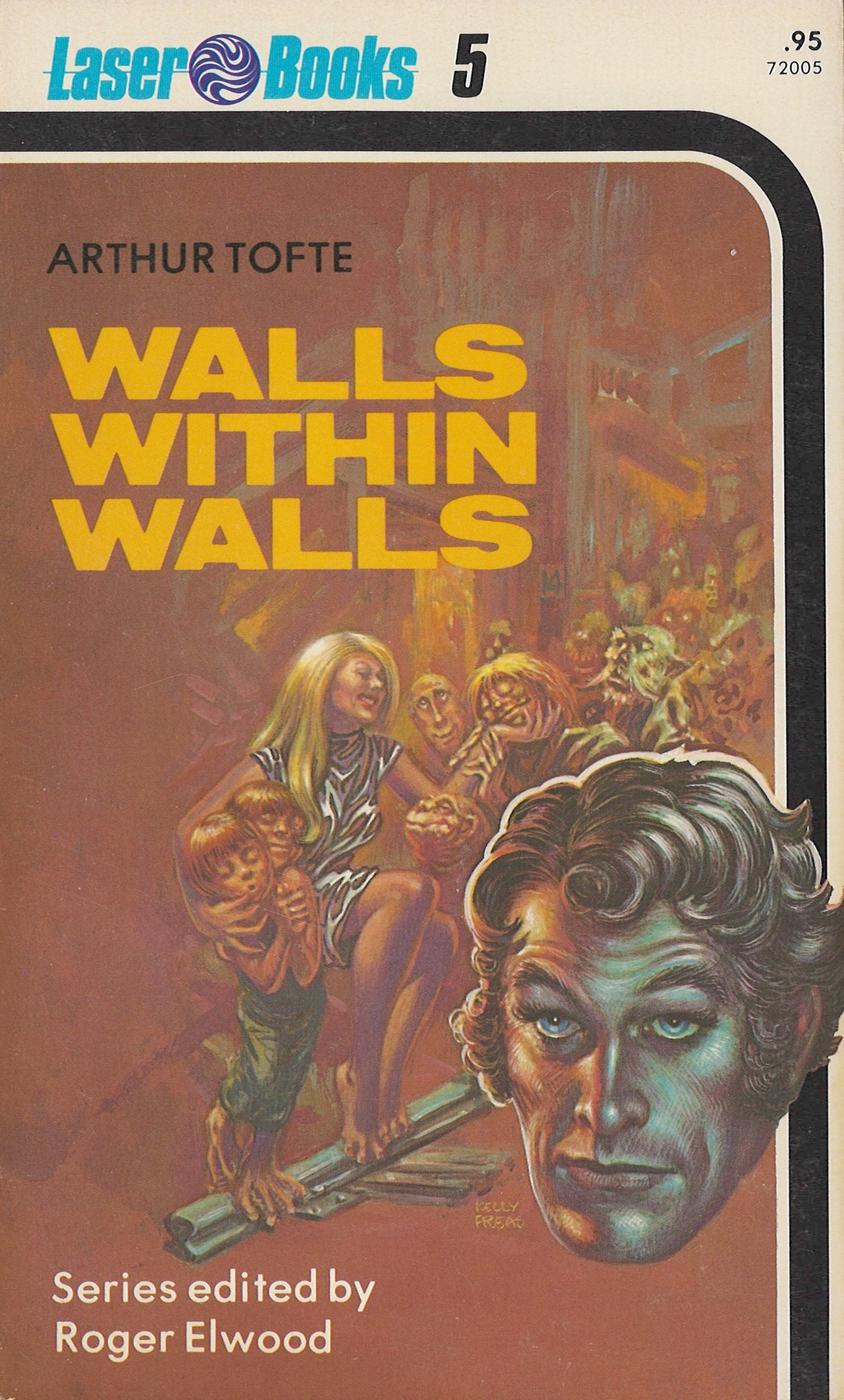
    Speaking of blackmail, thanks to my swift intervention and the heroic efforts of the Ontario Provincial Police, Kelly Freas is no longer being threatened by the Marketing Guy to turn in shitty cover art.

    For this entry, he instead turned in a cover the colour of actual shit.

    Before you get on my case, I want the record to show that I don’t dislike this cover art. It’s… fine. This is one of Freas’s more workmanlike pieces. It depicts elements of the story: the mutants of Destruction City in the background, Rolf (the protagonist) is in the portrait, and lighting is used to suggest a ray of sun shining down into the caverns where the mutants dwell. But there’s no flair, to it, no creativity, no spark, and the colours all congeal into a hodgepodge of blandness.

    Also I’m troubled by the depiction of the mutants as some kind of carnival sideshow. Bodily deformities being used a selling point for sci-fi is such an outdated idea.

    But then, the Laser Books’ mission statement is about bringing back Golden Age sci-fi, so what else should I expect?

    Would You Like to Know More?

    Now these guys know how to do mutants.

    Blurb

    For sixteen years Rolf’s parents had kept him hidden away from the society in which they lived. His twin brother was able to move about freely and indeed was regarded by all as a young man of talent and great promise. But Rolf was a mutant and, as such, illegally alive. What happens when he escapes from his hiding place and discovers a whole world of mutants living underground, beneath the highly controlled technologically advanced city that had been his prison, is the main thread of Arthur Tofte’s engrossing tale. The city was never the same again. Nor, perhaps, will you be after you read it.

    I had horrible nausea at the end which I didn’t have at the start, so no, I was not the same after reading it.

    There are a million science fiction books in the world with blurbs exactly like this one. I’m still mad at Marketing Guy for what he did to Freas, and I still think his blurbs are mostly mediocre, but for once, he’s not to blame. He’s been handed a cliche story and told to pitch it to a highly discerning New Wave audience. Even Don Draper would struggle to find an angle on this.

    Would You Like to Know More?

    1975 was a year when Ursula K. Le Guin‘s The Dispossessed, Philip K. Dick‘s Flow My Tears, the Policeman Said, and T.J. Bass‘s The Godwhale were cleaning up at the Nebulas and Hugos. With these titans of sci-fi on bookshelves, do you really think anyone is gonna reach for novels with blurbs like the Laser Books have?

    Story

    DWAYNE: Please, do not be frightened, we’re harmless.

    RAOUL: I have three arms.

    DWAYNE: I said “harmless” not “armless”.

    VYOLET: Lay off him. You know he’s only got one ear.

    — Futurama, Episode 205 “I Second that Emotion”

    Well, it was easier to read than Crash Landing on Iduna, but not by much.

    The story unfolds exactly how you’d expect. The world and its characters dwell in a postwar society (Resurrection City) created to ensure the survival of the human race. They do this in part by wiping out anyone who presents with heavily mutated DNA, but they don’t always get everyone: many flee to the old sewers beneath the city (called Destruction City), which contain ruins of whatever settlement Resurrection is built overtop of.

    It’s a genetic twist on the behaviourally-controlled world of Seeds of Change‘s enclosed city (check out my review for that book).

    Rolf ventures into the undercity, meets a mentor figure, educates himself, gets discovered by the authorities, and has to flee to the other side of the wall separating Resurrection City from the rest of the world. He gets a taste of rough living, realizes he can’t leave Resurrection without doing something about his brother Ralf and the unjust regime there, so he goes back. Ultimately he discovers what you all probably guessed early on: that everyone in this city carries “the taint of mutation” since the war. The society’s built on a lie and every scientist is complicit.

    But of course, this is Arthur Tofte, so we’re in for some deeply uncomfortable flourishes like Rolf, as a child, spying on his neighbour Elissa, also a child.

    One very hot day I was at my secret perch at the side wall when she came out dressed, as usual, in her short white tunic. She started to lie down in the grass, stopped and glanced back toward her house.

    I could even hear her giggle as she lifted her tunic over her head. She had nothing on underneath.

    Almost as if she knew I was watching and she wanted me to look at her, she lifted her arms overhead and turned slowly, her face raised to the sky, to let the hot sun beat down on all parts of her. — page 19

    And he waffles on about how her body looks for a few paragraphs. When I read this page, I knew I wouldn’t be allowed to just glide through a mediocre sci-fi novel. I would be forced to endure some deeply uncomfortable passages before I could close this thing.

    There are musings on genetic purity, the importance of wilderness living (idyllic pastoralism again, really?), and even a suggestion by another character that Elissa’s cold shoulder could be cured if Rolf rapes her, and that if Rolf doesn’t do the job, this other character will happily do it.

    I can’t even look up who makes this suggestion. I don’t want to revisit that unpleasantness; I’m already going to have a hard time facing the women in my life with this book in my brain.

    Conclusions and Recommendations

    Look if you want a good story about mutants, I can recommend some excellent Futurama episodes. If you want a good story about in-groups, out-groups, preconceptions, and sexual frustration, there are plenty of better stories; some written by other authors in the same period as the Laser Books, and some appearing in the Laser Books themselves. Your own good judgment will probably steer you better in this department than I could.

    Would You Like to Know More?

    The biggest award-winner of 1975 was The Dispossessed, by Ursula K. Le Guin. It’s a wonderful commentary on anarchism, capitalism, societies estranged from one another, and how even societies that espouse personal freedom will find novel ways to limit that freedom in the name of economic security and infrastructure development.

    My Goodreads Review

    This is a superfluous book in sci-fi canon whose one virtue is that it’s not as bad as some others in the series. But there is no reason why you’d want to pick this up, aside from, like me, a desire to collect the entire series. Give this one and Crash Landing on Iduna a pass for your own sanity. They are both mediocre-to-bad books and are two of the weakest entries in the Laser Books. If you want good stories about mutants, go watch Futurama!

    And with that, I close out this third bummer of a review. With luck, Arthur will never realize I sabotaged him. He’s leaving the cafe now, taking the book with him.

    I am free.

    Who’s Next?

    Actually, we’re all free! The three books I’ve just reviewed–Crash Landing on Iduna, Gates of the Universe, and Walls Within Walls— comprise what I’ve (un)affectionately dubbed the Trench of Sadness in the Laser Books collection.

    At this point in my reading, I was beginning to despair that all the remaining books would be of this quality, but Stephen Goldin‘s Herds gave me hope that there still might be some gems out there; It convinced me to keep reading.

    I’m glad I did, because our next book, ladies and gentlemen… is Serving in Time.

    Blurb

    Jan Jeroux is leading a carefree and idyllic life in the serene, underpopulated pastoral earth of the year 2500. His idyll ends abruptly when he is abducted and forced to join the Time Service of the mysterious world government. In the service he learns how history was manipulated and controlled to produce the beautiful world he enjoyed so much. Thinking he understands how to rectify the injustice and devastation inflicted on the world by the time managers, Jan decides to make things right. But he makes a tragic error…

    Geez, I know I’ve harped on about idyllic pastoralism, but this is the one mention of it that’ll get a free pass.

    This novel, penned by Gordon Eklund, is the one that convinced me to start writing about the Laser Books. It’s a book that inverts several familiar sci-fi tropes and delivers something truly original.

    If you haven’t been vibing with the last three reviews, I promise you, this is one you won’t want to miss. It’s only a week away, and I’m stuck here in an Ottawa internet cafe. I hope I make it back in time…

  • Laser Books Review 3

    Laser Books Review 3

    3. Crash Landing on Iduna by Arthur Tofte

    Well, life can’t all be sunshine and roses.

    Sometimes it’s cottagecore and fascism.

    This book is where the problem in “bringing back Golden Age sci-fi” shows itself: people think they want to go back, but they really, really don’t.

    Take John W. Campbell, editor of Astounding (now Analog) for example. He was a man of deplorable convictions who, according to Isaac Asimov, “Never had an unkind word to say about Hitler.” Many of the stories he championed depicted “supermen” (always white), degraded women, and positioned people of colour as evil.

    Would You Like to Know More?

    Cory Doctorow published an excellent opinion piece in Locus Magazine about Jeannette Ng‘s acceptance speech at the John W. Campbell Awards in which she called out both Campbell and the people who celebrate him.

    Crash Landing on Iduna romanticizes an imagined past.

    There’s a lot I have to unpack so let’s hurry up and crash the bloody ship already.

    Cover

    Even Freas has mentally checked out.

    Look, I’m not gonna sugar-coat it: this is one of Kelly Freas‘ most boring covers.

    I mean, look at all that negative space! You should be ashamed of yourself, Kelly. There’s a poor marketer starving for real estate on the back cover and here you are, throwing it away for nothin’.

    Front-and-centre we’ve got Chewbacca fondling Dolly Parton, and in the background… I can’t even tell what’s going on. Is that some kind of alien? What’s that dude on the left running through? Water? Tentacles?

    The blue-eyed devil on the right is Lars Evenson, the father of the Evenson family. I’ve got a bone to pick with him later.

    Blurb

    When a spaceship crashes, the survivors are in peril for their lives. When the planet and its inhabitants are unknown to the survivors, fear becomes tangible among them. When the survivors are a crippled man and his four children the odds against survival increase dramatically. When the entire family has lived a controlled, docile, protected life and has been deliberately kept passive by the managers of the society on earth from which they came, the situation looks hopeless. But when two of the survivors are Peder and Inga Evenson there is always hope. This is their story.

    Congratulations, marketing guy, you started every sentence of this thing but two with “When” and failed to capitalize “Earth.” You were lazy and disrespected Momma E. Hang your head in shame.

    Neither this nor Freas’s cover would entice me to buy this book, and I was not looking forward to reading it. But you know, I like to give people the benefit of the doubt. Maybe Freas and Marketing Guy had the flu that week, and that’s why Freas chose puke-green for the cover and Marketing Guy gave us a hundred words of fever drivel.

    Where art fails, maybe Art can succeed!

    Story

    Can’t believe my tree cousins were cut down to print this book.

    Nope.

    Buckle yer fuckles, good people, we’re in for a bumpy ride.

    On Earth, all needs are met and there are no wars, no strife, no scarcity. Jobs are optional and all your prescriptions are free. Sounds great, right?

    Lars Evenson doesn’t think so. He pines for the frontier lifestyle.

    When men built cabins in the woods and provided for their families. When human beings hunted and skinned animals in the woods. When people struggled with nature. When the average life expectancy was under fifty. When a cut finger could kill you. But when Lars breaks his leg in the first five minutes, he finds out just how much the past sucks. This is his story.

    (See, Marketing Guy? I can do it too!)

    Believing that true humans must struggle to survive, Lars packs up his whole family into a spaceship, flies it to an alien planet, gets his wife killed and himself crippled trying to land the thing, and his children have to shoulder the burden of survival.

    If Lars were around today, he’d be part of the cottagecore movement and his wife would have a tradwives TikTok — except they wouldn’t be around because they were vaccine deniers and measles and COVID tag-teamed them into an early grave!

    Would You Like to Know More?

    I recently read Philipp Dettmer‘s book Immune and found out why measles is such a scary disease. Like all viruses, measles reproduces by penetrating cells, hijacking them, and using them to make more of the virus, which then spreads to other cells to repeat the cycle.

    But measles is a special fucker in that it attacks Memory T and B cells. These are the cells in which the records of your body’s encounters with diseases are encoded, and they are the reason why you can’t get sick from the exact same virus twice (unless it mutates, as all viruses do, which is why vaccines are important).

    Once you survive a disease — influenza, common cold, COVID-19 — your body preserves a sort of “battle record”: what the enemy looked like, how they attacked you, and most importantly, which antibodies ultimately stopped the invasion. This is where “immunity” comes from: the memories of the battles your body won.

    Measles destroys those Memory cells and the records within, erasing the information your body needs to repel those diseases. Memory B cells in particular are a devastating loss because their records stretch back decades, possibly to the time you spent in your mother’s womb. And as we all know, some diseases like chickenpox are usually mild if we contract them as children, but potentially lethal if contracted as adults.

    So if you survive your bout with measles, you might actually be susceptible to hundreds, even thousands, of pathogens you already beat, and you’ll have to face them all again — get sick from them all again — to reacquire your immunity.

    So please, for the love of God, vaccinate yourself and your children!!!

    A few months after landing, Lars’s children, Inga and Peder, discover two tribes of aliens living on the planet: an aggressive one and a docile one. The family rushes to the aid of the docile one because white saviours, and after spending some time on Iduna, they set up a distress beacon and plan to go back to Earth to show people how sexy it is living that frontier lifestyle.

    I’m not joking: Peder sends his siblings Sven and Bretta back to Earth in the hopes that, once people see how toned you get building cabins in the woods, they’ll try it for themselves.

    They would be like a god and goddess out of man’s past… a past that could point to a better future. — page 190

    Conclusions and Recommendations

    Up until now, the Laser Books have been either harmless or entertaining. Crash Landing on Iduna is neither: the ideas it espouses are harmful and its story is incredibly boring.

    Idyllic pastoralism has been a staple of every regressive, exclusive, hateful ideology from Naziism to the Deep South alt-right because it extolls a past when men did not have to share power with women, their word was law, and the strong were determined through violent struggle.

    We find idyllic pastoralism so seductive because, in one sense, it is correct: we should co-exist with nature; we should find value in hard work; we should want to be masters of our own destinies.

    During COVID, cottagecore started as a movement among the LGBTQ+ community and flourished because people suddenly had the time to discover or rediscover simple joys: growing their own food, baking bread, handcrafting art.

    “But where our hearts truly lie is in peace, and quiet, and good tilled earth, for all Hobbits share a love of things that grow.” — Bilbo Baggins, The Lord of the Rings: The Fellowship of the Ring (2001)

    But what always happens with movements like this is that some asshole steps in and says, “Let’s go one step further… let’s also adopt traditional gender roles and morals,” when all we really wanted to do was bake nice bread and grow pretty flowers.

    I’ve spent many summers hiking and camping in the wilderness and I will be the first to tell you: I do not want to live there.

    I love reconnecting with nature, and I wouldn’t trade my adventures for anything. But when it’s minus ten degrees Celsius in a foot of snow and you can’t get a fire started, or you’re at death’s door in fifty degrees of desert heat, or you’re struck down with fever in a forest and you don’t have antipyretics, you understand why humans don’t live like that anymore.

    It fucking sucks.

    We need to walk in green places.

    We need to create things with our own two hands.

    We need to have the freedom to choose our path.

    But we should not idealize the past. Few words get my hackles up faster than, “Things were better when…”

    My brother’s an historian and I asked his take on this subject. I love his answer.

    “If there’s an amenity our ancestors would’ve killed for — hot shower, ready-made meal, warm bed — I will use it to the fullest, because they could not.” — Sean Dick

    Would You Like to Know More?

    Star Trek: Deep Space Nine did a phenomenal take on the sheer insanity of idyllic pastoralism with its season 2 episode, “Paradise”.

    Where was I? Oh yes. Crash Landing on Iduna. Can’t possibly be saved. This kind of book should never have been written.

    Recommendation

    “There be work for the axe. Take them behind the sauna, jumalauta.” — Ahti, Control

    Shoot. Almost forgot my Goodreads review!

    A frontier fantasy with every conceivable trope you might expect from that genre, including the white saviour. It touts idyllic pastoralism and positions its characters as heroes for choosing a life where they might die at any second from eating the wrong plant. This kind of backwards tripe should’ve died with the 1930s era of science fiction, but sadly, I predict us being plagued by it in the 2030s. Do yourself a favour and don’t read this book.

    That oughta do it.

    I gotta say, I’m not looking forward to the next appearance of Arthur Tofte in this series. He wrote Laser Book 5, so after our next title, we’re back in this man’s imagination. Mercifully, however, that will be the last we see of him in this series.

    Now, who’s on deck?

    Who’s Next?

    Gates of the Universe by Robert Coulson and Gene DeWeese, our first double act in the Laser Books.

    Blurb

    Operating a bulldozer may be exciting, but it’s not normally exciting in the way that Ross Allen found it. The fact that he was a science fiction writer on the side had nothing to do with it. There was something strange about the rock he struck with his machine. Even stranger was what he found inside it. But that was only the beginning. It led him to Orl who was brilliant and likeable, even if a bit odd by human standards. It brought him to Kari who was beautiful, but far different from any woman he’d ever met before. It led him to a world he could never have dreamed up himself.

    So… the protagonist… is a writer…

    … a sci-fi writer…

    … I’m gonna need another drink.