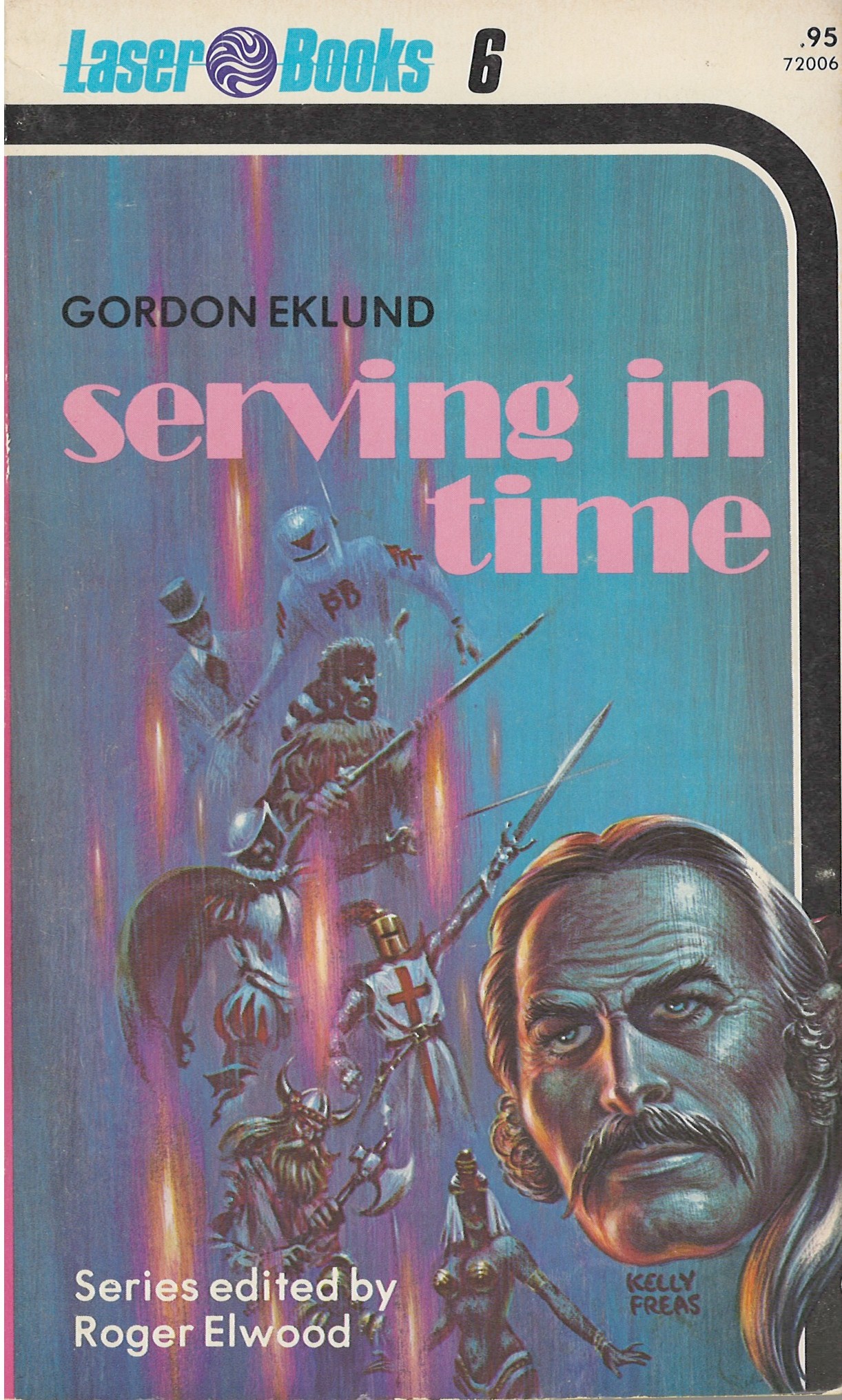
6. Serving in Time by Gordon Eklund
Fire up the DeLorean and cue the Huey Lewis, we’re goin’ back in time!
And forward in time!
To utopian futures and altered histories.
To villains triumphant and heroes betrayed.
To elections lost and wars won.
Ladies and gentlemen, Earthlings and Vulcans, androids and temporal agents, I give you…
Serving in Time by Gordon Eklund!


Oh my friends, words cannot begin to express how excited I am to share this book with you. As I mentioned at the end of my review on Walls Within Walls, this is the title that convinced me to start writing about the Laser Books. It’s not only a standout in the canon of science fiction, it’s also, like Herds, a story of hope for the times we live in, a scathing examination of our preconceptions, and an exhortation to fight the good fight no matter how impossible things seem.
There are twists and turns aplenty in this book, and I long to dig in, but like our hero Jan, I’m going to break the chronology here a bit.
If you like science fiction.
If you like stories of hope.
If you like time travel.
STOP READING NOW.
Try to find a copy of Serving in Time and read it, because this is not a tale to be spoiled lightly. And believe me, I’m going to give you everything in this review, nothing held back. The whole story will be revealed to you, and I would hate to leave you wishing you’d read this book before I told you about it.
So consider carefully, because this is your one and only warning.
SPOILER ALERT!
Let us begin.
Cover
“I’m back, baby.” — Bender, Futurama
Hallelujah and sing Hosanna, brethren, Kelly Freas has returned!
After the Trench of Sadness (books 3, 4, and 5) I feared perhaps Kelly had mentally checked out of the Laser Books altogether and resigned himself to turning in mediocre cover art for bad stories, but I see he merely needed the proper inspiration!
Granted, this isn’t one of Freas’s most representative covers–at best I spy four elements that actually appear in the novel–but God damn, I love this cover! The spectra of blues, purples, and pinks is such a departure from the brown and green tones which have dominated the covers thus far. The warriors and political leaders of history are drawn with such subtlety and character. And my favourite element: the pink motes, which bring vibrance and warmth to an otherwise cold and flat field.
Also, note how the light from those pink motes bounces off Horatio’s face in the portrait, making him a part of the scene rather than a separate entity. that’s extraordinarily subtle work on Freas’ part!
My only complaint–and ’tis a very minor complaint–is that Freas doesn’t really capture the time periods represented in the book. Serving in Time focuses solely on American history; vikings, knights, and Cleopatra ain’t in it. But that’s okay, because a major theme of the story is that people are linked by invisible threads of cause and effect, and everybody matters.
Would You Like to Know More?

Another excellent time travel story with a similar premise of “Reluctant Time Cops” is the NBC television series Timeless. Co-produced by Supernatural’s Eric Kripke, and starring Abigail Spencer, Matt Lanter, and Malcolm Barrett, Timeless follows a team who travel back in time to stop a man from altering American history.
But as these heroes try to put right what once went wrong, they begin to question whether the history they’re preserving is truly the best possible one.
What’s similar between Timeless and Serving in Time is that they focus exclusively on American history, limiting the subject matter to well-known episodes from the United States’ past, and capture a sort of king-of-the-hill game playing out across spacetime.
Plus, Freas still has an American frontiersman, politician, robot, and Horatio in the frame. I’ll happily accept an excess of style over accuracy any day!
Blurb
Jan Jeroux is leading a carefree and idyllic life in the serene, underpopulated pastoral earth of the year 2500. His idyll ends abruptly when he is abducted and forced to join the Time Service of the mysterious world government. In the service he learns how history was manipulated and controlled to produce the beautiful world he enjoyed so much. Thinking he understands how to rectify the injustice and devastation inflicted on the world by the time managers, Jan decides to make things right. But he makes a tragic error…
Okay, this is a very confusing blurb. It basically sounds like, “There’s nothing wrong. Everything’s wrong, and our hero needs to fix it.”
I don’t know if I’d pick up the novel based on this blurb, but I’m going to cut Marketing Guy a break here, because instead of being saddled with a story that’s unmarketable because it’s bland, he’s been given a tale that’s too complex and excellent to explain in 100 words.
Having read the book, I can tell you exactly what happened here.
The real conflict of the book doesn’t begin until the halfway point, whereas most books would kick into gear long before that. Don’t get me wrong, it’s riveting all the way through! But how do you pitch a book to a prospective reader when it doesn’t follow the typical narrative structure–especially when you only have 100 words to work with?
Moreover, MG actually did an amazing job describing the plot of the book, and with another three sentences, he might’ve been okay. But this is the Laser Books, and in the words of the philosopher Jagger, “You can’t always get what you want.”
But after two Tofte titles and the most forgettable novel I’ve ever read, Serving in Time is just what we need.
Story

Let’s travel back to December 15th, 2023.
The time: 2:00 a.m.
The place: Caesars Windsor, Ontario.
A few hours prior, my dad had finished his guest appearance as Santa Clause in The Tenors‘ Christmas show in the casino theatre. I’d travelled to Windsor with him, partly to carry his suitcase, and partly because I hadn’t had a Christmas getaway in years, and let me tell you, The Tenors’ Christmas show is one hell of a way to celebrate Christmas.
After roaming the casino floor in search of a Tim Hortons staffed by a lone overworked employee, we repaired to our room with a couple of cappuccinos and tried to entertain ourselves. Dad flipped through the various TV channels, and I read Serving in Time.
There, sitting by the window, the lights of Windsor and Detroit glittering under a starless winter sky, I was carried away.
As the blurb says, Jan Jeroux is Shanghaied into the Time Service after a conversation with his Uncle Phineas. Jan has never really had much responsibility in life, nor has he ever thought about how his perfect, utopian future came to be. But he’s about to learn.
Would You Like to Know More?
I’m convinced that Uncle Phineas is actually a future version of Jan; after giving Jan a pep talk, he vanishes into thin air two seconds before the Time Service comes for Jan, priming him for the adventure ahead–exactly the sort of thing the Time Service does throughout the novel. Eklund, showing masterful restraint, never confirms Phineas’ identity, but leaves it up to the reader to decide the truth.
There’s no way out once the Time Service nabs you. If you refuse to serve, or fail to pass your final exams, they cast you adrift in the void of time to die. It may raise your eyebrows that a supposedly utopian society would have an agency that utilizes such tactics, but it makes sense when you think about it.
Do you really think it’s safe to have a bunch of maladjusted flunkies who’d just been kidnapped and put through boot camp running around with the secrets of time travel in their brains?
The mandate of the Time Service is purely to observe the past and not interfere. We’ve seen this kind of thing on Star Trek plenty of times: historians who travel across history to witness events like the battle of Waterloo or the building of the pyramids, but who cannot engage with or alter the events they witness.
Sacred Timelines



There’s a term Marvel coined called the Sacred Timeline. I feel it could be applied to many time travel stories. Essentially, it posits that there is a single, inviolate timeline that must be preserved, often with the assistance of time cops or forces outside of time.
Some sci-fi properties like Star Trek include a “Temporal Prime Directive” or equivalent law forbidding all tampering with the timeline. The example burned into my brain is Crewman Daniels’ first appearance in the Star Trek: Enterprise episode “Cold Front”. Daniels shows Captain Archer a view from a temporal observatory, showing all the time travelers from the 31st Century Federation engaged in the real-time recording of history as it unfolds.
These time travelers can observe, but cannot interfere. The title “Cold Front” refers to the Temporal Cold War which the Federation of the future is fighting with factions who want the autonomy to rewrite history, either for their own benefit or the perceived benefit of all. One of the Federation’s favourite tactics in the war is recruiting agents from the past–people already adapted to their time and place in history–presumably mitigating the amount of false identities they need to create, and minimizing the number of person-shaped-holes in history they need to patch.
Most time travel stories centre on preserving the past rather than changing it (Back to the Future, Quantum Leap, Doctor Who), but this kind of non-interference raises several ethical questions.
The Ethics of Time Travel


Has anyone ever stopped to consider the psychological and emotional strain a policy of temporal non-interference would put on someone?
How hard would it be for a black person to go back and observe Martin Luther King, Jr.’s “I Have a Dream” speech, knowing he’s going to be assassinated five years later, and being told they can’t stop the assassination?
Or how about a Jew chronicling the Holocaust as it happened, and being told it’s illegal to save anyone?
Or perhaps a woman traveling to, I don’t know, literally any period in history, witnessing crimes against her sex on an unimaginably wide spectrum of violence, and being told to just observe and come home?
That’s why I love the show Timeless: it shows you how non-interference looks great on the living room television, but becomes impossible when you witness the weight of human suffering across history.
The people of the past are not set dressing for a story, they are real. And most of them got the shitty end of the stick; those of us alive today are only here because our ancestors were either lucky or rich enough to escape the flood or the plague or the firing squad.
“History isn’t a tale of who was right, but who was left.” — Sean Dick
There are many reasons given in time travel stories why meddling with the past is wrong:
- You may erase your present
- You don’t have the right to play God
- It’s morally wrong to meddle with people’s lives
The admonitions are always given in light of what we might lose, never what we might gain. They are always focused on preserving the status quo, which tends to benefit only a few.
Think of a below-the-poverty-line indigenous mother of three on a reservation. Do you really believe she would restrain herself from tampering with history? White men came and took everything from her people; now they’re telling her she doesn’t have the moral right to want to undo that?
I would actually argue most people would leap at the chance to try and alter the past because every single person on Earth has been screwed royally at one time or another. I’m sure someone reading this has had a misfortune happen to either them or a family member that is perfectly preventable with a quick jaunt to the past. Perhaps you had a family member who was killed or crippled in a car crash.
Or maybe it’s something even simpler: your train broke down and you missed that job interview you absolutely needed to get, and you have to move back with your parents because you can’t pay the rent on your 15-square-foot apartment anymore.
These morality plays about leaving well enough alone only work for those who are happy, well-fed, and comfortable. It seems to me the only people who could possibly embrace this policy of “temporal non-interference” would be cis-het white men because we’re the only ones pleased with the outcome of history.
Actually, wait a minute… I’m of Irish descent…
Gimme that time machine! I’m gonna have a little “chat” with Oliver Cromwell!
Well… I digress.
If you read everything I’ve written and believe that the Time Service is doing more than observing the past, then you’d be right.
Changing History
After graduating from the academy, Jan is partnered with a veteran time traveler named Horatio (man, what a loaded name for a man voyaging to the past!) and goes back to 19th century New York.
Horatio and Jan discuss whether they should vote for a local politician in order to gain his confidence and observe him in close company:
“But won’t that create a paradox? I mean, you’re not really a person in this time.”
Horatio smiled. “Paradoxes are a good deal harder to create than that. Time–history–is like a big river. It’s not easy to dam those powerful waters. If I vote, it won’t stay. The waters will sweep it easily away.”
Horatio does a lot more than cast votes: he pushes a man off a sidewalk into the mud, causing him to miss an important meeting with said politician. Horatio brushes this off as nothing more than a bit of fun, but Jan is puzzled: Horatio directly, indisputably interfered with the past.
But the present doesn’t look any different, so these changes clearly aren’t having ripple effects…
Or are they?
Kirk and Gail, Jan’s colleagues and fellow time academy graduates, persuade him that the Time Service might be corrupt, possibly trying to change history to suit their own ends. So as an experiment, Kirk says he wants to try stopping Horatio from bumping that man into the mud and seeing what response it prompts from the Service. Jan is reluctant to go along, but Gail supports Kirk. Kirk uses a time machine, as per their plan, only he doesn’t just stop Horatio.
Kirk murders him.
Jan and Gail return to their present to discover their utopian future is gone. In place of the world government under which they grew up, there’s a totalitarian regime that uses human-like androids to patrol the streets and summarily executes anyone who possesses firearms or advanced technology.
Pursued by armed androids, Jan, smartly grabs a few history books before he and Gail retreat to the relative safety of the distant past. He reads the books and puts the pieces together, and what follows is one of the greatest mic drop moments I’ve ever read in a sci-fi novel.
The Agenda of the Time Service
Jan starts rattling off events that happened in the history that he knows.
- George Washington was captured by the British and executed at the Battle of Fort Washington
- The cotton gin was never invented
- The United States declared war on Nazi Germany on September 1st, 1939
This is when the reader makes the horrible realization that the utopian future of 2500 isn’t built on real-life history, but on a history manufactured by the Time Service.
Horatio didn’t tell the whole truth when he said the river of time couldn’t be shifted. A single action can’t divert it, but a dozen of them? A hundred of them? All those small changes–meetings averted, wars declared, machines never invented–amount to a different future. That’s what the Time Service was created to do: divert the river of time and create a better, more egalitarian future.
How?
Let me explain.
Take the cotton gin for example: what happens if it is never invented? Well, cotton farming doesn’t take off as an industry in the American South, which means there’s no demand for cheap slave labour. Slavery as an industry collapses in America and the Civil War never happens.
Or how about the U.S. joining the war alongside Great Britain in September 1939 instead of waiting until December 1941? Faced with the prospect of fighting the most technologically-advanced nation on Earth, people rethink their allegiance to the Axis powers. Stalin cancels the rape of Poland. Many nations join the Allies. Nazi Germany is laid low long before the Holocaust reaches its peak, and President Roosevelt lives long enough to help Winston Churchill build the foundations for a World Government.
Noticing a pattern?
Every action the Time Service takes has a pro-social outcome. Populist xenophobes are prevented from rallying political support and taking office (hence Horatio pushing that guy into a mud puddle and making him miss his meeting), hateful ideologies are curtailed before reaching their zenith (hence the simultaneous declaration of war on Germany), and the general consolidation of power in the hands of individuals is prevented (hence Washington being caught and executed by the British).
So wait a minute… what about the history we know? The one where the Civil War and Pearl Harbor happened? Where does that lead if not to the utopian future we saw at the start of the novel?
The Aborted Timeline
I hope you’re sitting down, dear reader.
In most time travel stories, it is presumed that the real history of the world–the one you and I are living in–must be protected at all costs. Sure, it’s not perfect, but it’s better than the alternative. Think of Biff in Back to the Future II: he goes back in time, and creates a new timeline where he rules the world in a cyberpunk dystopia.
These types of time travel stories are about a group of plucky adventurers putting things back to normal, where apprehending the bad guy will automatically reset time to the comfortable history we know.
But in Serving in Time, the course which the river of time seeks to follow, the path of least resistance, the road which humanity will automatically take if everyone just sits back and not meddle with history–in other words, the Sacred Timeline–leads to a dystopian future where AI is used to police humanity, a totalitarian regime rules the world, minorities are not tolerated, and individual freedoms are severely curtailed.
Reading this book in 2023 was a revelation like no other. The notion that the Sacred Timeline leads, forever and always, to dystopia, is a bitter pill to swallow. It’s a bold move on Eklund’s part, but it rings truer today than in 1975.
But wait… if the Sacred Timeline leads to a dystopia… where did Jan’s utopian future come from?
The Real Renegades of Time
Let’s talk about the Time Service.
The final great technological invention of the world tyranny in our timeline was a time machine. They wanted to use it to tighten their grip on the planet and increase their power.
But the men and women who invented the time machine had other plans. They wanted to create a better world, and they knew the only way to defeat the tyranny was to kill it in the womb.
The problem is, no single action in history will stop the tyranny from rising. This would be the work of many agents, acting in concert, to build a dam brick by brick which would divert the river of time.
And they would have to repeat these actions: return over and over again to the critical moments and take the exact same actions. Utopia wouldn’t just be a one-and-done deal, it would require an entire army working forever and always to maintain it.
And you know what? It worked. Utopia was born.
But it turns out that Kirk, Jan’s friend from the academy, is actually a survivor of the aborted timeline. He, along with a handful of other agents, followed the Time Service’s founders into the new timeline, infiltrated the Time Service, and waited for the exact moment to strike.
Their plan isn’t to break the dam, but to ensure it is never built in the first place, and the best way to do that is by killing the dam’s builders.
Kirk’s plan works flawlessly, and Jan and Gail find themselves alone and without help. They spend the next few (subjective) years of their lives working to figure out exactly what events the Time Service manipulated, and how to tip their outcomes onto the utopian path. Ultimately they are successful, but it’s a harrowing road to get there, and many times it seems as if they are only going to obtain a partial victory. The writing and pacing has the ever-increasing momentum of a steam engine at full throttle.
Conclusions and Recommendations
“Our lives are not our own. We are bound to others, past and present, and by each crime and every kindness, we birth our future.” — David Mitchell, Cloud Atlas
I wish this book were longer, but I’m astounded at how much Gordon Eklund accomplishes in the 190 pages afforded him.
He somehow manages to write not only one of the best Laser Books, but also one of the most intriguing and challenging sci-fi books I’ve ever read. His assertion that evil always wins unless extraordinary measures are taken is not a new theme, but he hammers it home one nail at a time until you cannot deny it.
This book stuck with me because of its simple premise: the history we know and love is not the best outcome for the human race; most of it is not worth preserving, and we should have done better at each of the turning points. In this story, changing history is the whole point, and when you see the tweaks the Time Service made, you cannot help but agree with them. It’s a fantastic example of how technology can be used to set humanity free, or enslave us.
It’s also a message of hope for a time when we, as people, feel a distinct lack of personal freedom. The Time Service didn’t build their utopia overnight, nor was it created by a simple throw of a switch. It was built with a thousand small actions which together amounted to a better future.
The corporations and the politicians would have us believe that we are powerless, but each of us holds a brick with which we can dam their river and divert it onto the course we choose. It’s up to us whether we lay those bricks, either together or singly, but lay them we must if we want to live in fairer times.
My Goodreads Review
A time travel story that dares to suggest changing the past might not only be ethical, but the only way to build a better present, this story takes all the usual temporal tropes and flips them on their head. Gordon Eklund has achieved a truly original and powerful tale within the confines of the Laser Books, and it’s a story you should all be reading right now.
I am thoroughly impressed with Gord’s first outing in the Laser Books and eagerly await his next: Book 10, Falling Toward Forever. For now though, we must look to Book 7.
Who’s Next?

Seeklight by K.W. Jeter!
Jeter is notable for being friends with James P. Blaylock and Tim Powers, both of whom I discovered through the Treasure Chest (see The Laser Books). These three musketeers met in the English program at California State University, Fullerton in the 1970s, where they palled around with Philip K. Dick.
At time of writing, I’ve read several Powers novels, but nothing by Blaylock or Jeter, so I’m interested in getting a taste of the latter’s work. A glance at Jeter’s Goodreads page shows he’s most well known for his Star Wars and Trek tie-in novels.
Of the three, Blaylock is the only one who doesn’t have an entry in the Laser Books, probably because his oeuvre tends toward fantasy rather than sci-fi.
Blurb
Barry Malzberg calls Seeklight one of the three or four best science fiction novels he has ever read by an author new to the field. The world Seeklight creates is extraordinary. The English critic, Philip Pollock, says Seeklight is a “straightforward, highly imaginative, very well told story. It falls into the class that I rate as ‘a jolly good read’. As the crime novel critics say ‘I couldn’t put it down’.” He concludes his review by saying, “For a first novel it has remarkable selfpossession and professionalism and I enjoyed it very much indeed.” There is no doubt that you will too.
High praise. Join me next week to see if it lives up to the hype!
Leave a Reply