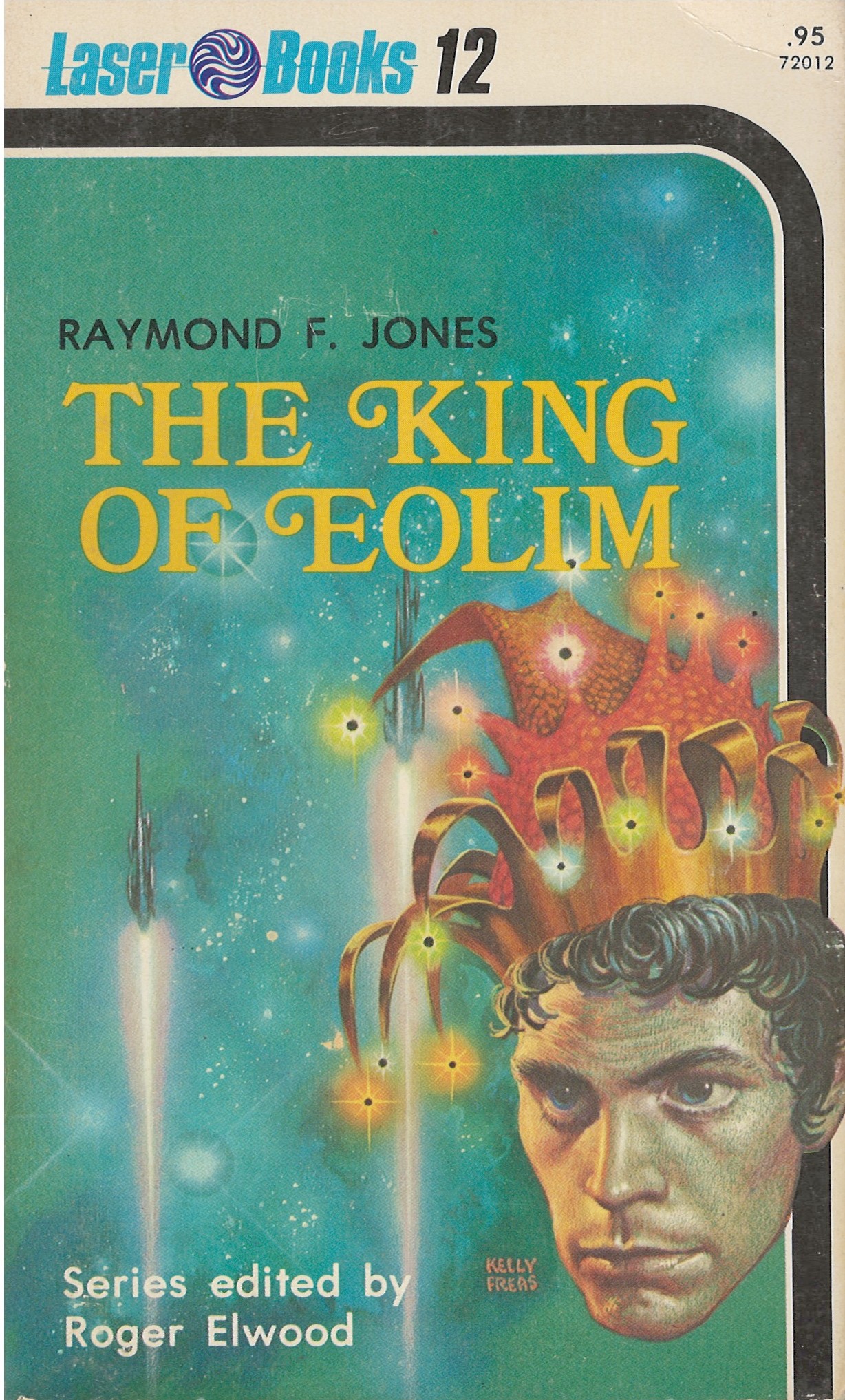
12. The King of Eolim by Raymond F. Jones
*sigh* I was having such a good fortnight.
First, my publisher told me they liked my first round of revisions on Seekers of the Fallen Stars, were adding the novel to their editorial pipeline, and wanted a proposal for Book 2 pronto. Sent that over, and they said it was strong, and told me to get writing.
Then Escape Pod emailed me saying they wanted to add my breakout novelette “EDIE” to their reprint catalogue and podcast it.
Then I watched Project Hail Mary, and knew right away that it was going down as a sci-fi classic alongside 2001, Contact, and Interstellar.
And then, just when life couldn’t get any more awesome, four astronauts–including a Canadian–launched to the moon for the first time since Apollo 17 in 1972.


A great wave of optimism has swept the world as Reid Wiseman, Victor Glover, Christina Koch, and Jeremy Hansen took us with them, further than any humans have ever gone before. I have been living a dream.
And then I remembered…
… I have to review The King of Eolim.


Raymond F. Jones, author of Book 1: Renegades of Time, returns for a second outing. And oh-my-various-gods, it is painful.
I suppose, much like the crew of Artemis II, sooner or later, we all gotta come back down to Earth.
Cover

If there’s a slide scale for Kelly Freas‘s work, it would look something like this:
Bad —— Workmanlike —— Excellent
Eolim’s cover falls somewhere between Workmanlike and Excellent, closer to the former than the latter. I really like what Kelly is doing with light and colour, but I think he overdid it a touch on the sparkle. And I’m not sure why there’s two spaceships; the Bradwell family takes two trips through space, sure, but on the same ship. Pictured in the portrait is Freeman, the protagonist (and no, you can’t convince me his father is the main character) and his crown, which we’ll talk about later.
Oh, we will talk about it.
Overall, the composition and blend of colours is good, but the sparkliness is just a little too much. I think he could’ve toned down the lighting.
Enjoy this positive feedback, good people. It’s all downhill from here.
Blurb
Adventure stories don’t normally make a point as well, but Raymond F. Jones is no ordinary adventure story writer. In this touching and beautiful tale, Forester Bradwell shares his son’s adventures and learns a lesson he will never forget. Neither will you. For Forester Bradwell is one of the elite in a time and society where stupidity and ignorance have been conquered by genetic engineering. But his son Freeman is a Retard. The King of Eolim is the story of the Bradwell’s search for a home that will truly be “home” for Free.
If you read that and threw up a bit in your mouth, I wouldn’t blame you. I had the same reaction, and I’ll tell you why.
Elementary school was the most excruciating experience of my life. I had good teachers and made some friends, but I was always the slowest kid at sports and scholastics, to the point where I was given a Special Accommodations rating to help me keep pace with my classmates in learning.
In the Ontario school system, this means I was often separated from the rest of my class and put in a small group of students with similar learning or concentration challenges so that I could be taught in a quieter environment where teachers could spend more time addressing my needs. These sessions actually nurtured my desire to be a writer, because I had the time to express my desires to my teachers who in turn gave me the time and space to pursue them.
But what bothered me for all those years is that I knew I learned differently from other kids, but I was still chained to the school system. Some of my fondest memories are of going to the school library, picking up a book, and reading. I could read whole books in one sitting, and if it was an educational or non-fiction book, I could frequently recall every single thing I read in that book for weeks afterward.
And yet, if you put me in a classroom and tried to teach me math, religion, or science, my eyes would glaze over and my mind would shut down.
And yes, I had the R-word thrown at me a few times. That is not something you forget.
Reading the cover blurb for this novel, I knew exactly what kind of story I was in for. I hoped I was wrong.
I wasn’t.
Story

This just in: Neurodivergent Youth Taken from his Abusive Family and Placed in Foster Care with Telepathic Aliens
In a eugenics-based future, undesirable traits have been edited out of human beings, but occasionally, children like Freeman Bradwell are born who, while completely ordinary by today’s standards, with healthy imaginations and empathetic minds, are considered R—— by the standards of a society where exceptionalism is ordinary and cold calculation is prized.
In school, Freeman’s “disability” is recognized by his students and teachers and he is crowned “King of Eolim”, in a perverse tradition that follows the wearing of a dunce cap.
Would You Like to Know More?
The dunce cap is a tradition stemming from the 19th and 20th centuries. Children at school who were considered slow or disruptive were brought to the front of the class and forced to wear a pointed cap with a D or DUNCE printed on it. Modern psychologists agree that these “problem children” were likely kids with ADHD or who would’ve benefitted from special learning accommodations, or even who simply didn’t gel well with the school system.
Kids like me, in other words.
While a normal practice, there were many who, even at the time, called it debasing and harsh . I cannot imagine the psychological damage that was done to children with brains like mine because of it.
The saddest thing is, Freeman knows he is being made fun of, but he tries to wear the crown with pride as a way of undercutting his abusers. He demonstrates a remarkable strength of will considering his young age and his lack of allies in this cruel society.
His worst abusers are his parents. His mother won’t show him an ounce of love, and his father Forester wants to take his family away from Earth so he won’t have to listen to his colleagues demean him for having a R—– son. So they fly away in a spacecraft and crash-land on an alien world, Iduna-style.
Throughout the novel, Forester belittles Freeman, disregards his ideas, and even when Freeman calls the attention of an alien tribe to assist his family after their crash landing, Forester takes it upon himself to assume the role of colonizer and indoctrinate the aliens into human ways of thinking.
Oh yeah, and he frequently equates the aliens to Freeman because of their wide-eyed, dim-witted innocence, and denigrates them for sacrificing many of their number to stop Forester from taking Freeman away from them–Freeman, at this point, having become their friend.
Forester and his wife, seeing that Freeman is happier on this alien world they’ve come to, leave him there and go back to Earth. At the end, Forester and his wife come to love Freeman, but they still think it’s for the best to leave him behind.
Conclusions and Recommendations
I’m sorry, guys, I have to wrap this up. I would’ve gone into more detail of the plot, but this book is too painful for me to talk about any longer.
There have been many well-intentioned attempts by sci-fi authors over the years to address issues such as race, sex, and neurodivergence, but lacking in modern resources and studies, such attempts were inevitably clumsy, and often harmful. The King of Eolim is one such attempt.
My Goodreads Review:
Raymond F. Jones is a veteran of the genre. He was a regular contributor to Astounding (Analog) and Galaxy. His last outing in the Laser Books, Renegades of Time, had some good scenes in it. But King of Eolim, however well-intentioned, is a deeply harmful book, and in the world of modern science fiction and neurodivergent studies, it has no place.
I can’t be too harsh on Jones, I’ve written some well-intentioned but deeply harmful stories myself, but I also had the benefit of living in a wiser society, with gentle, educated friends, who showed me where I mis-stepped and where I could do better. Maybe Jones could do better if he were alive today, maybe not.
But let this stand as a cautionary tale to writers everywhere, including myself: educate yourself before you write, lest your pen draw blood.
And with that… we’re one-fifth done the Laser Books. The King of Eolim marks the end of the initial run of 12 novels. Let’s see where Roger Elwood takes us next.
Who’s Next?

Lucky 13 is Blake’s Progress by R.F. Nelson. Blurb it, baby!
William Blake lived as no man had ever lived before. Sweeping across the centuries, he clashed with Cleopatra, chatted with Churchill, entertained with Ezekiel. His wife Kate was astounded at the man she had married. And she knew what she had to do! In this amazing account of Blake’s life, Ray Nelson tells it like it might have been, had Blake had his way. “There are wonders galore in this book… I don’t believe I’ve read a science fiction novel like Blake’s Progress before.”–Terry Carr
Well, you know, one mention of ole’ Winston C. and I’m on board. I’ll see you all then!
Addendum: Artemis II

As I write these words, the Orion spacecraft Integrity is falling back down Earth’s gravity well, on target for a splashdown April 10th at 7 o’clock. Godspeed, Artemis II. The whole world is wishing you four a safe and uneventful return.
Leave a Reply