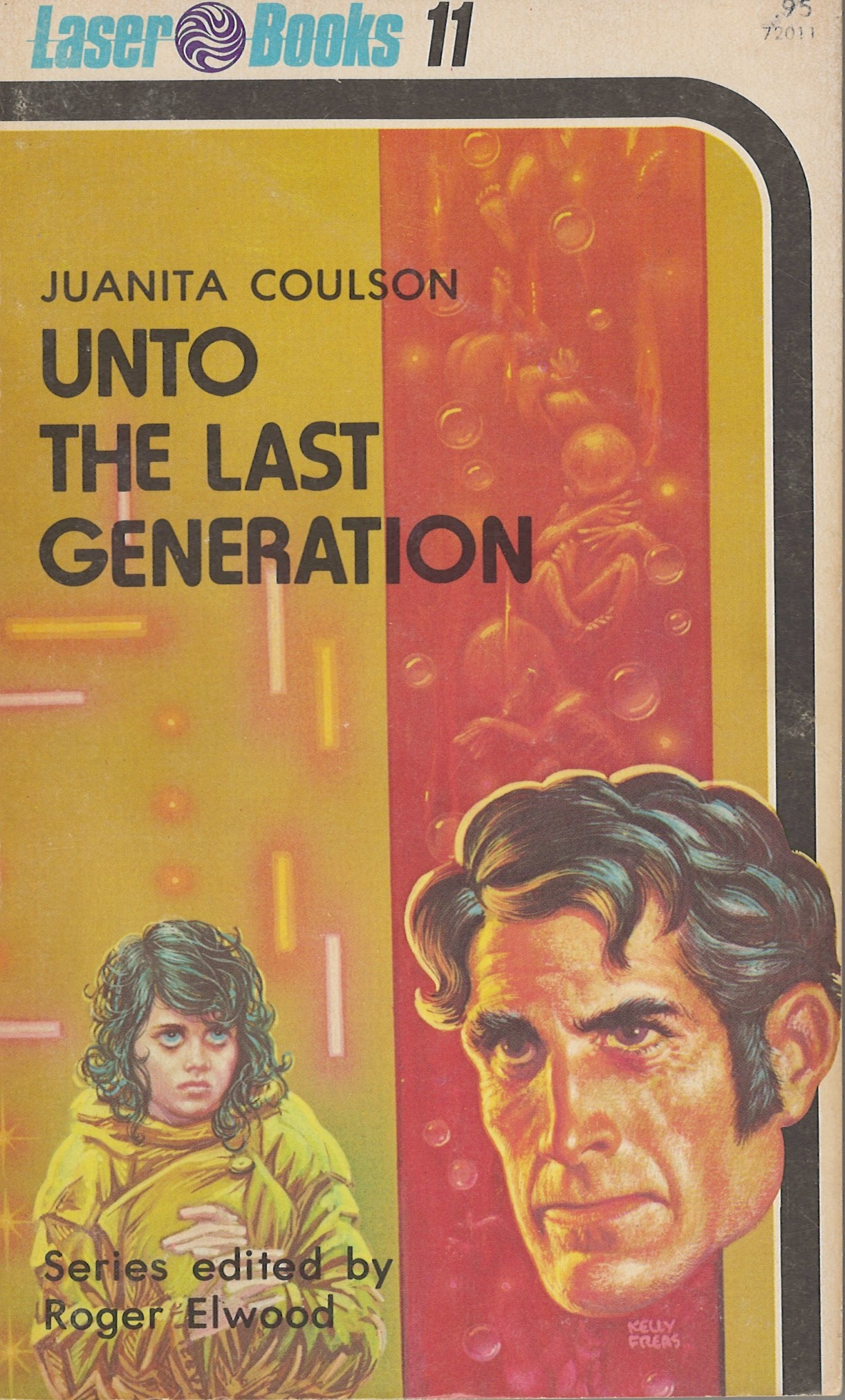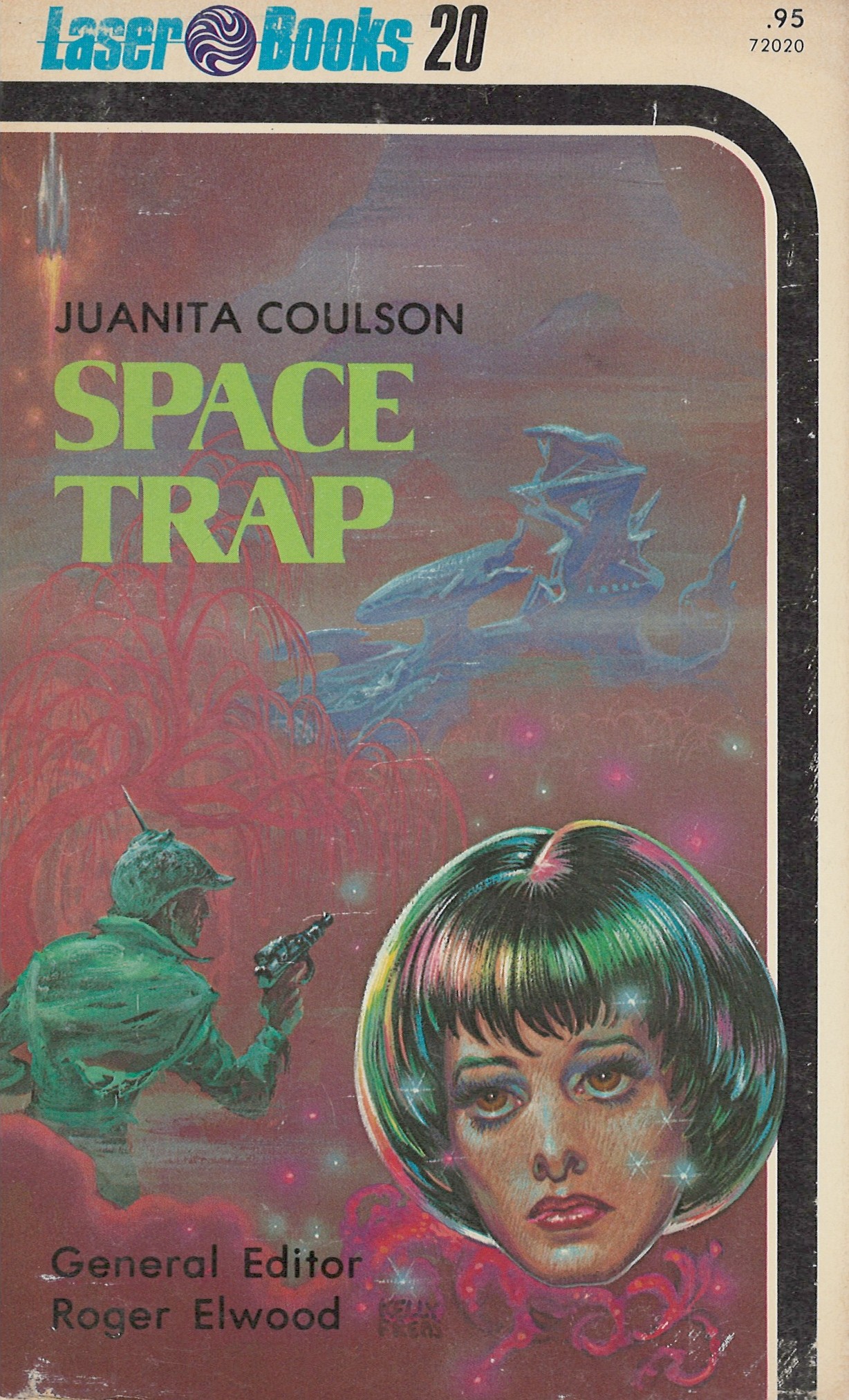
20. Space Trap by Juanita Coulson
Whoa, 20 came around real fast.


Juanita Coulson, the author of Laser Book 11. Unto the Last Generation, brings us a tale of exploration gone awry on a far off planet. Yes folks, this is the third shipwreck story we’ve seen on the Laser Books.
But, if you’ll recall my review for Last Generation, you’ll remember I had some glowing words for that book, in particular for Juanita’s perspicacious depiction of reproductive immune disorders. That was a 4 out of 5 book.
So I’m going into Space Trap with high hopes that she’ll do something very interesting.
First, some housekeeping.
As of the previous book, 19. The Unknown Shore (review here), Roger Elwood began including biographies of the Laser Books authors. This is a godsend. As you’ve no doubt realized, most of the authors of these books were not very prolific, so they never got enough attention to warrant the writing of extensive bios in magazines and periodicals. And if the authors died before rounding the bend into 2000 A.D., they likely never began the process of creating digital personas and records of their lives.
This means I have to go down a research rabbit hole for each and every one of these writers, but now, mercifully, I have a trailhead in the form of the Elwood bios, and I’ll include them in every review. For the sake of consistency, I’ll add Juanita’s here, even though I already covered her in my Last Generation review.
ABOUT THE AUTHOR
Juanita Coulson has been involved in the science fiction field most of her life. With her husband Robert, she edits and publishes the Hugo award winning fanzine, Yandro. Her first story, a collaboration with Marion Zimmer Bradley, was “Another Rib.” In addition to numerous short stories, she has the following science fiction novels to her credit: Crisis on Cheiron, The Singing Stones, Star Sister, The Gates of Eden, War Wizards. She has also written three gothic romances.
The Coulsons, and their son Bruce, attend numerous science fiction conventions: they were Fan Guests of Honor at the 1972 World SF Convention in Los Angeles. and the 1975 Deep South Con in Louisville, Kentucky.
Juanita Coulson also wrote Unto the Last Generation, LASER BOOK No. 11
See? Isn’t that so much more elegant than my digital bumbling?
Anyway, let’s get stuck in.
*Deep breath*
Cover

This is a bit better than The Unknown Shore. Kelly has really captured the surrealistic, dreamy quality of the planet NE 592. In fact, this might actually be a scene from early in the novel where R.C. and Ken are shown a vision of an Earthling murdering one of the M’Nae people. The Earthling is presented as a faceless, wraithlike image in the M’Nae’s telepathic imagery of the event. The giant crash of Noland’s Class-D spaceship in the background and the Survey Ship burning her engines as she falls planetward are all correct as well.
The blood-coloured trees, sparkles, and Thayenta’s rainbow hair really elevate the dream-like quality of this cover. The whole thing feels like a memory plucked from an alien mind: subjective and colourful.
That said, this still isn’t quite on par with Kelly’s best work, like The Black Roads or Invasion. The composition and staging of the elements is a little off. It feels like we’re looking at a stage play from the wings instead of the front row seats. It’s a little… off. Maybe you guys know what I mean.
Anyway, lettuce move onto the blurb.
Blurb

Planet NE 592 wasn’t due for Secondary Survey for another ten years. So why, Ken wondered, were they heading there now? Then on his screen he saw the disembodied face of a girl with jewel-like skin and felt, rather than heard, her plea: “Go Back.” But they couldn’t go back. Against their will, they were drawn to a crash landing on NE 592. They were trapped–with no means of escape. And NE 592 was not the uninhabited planet they had been led to believe it was!
As I said in my review of The Unknown Shore, I love nautical tales of shipwreck and marooning, and I love them even more when they’re set against the backdrop of the Universe.
Would You Like to Know More?

I was on vacation with L. in New Brunswick this past week whilst reading Space Trap, and we listened to a podcast episode which covered the sinking of the whaling ship Essex. This is the tale which inspired Herman Melville to write Moby-Dick.
In brief, the Essex was an American whaler which was rammed and sunk by a sperm whale on November 20, 1820 in the South Pacific. Of a crew of 20, only 8 survived, some by making landfall on a Pacific island, and others by resorting to cannibalism. Melville later sought out the survivors and used their accounts as background to the writing of Moby-Dick.
The story of the Essex matters because it is part of a growing body of evidence which proves the intelligence and sentience of whales. As whaling activity increased throughout the 19th century, a pattern of behaviour emerged among whales that is referenced in Moby-Dick: when whaling ships bore down on pods of whales in mating season, the males would signal the females to flee, and then they would turn and attack the whaling ships, usually losing their lives in the process, but sometimes taking a whaling ship with them to the deep. These attacks increased in frequency as more and more whalers invaded the sperms’ mating grounds.
In short, the whales learned how to defend themselves, their mates, and their offspring.
The importance of whales as a keystone species was only understood later with the discovery of the Whale Pump. The wanton destruction of these animals represents one of the greatest mistakes in the catalogue of human affairs on this planet–a mistake which we continue to perpetuate in the modern world.
There’s a Gordon Lightfoot song which speaks to the tragedy of humanity’s actions: “Ode to Big Blue”.
Knowing Juanita, she’ll probably make of this tale a deft study of colonialism and invading peoples. I’m actually excited! Let’s open this thing up and see what we got!
Story
Remember how excited I was to dive into Gordon Eklund‘s Falling Toward Forever after reading the incomparable Serving in Time? Remember how disappointed I became after seeing the travesty that Forever turned out to be? Remember how I said in my last review I shouldn’t get my hopes up just because an author turned in a great story once in the Laser Books?
I never listen to myself. I know I should, but I’m ever the optimist.
I was sitting with my girlfriend on the sofa in her parents’ house at ten-o’-clock. I finished the last page of Space Trap and let the book fall from my hands. L. looked up at me, laughed, and said, “You look so unimpressed.”
I held up the book and replied, “Well, this was pointless.”
And it was.
My God, Juanita, what kind of month were you having when you wrote this?
To outline in brief, our protagonist Ken…
… just Ken…
… crash lands with his captain, R.C. Zachary, on NE 592, and discovers that a race of telepaths has already colonized the place. Worse still, a group of regressive humans led by Zachary’s old colleague, Noland Eads, have also crashed here and the technophobic zealots have gone and started a shooting war with the telepaths.
Ken and R.C. are charged with a murder committed by Eads, and it is here that Ken meets Thayenta, a telepathic apprentice, and falls for her scantily clad body and feminine helplessness.
Look… if you’ve seen any number of Star Trek TOS episodes, you’ve seen this plot. Man falls for helpless alien waif–a “space trap,” if you will–who can barely speak English and immediately feels protective and possessive of her. He tries to make peace between the unenlightened humans and barbaric aliens and teach everyone Peace, Freedom, and the American Way.
I cannot tell you how tiresome such a plot is, especially in 19-fucking-76 when the SF New Wave was at its peak, redefining the genre and thrashing the Old Boys Club that science fiction used to be. And I am stunned that Juanita Coulson, authoress of Unto the Last Generation, would turn in a story this banal, this pointless, this exhausted after such a wonderful examination of human fertility and the importance of hope in a world in freefall.
But most shocking of all? How could a woman write a story that so naturally and effortlessly perpetuates the stereotypes her fellow female authors have struggled against for decades?
In the words of Vannevar Bush, “I apologize if I’ve become stirred, but I am.”
Conclusions and Recommendations
My Goodreads Review
A misogynistic colonizer’s wet dream. This novel is a throwback to the very worst stories produced in science fiction, and I’m shocked and appalled that a woman–let alone the authoress of the endlessly inventive and fiercely intelligent Unto the Last Generation–could pen it.
I know I’m coming across as very hard on Juanita Coulson, but I’m honestly so baffled and disappointed. She’s shown herself to be a very talented writer, and her choice in subject matter was subtle and clever in Last Generation. So why did she choose to waste her talents on this drivel?
There’s actually a very simple way to make this plot work, and it’s the same suggestion I made in Seeds of Change.
Write Thayenta as only pretending to be a speechless, emotionally immature waif. In truth, she’s only feigning loyalty to Ken in a bid to gather intelligence for her people. Once she gets everything she needs, she casts him and the other humans aside and her people throw the humans off-world.
This way, you could still tell the story from Ken’s POV, but his dreams of being the dashing space hero blow up in his face and his worldview is completely upended by Thayenta’s apparent “betrayal” of him. He realizes how stupid he was to underestimate her and her people, and how dangerous his own species has turned out to be. A real space trap indeed! This would be such a great inversion of expectations, and would be a massive “fuck you” to the imperialist plotlines of the Golden Age.
Juanita, you missed a golden opportunity. I’m sad this is the last time we get to see you on the Laser Books. I really enjoyed Unto the Last Generation, and it’s been an inspiration for me. But Space Trap is such a waste.
Who’s Next?
Okay, let’s shake this one off and see if the next author can wash the bad taste out of our mouths.

Ooh, hot diggity, I like the looks o’ this! Now, let’s see the blurb?
Blurb
The Sternverein polices the universe. Criminals dread it; law-abiding citizens esteem it; all respect it. Ryne an orphan from the tiny planet Jadjeel, worships it. The organization rescued him from slavery and trained him to be a man among men, and elite Blackjacket. It gave his life purpose and direction, excitement and adventure. But it is totally corrupt, as Ryne learns in the shattering episode that brings to a climax John Morressy’s sweeping odyssey, A Law For The Stars.
Corrupt space cops? Sign me up!