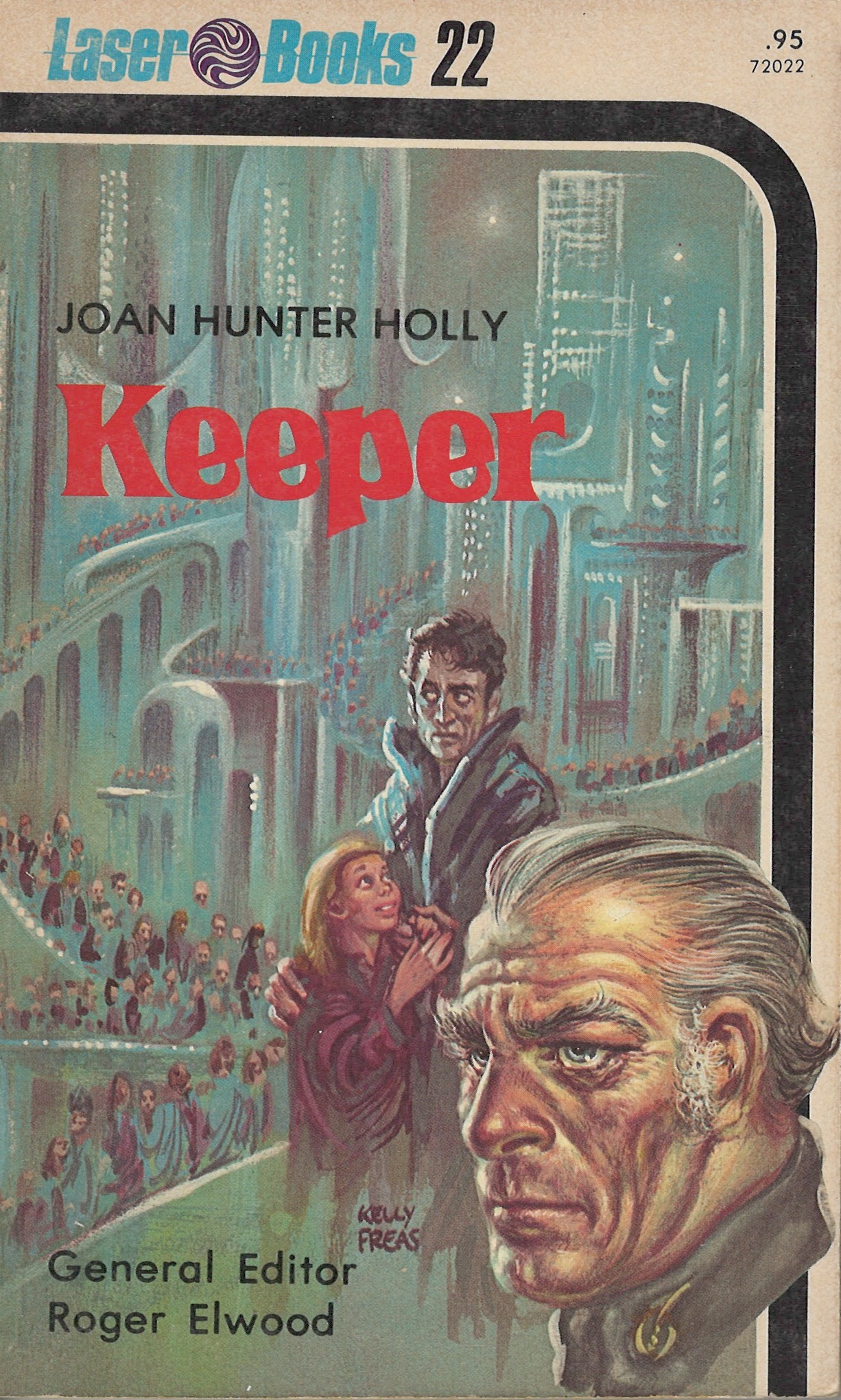
22. Keeper by Joan Hunter Holly
Don’t you just hate emotions sometimes?
Having lived with depression and anxiety, I can tell you there’s been many a time when I’ve wished I didn’t feel anything at all. It can be a terrible burden, being an emotional creature.
But it is also the only way to know that we are alive.
Throughout the Golden Age of Sci-fi, there’s been plenty of fiction which posits that emotion and intelligence are separate things, and that to be a truly enlightened species, we must learn not to feel. I can’t tell you how many depictions of “higher life forms” involved an evolutionary step of “letting go” of emotion.
Neuroscience was even on board with this idea for a long time, but in the last thirty years we’ve come to reexamine this notion that emotion and intelligence are incompatible. Indeed, the prevailing theory these days is that emotion is the bedrock of intelligence–that it emerges in complex organisms before problem-solving and communication. This theory is supported by a growing body of evidence that all animals which possess a brain are capable of feeling joy, sadness, fear, and love.
It makes sense if you look at it this way: how do you know the people who are important to you? You feel an emotional attachment to them. How do you know when you’re in danger? You feel a chill creeping down your spine. How do you know when you’ve done something important? You feel happy and accomplished.
Emotion is our lighthouse, guiding us toward safe harbour and warning us away from rocky shoals. The psychosomatic chemical responses triggered by intense emotions are the perfect tool for conditioning our behaviour. And while emotions can be manipulated so that we fall prey to irrational decisions, we cannot exist as living things without them.
That is the case which Joan Hunter Holly, pen name of Joan Carol Holly, makes in Keeper.


Author bio:
Joan Hunter Holly is the author of ten science fiction novels, including Encounter, The Mind Traders, and The Time Twisters, and of many shorter works, among them “The Gift of Nothing.” She wrote her first story at the age of five and won a blue ribbon in a youth talent contest a year later. Her first professional sale was made when she was eighteen. She comments: “I sometimes think I was born writing and wouldn’t be surprised if my very grave exuded the clackety-clack of a typewriter soft-pounding underground.”
She earned her B.A. degree in Psychology from Michigan State University, graduating with High Honors, but immediately reverted to writing. Her chief interests lie in the fine arts, American Indian culture and religion, gardening, and nature in all its forms.
She is also a member of The Science Fiction Writers of America and serves them as a Nebula Anthology Trustee.
Those are some pretty solid credentials for an entrant into the Laser Books.
And if you want to visit her grave and find out if she is still clackety-clacking away on her typewriter, you can find her in Delta Center Cemetery, Delta Township, Eaton County, Michigan, USA, Plot Section F, Lot 4, Grave 3.

Also, chalk another one on the board for “books bought at Bakka“!

It’s Kelly-time!
Cover

There have been Laser Books covers where Kelly has wasted space. This is not one of them. Let’s go through the elements.
In the portrait bottom-right, we’ve got the stern face of our chief antagonist, Re-Conditioner Bretton, a monster of a man who tortures people for a living.
Behind him we’ve got our protagonist Dainig clutching his ward, Peter (notably wearing his girl disguise). Dainig’s eyes are furtive, scanning the Metropolis-style city for signs of pursuit.
The looming cityscape is really well done, a true piece of Golden Age retrofuturism that still looks gorgeous today, but my favourite element of this cover is the crowds.
This is a future where humans have drugged, electrocuted, and coerced all emotion out of themselves, and so most of them behave less than human. Kelly brings that vacuous emptiness that’s on the inside of each of them to the outside, drawing their faces as vapid, slavering, ghoulish caricatures. I like the cover, but I love this artistic flourish.
And finally, the word Keeper is stamped overtop the city in bold, blood-red letters; Dainig is Peter’s Keeper, and he’s got blood on his hands, as we’ll see very soon.
Blurb

In this world of tomorrow, there is neither hatred nor love. Normal human sentiment is punishable by death! Dreams of happiness, human warmth and joy have given way to indifference. Man has been programmed not to feel. It is a chilling world in which there is no feeling at all, save fear… fear of any human emotion! This is the world in which Frederick Dainig must live. He told himself he couldn’t help it, but he knew better than to let himself care about the little child of whom he is the Keeper.
Hey, anybody watch Equilibrium?
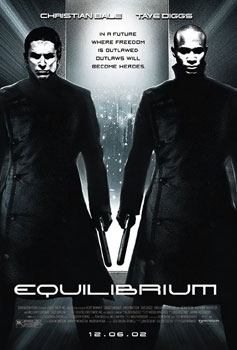
As you can probably tell just from the poster, this is one of the many Matrix knockoffs that came out between 2000 and 2005. I think somebody in Hollywood basically said, “Let’s do Fahrenheit 451, but with leather cassocks, katanas, and gun kata.”
“What’s gun kata?”
“I don’t know, but lets do it.”
And boy, did they.
This is a prime slice of early-00’s cheese. It’s actually pretty fun. Take a look at the trailer:
In this movie, everyone is on a drug called Prozia II which suppresses emotion. “Sense offenders” (people who feel emotion and secretly keep works of art and literature) are hunted down by Clerics of the Grammaton: gun-toting ninjas who enforce the state of Libria’s will.
Narratively, it’s exactly what you’d expect: they steal Fahrenheit 451‘s plot structure beat-for-beat almost without deviation. You know what they say: Imitation is the sincerest form of flattery that mediocrity can pay to greatness.
Ray Bradbury was indeed great.
… what were we talking about before? Oh yeah, the blurb. It’s fine.
Story
I hope everyone’s got their therapist on speed dial because we’re ’boutta feel some things.
In this twisted future, children are given away by their families to have all emotion tortured out of them via a violent electroshock procedure. If they express emotion of any kind, ZAP!
And if you relapse as an adult (a process called Re-Emergence), you’re taken by the Special Police for Re-Conditioning, which is the same electroshock torture, but worse.
The rationale for all this is that emotional behaviour led to the tragedies of the 20th and 21st centuries. Capitalism, war, famine, it’s all because people couldn’t control their feelings. Better to do away with them altogether.
Except…
Another horrid feature of this future is that people still fetishize emotion, even though they aren’t permitted to experience it. On some level, they know how fucked up they’ve become, they know they need to experience joy, sadness, rage, in order to be human. So the government satisfies these desires with Viewings.
Developmentally-challenged children–children with no hope of ever controlling their own feelings, Conditioned or not–are either offered up by their parents or ripped away from them and placed into rooms with walls that can be made transparent. There, clinicians manipulate these children’s emotions by offering gifts, love, pain, fear, in order to evoke a response which is then shown to a live studio audience and broadcast around the world.
And when the children finally realize they’re being manipulated, when the clinicians are unable to evoke any planned emotional response from them, the children are euthanized, either quickly or through starvation (to prolong suffering and therefore emotion).
The people get their dose of feelings vicariously, and go back to their tranquilized existence.
Peter is one of these victims. Dainig is the one charged with Keeping him: priming his emotional state so that his expectations can be affirmed or shattered by the other clinicians.
Dainig’s job is to psychologically torture a child.
When Dainig begans to feel empathy for Peter, he makes the decision to rescue him from the clutches of the government. He takes him home, gives him food and rest and love. He shows him the real world, transporting him on public transit in the guise of a small girl.
And then he does the one thing that I, as the reader, did not see coming: Dainig chickens out and returns Peter to his prison and submits himself for Re-Conditioning.
The scene where he walks an unwitting Peter back into the clinic was such a gut-punch, especially because Peter doesn’t have the cognitive ability to perceive that he is being double-crossed. He thinks Dainig and he are playing a game, until he walks into the clinicians’ office. He begs them to go back, to “go another way”, as if time can be unwritten. He doesn’t understand that some things like death and poor choices are permanent.
When Dainig submits himself to Re-Conditioning, he gets a surprise visitor between sessions: Laine Todd, a Re-Conditioner who’d been asking to see him for some time. Apparently she’d marked him as a potential Re-Emerger and wanted to treat him, but not for reasons of state. She tells him there’s a growing movement of Re-Conditioners who believe that society must stop torturing human beings and start learning to live with our feelings in a disciplined manner.
I was reminded of the passages from A Law For the Stars where Ryne is told that drugging feelings away is no substitute for self-discipline.
Laine wants Dainig to become a front man for her organization, and tells him to write off Peter as a lost cause, but Dainig finds a way to manipulate her into unwittingly helping him save Peter for a second time. Laine is furious, and in the final scene, threatens to kill him and Peter to save the organization, but her will is broken by the moment when Dainig throws himself in front of Peter to save him.
This simple act of love, so obvious and sensible to us, is baffling to these people who have no concept of what love is. It’s fascinating to see these supposedly intelligent people suddenly come to grips with their emotions and try to keep themselves together in the face of it.
In the end, Dainig and Peter are promised a place in a settlement where Re-Emergers like them will be left alone.
Conclusions and Recommendations
On the one hand, I feel bad this review is going to be so short, but on the other, I’m not sure what else I can say. Keeper does exactly what it sets out to do, and very well.
My Goodreads Review
A wasp’s stinger of feeling. Keeper is a brutal book to read, and so very simple in its plotting and characters, but no less painful for it. This is a classic example of Simple Idea + Perfect Execution. It’s an easy 4 out of 5, with some parts of it reaching almost to a 5, especially in the first third of the story. This is an easy admission to the Laser Book Hall of Fame.
In fact, that’s something we need to institute: the Laser Book Hall of Fame, reserved for the entries in this series that are must-reads or hidden classics. In a couple more installments, we’ll have reached #24 in this series, and that’ll be a good time to step back and reflect.
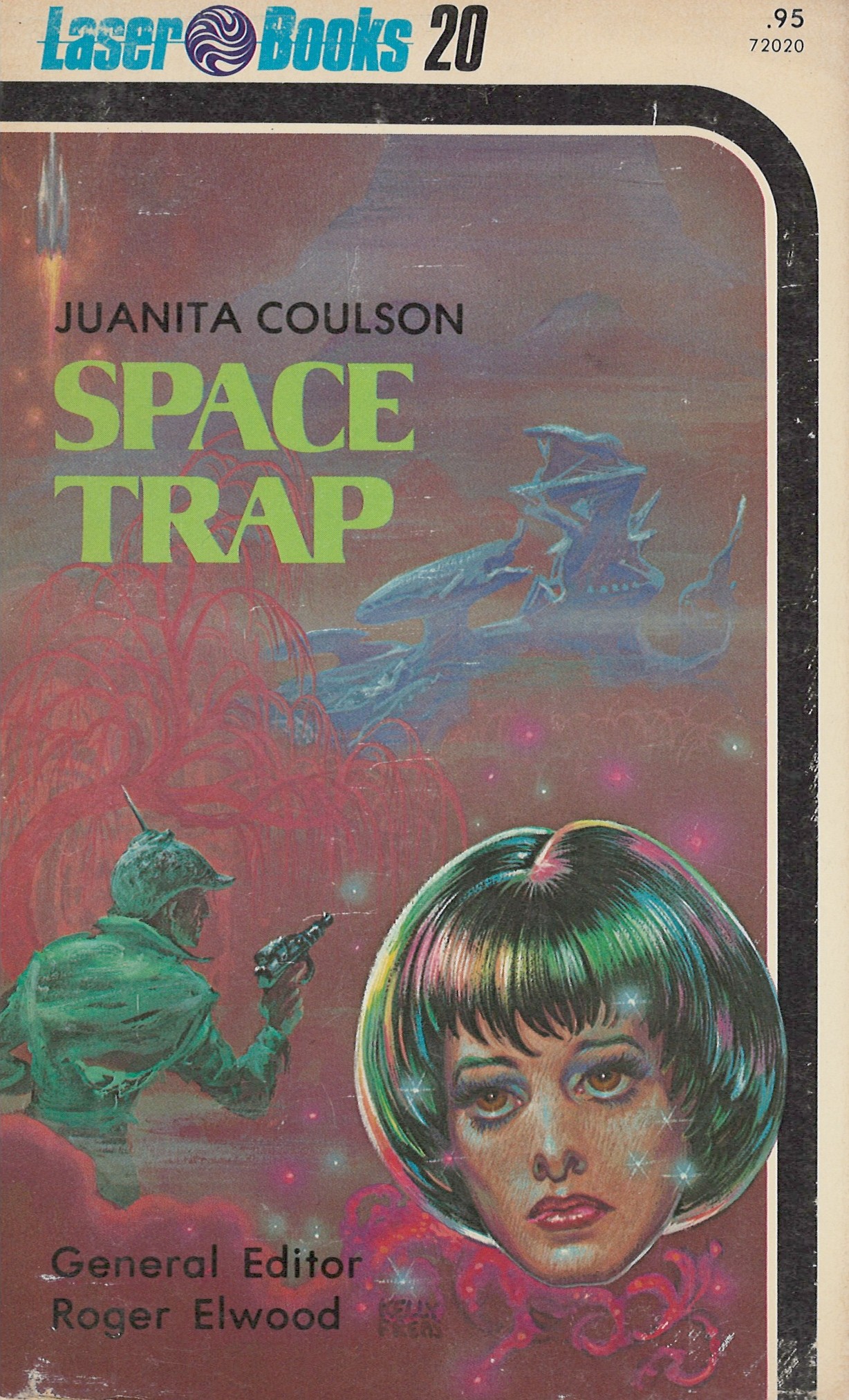
For now though, we must move on. The female authors are 3 for 4 in the Laser Books (dammit, Juanita, you just had to shit the bed with Space Trap…), and Joan will return in… Jesus, 33 books… for Shepherd.
I’m not gonna get my hopes up; so far, when a Laser Books author delivers a great title like Unto the Last Generation or Serving in Time, their second entry sucks burps. I’m praying that’s not the case for Joan, but… well, the pattern has firmly been set by now, and not even the authoresses are free from it. Fortunately, it’s a long road, getting from here to there, and we have to look to our next book.
Ladies and gentlemen, we’re about to be graced by sci-fi royalty.
Who’s Next?

If the name Jerry Pournelle rings no bells, fear not; I’ll do a write-up on him in our next review. Suffice to say, he was a contributor to my alma mater, Analog, a frequent collaborator of sci-fi grandmaster Larry Niven, science editor for Galaxy, and has an awards list as long as my arm.
He is, in other words, a Big Deal.
Blurb
Life imprisonment on Earth or transportation to Mars? Convicted of first-degree murder, Garrett Pittson chooses Mars–a colonized world strictly controlled by Earth and the giant mining corporations. But Garrett is not doomed to slavery in the mines. Tough men like him are needed on Mars–to fight for freedom in the outlawed Free Mars Army. With the beautiful Erica at his side, Garrett embarks on a deadly mission to prove that a free Mars has the power to survive and that he is a true Marsman.
I’m very excited to see what he’s cooked up for us in his first Laser Book entry, and I hope you’ll join me for that.
Meantime, I’m going to therapy, and I suggest you do too!
Everyone should go to therapy!
— My Girlfriend, L.