Listen carefully. I don’t know how much time I have.
I had to leave my house–drop everything, cut through the back field, cross the neighbour’s vineyard, and run ten kilometres toward town. From there I hitched a ride on a maple syrup truck south through Codrington to the 401, and thence to Cobourg. Tried to rent a car but my credit card bounced–should’ve known he’d have thought of that–so instead I paid cash for a train ticket to Ottawa.
He was on the train.
I thought about contacting my friends in Ottawa, maybe hole up at one of their places, but I realized that would just put them in danger. I slept on the bridge to Gatineau. My God, it was cold.
Saw a shadow moving in the night. Knew it was him.
He had the book with him.
He’s always right behind me. I can’t outrun him. But that’s okay. If–when–he catches me, I’m going to give him what he wants.
Just not the way he wanted it.
I’ve got it all figured out, you see. He wants me to tell him his book is good, that it’s a great work of science fiction, but he’s from the 70s. He’s not canny with computers–even his characters aren’t; they talk about smashing them up all the time. He’s regressive. He touts “the old ways”. Fair enough.
By the time he realizes I’ve tricked him, it’ll be too late.
Speak of the Devil; there he is now, coming into the internet cafe. Yes, I see you Arthur. I’m ready.
Give me the book.
I don’t know what kompromat Arthur held over Roger Elwood to blackmail him into buying a second title so soon after the first, but it must have been serious. And, unfortunately for me, Elwood isn’t the only one getting screwed because I now have to read what he bought. I do not have high hopes after Crash Landing on Iduna, so lets see if Tofte can redeem himself.
But before we cover Art, let’s start with cover art.
Cover
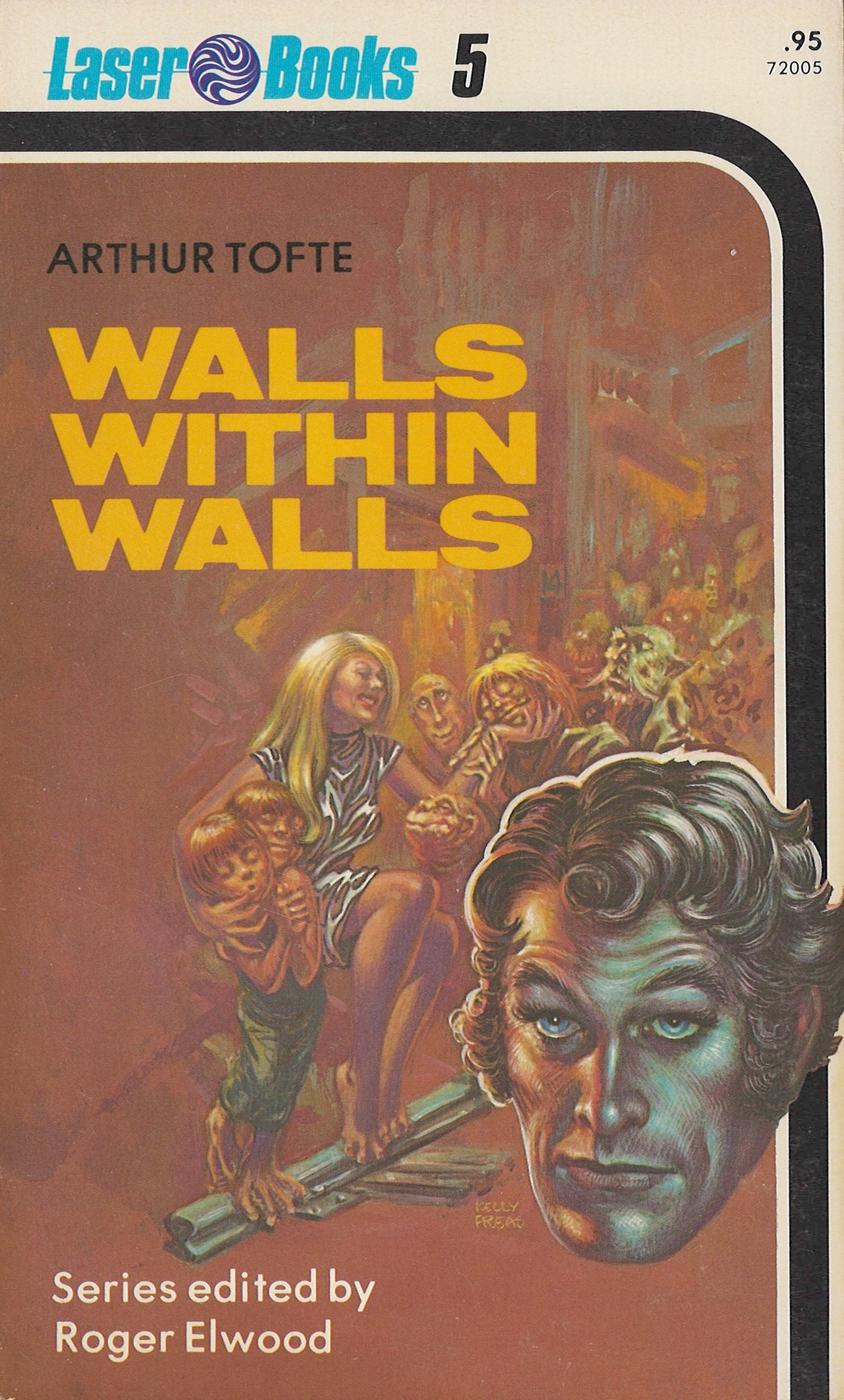
Speaking of blackmail, thanks to my swift intervention and the heroic efforts of the Ontario Provincial Police, Kelly Freas is no longer being threatened by the Marketing Guy to turn in shitty cover art.
For this entry, he instead turned in a cover the colour of actual shit.
Before you get on my case, I want the record to show that I don’t dislike this cover art. It’s… fine. This is one of Freas’s more workmanlike pieces. It depicts elements of the story: the mutants of Destruction City in the background, Rolf (the protagonist) is in the portrait, and lighting is used to suggest a ray of sun shining down into the caverns where the mutants dwell. But there’s no flair, to it, no creativity, no spark, and the colours all congeal into a hodgepodge of blandness.
Also I’m troubled by the depiction of the mutants as some kind of carnival sideshow. Bodily deformities being used a selling point for sci-fi is such an outdated idea.
But then, the Laser Books’ mission statement is about bringing back Golden Age sci-fi, so what else should I expect?
Would You Like to Know More?
Now these guys know how to do mutants.
Blurb
For sixteen years Rolf’s parents had kept him hidden away from the society in which they lived. His twin brother was able to move about freely and indeed was regarded by all as a young man of talent and great promise. But Rolf was a mutant and, as such, illegally alive. What happens when he escapes from his hiding place and discovers a whole world of mutants living underground, beneath the highly controlled technologically advanced city that had been his prison, is the main thread of Arthur Tofte’s engrossing tale. The city was never the same again. Nor, perhaps, will you be after you read it.
I had horrible nausea at the end which I didn’t have at the start, so no, I was not the same after reading it.
There are a million science fiction books in the world with blurbs exactly like this one. I’m still mad at Marketing Guy for what he did to Freas, and I still think his blurbs are mostly mediocre, but for once, he’s not to blame. He’s been handed a cliche story and told to pitch it to a highly discerning New Wave audience. Even Don Draper would struggle to find an angle on this.
Well, it was easier to read than Crash Landing on Iduna, but not by much.
The story unfolds exactly how you’d expect. The world and its characters dwell in a postwar society (Resurrection City) created to ensure the survival of the human race. They do this in part by wiping out anyone who presents with heavily mutated DNA, but they don’t always get everyone: many flee to the old sewers beneath the city (called Destruction City), which contain ruins of whatever settlement Resurrection is built overtop of.
It’s a genetic twist on the behaviourally-controlled world of Seeds of Change‘s enclosed city (check out my review for that book).
Rolf ventures into the undercity, meets a mentor figure, educates himself, gets discovered by the authorities, and has to flee to the other side of the wall separating Resurrection City from the rest of the world. He gets a taste of rough living, realizes he can’t leave Resurrection without doing something about his brother Ralf and the unjust regime there, so he goes back. Ultimately he discovers what you all probably guessed early on: that everyone in this city carries “the taint of mutation” since the war. The society’s built on a lie and every scientist is complicit.
But of course, this is Arthur Tofte, so we’re in for some deeply uncomfortable flourishes like Rolf, as a child, spying on his neighbour Elissa, also a child.
One very hot day I was at my secret perch at the side wall when she came out dressed, as usual, in her short white tunic. She started to lie down in the grass, stopped and glanced back toward her house.
I could even hear her giggle as she lifted her tunic over her head. She had nothing on underneath.
Almost as if she knew I was watching and she wanted me to look at her, she lifted her arms overhead and turned slowly, her face raised to the sky, to let the hot sun beat down on all parts of her. — page 19
And he waffles on about how her body looks for a few paragraphs. When I read this page, I knew I wouldn’t be allowed to just glide through a mediocre sci-fi novel. I would be forced to endure some deeply uncomfortable passages before I could close this thing.
There are musings on genetic purity, the importance of wilderness living (idyllic pastoralism again, really?), and even a suggestion by another character that Elissa’s cold shoulder could be cured if Rolf rapes her, and that if Rolf doesn’t do the job, this other character will happily do it.
I can’t even look up who makes this suggestion. I don’t want to revisit that unpleasantness; I’m already going to have a hard time facing the women in my life with this book in my brain.
Conclusions and Recommendations
Look if you want a good story about mutants, I can recommend some excellent Futurama episodes. If you want a good story about in-groups, out-groups, preconceptions, and sexual frustration, there are plenty of better stories; some written by other authors in the same period as the Laser Books, and some appearing in the Laser Books themselves. Your own good judgment will probably steer you better in this department than I could.
Would You Like to Know More?
The biggest award-winner of 1975 was The Dispossessed, by Ursula K. Le Guin. It’s a wonderful commentary on anarchism, capitalism, societies estranged from one another, and how even societies that espouse personal freedom will find novel ways to limit that freedom in the name of economic security and infrastructure development.
My Goodreads Review
This is a superfluous book in sci-fi canon whose one virtue is that it’s not as bad as some others in the series. But there is no reason why you’d want to pick this up, aside from, like me, a desire to collect the entire series. Give this one and Crash Landing on Iduna a pass for your own sanity. They are both mediocre-to-bad books and are two of the weakest entries in the Laser Books. If you want good stories about mutants, go watch Futurama!
And with that, I close out this third bummer of a review. With luck, Arthur will never realize I sabotaged him. He’s leaving the cafe now, taking the book with him.
I am free.
Who’s Next?
Actually, we’re all free! The three books I’ve just reviewed–Crash Landing on Iduna, Gates of the Universe, and Walls Within Walls— comprise what I’ve (un)affectionately dubbed the Trench of Sadness in the Laser Books collection.
At this point in my reading, I was beginning to despair that all the remaining books would be of this quality, but Stephen Goldin‘s Herds gave me hope that there still might be some gems out there; It convinced me to keep reading.
I’m glad I did, because our next book, ladies and gentlemen… is Serving in Time.
Blurb
Jan Jeroux is leading a carefree and idyllic life in the serene, underpopulated pastoral earth of the year 2500. His idyll ends abruptly when he is abducted and forced to join the Time Service of the mysterious world government. In the service he learns how history was manipulated and controlled to produce the beautiful world he enjoyed so much. Thinking he understands how to rectify the injustice and devastation inflicted on the world by the time managers, Jan decides to make things right. But he makes a tragic error…
Geez, I know I’ve harped on about idyllic pastoralism, but this is the one mention of it that’ll get a free pass.
This novel, penned by Gordon Eklund, is the one that convinced me to start writing about the Laser Books. It’s a book that inverts several familiar sci-fi tropes and delivers something truly original.
If you haven’t been vibing with the last three reviews, I promise you, this is one you won’t want to miss. It’s only a week away, and I’m stuck here in an Ottawa internet cafe. I hope I make it back in time…
I’m willing to give you the benefit of the doubt and say that, between this and Crash Landing on Iduna, maybe you were having an off-week. Probably flu season, right? Okay? Please? You’re gonna be back on form with the next title, right? Because I’m sorry man, you cannot keep doing this.
There’s even more negative space than on your last cover! And the colour gradient is so similar I feel like you changed one digit on each of your hexadecimals and called it a day. This not why Elwood’s paying you the big bucks.
Wait… did he withhold your paycheque for this month? Is that why your work is suddenly so bad? ‘Cause if that’s the case I will call up my lawyers and we’ll get this straightened out.
No? It’s something else? But what could… oh my God, is it Marketing Guy?! Is he threatening you, getting you to reduce the quality of your art so his cover blurbs stand out more? Don’t speak, don’t do anything, I’m just going to turn the book over and point to the blurb, and if you are in danger, just nod your head once, slowly.
Blurb
Operating a bulldozer may be exciting, but it’s not normally exciting in the way that Ross Allen found it. The fact that he was a science fiction writer on the side had nothing to do with it. There was something strange about the rock he struck with his machine. Even stranger was what he found inside it. But that was only the beginning. It led him to Orl who was brilliant and likeable, even if a bit odd by human standards. It brought him to Kari who was beautiful, but far different from any woman he’d ever met before. It led him to a world he could never have dreamed up himself.
OPP Transcript–19/01/2026
Operator: 911, what’s your emergency?
James Dick: Um, yes, operator, I think my friend is being threatened!
Operator: All right, stay calm, sir. Can you describe the nature of this threat?
JD: He’s a cover artist for a line of sci-fi books and he’s being made to reduce the quality of his work so that sub-par marketing blurbs can stand out. I–I just–I don’t know what to do!
Operator: I understand completely, sir. Please just tell me: how bad is the quality of the blurb?
JD: Well it’s… it’s not the worst I’ve ever seen, but it’s… it’s just mediocre. It’s meandering, doesn’t go anywhere, doesn’t say anything concrete about the book, and it… it… I’m sorry, this is really quite confusing.
Operator: You’re doing very well, sir. We have officers en route. Just a little longer, sir. One final question: do you feel enticed to buy the book?
JD: No, not at all.
Operator: Good, good. We’re going to resolve this soon. Our officers are arriving on the scene now and they’re going to take over from here.
JD: Oh, I can see the flashing lights! Kelly, we’re saved!!
END TRANSCRIPT
Story
So um… there’s this story, right? And… it’s a… a sci-fi story.
All right, I’ll be brutally honest with you. I cannot remember anything past page 9 of this book.
I know for certain I read it cover to cover last year, otherwise I wouldn’t have moved on with this series, but aside from sentence fragments and bits of scenes, I cannot for the life of me recall anything clearly other than Ross getting teleported to the alien planet with his boss Kujawa.
I’m so sorry, I’m truly at a loss! If you put a gun to my head right now and said, “Give me a synopsis or I’ll pull the trigger,” my response would be, “… you’d better pull the trigger.”
I toyed with the idea of rereading this book for this review, but then I thought, “Why?” If this book left so little impact that I can remember only 0.5% of it, it’s not a book worth recommending, so what would be the point?
Okay, here’s what I’m sure of:
Ross and his boss Kujawa accidentally travel to an alien planet via some kind of Stargate hidden under the construction site they’re working on.
Kujawa is killed… somehow. Pretty sure it’s Ross’s fault.
Ross falls in with a woman named Kari (pictured on the cover) whose brawn is greater than her brains, and Orl, a lizard-man whose brains are greater than his brawn.
Ross learns the planet is a sort of Union Station for Stargates, all leading to other parts of the universe.
Together they face some kind of alien threat.
Ross and Kari win the day, open the gates, and fly off into the sunset.
Beyond that, I cannot recall specifics. So… yeah…
My Goodreads Review
I read this last year and cannot remember a single thing about it beyond page 9. This has been the single most unmemorable book I have ever read. Take that for what it is.
This is a bummer. I feel like I’m shortchanging you guys with this review. Maybe next week will be–
For sixteen years Rolf’s parents had kept him hidden away from the society in which they lived. His twin brother was able to move about freely and indeed was regarded by all as a young man of talent and great promise. But Rolf was a mutant and, as such, illegally alive. What happens when he escapes from his hiding place and discovers a whole world of mutants living underground, beneath the highly controlled technologically advanced city that had been his prison, is the main thread of Arthur Tofte’s engrossing tale. The city was never the same again. Nor, perhaps, will you be after you read it.
No… no it’s too soon! He can’t be back, he just can’t be! I only just finished Crash Landing on Iduna! I’m not mentally prepared for this!
This book is where the problem in “bringing back Golden Age sci-fi” shows itself: people think they want to go back, but they really, really don’t.
Take John W. Campbell, editor of Astounding (now Analog) for example. He was a man of deplorable convictions who, according to Isaac Asimov, “Never had an unkind word to say about Hitler.” Many of the stories he championed depicted “supermen” (always white), degraded women, and positioned people of colour as evil.
Crash Landing on Iduna romanticizes an imagined past.
There’s a lot I have to unpack so let’s hurry up and crash the bloody ship already.
Cover
Even Freas has mentally checked out.
Look, I’m not gonna sugar-coat it: this is one of Kelly Freas‘ most boring covers.
I mean, look at all that negative space! You should be ashamed of yourself, Kelly. There’s a poor marketer starving for real estate on the back cover and here you are, throwing it away for nothin’.
Front-and-centre we’ve got Chewbacca fondling Dolly Parton, and in the background… I can’t even tell what’s going on. Is that some kind of alien? What’s that dude on the left running through? Water? Tentacles?
The blue-eyed devil on the right is Lars Evenson, the father of the Evenson family. I’ve got a bone to pick with him later.
Blurb
When a spaceship crashes, the survivors are in peril for their lives. When the planet and its inhabitants are unknown to the survivors, fear becomes tangible among them. When the survivors are a crippled man and his four children the odds against survival increase dramatically. When the entire family has lived a controlled, docile, protected life and has been deliberately kept passive by the managers of the society on earth from which they came, the situation looks hopeless. But when two of the survivors are Peder and Inga Evenson there is always hope. This is their story.
Congratulations, marketing guy, you started every sentence of this thing but two with “When” and failed to capitalize “Earth.” You were lazy and disrespected Momma E. Hang your head in shame.
Neither this nor Freas’s cover would entice me to buy this book, and I was not looking forward to reading it. But you know, I like to give people the benefit of the doubt. Maybe Freas and Marketing Guy had the flu that week, and that’s why Freas chose puke-green for the cover and Marketing Guy gave us a hundred words of fever drivel.
Where art fails, maybe Art can succeed!
Story
Can’t believe my tree cousins were cut down to print this book.
Nope.
Buckle yer fuckles, good people, we’re in for a bumpy ride.
On Earth, all needs are met and there are no wars, no strife, no scarcity. Jobs are optional and all your prescriptions are free. Sounds great, right?
Lars Evenson doesn’t think so. He pines for the frontier lifestyle.
When men built cabins in the woods and provided for their families. When human beings hunted and skinned animals in the woods. When people struggled with nature. When the average life expectancy was under fifty. When a cut finger could kill you. But when Lars breaks his leg in the first five minutes, he finds out just how much the past sucks. This is his story.
(See, Marketing Guy? I can do it too!)
Believing that true humans must struggle to survive, Lars packs up his whole family into a spaceship, flies it to an alien planet, gets his wife killed and himself crippled trying to land the thing, and his children have to shoulder the burden of survival.
If Lars were around today, he’d be part of the cottagecore movement and his wife would have a tradwives TikTok — except they wouldn’t be around because they were vaccine deniers and measles and COVID tag-teamed them into an early grave!
Would You Like to Know More?
I recently read Philipp Dettmer‘s book Immuneand found out why measles is such a scary disease. Like all viruses, measles reproduces by penetrating cells, hijacking them, and using them to make more of the virus, which then spreads to other cells to repeat the cycle.
But measles is a special fucker in that it attacks Memory T and B cells. These are the cells in which the records of your body’s encounters with diseases are encoded, and they are the reason why you can’t get sick from the exact same virus twice (unless it mutates, as all viruses do, which is why vaccines are important).
Once you survive a disease — influenza, common cold, COVID-19 — your body preserves a sort of “battle record”: what the enemy looked like, how they attacked you, and most importantly, which antibodies ultimately stopped the invasion. This is where “immunity” comes from: the memories of the battles your body won.
Measles destroys those Memory cells and the records within, erasing the information your body needs to repel those diseases. Memory B cells in particular are a devastating loss because their records stretch back decades, possibly to the time you spent in your mother’s womb. And as we all know, some diseases like chickenpox are usually mild if we contract them as children, but potentially lethal if contracted as adults.
So if you survive your bout with measles, you might actually be susceptible to hundreds, even thousands, of pathogens you already beat, and you’ll have to face them all again — get sick from them all again — to reacquire your immunity.
So please, for the love of God, vaccinate yourself and your children!!!
A few months after landing, Lars’s children, Inga and Peder, discover two tribes of aliens living on the planet: an aggressive one and a docile one. The family rushes to the aid of the docile one because white saviours, and after spending some time on Iduna, they set up a distress beacon and plan to go back to Earth to show people how sexy it is living that frontier lifestyle.
I’m not joking: Peder sends his siblings Sven and Bretta back to Earth in the hopes that, once people see how toned you get building cabins in the woods, they’ll try it for themselves.
They would be like a god and goddess out of man’s past… a past that could point to a better future. — page 190
Conclusions and Recommendations
Up until now, the Laser Books have been either harmless or entertaining. Crash Landing on Iduna is neither: the ideas it espouses are harmful and its story is incredibly boring.
Idyllic pastoralism has been a staple of every regressive, exclusive, hateful ideology from Naziism to the Deep South alt-right because it extolls a past when men did not have to share power with women, their word was law, and the strong were determined through violent struggle.
We find idyllic pastoralism so seductive because, in one sense, it is correct: we should co-exist with nature; we should find value in hard work; we should want to be masters of our own destinies.
During COVID, cottagecore started as a movement among the LGBTQ+ community and flourished because people suddenly had the time to discover or rediscover simple joys: growing their own food, baking bread, handcrafting art.
But what always happens with movements like this is that some asshole steps in and says, “Let’s go one step further… let’s also adopt traditional gender roles and morals,” when all we really wanted to do was bake nice bread and grow pretty flowers.
I’ve spent many summers hiking and camping in the wilderness and I will be the first to tell you: I do not want to live there.
I love reconnecting with nature, and I wouldn’t trade my adventures for anything. But when it’s minus ten degrees Celsius in a foot of snow and you can’t get a fire started, or you’re at death’s door in fifty degrees of desert heat, or you’re struck down with fever in a forest and you don’t have antipyretics, you understand why humans don’t live like that anymore.
It fucking sucks.
We need to walk in green places.
We need to create things with our own two hands.
We need to have the freedom to choose our path.
But we should not idealize the past. Few words get my hackles up faster than, “Things were better when…”
My brother’s an historian and I asked his take on this subject. I love his answer.
“If there’s an amenity our ancestors would’ve killed for — hot shower, ready-made meal, warm bed — I will use it to the fullest, because they could not.” — Sean Dick
Where was I? Oh yes. Crash Landing on Iduna. Can’t possibly be saved. This kind of book should never have been written.
Recommendation
“There be work for the axe. Take them behind the sauna, jumalauta.” — Ahti, Control
Shoot. Almost forgot my Goodreads review!
A frontier fantasy with every conceivable trope you might expect from that genre, including the white saviour. It touts idyllic pastoralism and positions its characters as heroes for choosing a life where they might die at any second from eating the wrong plant. This kind of backwards tripe should’ve died with the 1930s era of science fiction, but sadly, I predict us being plagued by it in the 2030s. Do yourself a favour and don’t read this book.
That oughta do it.
I gotta say, I’m not looking forward to the next appearance of Arthur Tofte in this series. He wrote Laser Book 5, so after our next title, we’re back in this man’s imagination. Mercifully, however, that will be the last we see of him in this series.
Operating a bulldozer may be exciting, but it’s not normally exciting in the way that Ross Allen found it. The fact that he was a science fiction writer on the side had nothing to do with it. There was something strange about the rock he struck with his machine. Even stranger was what he found inside it. But that was only the beginning. It led him to Orl who was brilliant and likeable, even if a bit odd by human standards. It brought him to Kari who was beautiful, but far different from any woman he’d ever met before. It led him to a world he could never have dreamed up himself.
They’re moving in herds. They do move in herds. — Dr. Alan Grant, Jurassic Park
With Raymond F. Jones‘s Renegades of Time behind us, it’s time to ring in the New Year with Stephen Goldin’s first Laser Books entry.
This will not be the last tale we get from Goldin either; as mentioned in my previous review, this author spun four yarns across the run of 58 Laser Books. Guess we’ll see if his talent merits repeat appearances.
But first, of course, we must pay due deference to the almighty Kelly Freas and his cover art.
Cover
O-ho, delicious!
This book is very much a tale of opposites: light versus dark, generosity versus greed, community versus self-centredness. Freas captures that expertly with his use of contrasts: cold and warm colours juxtaposed in two opposing parts of the frame. Note how the Zartics occupy a lofty, heavenly position over Wesley Stoneham (the portrait) who is surrounded in a lower, baser position by the flames of hell.
By placing a shining bright star above the Zartic city — a star which calls to mind that which shone over Bethlehem which caught the attention of wise men from a far distant country to bring gifts to Christ’s crib — Freas suggests that the Zartic way of life (communal, unselfish) might be the ideal we all should aspire to.
Would You Like to Know More?
There have been many scientific attempts to explain the Star of Bethlehem in the two thousand years since it occurred. This article by Astronomy explores some of those theories.
Additionally, check out Arthur C. Clarke‘s landmark science fiction short story, “The Star”, for a truly heartbreaking study of this odd question mark in the annals of history.
Also, even though Freas is following a formula prescribed for these covers by Harlequin, he still manages to reflect Stoneham’s ego by making his head appear just a hair (ha-ha) larger than his comrades on the other Laser Book covers.
I don’t even feel like I can make jokes about this, it’s just a solid, well thought out cover. Great work, Freas!
Blurb
The wife of a powerful figure in California is found brutally murdered in the couples’ lonely mountain retreat. Wesley Stoneham made certain that all the evidence concerning the murderer of his wife pointed to a nearby hippie community. He had three goals in mind: to get rid of his wife, to drive out to the hippie commune and to enhance his own power in the State. He was at the point of achieving them all when Garnna, from the peaceful planet of Zartic finally made contact with Debby, a hippie from the commune, who had problems of her own. Then Stoneham’s troubles began.
Looks like we got ourselves a good old-fashioned “howcatchem?” with a sci-fi twist! Unlike other Laser Books blurbs, it feels like the premise of a New Wave sci-fi tale, rather than a Golden Age one: a corrupt politician as a villain, a hippie from a commune for a heroine, and an alien from across the stars as a trusty sidekick. Golden Age stories typically position politicians as authority figures (or at worst, harmless buffoons), hippies as deviants, and aliens as either angels or demons.
Actually, I can think of a fair few Golden Age short stories by Arthur C. Clarke that have similar premises: an alien helping a human put right what once went wrong. But in a post-Watergate world, a story like this takes on a new sense of urgency — and Watergate was only three years old by the time Herds was published.
Again, I can’t really make jokes. The blurb works! So why don’t we just dive right in and see if this book is all that it promises?
Story
“… people won’t vote for a man who has been charged with a capital crime, even if he’s innocent.” Maschen, Herds
Oof, this hits too close to home…
The book reads exactly like an episode of Columbo (the episode I’m thinking of is “Candidate for Crime“, which aired two years prior to Herds‘ publication… and one year after Watergate… hmm) which is one of my favourite shows, so that alone pushes all the right buttons for me.
Would You Like to Know More?
If you haven’t seen Columbo, or you’re already a fan who craves some behind-the-scenes trivia, check out the comprehensive and sprawling Columbophile Blog. Here, you’ll find reviews of every single Columbo episode (including the two TV movies that first gave us the Lieutenant), series facts, and rankings of the best (and worst) of actor Peter Falk’s outings as the iconic detective. And, if you are a newcomer and want a taste of what this show has to offer, the blog also has links to a handful of full episodes free on YouTube!
But what I love most about this book is the commentary on power and society, and how we view certain people as credible and others as incredible. Stoneham, as a politician, naturally curries favour with other politicians, local law enforcement, and the media. His attempt to pin his crime on a minority is a base, cynical act, but sadly one which feels all too familiar in Donald Trump’s America.
Full Disclosure: I read this book a year before Trump got re-elected, and looking back through its pages for this review today is a chilling experience.
In addition to the quote above, I’d like to share with you a couple more passages from the book — a book written, I’ll remind you, in 1975. The interlocutors are Dr. Polaski, an anthropologist studying the hippie commune, and Sheriff Maschen, who is investigating Wesley Stoneham:
“If you could boil all the current troubles of the world down into a single word, sheriff, what would it be?”
Maschen thought as best he could, but his brain was not functioning at its sharpest this morning. “I don’t know. What?”
“Divisiveness. The splintering off of groups from the whole, the alienation of the individual from his group, and the sheer polarity between groups. Have you noticed that moderation has seemed to become a thing of the past? People are no longer able to agree to disagree anymore; they’re either violently in favor of something or just as violently opposed. Individuals are feeling more and more set apart from the society in which they’re living, which increases tensions. The groups, instead of trying to settle differences, actually go around looking for new ways to disagree. Each group becomes hardened against the problems of another, and then each one splinters into a myriad of sub-groups, and the cycle is repeated. — Herds, pages 170-171
Ask yourself: how many times have I had this conversation with my friends and family lately? How often have I heard it at work or in the classroom? How clearly do I feel that I am seeing this every day?
The discussion is not new — in truth, it’s probably thousands of years old — but how keenly these words cut in the year 2026 A.D.
And further on, another character asks Polaski:
“But you must have some theory as to causes,” Simpson persisted.
“I do, yes, but I hesitate to state them when I can’t substantiate them. It would be a ridiculous oversimplification to blame any one factor, but I think that one of the primary causes is modern rapid communications. In the space of just a few generations, we have moved into a position where we can know instanteously what is gonig on anywhere else in the world. We never had that ability before, and consequently we find ourselves faced with worries over food riots in Kurdistan that we would never have even thought about a century ago. There are suddenly too many things that must be cared about, and our minds, which are unused to so many complications, rebel. In order to preserve sanity, they narrow their attention to one specific field and ignore — or worse, despise — all others. Society, which should be a cohesive whole in order to be most effective, is breaking down to a collection of narrow-minded individuals who care nothing for anyone but themselves and their group. And we’re going to have to learn how to treat this problem on an immense scale before our world becomes any saner.” — Herds, page 172
Wow.
This is what I meant in my first post about the Laser Books that some of these titles should still be talked about. Herds is a story about an self-centred egoist who believes he has just enough power to commit a murder and get away with it.
And you know what?
He would have.
It takes the intervention of a psychic alien to find the evidence that will put Stoneham away. But even then, Goldin intimates that Stoneham might not actually see jail time, that the real victory is that, with this murder allegation hanging round his neck, he will never reach the corridors of power.
But recall the Chappaquiddick incident, six years prior to Herds‘ publication, in which Teddy Kennedy’s reckless driving killed Mary Jo Kopechne and he got away with it.
Or how about That Bad Man who orchestrated a failed insurrection, and was re-elected to the U.S. Presidency four years later? He got away with it.
The most haunting thing about Herds as a book is that it throws the faults of our society into stark relief. Ask yourselves who’d win: a politician with a faultless track record, or a frazzled, pot-smoking hippie girl who says she gets visions from the planet Zartic?
No single line makes a murderer soil their pants faster than this.
I really love the various symmetries that exist in this story. The commune and Zartic represent similar utopian societies. Debby and Garnna are both iconoclasts who believe in getting involved and challenging authority. Humanity and the Zartics face similar problems of burying their heads in the sand in the face of great trouble.
But most of all, I love how the stakes reflect the moral question at the centre of the book: “Who has credibility… and why?”
Conclusions and Recommendations
One of the annoying publishing guidelines of the Laser Books is that the protagonist has to be a man. Consequently, even though Debby is the centre of the story, she’s not allowed to be the sole driver of the plot. Goldin is forced to bring in Sheriff Maschen, Dr. Polaski, and a few other boys to help Debby along. This is really the biggest fault with Herds. When these men appear, they crowd out Debby, who truly deserves the lion’s share of screentime.
Other than that… there’s actually nothing wrong with this book. I vibed with it the whole way through and read a handful of my favourite passages to my family. I actually wished it were longer so Goldin could have more room to examine each of the book’s social environments — the police station, the commune, Zartic — in greater detail. My Goodreads review, therefore, will be very positive:
This is a book for our times. The premise of a politician trying to pin his crime on a minority is always relevant, but is especially biting today with Donald Trump in the White House. The plot reads exactly like a classic NBC-era Columbo episode: a “howcatchem” as opposed to a “whodunnit”. Stakes are both high and personal, as you don’t want Wesley Stoneham anywhere near the levers of power in America, and the only one standing in his way is a woman whose credibility he’s determined to destroy. The only thing I would wish different is that that woman, Debby, received a greater share of screen time as opposed to being pushed aside for Big Strong Men to tell her how they’re going to catch Stoneham. An easy recommend from me!
I’d love to talk more about this book, but we’ve barely scratched the surface of the Laser Books, so we’ll bid adieu to Herds and Stephen Goldin. Grieve not; we’ll see him again in Laser Book 8, Caravan!
But for now, on deck we have… hold on… *squints at list*
When a spaceship crashes, the survivors are in peril for their lives. When the planet and its inhabitants are unknown to the survivors, fear becomes tangible among them. When the survivors are a crippled man and his four children the odds against survival increase dramatically. When the entire family has lived a controlled, docile, protected life and has been deliberately kept passive by the managers of the society on earth from which they came, the situation looks hopeless. But when two of the survivors are Peder and Inga Evenson there is always hope. This is their story.
My love affair with eyeshine, Necromongers, and David Twohy.
Each year I tend to dive deep into a particular franchise. Sometimes it’s a book series, like Patrick O’Brian‘s Aubrey & Maturin. Sometimes it’s a video game series, like Bungie‘s Halo. And sometimes it’s a multimedia cabinet of curiosities like today’s exhibit.
“You’re not afraid of the dark, are you?” — Richard B. Riddick
In 2025 I discovered the Riddick franchise, and I have been endlessly fascinated ever since.
By happenstance, I became a fan of this franchise just as it turned 25 years old. I’d been aware of it since 2004, but I’d never made the leap into watching it. It’s like been like a ghost at the back of my mind whispering from the dark for most of my life, and now that I’ve finally jumped in, I’m wondering what the hell took me so long.
Few things make me more excited than seeing this face in my notifications.
The story begins on February 7th, 2025, when Lord Mandalore dropped his latest video game review: The Chronicles of Riddick: Escape from Butcher Bay.
Would You Like to Know More?
MandaloreGaming is a channel dedicated to reviewing videogames. His content tends toward “lost media” or “abandonware”, so watching the reviews is like observing an archaeologist dig up some bizarre artifact from the past.
Mandalore’s writing is witty, his delivery dry, with in-jokes and references carrying from one review to another. These reviews, in my opinion, easily stand as entertainment pieces in themselves, as well as allowing you to experience the world and story of games which you might not be able to find anymore.
This was the first time in my life that I actively engaged with Riddick content, however vicariously. Mandalore has an incredible ability to bring his subjects to life in his reviews, and Butcher Bay is no exception. I believe it’s one of his best-written and -edited videos.
A few minutes into the video, it suddenly hit me that I had seen this game before. My childhood friend Ian had a copy. My parents never let me buy M-rated games, but Ian’s did, so his house was sort of a contraband hotbed for me. I remembered him describing the premise of Riddick: he’s a man with hypersensitive eyes who can see perfectly in darkness, but even small amounts of light will cause him pain unless he wears his trademark protective goggles.
I didn’t think much of it at the time — just another M-rated game in his library — but there were other whisperings…
Summer of 2004
In 2004, my brother was taking music lessons after school, so my parents would drive me to my grandmother’s house on Coleridge Avenue and I’d hang out for a couple of hours. At the time I was cultivating a love of Star Trek, and the Syfy channel did afternoon reruns of all five shows (back when there were only five, of course). From 3p.m. to 5p.m. was Next Generation and Voyager, so I’d crack open a Coke, heat up a box of Michelina’s macaroni and cheese, and watch.
At that time there was a flood of dark and strange action films in cinemas. The Matrix Revolutions, Underworld, Blade: Trinity, and Van Helsing are all movies I recall seeing trailers for on TV, but Chronicles to this day is the one that remains clearest in my mind, and it’s largely thanks to Canadian actor Colm Feore.
“Convert now or fall forever.” — Lord Marshal, The Chronicles of Riddick
This specific shot and Feore’s menacing delivery remained lodged in my brain for twenty years, along with the baroque imagery and moody lighting. With other films like Underworld and The Matrix Revolutions, I could at least tell you what world they took place in, but Chronicles… I couldn’t pin it down. Was it sci-fi? It looked like there were knights and magic in it, so… fantasy? Some altogether stranger reality? Just what kind of world was it? I chewed on such questions a great deal at the time, and would occasionally think of them in the years since.
Then along came Mandalore’s reviews and I finally decided to take the plunge.
SPOILERS for the entire Riddick franchise beyond this point. This is your only warning!
Some films are heightened by a blind viewing; Pitch Black is one of them. As such, I recommend giving it a watch before you read further. It remains the best of the Riddick franchise and I would hate to spoil it for you.
The film chronicles the crash-landing of the commercial transport Hunter Gratzner on a desolate planet (M6-117) in a triple star system. Richard B. Riddick (Vin Diesel) is a convict who’s being conveyed to prison by the spacecraft, in the custody of bounty hunter William J. Johns (Cole Hauser). A number of other passengers sleep aboard in cryotubes, including Pilot Carolyn Fry (Radha Mitchell), Imam (Keith David), and Jack (Rhiana Griffith), among others. Shortly after the crash, Riddick escapes into the wasteland.
With no food or water, the survivors are forced to explore the desolate world, and this is where screenwriter/director David Twohy shows his skill at building intrigue.
The survivors make a series of discoveries in rapid succession:
There are a number of termite-like pillars on this planet near the crash site
Skeletons further from the crash site reveal that all life on this planet has been wiped out
There is a mining settlement a long distance from the crash site. It’s abandoned, but a skiff is still landed on the surface. This vessel can be powered with fuel cells from the Hunter Gratzner and used to escape the planet
Fry finds an orrery (a model of the solar system) and spins it, discovering that their planet is bathed in perpetual daylight at all times
Back at the Hunter Gratzner‘s crash site, something kills one of the survivors
Fry learns the pillars are tunnels leading deep into the crust of the planet, where carnivorous aliens dwell
At the settlement, a survivor disturbs a swarm of these creatures in juvenile form and is eaten, but the creatures do not emerge into sunlight.
So, altogether, we have a deadly threat that is afraid of sunlight, on a planet where there’s never darkness, and all the survivors have to do to escape is move a few fuel cells. No problem, right?
Well…
Pitch Black‘s Best Sequence
The orrery, powered by a solar cell, spins lazily. Coloured lightbulbs represent the suns.
The survivors find the remains of the mining team in the coring room of the settlement, and Fry is bugged by the question of how these people could’ve been killed by nocturnal creatures if the sun never sets. She goes to the orrery, and spins it.
Spins it…
Spins it…
Boom. Turns out there is actually one alignment of the planetary system in which a nearby gas giant blots out the suns, producing an eclipse on this side of the planet. A lasting eclipse. Hours? Days? Longer?
B-but, it’s a rare event, right? The date on the most recent core sample was twenty-two years ago. Surely the eclipse isn’t going to happen anytime soon, right?
Oh shit.
This is one of the most thrilling sequences I’ve ever seen in a sci-fi film. Every scrap of information we’ve gleaned over the last hour as an audience comes together in one moment of revelation. Up until now, Riddick has been the scariest thing in the film, and now there’s something way worse coming.
The cinematography, the music, the editing, all of it gels to create a thrilling race against the clock that ends in pure terror.
The Story Behind Pitch Black
“PITCH BLACK grew out of an idea suggested by David Madden at Interscope. Travelers visit a planet where multiple suns mean perpetual daylight, but when an eclipse brings darkness, ghosts emerge. The ghost element only made it as far as our first draft, but that wasn’t what was most important to us.” — Ken Wheat, Screenwriter, in an interview with Script Secrets
Put a pin in that ghost idea. It’ll come back to haunt us.
Seeing the opening shot from Pitch Black immediately made me think of Alien3, and that’s no accident. Writer/director David Twohy wrote one of the drafts of the Alien3 screenplay: the critical one that turned the setting into a space prison.
The film was originally titled Nightfall and about a female outlaw named Tara Krieg with tribal tattoos and enhancements from her interstellar tribe of barbarians. Imam was named Noah Toth a member of a technology-based version of Christianity and he had no pilgrims, there was no eclipse, only a two-month day and two-month night, there was no geologist’s outpost, only ancient ruins and instead of aliens the villains were the ghosts of the creatures who built the ruins trying to defend their homeworld. There was no escape ship, but a distress beacon, and Tara, Carolyn Fry, Jack, Noah Toth (Imam) and Paris were all supposed to make it off the alien world, called “Hades” instead of M6-117. Johns’ morphine addiction, the cannon-fodder teens, the solar orrery and the geologist’s camp were added by David Twohy. — Pitch Black IMDb Trivia
Put a pin in this too.
Twohy came onto the film and decided to bring everything down to Earth. He gave his three leads character arcs (unusual in an action-horror film), placed a very human question at the heart of the story, and just lightly drizzled on some sci-fi elements (eyeshine, aliens). He used the action sequences to build up his themes, and the quiet moments to sketch out a larger world beyond the confines of the story. This whole film is a masterclass in how to do more with less.
And, crucially, it feels like what Alien3 should have been: the dregs of humanity deciding whether or not to be human.
I mention all this background info now because I want you to hold it in the back of your mind going forward. These versions of Pitch Black containing barbarians and supernatural forces will become very relevant in four years.
Toward the end of filming Pitch Black, Twohy and Vin Diesel realized that Riddick had potential for more stories, so they changed the ending of the film: instead of Riddick sacrificing himself to save Carolyn Fry, Fry would sacrifice herself to save Riddick, sowing the final seeds of his transformation back into a member of the human race.
Thematically, this ending is perfect. Like the rest of the movie, it’s totally unexpected and goes against convention.
Riddick in Pitch Black
Now we need to talk about eyeshine.
In Pitch Black, Riddick is a murderer. We don’t know who he killed, how many, or why, but he got “sent to a slam” where he was told he’d never see daylight again. In order to survive, he paid a prison doctor 20 menthol Kools (cigarettes) to surgically alter his eyes so he could see in darkness.
Menthol, being a natural anaesthetic, cools the harsh burn caused by cigarette smoke, making the experience of smoking less of a shock to young people’s lungs the first time they inhale. Studies have found that nicotine addiction develops much faster when smoking menthol cigs because of this.
And yet, for some reason, the sale of these cigarettes is legal on Indigenous reservations across Ontario, where substance abuse remains a critical health concern.
As I mentioned, ordinary light is now unbearably painful to him.
I loved the scene where he tells this story: when he realized normal life was forever beyond his reach, he sacrificed a huge part of his humanity in order to live comfortably among monsters. And now, with the alien planet turning dark around them, he might be the survivors’ only hope to peer through the blackness and find a way to safety.
They need him to see; he needs them to help haul the fuel cells to the escape skiff.
This is ultimately what Pitch Black is about: the social contract. We, as humans, make a mutual promise to help each other, stay close to each other, and not betray each other’s trust. If we fail in any of these respects, we find ourselves alone and at the mercy of the beasts slavering in the dark.
Would You Like to Know More?
I read the Pitch Black screenplay after watching the film and there’s a critical shot that was left out of the finished cut: one of the adult aliens, when denied a chance to feast on a survivor’s remains, cannibalizes one of her brood. The movie isn’t necessarily weaker for this omission, but it helps crystallize the movie’s message: we can either choose to be humans or animals.
Riddick chose to be an animal. Fry chooses the same thing when she tries to sacrifice all the passengers during the crash landing to save her own skin. Her crewmate stops her, dies doing so, and she becomes the unwilling hero of the film. She makes the choice to be human, and by her example, Riddick makes the same choice.
In darkness and desperation, far more is revealed about us than can ever be seen in the light.
My Thoughts on Pitch Black
David Twohy took what could have been a very by-the-numbers action-horror flick and injected it with a level of humanity rarely seen in such medium-budget features. It’s clear that he takes a special passion in sci-fi, particularly of the gritty, swaggering kind. It’s scenes like the eyeshine reveal that show his strength: he’s able to sketch out a much larger world, despite working inside a very small canvas.
Pitch Black is perfectly situated as a sci-fi film, representing the hinge point between 90s and early 2000s cinema and science fiction. It’s notable for having one of the first highly successful internet promotion campaigns for a film, and was able to punch high above its budget range thanks to passionate writing, directing, and acting — not to mention a killer score by Graeme Revell. I instantly fell in love with it and the universe, and longed to see more.
And moviegoers at the time clearly wanted more as well, because Pitch Black made back two-and-a-half times its budget in ticket sales, which is a necessary first step for a sequel. Tie-in media was also a possibility, and this is where Pitch Black: Slam City enters the picture.
Pitch Black: Slam City (2000)
Written by David Twohy and illustrated by Brian Murray, Slam City is an interactive flash comic prequel to Pitch Black, available for download on the film’s website (now defunct). YouTube user Demented Derek has the entire recording of Slam City, running at ~8 minutes in length, if you would like to check it out.
The story is framed as a prison log, detailing Riddick’s escape from the Ursa Luna Penal Facility (a.k.a. “Slam City”) in 11 hours 22 minutes, acquiring his eyeshine ability along the way. The whole thing is framed like a log from the station’s security feeds, enhanced with art from “Police Sketch Artist” Brian Murray.
David Twohy’s back on form writing for this gritty sci-fi setting, penning the same sharp, efficient dialogue he showcased in Pitch Black. Brian Murray delivers art that is, in a word, clean. There’s a seamless blending between the hand drawn panels and the computer-generated 3D elements.
Would You Like to Know More?
Watching Slam City brought back a wave of nostalgia for late 90s, early 2000s video game cutscenes for me; the kind I grew up with. Check out the intro cutscene from System Shock to see what I mean.
Slam City confirmed a suspicion I had in Pitch Black: Riddick was, in 2000, a cyberpunk character and intellectual property. This interactive comic epitomizes Twohy’s initial stamp on the series. He took it from a fluffy Hollywood fantasy to a gritty sci-fi universe reminiscent of William Gibson‘s Neuromancer.
Hey, wait a minute…
Doesn’t Molly Millions also have shiny eyes??
There’s also a moment in Slam City which returned in The Chronicles of Riddick. After Riddick arrives in Ursa Luna, the guards turn some dogs loose to hunt down prisoners who aren’t in their cells for curfew. One of these dogs runs into Riddick, and they befriend each other. Riddick notes the scars on the dog’s face and says, “Yeah, know how it feels.” This line was omitted from the final cut of Chronicles but it’s in the screenplay and the novelization.
Fans of this version of Riddick — the cyberpunk version where Riddick is just a man who sacrificed a big part of his humanity to survive — didn’t know it at the time, but Slam City was the last they would ever see of him.
The Chronicles of Riddick (2004)
After PolyGram Filmed Entertainment merged with Universal Studios, the latter acquired the rights to the character Riddick. While Pitch Black hadn’t broken any records, it had turned a tidy profit, which suggested to Universal that Riddick was franchise material.
“… but if you look into any Riddick project, you’ll find out that Vin Diesel had a ton of input into the character.” — MandaloreGaming, The Chronicles of Riddick Escape from Butcher Bay Review
It’s clear from researching this franchise that this is probably Vin Diesel’s favourite role. He and David Twohy were chomping at the bit to bring Riddick back to the big screen after Pitch Black, and they were determined to do it in a big way. Twohy wrote material but Universal was, initially, uninterested. Pitch Black did well, but not that well, at the box office.
What changed Universal’s tune was DVD sales. Pitch Black turned out to be a big seller on home video; so much so that, a couple years later, Universal came to Twohy and asked to see what he’d written.
You have to understand, when we made Chronicles of Riddick, this is how confident we were […] when David and I delivered the script to the studio, we delivered three leather binders. One said “Core One,” the second said “Core Two,” and the third said “Core Three.” Now, all but the first one basically had Xerox paper stuffed in it, right? With like a little treatment on each one. It was a locked leather binder and we only gave the studio keys to the first binder. [laughs] It was a statement saying, “This is a trilogy. Think of Pitch Black as The Hobbit to The Lord of the Rings” […] — Vin Diesel
Whatever they did worked because Universal greenlit The Chronicles of Riddick and pulled out all the stops: they threw over a hundred million dollars at the film, lined up tie-in media such as short films and video games, hired sci-fi and fantasy heavyweight Alan Dean Foster to write the novelization, and promoted the film like crazy.
That’s probably why I remember it: it must’ve been everywhere.
Chronicles is set five years after the end of Pitch Black. Right away, the tone is immediately different: the opening shots of giant conquest icons planted on a dead world, plate-clad warriors standing on cathedral steps, and a ghostly hand depressing a switch that obliterates a planet is far more evocative of Warhammer 40,000 than Alien3. Aereon (Judi Dench) delivers a Galadriel-style voiceover telling of an army called Necromongers crusading across the universe, killing or converting every world in its path.
Riddick is in hiding on the planet U.V.6, after dropping off Jack and Imam on Helion Prime. A group of mercs led by Toombs (Nick Chinlund) track him down, but he gets the better of them and learns that the bounty on his head has spiked to 1.5 million U.D. and the planet that posted the bounty is Helion Prime. Thinking that Imam has betrayed him, he ditches Toombs and takes off.
I have never seen an actor have as much fun on-camera as Nick Chinlund playing Toombs.
En route, Riddick has a vision of a dead world and a woman, Shirah (Kristin Lehman) telling him he needs to remember where he comes from. These words are echoed by Imam and Aereon when Riddick arrives on Helion Prime. They tell him he’s a Furyan, and he’s the one hope they have to stop the Necromonger horde.
Riddick in Chronicles
Unfortunately, we must now discuss my least favourite of David Twohy’s creative decisions in this franchise.
Up until this point, Riddick was just a man. A remarkably dangerous, fiercely intelligent, improvisational killer, but still just a man. In his own words, he started out in a liquor store trash can with an umbilical cord wrapped around his neck (the story is achingly familiar to anyone who’s even glanced at the statistics of infants abandoned in impoverished neighbourhoods). Recall that in Pitch Black, he repeatedly gets beaten and subdued by bounty hunter Johns, also an ordinary man, and the battered and bruised Fry even gets a shot or two in when he turns his back on her.
In Chronicles, Twohy makes Riddick a prophesied hero destined to stop the Necromonger legion’s rampage across the universe.
As a result, Riddick’s origin story is retconned: he was one of millions of male Furyans strangled with their own umbilical cords by the Lord Marshal Zhylaw, a move evocative of Pharoah commanding all Hebrew firstborn boys to be cast into the Nile River in the book of Exodus.
Would You Like to Know More?
Lord Marshal Zhylaw is played by Canadian stage veteran Colm Feore. Hot off his turn as Andre Linoge in Stephen King‘s Storm of the Century, Feore had become by this time one of Hollywood’s go-to pinch hitters. I had the chance to see him play King Lear a few years ago, and he was stellar. Watching him act in Chronicles was like watching a Formula 1 car go for a Sunday drive: he has a gear that would leave all his cast-mates in the dust, but sadly, he’s never given the chance to demonstrate it.
A common criticism levelled at the film is that it’s Conan the Barbarian in space. Having read many of Robert E. Howard‘s Conan stories, plus the novelization of Chronicles, and watched Riddick (2013), that comparison is far more apt than people think. Like Conan, Riddick is a cutthroat who rises to become a king (well, Lord Marshal), falls victim to powerplay, and has to claw his way back to the top against impossible odds.
Riddick in Escape from Butcher Bay
As part of the multimedia push Universal was giving Riddick, a video game was commissioned. The Chronicles of Riddick: Escape from Butcher Bay is a prequel to Pitch Black that tells the story of Riddick’s incarceration and eventual escape from the eponymous triple max prison, Butcher Bay.
As far as I’m aware, this game is canon. I’m not going to do a deep dive into it — you can watch MandaloreGaming’s review for that — but I will call your attention to the eyeshine.
At the start of the game, Riddick doesn’t have eyeshine. He acquires it after meeting a character named Pope Joe. But unlike in Pitch Black, Pope Joe doesn’t surgically give Riddick eyeshine, he just stitches up some injuries, and suddenly, without warning, Shirah speaks and Riddick gets his eyeshine ability.
Now, the game frames this moment as if Riddick chose to believe Pope Joe gave him eyeshine. If so, he both lied to Fry and Jack in Pitch Black and to himself over the years. The implication is that eyeshine is an innate Furyan ability.
But… if so, why doesn’t Shirah or the Purifier have it?
Would You Like to Know More?
Shirah and the Purifier are both Furyans. The latter even evinces some of the same Furyan energy Riddick uses. So why don’t they have eyeshine? Is it just one of many abilities that a Furyan can acquire, or is it somehow unique to Riddick, him being what the script labels an “Alpha” Furyan?
These are the kinds of problems Twohy’s changes introduced.
Chronicles Continued
In addition to being made a Chosen One, David Twohy spun the dials on Riddick’s strength and combat ability. Whereas Riddick struggled to take down a single rent-a-cop in Pitch Black, now he’s able to mop the floor with entire squads of the best soldiers in the universe. By the end of Chronicles, he’s even going toe-to-toe with a supernatural half-undead Colm Feore moving as fast as Sonic the Hedgehog! You never feel worried about him because it seems like there’s never a situation he encounters he can’t come through smiling.
And, if you watch the Director’s Cut of Chronicles, Riddick even has a dash of the supernatural himself: just as Vaako (Karl Urban) is about to blast him with a pair of pistols, Riddick receives a final vision from Shirah who bestows some kind of Furyan energy upon him. He unleashes it in the form of a shockwave that wipes out Karl Urban’s Necro squad.
The Meaning of the Changes
“I knew the trap that other sequels had fallen into, kind of replaying the same thing over and over again. So I said I think the key to it is not to do the expected: don’t go back to the same planet, don’t meet the same creatures, don’t even let it be a creature movie. Could we change genres and yet keep the same tone and keep the same characters? I think that was the inspiration for the approach and the metamorphosis between Pitch Black and Chronicles of Riddick.” — David Twohy
I have such unbelievable respect for David Twohy for making this change. He seems like a writer after my own heart: when writing a sequel, it’s imperative to try something new and not retread old ground.
But with all due respect to Twohy, I don’t think this is the whole story.
Pitch Black was a low-budget sci-fi action-horror film from a small studio shot in the loneliest part of the Australian outback. David Twohy and Vin Diesel could swing for the fences so long as they took responsibility for the film’s success or failure.
Chronicles is a big-budget special effects extravaganza funded by a major studio/distributor complete with a host of tie-in media. A movie this big cannot afford to be a failure. My feeling is that, finding themselves in the major leagues, Twohy and Diesel decided to play things safe: give the studio and audience a hero rather than an antihero, make him special, give him powers, elevate him above ordinary folk, give him admirers, pit him against the ultimate evil. Stay within a prescribed formula, don’t colour outside the lines.
Chronicles makes a lot more sense when you consider the media environment it was born into.
The Star Wars prequels and Harry Potter had dominated the box office for the past four years, and those franchises are built upon prophecies, Chosen Ones, and Dark Lords. The Force and wizardry had a stranglehold on pop culture.
Riddick was up against films the size of Necromonger conquest icons. Maybe Twohy and Diesel felt they had to incorporate elements from those films if they wanted to stand alongside them.
Would You Like to Know More?
In between Riddick films, the 9/11 terrorist attacks occurred and flipped a switch in the West’s collective consciousness. Suddenly stories of religious extremism were everywhere. The childhood game of Cops and Robbers (formerly Cowboys and Indians) became SWAT and Terrorists, or some variant thereof.
You didn’t go near brown-skinned people in the street because they might blow themselves up.
In gaming, Halo: Combat Evolved came out. The enemies in that game are the Covenant, an alliance of aliens following a fundamentalist interpretation of religion bent on the genocide of humanity. Around the time Chronicles came out, the advertising freight train for Halo 2 was just getting underway.
I have no trouble imagining the Riddick script containing thinly-veiled Jihadists was greenlit partly to meet the current zeitgeist. What’s interesting is that you have Imam, an Arab Muslim-coded character, return as a good guy in Chronicles.
A Deadly Weekend
The Chronicles of Riddick hit cinemas in the United States on Friday, June 11th, 2004.
Would you like to know what film premiered in the States exactly one week prior, on June 4th ?
I remember watching Harry Potter and the Prisoner of Azkaban twice in the same 24-hour period: once with my parents, and once with my friend Ian the very next day.
You remember my friend Ian, the one who first explained Riddick to me?
When I learned this, the pieces suddenly fell into place. I never heard any more about The Chronicles of Riddick because my ears were ringing with “EXPECTO PATRONUM!” the whole summer long.
I can hear you saying, “But James, they released a full week apart!”
This chart shows that Prisoner of Azkaban was #1 at the United States box office for two consecutive weeks, running right into Chronicles’ release window.
I imagine whoever decided to release on June 11th was fired from Universal.
Riddick had no business releasing within the same month as Azkaban, let alone the same week! Each Potter film generated more hype than the last. It was obvious to anyone that Harry would be the only thing people would be talking about until June 30th, when Spider-Man 2 swung into cinemas.
Looking at The Numbers, Chronicles also released the same weekend as Garfield: The Movie, which raked in $208,094,550 to Chronicles‘ $107,212,751. If Riddick had waited until June 25th, his only competition would’ve been The Notebook, the Harry Potter hype would’ve died down, and word of mouth would’ve killed off all interest in Garfield.
But I want you to take a moment and re-examine Chronicles‘ box office take: $107,212,751, against a budget of roughly the same amount.
Riddick made back most or all of his money during the reign of the second-highest grossing film of the year, Prisoner of Azkaban.
Really think about that for a second. People loved Riddick enough to shell out a hundred-million dollars in ticket purchases despite Harry Potter still going strong in theatres. Imagine what that number might look like if Riddick had released against softer competition.
The more I think about it, the more impressed I am. Riddick went up against Harry fuckin’ Potter and Garfield and took a sizeable bite out of both their box office earnings. That should tell you how much love there is for this character.
We’re going to return to this discussion after we talk about the third feature film.
My Thoughts on The Chronicles of Riddick
“I might’ve gone a different way.” — Riddick
One summer night, while alone on the family farm, I cracked open a beer and keyed up The Chronicles of Riddick on our janky home theatre system. I’d seldom been so excited to see a film; not only was it the sequel to one of my new favourite sci-fi features, but I would get closure to a mystery that’d scratched at my mind since 2004.
What is this film?
The version I watched was the Director’s Cut, and by the time the credits rolled I confess I felt… let down. It was a far greater divergence from Pitch Black‘s tone and aesthetic than I’d been expecting. The decisions surrounding Riddick’s “prophesied hero” character in particular rankled. And yet…
And yet…
… I couldn’t stop thinking about it! Visually, it is one of the most spectacular films I’ve ever seen. David Twohy is a sci-fi writer who delights in showing you how the pieces of his worlds fit together, and his full talents are on offer in Chronicles. From first shot to last, you understand how Necromongers work, how Crematoria works, how Helion Prime works — an entire universe, explored in just over two hours.
The special effects are astounding, and hold up remarkably well. The shots that stand out most in my mind are those of the Necromonger ships and conquest icons looming over Helion Prime and the hellscape of Crematoria.
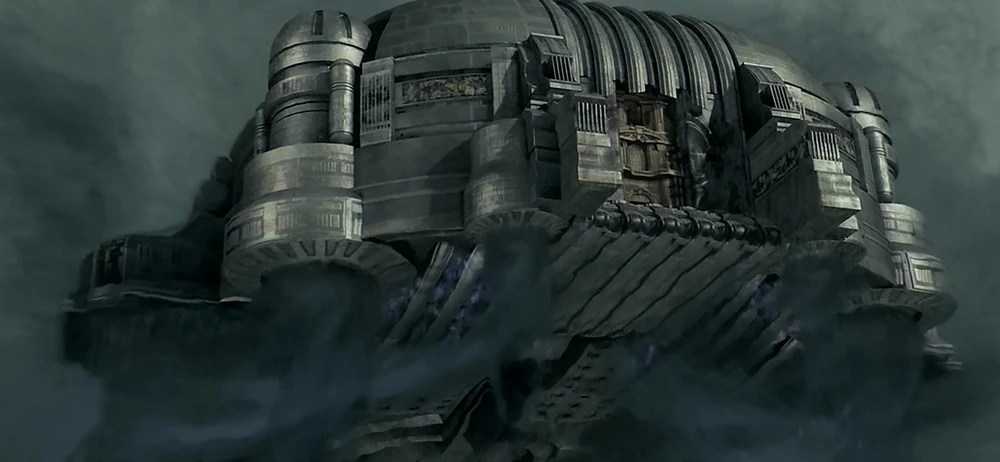
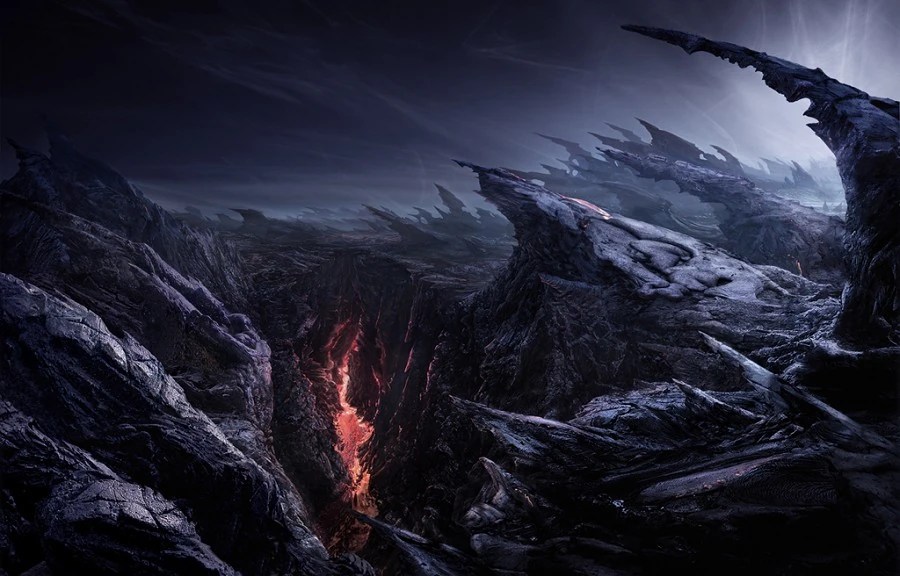
Just look at these! This is like some fever dream or half-remembered fairy tale. The detail in these designs is exquisite, and when you read into the backstory of the characters and setting, it all serves a purpose. The production and art teams didn’t build a single piece of armour or animate any part of a spaceship without having a specific reason for doing so. There are big-budget films shot today that don’t take one-tenth this much care.
Would You Like to Know More?
This attention to detail is par for the course in Twohy’s films. From script to screen, whether the setting be mundane or fantastical, Twohy takes the time to make sure the story flows logically and all elements drive it forward. Check out his sci-fi film, The Arrival, to see an example of this.
If I could describe Twohy’s visual style in one word: swagger. He never loses his confidence when telling a story, no matter the incongruencies or idiosyncrasies. He clearly, unabashedly loves these worlds and wants to present them in the most flattering, sexy way possible. There’s any number of things you could criticize about Chronicles but presentation isn’t one of them.
I think this, ultimately, is why Chronicles stuck in my brain despite being initially disappointing as a follow-up to Pitch Black: no other film looks like it. What other big budget sci-fi fare was there in 2004? Star Wars. That’s it. J.J. Abrams‘ Star Trek (also featuring Karl Urban) was still five years away. Big budget sci-fi television wouldn’t take off until the 2010s with the rise of the streaming giants.
To this day I can’t think of any films with Chronicles‘ specific, far-flung science fantasy sensibilities aside from Dune. Chronicles is a giant question mark in the history of sci-fi cinema that my brain can’t stop chewing on.
Somewhere in the many threads of alternate realities, there’s a ‘verse where Chronicles opened on a different weekend and made $300,000,000 at the box office — not a groundbreaking payday, but enough to warrant greenlighting an immediate sequel, perhaps a franchise concurrent with Vin Diesel’s Fast & Furious films. If things had gone differently, I can imagine Riddick sitting in the same comfy niche as Underworld: a release every three years, making back 2.5 to 3 times its budget with each release, with more of the universe being illuminated with each film. I’m very curious what David Twohy and Vin Diesel would’ve chosen to explore.
Despite being an underwhelming box office release, Chronicles, like Pitch Black before it, did very well on home video, proving once again there was a hunger for this character. Alas, it would be nine years before we got another Riddick feature film.
Part of the multimedia push for Chronicles, Dark Fury is a 35 minute short film bridging the gap between the two Riddick feature films, released on June 15th — four days after Chronicles hit cinemas. Rhiana Griffith returns as Jack (she was recast by Alexa Davalos in Chronicles) along with Keith David as Imam. Futurama‘s Tress MacNeille and video game voiceover veteran Roger L. Jackson lend their talents to the villains Chillingsworth and Junner. Nick Chinlund makes his first chronological appearance as the mercenary Toombs.
Shortly after escaping M6-117, the skiff flown by Riddick with Jack and Imam aboard is captured by the Kublai Khan, a mercenary ship prowling the galaxy for the most wanted killers and crooks. Antonia Chillingsworth, owner of the ship, has a collection of human beings in “suspended time”: they experience time so slowly that an eyeblink is the work of an hour, and a breath the work of a day. But their synapses are unimpaired which means they experience every excruciatingly slow moment trapped inside their bodies.
Dark Fury feels like an episode of Love, Death & Robots. It has lush, lurid, sci-fi imagery and some really creative aliens in the form of the Shrill: whirling, tentacular creatures of neon light capable of liquifying their prey with a touch. The scene in the dark room where Riddick slays them is something to behold.
This is where animation shows its chops: creatures that would be almost impossible to create convincingly in a live-action film are brought to psychedelic life in a hand-drawn space.
Dark Fury is another case where Riddick breaks with pre-established style: the dark baroque imagery of the Necromongers and the gritty guts of Crematoria are traded for the slick, opulent interiors of the Kublai Khan: pearlescent floors and walls trimmed with looping whorls of gold.
What’s notable to me about this film is it mirrors, in many ways, the plot of Assault on Dark Athena, released in 2009: in that game, Riddick and Johns get captured by the titular merc ship after fleeing Butcher Bay in a stolen shuttle, where they face off against Revas (who has surprisingly similar hair to Chillingsworth), a merc leader who’s in the business of capturing people, but for an altogether grislier purpose.
Would You Like to Know More?
Revas raids planets and captures people to turn them into Ghost Drones, cyborg corpses who unquestioningly obey every command given to them. Check out Mandalore’s review if you want to hear the full story of this game, including why it came out five years after Chronicles.
Riddick (2013)
As soon as Chronicles was over, I cracked open another beer and put on Riddick. As the film buffered, I cast my mind back and tried to remember what the media landscape back then looked like. Breaking Bad was in its final season, Game of Thrones was taking over the world, Grand Theft Auto V was about to hit like the meteorite that killed the dinosaurs, and Disney and Marvel reigned supreme at the box office, with a decent showing from DC.
David Twohy and Vin Diesel had originally envisioned turning Riddick into Lord of the Rings, with Pitch Black serving as The Hobbit. Riddick 2 would’ve been an adventure in the Underverse, and Riddick 3 would’ve been a journey to Furya. But when Chronicles performed poorly at the box office, Universal shelved Riddick. It took some clever negotiation on Diesel’s part to get the rights to the character back.
When that happened, Twohy and Diesel scaled back the scope of their next movie to tell a more intimate story.
Riddick begins with a very moody, well-shot sequence of its hero indulging in the boons that come from being Lord Marshal of the Necromongers by day and fending off assassination attempts by night. He’s still grieving over Jack/Kyra’s death in Chronicles. We don’t know how much time has elapsed, but from the wear and tear on the Necromongers’ armour, it’s been probably been a while.
Karl Urban returns (briefly) as Vaako and is back to his usual schemes. He arranges a ruse whereby Riddick is taken to a dead world which Vaako claims is Furya, but is in fact just another desert planet. The Necromonger squad turns on Riddick and nearly kills him, but instead he is thrown down a rocky escarpment and left for dead.
I’m going to bring up Blindsided here because there’s no other place to do it.
This is a short motion comic in the same vein as Slam City. Unlike Slam City, however, it is based on storyboarded scenes that didn’t make the theatrical cut of Riddick, but which did make the Director’s Cut, so if you watch that but skip Blindsided, you aren’t missing anything.
Blindsided depicts a double assassination attempt on Riddick in his quarters aboard Basilica. One assassin appears to be an elite Necromonger warrior not previously seen in the films, the other is one of the Lord Marshal’s mistresses (now Riddick’s, because “You Keep What You Kill”).
The artistry is very grimdark and it’s a well-put together vignette, but aside from that, there really isn’t any reason to watch it. It was released separately as part of the promotional push for Riddick, but the substance of it appears in the Director’s Cut.
When people compare Chronicles of Riddick to Conan the Barbarian, I’m guessing they’re thinking of the 1982 film starring Arnold Schwarznegger. That’s fair — the plots have similar beats — but Riddick actually bears a much closer resemblance to Robert E. Howard’s original works, specifically “The Scarlet Citadel”.
This story opens with Conan, now king of Aquilonia, answering a bogus call for aid from one of his vassals. His army is obliterated and he is locked in a keep filled with eldritch monsters. His only hope of saving his own skin and his kingdom is a sorcerer believed dead for ten years who is also trapped in the citadel. The story culminates in a showdown with his betrayers wherein he retakes his throne.
Riddick follows many of the same beats: he’s left for dead in an ancient place filled with eldritch horrors, makes an unexpected alliance with the mercenary Johns’ father (Matt Nable), and faces many gruesome trials on the long climb back up to his throne aboard the Necromonger Basilica, where he manages to kill one of his betrayers, Krone (Andreas Apergis). Beats from Howard’s other stories appear: Riddick spends time in the wilderness, learning how to survive in alien environs, making friends with certain beasts, and eventually charming a diffident woman.
Most viewers (myself included) tend to agree on two things about Riddick:
The first act of the film is the strongest, where Riddick is left for dead, has to learn the rules of this alien world, and befriends a canine-like creature
Riddick tries too hard to be Pitch Black; being shipwrecked on a planet with an impending alien threat (heralded by rain this time instead of darkness) is something we’ve seen, and it was done better in Pitch Black.
Miscasting and Story Missteps in Riddick
Dave Bautista as DiazKatee Sackhoff as DahlBokeem Woodbine as Moss
When Riddick realizes he’s on the clock to escape this planet, he makes a risky move and broadcasts his presence to the mercenaries and bounty hunters of the galaxy, knowing they cannot resist such a juicy payday. Two bands of mercs touch down on the planet, and Riddick immediately begins playing them off one another, whittling down their numbers with subterfuge and sabotage.
But one of the merc leaders is Boss Johns, father of William J. Johns, the bounty hunter who was taking Riddick back to prison in Pitch Black. Boss Johns isn’t interested in collecting a bounty from Riddick, but instead wants answers regarding the fate of his son.
Yeah, that’s gonna be a real awkward convo…
When I saw that Katee Sackhoff, Dave Bautista, and Bokeem Woodbine were in this film, I was thrilled. One thing that both Pitch Black and Chronicles excelled at was hiring excellent local talent (Australian in the first case, Canadian in the latter) to breathe life into quirky side characters. Every side character in Pitch Black and Chronicles is memorable thanks to this.
Sackhoff had Battlestar Galactica under her belt. Dave Bautista was one year away from mega-stardom with Guardians of the Galaxy (in which Vin Diesel would also star). Bokeem Woodbine would turn around and deliver a magnificent performance as Mike Milligan in season 2 Fargo right after Riddick. With such enormous talent on-set, you’d think David Twohy would give them real characters to play.
Sadly that’s not the case. Nothing about these characters stands out in my memory. Twohy thus far with this franchise had been able to make the most of every single line of his scripts, using each one of his supernumeraries to sketch out the world a little further, but he faltered with Riddick‘s mercs. They’re neither memorable nor do they illuminate the ‘verse beyond the film. They are the cardboard cutouts that Twohy managed to avoid writing in Pitch Black.
Something I’ve noticed with Vin Diesel is that he needs characters as swaggering, quirky, and idiosyncratic as his own roles to play off of, otherwise he has to hold back in his performance to avoid looking out of place.
I know all of these supporting actors are exactly the right kind of people for Vin Diesel to work with, but the script doesn’t help them, so they can’t help Vin, and the whole movie suffers because of it.
The essential premise and conflict is strong, but there’s not enough good material to fill out the two-hour runtime.
Recommendations
There’s a couple ways you could tighten this into a killer story:
Cut thirty minutes from the runtime and double-down on “The Scarlet Citadel” mythic elements: the dethroned king lost in the wilderness who has to make some unlikely alliances to survive. Reduce the cast to only those most interesting actors, and give them good material to work with. Throw Riddick into the crucible with Boss Johns, have them duke it out until they’re at the brink of death, and only then allow them to work things out.
Cut this film down to under twenty minutes, maintaining the surreal, dreamlike feel of the opening and closing sequences. Make it into some kind of grief-fueled fever dream, where Riddick surfaces at the end clear-headed and ready for his next adventure.
So far, Riddick has failed to save people. Let this film be his chance to finally get it right, to move on from his guilt, and put him in a position to finally face Furya.
Beyond Riddick
“THRESHOLD! TAKE US TO THE THRESHOLD!” — Necromongers, after the fall of Helion Prime
The final shot of Riddick depicts our hero standing over the corpse of one of his betrayers, watching as the Threshold to the Underverse looms ever larger out the window. The architect of Riddick’s betrayal, Vaako, has followed in the Lord Marshal’s footsteps and become something not quite alive or dead, and he waits on the other side of this gaping wound in space. Riddick’s path leads into darkness, and an unknown future.
As much as I find Riddick a disappointment, I certainly won’t complain about it. It did its job, bringing the character back in a time and place when we least expected him. Critically, it may not have been a darling, but numbers don’t lie:
It earned $94,763,758 worldwide against a $23,000,000 budget, as well as an estimated $26,000,000 in home video sales. That, ladies and germs, is what is called a successful film.
Do you see now what I mean about there being a hunger for this character? Even the least impressive film in the series, when released in a slow week, made an absolute killing, earning far more than enough to justify a sequel. Universal made a huge blunder in 2004, pitting Chronicles of Riddick against Prisoner of Azkaban, and here is the proof!
Vin Diesel and David Twohy have teased a fourth Riddick film for years, but it wasn’t until 2024 that Riddick: Furya was confirmed to be in production.
“They say most of your brain shuts down in cryosleep…” — Riddick’s first line in Pitch Black
Little is known about this film, aside from that, in August 2024, Diesel confirmed that he and David Twohy were making it. A couple of production stills have appeared on IMDb since then, but even so, all we know about the plot is that it will involve Riddick returning to his homeworld to find survivors of the Necromonger purge.
I didn’t have the chance to see Pitch Black, Chronicles, or Riddick in theatres; I will not miss Furya. I may be a latecomer to this franchise, but I’ve quickly developed a passion for it, drawing inspiration from the character and his world for my own creative works. Let me now summarize what his stories mean to me:
Pitch Black remains one of my all time favourite science fiction films, full stop.
Pitch Black: Slam City is a lightning-flash look at the direction these films might once have taken, with 90s nostalgia-inducing presentation and sharp, efficient writing.
The Chronicles of Riddick is an endlessly watchable piece of low-engagement cinema featuring an army of Canada’s best stage and screen talent.
The Chronicles of Riddick: Dark Fury is a gorgeously-animated short sci-fi piece that could easily fit into a season of Love, Death & Robots.
Riddick, despite quite a few missteps, still has some marvelous sequences in it and with a few touchups, could have been a far stronger film.
If Riddick: Furya can make a splash, it might be the movie that brings Richard Bruno Riddick back into the spotlight, and welding goggles back into fashion. The character of Riddick has been thrown into cryosleep and thawed out again more times than any other convict. It wouldn’t take much to thaw a franchise like this.