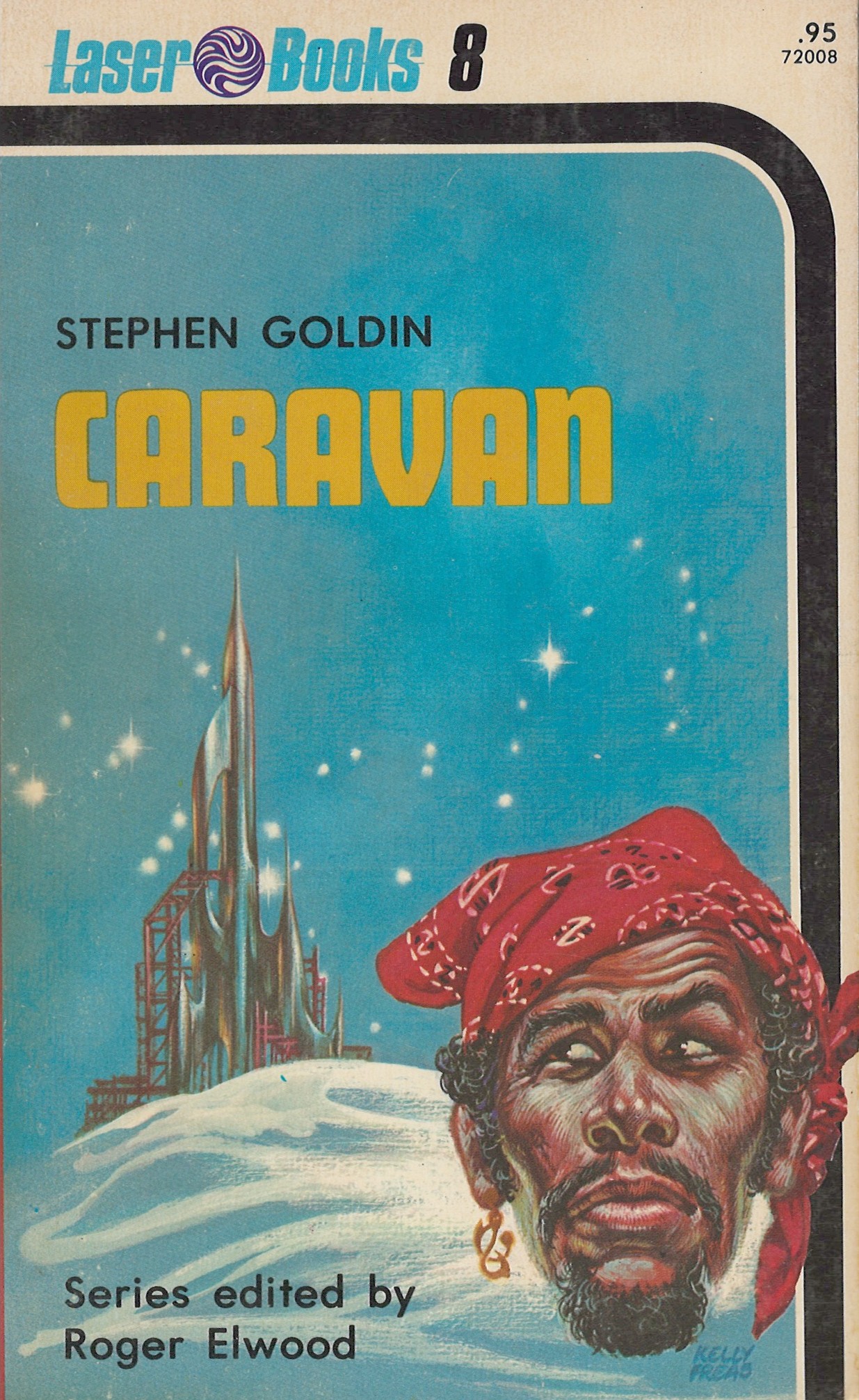
8. Caravan by Stephen Goldin
We’ve had one, yes, but what about second Goldin?
Yes, dear readers, I am delighted to say that the author of the fantastic Columbo-style howcatchem Herds has returned with a new yarn, this time the tale of a nightmare road trip across doomsday America.


If you haven’t read my review of… wait a second.
*Squints*
Well, I’ll be damned!

I completely forgot that I bought this at Re: Reading on the Danforth!
What a lovely day this is turning out to be. It’s little things like this that make life worth living.
It’s my sincere pleasure to introduce you all to my favourite place to shop for used books in my hometown of Toronto. Re: Reading has everything: a juicy selection of genre fiction, rare first editions from the likes of James Clavell and Frank Herbert, complete TV series on DVD, but my personal favourite is the shelf in the Quantum Unicorn: Science Fiction Fantasy Chamber filled with back issues of SFF magazines dating to the 1950s.
You wouldn’t believe some of the things they’ve got here! Old issues of Galaxy with some of Herbert’s earliest short stories, copies of Analog containing the first appearances of the Strugatsky Brothers in English, and issues of The Magazine of Fantasy and Science Fiction stuffed with original cinema and science columns penned by Harlan Ellison and Isaac Asimov. Buy three, get the fourth free!
And I have.
God help my reading list, but I have…

But wait there’s more! When I asked Christopher, the proprietor, if he had any Laser Books, he said, “Yeah, I think we have a couple.”
A couple? Try a couple dozen!
Unfortunately, most of them were copies of books already in my collection, but Caravan was one of those I was missing, so I was pleased as punch walking out of the store that day.
Man, fifteen bucks to get multiple original publications of some of the best sci-fi authors ever. What a magical place. If you’re ever in Toronto, or if you live there but have never visited Re: Reading, you can find them on the Danforth between Pape and Chester, closer to Pape than Chester. There’s parking one block north. Tell Christopher I sent you.
Where was I? Ah yes!
If you haven’t read my review of Herds — I mean, you should have, but in case you didn’t — I won’t get into the meat of that novel here. Instead, I’ll just briefly outline Goldin’s style:
- Straightforward, unadorned prose
- Simple characters with easily understood motivations
- Scathing social commentary
Herds in particular stands out in my memory for deconstructing several Golden Age of Sci-fi myths about society, chief among which is the nature of credibility: who has it and why.
Herds currently stands as my second-favourite of the Laser Books, behind Serving in Time. I’m eager to find out where Caravan sits in the pack, but of course, as we all know, we must first weigh the work of Kelly Freas.
Eh, it’s a bit of a step back from Seeklight in its use of negative space. I understand Freas is trying to imply the barren solitude of post-collapse America, but I don’t remember seeing much snow in Caravan. The burned-out husks of vehicles, the titular Caravan barreling down cracked and crumbling highways, and the gunfights in the gas stations and motels are the deepest impressions the book left in my mind.
More Mad Max, less Mount Everest.
Yes, there’s a spaceship, but you don’t see it till very late in the book when the caravan’s purpose is revealed. I don’t dislike it as much as Crash Landing on Iduna or Gates of the Universe, but like… come on.


The most I can say is that Caravan’s cover doesn’t make me nauseated.
The real star of this cover is the dude in the doo rag, Kudjo Wilson. He’s drawn with such personality, and the expression in his eyes could be anything from suspicion to hope to unease. Kudjo’s a guard for the caravan — a bad mofo in the parlance of the inner city. He’s the kind of black man white southern Americans have nightmares about: fiercely independent, loyal to his kin, and extremely handy with a switchblade.
When the cops show up at Kudjo’s house, they’re the ones who leave in body bags.
So, on the cover as well as in the book, Kudjo’s really carrying the day. I’ll give points for the portrait, even if the overall composition is lackluster.
*Sigh*
Do we have to? We all know Marketing Guy fucked it up, can we not just skip this bit? No? Fiiiine.
Blurb
When Peter Stone wrote his book, “World Collapse,” he thought he was just describing possible trends his book might help avoid. But not only did the collapse come, everyone blamed Stone for it, because he had predicted it. He is rescued from the angry mob by a caravan of “idealists.” The caravan’s leader, Honon, is the most idealistic, practical, hardened, lovable leader to come along in many a year… and it is only his belief in his dreams that enables the caravan to reach the starship. Stone had never predicted this!
Holy shit… it’s actually good?! How?! How did this happen? Did Marketing Guy get replaced between books? Is this MG 2.0?
Okay, straight up, not a word of a lie, I’d buy this book, and I’ll tell you why.
Growing up as a child of the early 2000s, I was a devotee of Al Gore. I watched The Day After Tomorrow too many times to count. I truly believed that radical changes in the climate were just around the corner. And then… they weren’t. Of course, they were happening, just not on the time scales predicted.
Later, I read Michael Crichton‘s novel State of Fear and became a closeted climate realist. I believed the carbon footprint idea was a government deception like the Red Scare and the War on Terror in order to distract and control people.
Would You Like to Know More?
It turns out I was half right. BP Oil created the notion of a carbon footprint to shift the blame for catastrophic emission levels onto the general public. The result was a sort of mass-flagellation that any student of history would immediately find familiar:
When life is getting worse for the Everyman, tell him he can fix it by depriving himself of the things he wants and becoming an ascetic, and get him to shame anyone who won’t do the same. Thus the real culprits get off the hook.
I tell you all this because the resentment I felt toward people like Al Gore is something I saw reflected in many people throughout the 2010s. There was a cancerous belief that the prophets of science had failed us. That oft-repeated refrain of, “It will happen. Maybe not on the timescale we predicted, but it will happen” became hateful to a great many people, myself included.
Obviously, I’ve got my head on straight now, and that’s why this blurb intrigues me.
How would the world treat a prophet who lived long enough to see his prediction come true?
Humans always shoot the messenger, despite all adages to the contrary. And as the 21st Century matures and brings with it all manner of climate catastrophes, will we change our attitudes toward the climate scientists we’ve spat on and disregarded for so long, or will we ultimately hold them responsible, either for speaking too loudly or doing too little, to stop climate change?
Story

Caravan posits a world where overpopulation has led to societal collapse. Peter Stone, the protagonist, predicted this in his book, “World Collapse.” Each chapter begins with a real-life news article, and a page from Stone’s book commenting on the societal phenomenon in the article.
Would You Like to Know More?
We’ve had one, yes, but what about second Stone?
Yep, if you’re keeping track, this is the second Laser Book with a protagonist named Stone, the first being Thomas F. Monteleone‘s Seeds of Change (check out my review for that here).
Let’s go for the hat trick, Roger Elwood. One more Stone! One more Stone!

The pages written by Stone (which in fact are written by Goldin) read less like a non-fiction book about societal phenomena and more like a YouTube commenter trying to sound intelligent by regurgitating concepts they kinda sorta understand, but have no intention of doing anything about.
Slacktivism, in another word.
Reading his passages, I actually find myself sympathizing a little bit with the other people in the world.
Would You Like to Know More?
The premise of Goldin’s book is that overpopulation will lead to collapse, but in the last two decades, it’s begun to look like underpopulation, or demographic collapse, is the greatest threat facing the nations of the world. With the cost of living rising to an exorbitant level, it’s very difficult to raise children, and with a decline in population comes an inability to exploit and distribute a country’s resources.
Gas stations run dry.
People can’t drive to the grocery store.
Those with no support systems like family or friends begin to die off.
Populations shrink faster.
Buildings sit empty.
Nature begins reclaiming cities.
What’s so eerie about Goldin’s depiction of America is that he absolutely nailed what the country — and indeed the Earth — would look like if demographic collapse occurs on a widespread scale: ghost cities, silent suburbs, and decaying highways, all primed for plants and animals to retake them.
The story begins with Stone trying to find sanctuary in an America where police have turned into gangs, people shoot each other over gasoline, and the government has abdicated all responsibility to its people.
Basically the modern United States.
Scarcity of resources and Stone’s reputation as a doomsayer means he’s always turned away by the gated societies that still survive. Leaving one of these societies in despair, he is set upon by a group of kids who recognize him, and blame him for their present circumstances. Just before they can really work him over, Kudjo Wilson shows up and gets medieval on the kids asses, saving Stone’s life.
Kudjo belongs to a caravan, a group of armed men and women criss-crossing the country gathering what resources they can, and delivering it to a launch site in the Carlsbad Caverns. From there, a splinter of the US Government launches spacecraft to carry what’s left of humanity to the stars. The leader of the caravan, Honon, invites Stone to join them. With nowhere else to go, Stone accepts.
Would You Like to Know More?
Honon invites Stone to join the caravan because Stone is a cynic; as Honon says, “Every cynic is just an optimist who’s been knocked around one too many times.” This is actually a central theme of the book: why does anyone go on living if they believe there is no hope left in the world? Are we just hardwired to choose life, or deep down, in our heart of hearts, do we all preserve a spark of hope that things will get better?
Many moral conundrums ensue as they drive westward across the country, including a question of whether or not to chase down and punish a group of raiders who attacked a defenceless settlement and raped a woman. Some of the sequences in this book can be truly brutal, and Goldin pushes the envelope of the Laser Books in the violence he depicts.
The caravanners are not much better than raiders themselves: they believe their mission of preserving humanity entitles them to steal from anyone they want and take on the mantle of judge, jury, and executioner when they feel it necessary. But Goldin again demonstrates nuance when he shows the internal struggles of the caravanners with their role.
Honon is a complicated leader: he pursues his goals doggedly, but questions himself at every turn. He remains strong for his people, but isn’t above saying, “This moral dilemma is too big for me to decide alone. You all should have a say.” He believes criminals should be punished, but isn’t totally comfortable meting out justice at gunpoint just because there’s no other option in a lawless world. Honon tries to be pro-social in a world where societies frequently fall victim to infighting, powerplay, or each other.
Caravan’s Best Scene
There’s a woman in the caravan Stone falls for: Risa. She left her neighbourhood when she was little and hasn’t seen her mother since.
The route the caravan takes brings them close to Risa’s neighbourhood, and she and Stone take a detour. They find her mother’s house and it’s… empty.
This is such a crushing moment to read because it makes the collapse of society deeply personal. What if you left home, and came back to find it utterly abandoned, silent, empty? What if you came home hoping for just one last hug from your mother only to find her gone — not dead, but vanished?
I can only imagine this is the experience many Ukrainians will have when the war with Russia finally ends; people will go back to their homes, looking for their parents, and find, if not craters, deserted suburbs, picked over by scavengers.
It’s a really bleak scene and hits harder than most material in the Laser Books ever does.
Stone transforms in a big way by the end of the book. He regains his sense of optimism and devotes himself to building a new life out amongst the stars with Risa, whom he marries on the last page. It’s a weirdly optimistic ending considering all that’s come before, and I can’t imagine any other sci-fi novelist from this period doing the same, but it’s the Laser Books, so whatever.
Conclusions and Recommendations


With Herds we’ve got a Columbo episode and with Caravan we’ve got Mad Max. Both these books work because they examine the personal cost of extraordinary events happening to ordinary people.
But as with Herds, I think Goldin could’ve gone further in exploring the inner life of his protagonist. Stone feels too much like a casual observer to events. What did he lose in the collapse? What did it cost him? These are the things I need to know. Again, Goldin’s female character, Risa, holds more promise in her character arc than Stone, but is held back by being a secondary character.
My Goodreads Review
Caravan is striking because it depicts a post-apocalyptic America which is far closer than people think — not because of overpopulation, as the book suggests, but demographic collapse, which many countries now face. Some of this imagery will haunt me for years. The social commentary isn’t as deep as Goldin’s previous entry in the Laser Books, Herds, but it’s still enough to tickle your brain.
We must now bid farewell to Stephen Goldin once again, and this time for a long while. We won’t see his name until Laser Book 25, Scavenger Hunt, near the middle of this series. I’m keen to see what he cooks up then.
Brr… is it getting chilly in here?
Who’s Next?

YEEEEEESS!!!
That my friends is the sound of the angels singing rapturous harmony. Next Monday is gonna be a watershed moment in the Laser Books, because our next title is Invasion by Aaron Wolfe.
If that name doesn’t ring a bell, it’s because it’s a pen name for an author you’ve almost certainly heard of.
An author of over 140 published novels and 74 short stories.
An author who’s sold over 500 million books.
An author with a net worth of $200 million.
An author by the name of…
And he has written the first five-star Laser Book.
Blurb
Barry Malzberg says that Invasion “is simply one of the most remarkable first novels in any field that I have ever read.” The English critic, Philip Pollock says that it is “quite genuinely spine-chilling, well-written… with a twist to the ending which I like very much…” (but we can’t reveal the ending). He goes on to say that “in any collection of SF there has to be one tale such as this, and I think it might probably be difficult to find another one of quite this calibre.” Difficult indeed! Invasion is nothing less than a superb novel.
I’m not even going to harp on the fact that, like Seeklight, this is another critics’ blurb, because for once, ladies and gentlemen, the critics are absolutely correct.
Dig out your snowshoes and zip up your parkas. Next Monday brings a blizzard…
… and terror.

Leave a Reply