
9. Invasion by Aaron Wolfe (Dean Koontz)
Stay tuned at the end of this review for an important public service announcement regarding the Laser Books upload schedule!
At 4:30p.m., June 19th, 1999, a man named Bryan Edwin Smith struck Stephen King with his van and put him in the hospital. While he was recuperating, he wrote the novel Dreamcatcher, which is a story of a small rural community that comes under threat from alien lifeforms during a terrible blizzard. Most of the action takes place in a cabin. Dreamcatcher came out in 2001.
Would You Like to Know More?
Despite being a hot mess of a book, I actually have very fond memories of it. I read it in late December of 2017 while my grandmother, Doreen Dick, lay dying in Michael Garron Hospital. I needed to get out of my house and be alone after visiting her, so I’d hike a kilometer through the snow to a Tim Hortons on Warden Avenue, order an iced capp, and read the book for a couple hours while the sun went down.
Even then, I knew it was not the best of Stephen King’s work, but it was a much-needed, low engagement escape at a time when I desperately needed one, and for that, I’m happy to have picked up the book when I did.
Mid-winter — especially a bitter cold Ontario mid-winter — is an excellent time to read Dreamcatcher. As the dark comes early and the temperature plunges below -20 Celsius, the oppressive atmosphere of the book is enhanced. Try to find a beat up paperback version from a used bookstore and read it by a solitary incandescent lamp in a place where the wind keens tauntingly.
Suddenly everything which seems silly in the book becomes quite a bit scarier.
Stephen King and Dean Koontz are often mentioned in the same breath because they both work in similar genres (horror and suspense), are both incredibly prolific, and, by any metric, enormously successful. I remember discovering King in my teens, as most young writers do, but it took a while for his style to click with me.
I didn’t discover Koontz until I read Invasion, which he wrote under the nom de plume Aaron Wolfe, and something struck me harder than Smith’s truck struck King.
Invasion is Dreamcatcher.
Or rather Dreamcatcher as it should have been.
It was written in 1975.
And it is Dean Koontz’s first novel.


I actually could not believe Invasion was a Laser Book by the time I finished it. The quality is so high it could’ve easily appeared as a serial in any science-fiction or horror magazine at the time, or been published as a standalone novel by Ace, Del Rey, or Tor.
Invasion is the equivalent an in-field home run for the Laser Books: we’ve had a few singles (Seeds of Change, Caravan), a few strikeouts (Crash Landing on Iduna, Gates of the Universe), a proper home run or two (Serving in Time, Herds), but now we have a play that is unbelievably rare and awesome, and just when you think it’s gonna get shut down, Koontz pulls it home.
There’s literally no part of this book that isn’t incredible, and it all starts with the cover.
Cover

This is Freas‘s best cover yet, hands down. Why? He tells the entire story.
First thing you notice is the protagonist in the portrait, Don, staring in bug-eyed terror at the skull in the centre-left, behind Roger Elwood‘s name.
From there the eye naturally travels up to the alien invaders on the left, which are sketched with such simplicity while still being faithful to their description in the novel. I don’t know how Freas managed to make their claws so detailed while being so tiny. The eye roves over theirs, glowing and yellow, then up to the shattered doors of the farmhouse, then up to the huge snowball-shaped spaceship hovering over everything.
This is literally the path the story takes: first you see the aliens’ leavings, then their eyes, then the home they broke into, then their ship. Freas visually describes the story to you the way Don witnesses it.
But perhaps my favourite element of the cover is that blood-red title looming over everything. We’ve never seen a title with these rigid lines in the Laser Books before, nor one such an alarming and pure shade of red. At first I thought it was a military stencil font, like the kind you see stamped onto the Ark of the Covenant at the end of Raiders of the Lost Ark, but upon closer inspection, I realize that’s not it.
The letters are composed of simple geometric shapes. Stare at any one of them for long enough, and it almost ceases to be a letter at all, and just becomes an abstract symbol. Like when you say a word like “refrigerator” ten times in a row and it loses all meaning and becomes a weird collection of sounds.


The craziest thing is… this is an actual metaphor for the book’s plot! Don sees all the individual signs of the alien invasion around Timberlake Farm, but doesn’t recognize them for what they are because he isn’t stepping back and seeing the wider picture.
Perspective, sightlines, colour, title font, Freas went above and beyond the call of duty with Invasion’s cover. As my girlfriend L. would say, “I have no notes.”
Blurb
Barry Malzberg says that Invasion “is simply one of the most remarkable first novels in any field that I have ever read.” The English critic, Philip Pollock says that it is “quite genuinely spine-chilling, well-written… with a twist to the ending which I like very much…” (but we can’t reveal the ending). He goes on to say that “in any collection of SF there has to be one tale such as this, and I think it might probably be difficult to find another one of quite this calibre.” Difficult indeed! Invasion is nothing less than a superb novel.
Okay, listen.
I know I harped on about Seeklight‘s usage of critic reviews on the cover blurb, but the reality is, I don’t think the hype for that book was deserved. It was competently written, but it’s plot was done better in the years before and since.
Invasion, though… I’m pissed off as hell it doesn’t have a proper blurb, because that would be so easy to write. It could even be one sentence:
Isolated on a rented farm during a terrible blizzard, a man fights to protect his family against the alien creatures prowling in the snow outside.
However, this one time, I’m giving it a pass, because every word of praise for Invasion is deserved.
In short, I would not be very tempted to read this book based on the cover blurb, which is a crime on Marketing Guy’s part because I would’ve missed out on — yes, I’ll quote the blurb — “nothing less than a superb novel.”
Of course all of this is preamble to what I really want to tell you about.
Story

Don is a discharged Vietnam veteran working through the trauma of his terrible time in that war. He’s rented the Timberlake Farm in New England (no, down, down, Stephen! I’ll walk you later) with his wife, Connie, and his son, Toby. They’re the very picture of a well-adjusted, loving family, and Don seems to be on the mend, barring a few phantoms from the war.
Don’s also a writer (down, Stephen! Later, I said!).
Even when a blizzard covers the farm in deep snow, the three of them take it in stride, keen to enjoy a cozy winter together. Don and Connie make saucy comments and try to figure out how to have an intimate moment with Toby in the house. The cuteness is almost too much to bear.
Then Toby finds this strange track in the snow.

“Starting with the feet.” — Roanoke Gaming
This is, as the kids say, sus. It’s like no animal track Don has ever seen before. It’s fun seeing him do these mental gymnastics trying to explain what kind of creature made it, because it’s exactly the kind of thing anyone would do when faced with the unknown.
Pretty soon, other things start to go wrong: livestock winds up dead, the phone lines are cut, and strange yellow eyes peer in at Don and his family from the ground floor windows. They all begin to suspect something is out there, stalking them. But why doesn’t it come inside? And why have all the outbuildings on the farm begun to smell so heavily of ammonia?
The buildup of suspense is masterful.
Would You Like to Know More?
Barry Malzberg‘s introduction to the book makes particular mention of Aaron Wolfe/Dean Koontz’s credits in Escapade, Virginia Quarterly, and Alfred Hitchcock’s Mystery Magazine. Hitchcock‘s in particular has historically been a showcase of some of the best rising talents in mystery and suspense, so I’m not at all surprised to hear Koontz cut his teeth there.
As the threat builds, Don’s memories of the war resurface. He partook of some grisly hand-to-hand combat, and the terror of those events never left him. He elucidates the lessons he learned on pages 104 to 105. This is one of my favourite passages from the book. I call it The Death Poem.
Death is real and final.
Death is not a release from suffering.
Death is not a blessing.
Death is not a mystery.
Death is not a solution.
Death is not a trip to heaven.
Or to hell.
Or to limbo.
Or to nirvana.
Or to (fill in your favourite paradise).
Death is not a oneness with Nature.
Or with God.
Or with the universe.
Death is not reincarnation.
Death does not just happen to other people.
Death is not just what the villain deserves.
Death is not just a novelist’s device.
Death is not heroic.
Death is not just for the movies.
Death is not just a stage we go through.
Death is not mutable.
Death is not beatable.
Death is not cheatable.
Death is not a joke.
Death. Is. Real. And. Final.
Final.
Forever.
And that’s it.
This is the second hardest mic drop I’ve encountered in the Laser Books.
The first… is also in Invasion, on the very last page.
Lines from the above poem recur with ever-increasing frequency as the tension rises and the threat closes in on Don and his family. He does not fear death for himself, but is terrified at the prospect of losing his wife or son and having to live with the memory of that.
He also isn’t completely honest with them about how deeply the war affected him, or how it changed his worldview, and that latent anxiety becomes a new enemy he must contend with in addition to the aliens.
After a couple days of mounting terror, Don makes the difficult decision to hike to the Johnsons’ house and use their phone. They’re a couple miles away and the snow is only getting deeper, but by this point he is forced to admit that something inhuman out there is hunting him and his family.
The one question he can’t answer is… why don’t these creatures simply march into the house and kill them all?
He gets a big clue at the neighbours’ house. He finds them both dead, with the phone lines cut and, most crucially, the heat off. Don beats a hasty retreat back to Connie and Toby, having reasoned out what’s going on. His memories from the war have kicked in and the pattern of strange occurrences finally makes sense:
- Cutting the communication lines
- Foraging for food
- Eliminating isolated groups
- Close observation
It’s the exact playbook of an advance reconnaissance force, and you only deploy recon for one reason:
Planning an invasion.
The Aliens

Dean Koontz may have cut his teeth in mystery and suspense, but he shows an aptitude and a love of science fiction with his aliens.
While the principle solvent in the human body, and the compound of which we are mostly made, is H2O (water), the principle compound that comprises the aliens is NH3 — ammonia — which has a melting point of −77.73 °C and boiling point of −33.34 °C.
The coldest winter on Earth is just barely tolerable for the aliens. The ideal temperature range for humans indoors is generally between 18 and 22 °C, depending on individual preference. To the aliens, that would be like standing inside an oven.
There’s a phenomenal scene when the aliens shut down power to the farmhouse and break in, and Don watches as their bodies literally start boiling off of them as the ammonia sublimates into gas.
Would You Like to Know More?
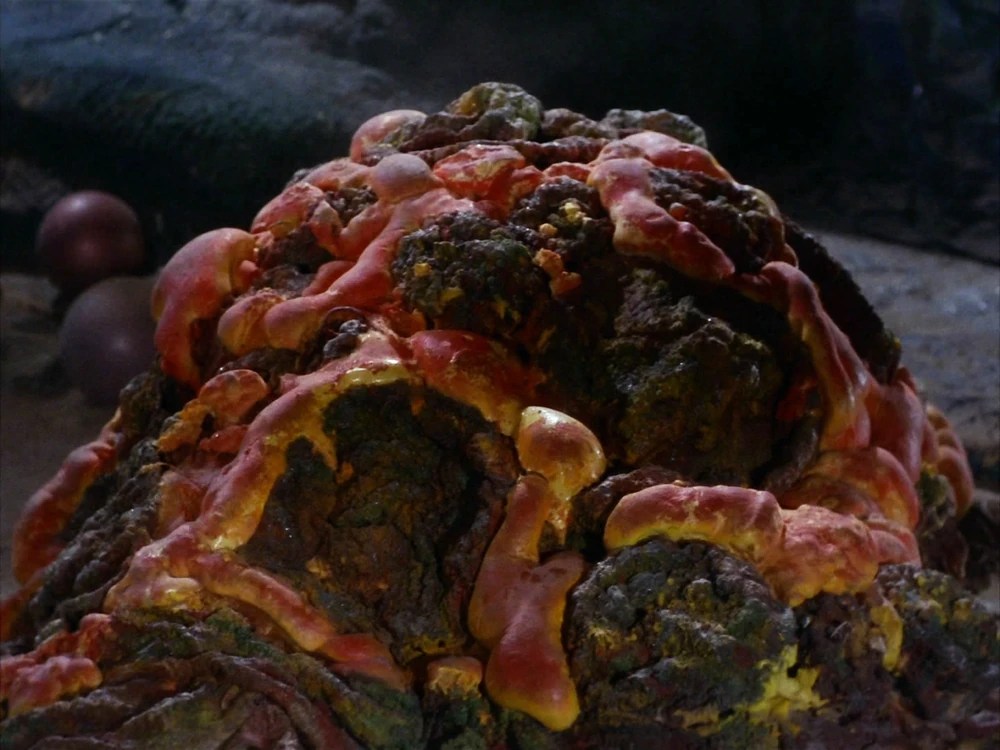
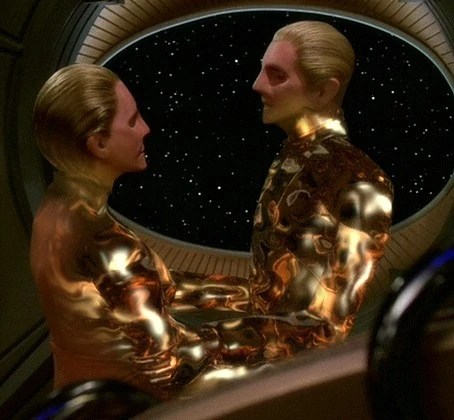
I love depictions of alien life with alternative biochemistries, or even the absence thereof. Silicon-based life was popularized in the Star Trek TOS episode “The Devil in the Dark” with the Horta, and has since remained a staple of science fiction. The Changelings of Deep Space Nine are also an incredibly strange and wonderful form of life that appears carbon based, but probably have so much more going on.
My favourite non-carbon-based alien life form, however, is the Hiss from Remedy‘s Control.
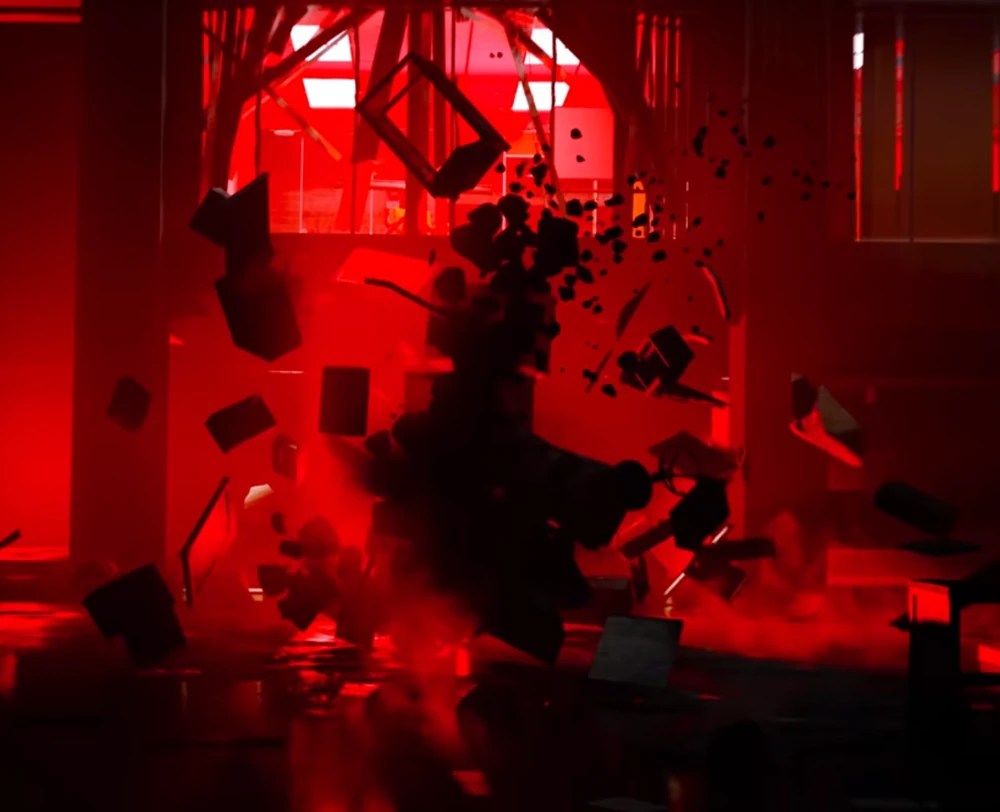


The Hiss is hard to describe. It’s a “resonance-based entity” so it exists primarily as a sort of signal, radio wave, or vibration. It came crashing through the walls of our reality from a parallel universe, and its been doing this dimension hopping for God knows how long, taking over who knows how many cultures in its wake.
It’s like a virus in the way it takes control of the people, places, and things it passes through. And when you become possessed, you act like a modem or relay, infecting others with the Hiss signal.
But it’s also adaptable like a full-fledged organism. When it encounters something that resists infection, it takes those it possessed — usually soldiers and security guards — and “activates” them, sending them into battle to destroy the one resisting, or subdue them so that they can be overwhelmed by a more powerful burst of the signal later on.
And resisting only makes things worse: the Hiss is an interdimensional force with loads of shit that it acquired over its time roaming the multiverse, including the supernatural weapons of fallen civilizations. It can and will throw the arsenals of whole planets — including some Lovecraftian monstrosities — at you if you fight it hard enough.
Oh and the best part? Any single ability or weapon the Hiss acquired can, eventually, be uploaded to all its soldiers.
Basically, unless you’re Jesse Faden, or the Dark Presence, your one choice with the Hiss is when you’re ready to give in. I can’t really think of another sci-fi property with a “sound-based life form.”
SPOILERS!
Hey, we haven’t had one of these sections since Seeds of Change!
So, as is typical with these alien arrival stories, the visitors from space are here to gauge our evolutionary development and find out if we present a threat. Is coexistence possible? Can’t we all just get along?
In the final chapters of the book, Connie is killed by one of the aliens’ venomous stingers and Toby is telepathically possessed in order to communicate with Don. Since Don’s a writer, they want him to write a book recounting the whole alien encounter from his point of view, so the aliens can understand how humans see them.
So yeah, the whole book is basically a seven-day retrospective on a First Contact event gone horribly awry.
Would You Like to Know More?
Fiiine, Stephen, I’ll give you a walk.
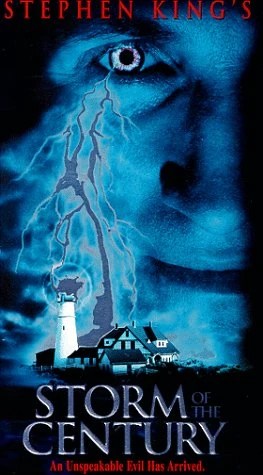

The framing devices of Invasion, the family-man protagonist, the oppressive winter storm, and the constant taunting of the aliens also put me in mind of Stephen King’s stories. He does that a lot in his books: frames the entire tale as a recollection by a writer and an outline of the lessons that man learned, but the one in particular I’m thinking of is Storm of the Century.
This is tying back to the start of this review re: all the comparisons you could make between King and Koontz. I just find it funny that from 1999 to 2001, King retread so much of the same ground Koontz did in 1975 with Invasion.
Don writes the book in three days, and gives it to the aliens, and the aliens give him back his son… and another gift.
This legitimately knocked my socks off.
The aliens turned and stalked out of the room.
They were finished with me, and they never looked back.
Toby said, “Dad? What’s going on here? I’m scared.” His voice trembled.
“It’s over,” I assured him. I picked him up and hugged him. “There’s nothing to be afraid of now.”
“Where’s Mom?”
“Let’s go find her,” I said, a lump rising in my throat.
I carried him upstairs.
She was sitting up in bed when we got there. She was as beautiful as ever. “Don?”
“I’m here.”
“Toby?”
“Hi, Mom.”
Death is not final.
— Pages 189-190
I did not see that coming.
The whole tone of the book right up to the end has been dark, and each moment affirmed Don’s bleak worldview. The aliens fucked up his life, tore his heart out, threatened his son, but at least he could cling to that small certainty that life is finite and death is final.
And then the aliens resurrect his wife like it’s nothing.
Don’s orderly world is upended on the last page, and the last two paragraphs he writes feel like a man coming to terms with his own insanity. It’s a happy ending, but it’s the kind of happy that comes from accepting there is no meaning in the world. The rules don’t apply, and never did. Don was delusional the whole time.
This ending is disturbing because it confronts us with a world where life and death are freely given and bartered for. The end doesn’t have to be The End. But we only value our earthly time because we believe it to be finite.
Would we still value life if it were not finite?
Conclusions and Recommendations
I read that Dean Koontz soured on Invasion for the same reason that other Laser Books authors soured on their works: Roger Elwood did a lot of cutting-down to meet the guidelines set out by Harlequin. I can only imagine that Koontz would’ve doubled down on the passion between Don and Connie and extended the book to draw the tension out like a blade. He keeps saying he might pick up Invasion and republish it as it was meant to be, like Tim Powers did with The Skies Discrowned, but it’s been over fifty years, so I don’t know how likely that is.
I’m saddened to hear he doesn’t like the book because it is truly an incredible novel. I still can’t believe it’s one of the Laser Books. Playing within the rigid guidelines, Koontz somehow came out with a story that could stand all on its own. And like I said at the start, he even beat Stephen King to the Dreamcatcher scenario of “alien invasion in the snow.”
No notes at all.
My Goodreads Review
This is my first five-star Laser Book review, and it is well earned. Dean Koontz, writing as Aaron Wolfe, wrote an “alien invasion in the snow” story a full 25 years before Stephen King wrote Dreamcatcher, but whereas Dreamcatcher is a hot mess, Invasion is a suspense story as chilling as an Alberta Clipper, with deep musings on life, death, family, and meaning in the cosmos. I can recommend this book heartily and without any reservation. It is a killer tale.
Well, death may not be final, but this review has certainly reached its end, and so I bid a teary-eyed farewell to Dean Koontz, a.k.a. Aaron Wolfe, and look to our next Laser Book.
Who’s Next?

Ladies and gentlemen, let’s give a warm welcome to our favourite spinner of time travel yarns, Gordon Eklund! So happy to have you back so soon, bud! We’re really eatin’ good with the last few Laser Books. Let’s check out the blurb.
Blurb
As a mercenary soldier of fortune, Calvin Waller has grown used to danger. Danger is the air he breathes. But when he finds himself thrown from the midst of an African battle into a primitive farm community of the future, he is naturally disoriented. Trained as he is, he quickly gets his bearings and begins a new and different battle…only to be “thrown” again. He is being manipulated. Falling Toward Forever, is the story of his search for The Manipulator, and for himself. A strange and wonderful search…for The Manipulator holds all the strings.
I’m tremendously excited to see what other temporal twists Eklund can cook up after Serving in Time! See y’all soon!
Public Service Announcement
The Laser Book reviews will be switching from a weekly to a bi-weekly upload schedule. This is so that I can devote more time to editing my novel, Seekers of the Fallen Stars, to stay on track for a 2027 publishing date.
In theory, I could keep releasing the Laser Books Reviews on a weekly basis, but their quality would suffer and I would soon run into the very real issue that I’ve not yet read all of them. At time of writing, I’m about halfway through 16. Kane’s Odyssey. That still leaves 42 titles I have to get through, and I do want to read and write other things over the course of this year.
The quality and length of the Laser Books Reviews depends on two factors:
- The quality of the book I’m discussing
- The kinds of jokes and discussion topics I’m able to pull in based on who the author is
For example, the Seeklight review was one of my favourites to write because of K.W. Jeter’s Star Wars connection. I could make so many references and jokes based on that. That’s the kind of review I want to deliver every time, and so I need time in order to keep that up.
The good news is, you’ll be getting Laser Books reviews up through next year, and in the off-weeks, I may have a chance to talk about other books I’ve read or projects I’m working on. Ultimately, my novels and short stories take precedence over this blog, but if I can consistently deliver quality work on both fronts by giving myself more time, I will do that.
Excellence, in all things! I’ll see you guys in two weeks!
Leave a Reply